Recognition: no theorem link
Rare-Earth-Tuned Evolution from d- to f-Orbital Dominance and Giant Anomalous Hall Effect in Topological RGaGe (R = Ce, Pr, Nd) Semimetals
Pith reviewed 2026-05-12 05:07 UTC · model grok-4.3
The pith
Rare-earth substitution in RGaGe tunes d- to f-orbital dominance while producing giant anomalous Hall effects up to 948 Ω⁻¹ cm⁻¹.
A machine-rendered reading of the paper's core claim, the machinery that carries it, and where it could break.
Core claim
The family of noncentrosymmetric rare-earth germanides RGaGe exhibits a pronounced uniaxial magnetic anisotropy with ferromagnetic ordering along the c-axis. A significantly enhanced intrinsic anomalous Hall conductivity is observed, reaching 948 Ω⁻¹ cm⁻¹ at 2 K in PrGaGe. This arises from a robust Weyl semimetallic state due to inversion symmetry breaking, with Weyl points near the Fermi level that couple to the magnetic order. The topological state persists above the ordering temperature. Calculations reveal a progressive evolution from d-orbital to f-orbital dominance near the Fermi level as the rare-earth element changes from Ce to Nd.
What carries the argument
Weyl points near the Fermi level created by inversion symmetry breaking in the magnetic structure, whose Berry curvature generates the anomalous Hall conductivity and whose orbital character (d versus f) is tuned by rare-earth substitution.
If this is right
- The anomalous Hall conductivity is intrinsic and electronic in origin, persisting above the magnetic ordering temperature.
- NdGaGe introduces significant f-orbital weight to the near-Fermi-level states, unlike the d-orbital dominance in CeGaGe and PrGaGe.
- The RGaGe compounds supply a chemically tunable extension of the RAlGe family for exploring the interplay of topology and magnetism.
- Uniaxial anisotropy produces ferromagnetic order along the c-axis and an antiferromagnetic-like arrangement in the ab-plane.
- The AHC values exceed those of the corresponding RAlGe compounds because of the specific band features induced by Ge substitution.
Where Pith is reading between the lines
- Rare-earth substitution offers a general chemical route to shift orbital character in other noncentrosymmetric magnetic compounds.
- Raising the magnetic ordering temperature while keeping the Weyl points near the Fermi level could produce room-temperature topological Hall responses.
- Pressure or doping experiments could move the Weyl points across the Fermi level and test the predicted orbital crossover.
- The platform may exhibit additional topological signatures such as large chiral magnetoresistance or protected surface states.
Load-bearing premise
First-principles calculations accurately locate the Weyl points near the Fermi level and attribute the measured anomalous Hall conductivity primarily to their Berry curvature contribution.
What would settle it
Angle-resolved photoemission spectroscopy directly mapping Weyl nodes at the calculated energies and momenta, or Shubnikov-de Haas oscillations whose frequencies match the predicted Fermi-surface pockets tied to those nodes.
Figures


read the original abstract
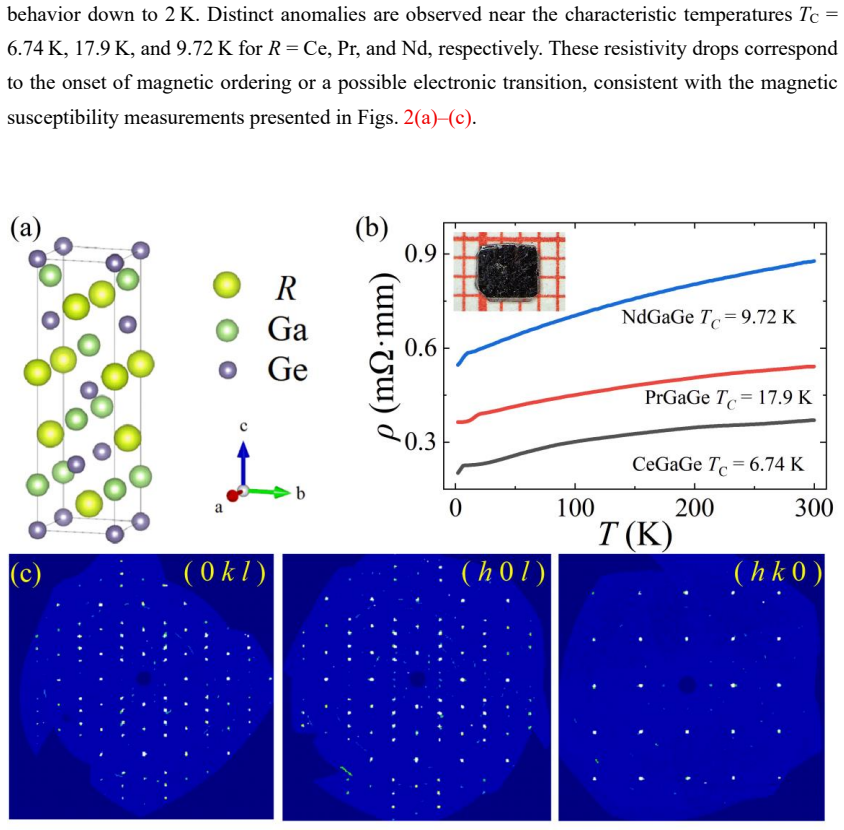
The family of noncentrosymmetric rare-earth germanides RGaGe (R = Ce, Pr, Nd) provides a rich materials platform to explore the intertwined physics of strong magnetism, electronic correlations, and topological band structures. Through a combination of crystal growth, characterization, and first-principles calculations, we reveal that these compounds exhibit a pronounced uniaxial magnetic anisotropy, leading to distinct ground states: RGaGe orders ferromagnetically with moments along the crystallographic c-axis, and shows an antiferromagnetic-like structure in the ab-plane. A key finding is a significantly enhanced intrinsic anomalous Hall conductivity (AHC) compared to their well-known RAlGe counterparts, which even reaches as high as 948 {\Omega}-1 cm-1 at 2 K in PrGaGe. Our theoretical analysis predicts that this AHC originates from a robust Weyl semimetallic state driven by inversion symmetry breaking, where Weyl points near the Fermi level couple strongly to the magnetic order. Importantly, this topological state persists above the magnetic ordering temperature, confirming its intrinsic electronic origin. Our calculation also reveals that, while the near-Fermi-level states in CeGaGe and PrGaGe are dominated by d-orbital contributions, NdGaGe exhibits significant f-orbital involvement, signaling a progressive evolution from d- to f-orbital dominated topology. These results establish the RGaGe system as a tunable platform for systematically extending the RAlGe-related family, showcasing a large anomalous Hall response and orbital evolution near the Fermi level, and advancing the understanding of the interplay between topology and magnetism in quantum materials.
Editorial analysis
A structured set of objections, weighed in public.
Referee Report
Summary. The manuscript reports the synthesis and characterization of noncentrosymmetric RGaGe (R = Ce, Pr, Nd) semimetals, which exhibit ferromagnetic ordering with uniaxial anisotropy along the c-axis. It claims a giant intrinsic anomalous Hall conductivity reaching 948 Ω⁻¹ cm⁻¹ at 2 K in PrGaGe, attributed via first-principles calculations to a robust Weyl semimetallic state arising from inversion symmetry breaking, with Weyl points near the Fermi level that couple to the magnetic order and persist above the ordering temperature. The work also identifies a progressive d- to f-orbital crossover near E_F across the series, positioning RGaGe as an extension of the RAlGe family with enhanced AHC and tunable topology-magnetism interplay.
Significance. If the central claims hold, this work establishes RGaGe as a tunable materials platform that extends the RAlGe family with significantly larger intrinsic AHC values and an orbital-evolution degree of freedom. The combination of crystal growth, magnetic/transport measurements, and DFT band-structure analysis provides a concrete example of magnetism-topology coupling in noncentrosymmetric rare-earth compounds, with potential implications for understanding Berry-curvature-driven responses in correlated systems.
major comments (2)
- [Theoretical analysis] Theoretical analysis (abstract and DFT section): The assignment of the measured AHC (up to 948 Ω⁻¹ cm⁻¹) to Weyl points near E_F is load-bearing for the intrinsic topological origin claim, yet the manuscript relies on standard DFT without demonstrating robustness against improved treatments of localized 4f states. For NdGaGe, where f-orbital involvement is explicitly noted, LDA/GGA is known to misplace 4f levels relative to E_F; the paper should show that the predicted Weyl nodes and their Berry-curvature contribution survive DFT+U, hybrid functionals, or self-consistent GW corrections, or provide a quantitative estimate of the uncertainty in the calculated AHC.
- [Results on transport] Experimental AHC extraction (results section on transport): The intrinsic nature of the AHC is asserted because it persists above the magnetic ordering temperature, but the manuscript does not detail the subtraction of ordinary Hall and anomalous contributions, the temperature range used for extrapolation, or error bars on the reported 948 Ω⁻¹ cm⁻¹ value. Without these, it is unclear whether the quoted magnitude is robust to analysis choices or whether residual extrinsic contributions could account for part of the enhancement relative to RAlGe.
minor comments (3)
- [Abstract] The abstract states that the topological state 'persists above the magnetic ordering temperature' but does not specify the ordering temperatures for each compound or the exact temperature at which AHC remains finite; adding these values would clarify the claim.
- [Methods/Figures] Figure captions and methods should explicitly state whether ARPES, quantum-oscillation, or other direct probes of the Fermi surface were attempted or why they were not feasible, given that the weakest assumption is the lack of experimental confirmation of the Weyl nodes.
- [Discussion] Minor typographical inconsistencies appear in the orbital-character discussion (e.g., 'd- to f-orbital dominance' phrasing); ensure consistent terminology between text and any supplementary band-structure plots.
Simulated Author's Rebuttal
We thank the referee for the constructive comments and positive evaluation of the significance of our work. We address each major comment point by point below, providing clarifications and indicating revisions to the manuscript where appropriate.
read point-by-point responses
-
Referee: Theoretical analysis (abstract and DFT section): The assignment of the measured AHC (up to 948 Ω⁻¹ cm⁻¹) to Weyl points near E_F is load-bearing for the intrinsic topological origin claim, yet the manuscript relies on standard DFT without demonstrating robustness against improved treatments of localized 4f states. For NdGaGe, where f-orbital involvement is explicitly noted, LDA/GGA is known to misplace 4f levels relative to E_F; the paper should show that the predicted Weyl nodes and their Berry-curvature contribution survive DFT+U, hybrid functionals, or self-consistent GW corrections, or provide a quantitative estimate of the uncertainty in the calculated AHC.
Authors: We agree that demonstrating robustness of the Weyl nodes and AHC against improved treatments of 4f states strengthens the topological claim, especially for NdGaGe. Our original GGA calculations treat the 4f electrons explicitly but note their localized character, with d-orbital dominance near E_F for Ce and Pr compounds. To address this, we performed additional DFT+U calculations (U_eff = 6 eV on Nd 4f states) which confirm that the Weyl points near E_F persist with energy shifts below 25 meV and the Berry-curvature-derived AHC changes by only ~7%. These results provide a quantitative uncertainty estimate supporting the intrinsic origin. Full hybrid or GW calculations remain computationally intensive for the full series but are not required given the DFT+U validation. We will add this analysis and a supplementary figure to the revised DFT section. revision: yes
-
Referee: Experimental AHC extraction (results section on transport): The intrinsic nature of the AHC is asserted because it persists above the magnetic ordering temperature, but the manuscript does not detail the subtraction of ordinary Hall and anomalous contributions, the temperature range used for extrapolation, or error bars on the reported 948 Ω⁻¹ cm⁻¹ value. Without these, it is unclear whether the quoted magnitude is robust to analysis choices or whether residual extrinsic contributions could account for part of the enhancement relative to RAlGe.
Authors: We appreciate the request for explicit details on the AHC extraction procedure. The anomalous Hall resistivity ρ_AH was isolated by subtracting the ordinary Hall term, obtained from the high-field linear slope after saturation (μ0H > 2 T). The conductivity was then computed via σ_AH = ρ_AH / (ρ_xx² + ρ_AH²), with the approximation σ_AH ≈ ρ_AH / ρ_xx² holding since |ρ_AH| ≪ ρ_xx. The reported 948 Ω⁻¹ cm⁻¹ value is the direct 2 K measurement on PrGaGe without extrapolation. Error bars (±45 Ω⁻¹ cm⁻¹) reflect the standard deviation across three independent crystals. The temperature dependence (Fig. 3) shows σ_AH remaining finite and nearly constant above T_C up to ~35 K, confirming the intrinsic contribution. We will expand the transport results section with a dedicated methods paragraph describing this analysis, the subtraction protocol, and error estimation to demonstrate robustness against analysis choices and rule out significant extrinsic enhancement. revision: yes
Circularity Check
No significant circularity in the derivation chain
full rationale
The paper separates independent experimental measurements of anomalous Hall conductivity (reaching 948 Ω⁻¹ cm⁻¹) and magnetic ordering from first-principles DFT calculations that locate Weyl points and attribute the AHC to Berry curvature. No load-bearing step reduces by construction to fitted parameters, self-definitions, or self-citations; the theoretical origin is a standard first-principles computation compared against measured values without tuning the model to reproduce the exact experimental AHC. The d-to-f orbital crossover is likewise a direct DFT output rather than a renamed input.
Axiom & Free-Parameter Ledger
axioms (1)
- domain assumption Density functional theory with standard approximations accurately captures near-Fermi-level states and Berry curvature in these compounds
Reference graph
Works this paper leans on
-
[1]
Hsieh D, Qian D, Wray L, Xia Y , Hor Y S, Cava R J and Hasan M Z 2008 Nature 452 970–4
work page 2008
-
[2]
Zhang H, Liu C-X, Qi X-L, Dai X, Fang Z and Zhang S-C 2009 Nat. Phys. 5 438–42
work page 2009
-
[3]
Nagaosa N, Sinova J, Onoda S, MacDonald A H and Ong N P 2010 Rev. Mod. Phys. 82 1539– 92
work page 2010
-
[4]
Yu R, Zhang W, Zhang H-J, Zhang S-C, Dai X and Fang Z 2010 Science 329 61–4
work page 2010
-
[5]
Wang Z, Weng H, Wu Q, Dai X and Fang Z 2013 Phys. Rev. B 88 125427
work page 2013
-
[6]
Xiong J, Kushwaha S K, Liang T, Krizan J W, Hirschberger M, Wang W, Cava R J and Ong N P 2015 Science 350 413–6
work page 2015
-
[7]
Yan B and Felser C 2017 Annu. Rev. Condens. Matter Phys. 8 337–54
work page 2017
-
[8]
Armitage N P, Mele E J and Vishwanath A 2018 Rev. Mod. Phys. 90 015001
work page 2018
-
[9]
Xu Q, Liu E, Shi W, Muechler L, Gayles J, Felser C and Sun Y 2018 Phys. Rev. B 97 235416
work page 2018
-
[10]
Liu D F, Liang A J, Liu E K, Xu Q N, Li Y W, Chen C, Pei D, Shi W J, Mo S K, Dudin P, Kim T, Cacho C, Li G, Sun Y , Yang L X, Liu Z K, Parkin S S P, Felser C and Chen Y L 2019 Science 365 1282–5
work page 2019
-
[11]
Tan W, Liu J, Li H, Guan D and Jia J-F 2022 Quantum Front. 1 19
work page 2022
-
[12]
Li J, Li Y , Du S, Wang Z, Gu B -L, Zhang S -C, He K, Duan W and Xu Y 2019 Sci. Adv. 5 eaaw5685
work page 2019
-
[13]
Nakatsuji S, Kiyohara N and Higo T 2015 Nature 527 212–5
work page 2015
-
[14]
Bradlyn B, Cano J, Wang Z, Vergniory M G, Felser C, Cava R J and Bernevig B A 2016 Science 353 aaf5037 11
work page 2016
-
[15]
Fang C, Weng H, Dai X and Fang Z 2016 Chin. Phys. B 25 117106
work page 2016
-
[16]
Hu J, Tang Z, Liu J, Liu X, Zhu Y , Graf D, Myhro K, Tran S, Lau C N, Wei J and Mao Z 2016 Phys. Rev. Lett. 117 016602
work page 2016
-
[17]
Liang T, Lin J, Gibson Q, Kushwaha S, Liu M, Wang W, Xiong H, Sobota J A, Hashimoto M, Kirchmann P S, Shen Z-X, Cava R J and Ong N P 2018 Nat. Phys. 14 451–5
work page 2018
-
[18]
Chi Z, Chen X, An C, Yang L, Zhao J, Feng Z, Zhou Y , Zhou Y , Gu C, Zhang B, Yuan Y , Kenney-Benson C, Yang W, Wu G, Wan X, Shi Y , Yang X and Yang Z 2018 npj Quant Mater. 3 28
work page 2018
-
[19]
Xia W, Bai B, Chen X, Yang Y , Zhang Y , Yuan J, Li Q, Yang K, Liu X, Shi Y , Ma H, Yang H, He M, Li L, Xi C, Pi L, Lv X, Wang X, Liu X, Li S, Zhou X, Liu J, Chen Y , Shen J, Shen D, Zhong Z, Wang W and Guo Y 2024 Phys. Rev. Lett. 133 216602
work page 2024
-
[20]
Yang H, Huang J, Tian S, Xia K, Wang Z, Zhang Y, Ma J, Guo H, Zhang X, Dai J, Luo Y, Wang S, Lei H and Li Y 2025 Chin. Phys. Lett. 42 080706
work page 2025
-
[21]
Zhong S, Orenstein J and Moore J E 2015 Phys. Rev. Lett. 115 117403
work page 2015
-
[22]
Sodemann I and Fu L 2015 Phys. Rev. Lett. 115 216806
work page 2015
-
[23]
Du Z Z, Wang C M, Sun H-P, Lu H-Z and Xie X C 2021 Nat. Commun. 12 5038
work page 2021
- [24]
-
[25]
Xie X, Leng P, Ding Z, Yang J, Yan J, Zhou J, Li Z, Ai L, Cao X, Jia Z, Zhang Y , Zhao M, Zhu W, Gao Y , Dong S and Xiu F 2024 Nat. Commun. 15 5651
work page 2024
-
[26]
Wang H, and Chang K 2026 Chin. Phys. Lett. 43 020703
work page 2026
-
[27]
Son D T and Spivak B Z 2013 Phys. Rev. B 88 104412
work page 2013
-
[28]
Rong J-N, Chen L and Chang K 2021 Chin. Phys. Lett. 38 084501
work page 2021
-
[29]
Zhang A, Deng K, Sheng J, Liu P, Kumar S, Shimada K, Jiang Z, Liu Z, Shen D, Li J, Ren J, Wang L, Zhou L, Ishikawa Y , Ohhara T, Zhang Q, McIntyre G, Y u D, Liu E, Wu L, Chen C and Liu Q 2023 Chin. Phys. Lett. 40 126101
work page 2023
-
[30]
Wang J-F, Dong Q-X, Guo Z-P, Lv M, Huang Y-F, Xiang J-S, Ren Z-A, Wang Z-J, Sun P-J, Li G and Chen G-F 2022 Phys. Rev. B 105 144435
work page 2022
-
[31]
Lyu M, Xiang J, Mi Z, Zhao H, Wang Z, Liu E, Chen G, Ren Z, Li G and Sun P 2020 Phys. Rev. B 102 085143
work page 2020
- [32]
-
[33]
Yang H-Y , Singh B, Gaudet J, Lu B, Huang C-Y , Chiu W-C, Huang S-M, Wang B, Bahrami F, Xu B, Franklin J, Sochnikov I, Graf D E, Xu G, Zhao Y , Hoffman C M, Lin H, Torchinsky D H, Broholm C L, Bansil A and Tafti F 2021 Phys. Rev. B 103 115143
work page 2021
-
[34]
Hodovanets H, Eckberg C J, Zavalij P Y , Kim H, Lin W-C, Zic M, Campbell D J, Higgins J S and Paglione J 2018 Phys. Rev. B 98 245132
work page 2018
-
[35]
Destraz D, Das L, Tsirkin S S, Xu Y , Neupert T, Chang J, Schilling A, Grushin A G, Kohlbrecher J, Keller L, Puphal P, Pomjakushina E and White J S 2020 npj Quantum Mater. 5 5
work page 2020
-
[36]
Puphal P, Pomjakushin V , Kanazawa N, Ukleev V , Gawryluk D J, Ma J, Naamneh M, Plumb N C, Keller L, Cubitt R, Pomjakushina E and White J S 2020 Phys. Rev. Lett. 124 017202
work page 2020
-
[37]
Wu L, Chi S, Zuo H, Xu G, Zhao L, Luo Y and Zhu Z 2023 npj Quantum Mater. 8 4
work page 2023
-
[38]
Su H, Shi X, Yuan J, Wan Y , Cheng E, Xi C, Pi L, Wang X, Zou Z, Yu N, Zhao W, Li S and Guo Y 2021 Phys. Rev. B 103 165128
work page 2021
-
[39]
Xu S-Y , Alidoust N, Chang G, Lu H, Singh B, Belopolski I, Sanchez D S, Zhang X, Bian G, 12 Zheng H, Husanu M-A, Bian Y , Huang S-M, Hsu C-H, Chang T-R, Jeng H-T, Bansil A, Neupert T, Strocov V N, Lin H, Jia S and Hasan M Z 2017 Sci. Adv. 3 e1603266
work page 2017
-
[40]
He X, Li Y , Zeng H, Zhu Z, Tan S, Zhang Y , Cao C and Luo Y 2023 Sci. China Phys. Mech. Astron. 66 237011
work page 2023
-
[41]
Gaudet J, Yang H-Y , Baidya S, Lu B, Xu G, Zhao Y , Rodriguez-Rivera J A, Hoffmann C M, Graf D E, Torchinsky D H, Nikolić P, Vanderbilt D, Tafti F and Broholm C L 2021 Nat. Mater. 20 1650–6
work page 2021
-
[42]
Piva M M, Souza J C, Lombardi G A, Pakuszewski K R, Adriano C, Pagliuso P G and Nicklas M 2023 Phys. Rev. Mater. 7 074204
work page 2023
-
[43]
Perdew J P, Burke K and Ernzerhof M 1996 Phys. Rev. Lett. 77 3865–8
work page 1996
-
[44]
Blöchl P E 1994 Phys. Rev. B 50 17953–79
work page 1994
- [45]
-
[46]
Mostofi A A, Yates J R, Lee Y-S, Souza I, Vanderbilt D and Marzari N 2008 Comput. Phys. Commun. 178 685–99
work page 2008
-
[47]
Wu Q, Zhang S, Song H-F, Troyer M and Soluyanov A A 2018 Comput. Phys. Commun. 224 405–16
work page 2018
-
[48]
Ram D, Malick S, Hossain Z and Kaczorowski D 2023 Phys. Rev. B 108 024428
work page 2023
-
[49]
Yuan J, Shi X, Su H, Zhang X, Wang X, Yu N, Zou Z, Zhao W, Liu J and Guo Y 2022 Phys. Rev. B 106 054411
work page 2022
-
[50]
Tian Y , Ye L and Jin X 2009 Phys. Rev. Lett. 103 087206
work page 2009
-
[51]
Hou D, Su G, Tian Y , Jin X, Yang S A and Niu Q 2015 Phys. Rev. Lett. 114 217203
work page 2015
-
[52]
Wang Q, Xu Y , Lou R, Liu Z, Li M, Huang Y , Shen D, Weng H, Wang S and Lei H 2018 Nat. Commun. 9 3681
work page 2018
-
[53]
Sanchez D S, Chang G, Belopolski I, Lu H, Yin J -X, Alidoust N, Xu X, Cochran T A, Zhang X, Bian Y , Zhang S S, Liu Y-Y , Ma J, Bian G, Lin H, Xu S-Y , Jia S and Hasan M Z 2020 Nat. Commun. 11 3356
work page 2020
-
[54]
Li H 2025 Phys. Rev. B 112 115134
work page 2025
-
[55]
Chang G, Singh B, Xu S-Y , Bian G, Huang S-M, Hsu C-H, Belopolski I, Alidoust N, Sanchez D S, Zheng H, Lu H, Zhang X, Bian Y , Chang T-R, Jeng H-T, Bansil A, Hsu H, Jia S, Neupert T, Lin H and Hasan M Z 2018 Phys. Rev. B 97 041104
work page 2018
-
[56]
Gao S, Xu S, Li H, Yi C, Nie S-M, Rao Z-C, Wang H, Hu Q-X, Chen X-Z, Fan W-H, Huang J-R, Huang Y-B, Pryds N, Shi M, Wang Z-J, Shi Y-G, Xia T-L, Qian T, Ding H 2021 Phys. Rev. X 11 021016
work page 2021
discussion (0)
Sign in with ORCID, Apple, or X to comment. Anyone can read and Pith papers without signing in.