Recognition: 1 theorem link
· Lean TheoremStructural transition and fragmentation of vortex lattices in rotating tilted dipolar Bose-Einstein condensate
Pith reviewed 2026-05-12 03:44 UTC · model grok-4.3
The pith
Tilted dipolar Bose-Einstein condensates undergo a square-to-triangular vortex lattice transition before losing all vortices past the magic angle, with Lee-Huang-Yang corrections restoring vortices in the elongated state.
A machine-rendered reading of the paper's core claim, the machinery that carries it, and where it could break.
Core claim
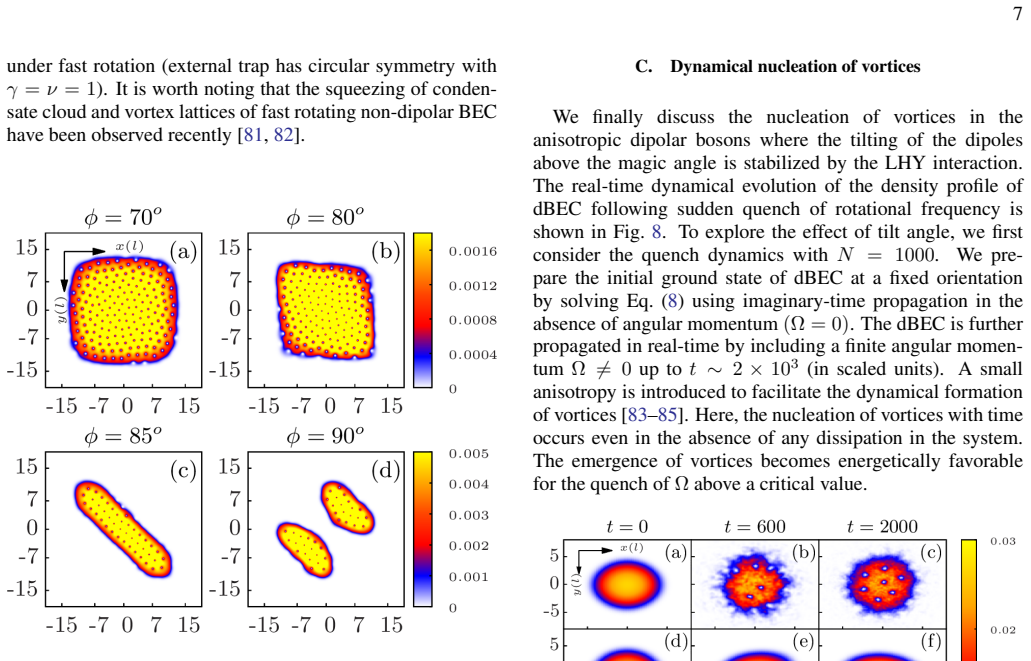
We reveal the structural transformation of vortices from square to triangular lattices as the tilt of dipolar bosons relative to the polarization axis approaches a critical angle. When the tilt of the magnetic dipoles surpasses the magic angle, the condensate elongates diagonally and becomes devoid of vortices. Moreover, we include the Lee-Huang-Yang correction, which enables the formation of vortices in the elongated condensate. Additionally, when dipoles are oriented perpendicular to the polarization axis, the Lee-Huang-Yang correction results in the fragmentation of condensates under strong rotation. The quench dynamics of the rotational frequency demonstrate the development of vortexlatt
What carries the argument
The extended Gross-Pitaevskii equation incorporating the Lee-Huang-Yang correction for a quasi-two-dimensional rotating tilted dipolar condensate, with the dipole tilt angle serving as the parameter that drives changes in lattice symmetry and vortex presence.
Load-bearing premise
The extended Gross-Pitaevskii equation with Lee-Huang-Yang correction, combined with the quasi-two-dimensional harmonic confinement approximation, accurately captures the physics of the tilted rotating dipolar system across the explored parameter range.
What would settle it
Direct imaging of the condensate density after a controlled tilt ramp to angles near or past the magic angle; the absence of a square-to-triangular lattice change or the persistent absence of vortices in the elongated state without matching Lee-Huang-Yang signatures would falsify the central predictions.
Figures




read the original abstract
We investigate the vortex lattices of harmonically confined quasi-two-dimensional tilted rotational dipolar Bose-Einstein condensates. By employing an extended Gross-Pitaevskii equation for a rotating condensate, we reveal the structural transformation of vortices from square to triangular lattices as the tilt of dipolar bosons relative to the polarization axis approaches a critical angle. When the tilt of the magnetic dipoles surpasses the magic angle, the condensate elongates diagonally and becomes devoid of vortices. Moreover, we include the Lee-Huang-Yang correction, which enables the formation of vortices in the elongated condensate. Additionally, when dipoles are oriented perpendicular to the polarization axis, the Lee-Huang-Yang correction results in the fragmentation of condensates under strong rotation. The quench dynamics of the rotational frequency demonstrate the development of vortex lattices; however, with a strong rotational quench, the condensate remains free of vortices. Our numerical analysis highlights the beyond mean-field effects of the rotational properties of anisotropic dipolar bosons, which can be observed in current dipolar quantum gas experiments.
Editorial analysis
A structured set of objections, weighed in public.
Referee Report
Summary. The manuscript numerically studies vortex lattices in a harmonically confined quasi-two-dimensional rotating tilted dipolar BEC using the extended Gross-Pitaevskii equation that includes the Lee-Huang-Yang (LHY) correction. It reports a structural transition from square to triangular vortex lattices as the dipole tilt angle approaches a critical value, a vortex-free diagonally elongated state once the tilt exceeds the magic angle, reappearance of vortices when the LHY term is included in the elongated regime, LHY-induced fragmentation for perpendicular dipoles under strong rotation, and quench dynamics showing vortex lattice formation or its absence depending on quench rate.
Significance. If the numerical results prove robust, the work would demonstrate concrete beyond-mean-field effects on vortex ordering and fragmentation in anisotropic dipolar gases under rotation, a regime accessible in current experiments with magnetic or electric dipolar atoms. The inclusion of the LHY term and the exploration of tilt-induced anisotropy provide timely predictions for structural transitions that could be tested in rotating dipolar condensates.
major comments (3)
- [Numerical methods / Results] The central claims rest entirely on solutions of the extended GPE under the quasi-2D approximation, yet the manuscript provides no grid resolution, convergence tests, error estimates, or validation against limiting cases (e.g., zero tilt or non-rotating limits). This absence undermines in the reported square-to-triangular transition and the vortex-free elongated state (abstract and results sections).
- [Results on post-magic-angle elongation] When the tilt exceeds the magic angle the condensate is reported to elongate diagonally and become vortex-free; however, this elongation directly challenges the validity of the quasi-2D reduction and the effective 2D dipolar kernel plus LHY term, because the tight z-confinement assumption may break down. No z-integrated density profiles, comparison to full 3D evolution, or justification of the dimensional reduction in this regime are supplied.
- [LHY term implementation and results] The claim that the LHY correction enables vortex formation in the elongated condensate (and causes fragmentation for perpendicular dipoles) is presented without quantitative assessment of how the LHY coefficient was chosen or its sensitivity; the parameter appears among the free parameters but no robustness checks are shown.
minor comments (2)
- [Abstract / Introduction] The abstract and introduction would benefit from explicit statements of the range of rotation frequencies and dipolar strengths explored, together with the precise definition of the 'critical angle' and 'magic angle' used in the figures.
- [Figures] Figure captions and axis labels should include the specific values of the LHY coefficient and the quasi-2D confinement parameters employed for each panel.
Simulated Author's Rebuttal
We thank the referee for the careful reading of our manuscript and the constructive comments, which have helped us improve the clarity and rigor of our numerical study. We address each major comment below and will incorporate the necessary revisions and additions in the updated version.
read point-by-point responses
-
Referee: The central claims rest entirely on solutions of the extended GPE under the quasi-2D approximation, yet the manuscript provides no grid resolution, convergence tests, error estimates, or validation against limiting cases (e.g., zero tilt or non-rotating limits). This absence undermines in the reported square-to-triangular transition and the vortex-free elongated state (abstract and results sections).
Authors: We agree that additional numerical details are essential for establishing reliability. In the revised manuscript we will specify the grid resolution (typically 512×512 points with dx = 0.05–0.1 in dimensionless units), report convergence tests performed by doubling the grid size and confirming that vortex positions and lattice structure remain unchanged within 1% in energy, and include error estimates based on residual norm of the imaginary-time evolution and conservation of angular momentum. We will also add explicit validation: in the zero-tilt limit the triangular lattice is recovered with the expected Abrikosov spacing, and in the non-rotating limit the ground state is vortex-free, consistent with known results for dipolar BECs. These additions will be placed in a new subsection of the Methods and referenced in the Results. revision: yes
-
Referee: When the tilt exceeds the magic angle the condensate is reported to elongate diagonally and become vortex-free; however, this elongation directly challenges the validity of the quasi-2D reduction and the effective 2D dipolar kernel plus LHY term, because the tight z-confinement assumption may break down. No z-integrated density profiles, comparison to full 3D evolution, or justification of the dimensional reduction in this regime are supplied.
Authors: We acknowledge the referee’s concern that strong in-plane elongation could potentially invalidate the quasi-2D assumption. The z-confinement frequency is chosen such that ω_z / ω_⊥ ≳ 10 throughout the parameter range, keeping the z-width much smaller than the in-plane Thomas-Fermi radii even after diagonal elongation. In the revision we will add (i) z-integrated density profiles for the post-magic-angle states demonstrating that the z-variance remains < 0.1 (in trap units) while the in-plane aspect ratio reaches ~3, and (ii) a brief analytic justification showing that the effective 2D dipolar kernel remains accurate provided the z-width is smaller than the dipolar length scale. A full 3D simulation for the largest elongations is computationally demanding; we will note this limitation and argue that the qualitative vortex-free behavior is robust within the quasi-2D regime relevant to current experiments. revision: partial
-
Referee: The claim that the LHY correction enables vortex formation in the elongated condensate (and causes fragmentation for perpendicular dipoles) is presented without quantitative assessment of how the LHY coefficient was chosen or its sensitivity; the parameter appears among the free parameters but no robustness checks are shown.
Authors: The LHY coefficient is not a free parameter but is fixed by the standard expression γ_LHY = (32/3) g √(a³ n / π) (with g = 4π a ħ²/m) evaluated at the local density; its value is therefore determined once the 3D scattering length and peak density are specified. In the revised manuscript we will (i) explicitly state the numerical value used and how it is computed from the experimental parameters, and (ii) present robustness checks in which γ_LHY is varied by ±20% around the nominal value. These checks confirm that the reappearance of vortices in the elongated regime and the fragmentation for perpendicular dipoles persist qualitatively, with only quantitative shifts in the critical rotation frequency. The results will be summarized in a new paragraph and an accompanying figure in the Supplemental Material. revision: yes
Circularity Check
No circularity: results are direct numerical outputs of the extended GPE
full rationale
The paper performs direct numerical integration of the extended Gross-Pitaevskii equation (including LHY term) under quasi-2D harmonic confinement to obtain vortex lattice structures, transitions, and fragmentation. No parameters are fitted to subsets of the target data and then relabeled as predictions; no self-citations supply load-bearing uniqueness theorems or ansatzes; the quasi-2D reduction and LHY form are stated as modeling choices whose validity is an external assumption, not a definitional loop. All reported phenomena (square-to-triangular transition, vortex-free elongation past the magic angle, LHY-induced vortex reappearance) are simulation outputs, not quantities forced by construction from the inputs.
Axiom & Free-Parameter Ledger
free parameters (3)
- dipole tilt angle
- rotation frequency and quench rate
- dipolar interaction strength and LHY coefficient
axioms (2)
- domain assumption The extended Gross-Pitaevskii equation with Lee-Huang-Yang correction provides a quantitatively accurate description of the rotating tilted dipolar condensate
- domain assumption Quasi-two-dimensional harmonic confinement is sufficient to capture the essential physics
Lean theorems connected to this paper
-
IndisputableMonolith/Foundation/AbsoluteFloorClosure.leanreality_from_one_distinction unclearWe investigate the vortex lattices of harmonically confined quasi-two-dimensional tilted rotational dipolar Bose-Einstein condensates. By employing an extended Gross-Pitaevskii equation...
Reference graph
Works this paper leans on
-
[1]
A. Griesmaier, J. Werner, S. Hensler, J. Stuhler, and T. Pfau, Phys. Rev. Lett.94, 160401 (2005)
work page 2005
- [2]
-
[3]
M. Lu, N. Q. Burdick, S. H. Youn, and B. L. Lev, Phys. Rev. Lett.107, 190401 (2011)
work page 2011
-
[4]
Y . Tang, W. Kao, K.-Y . Li, and B. L. Lev, Phys. Rev. Lett.120, 230401 (2018)
work page 2018
- [5]
-
[6]
A. Trautmann, P. Ilzhöfer, G. Durastante, C. Politi, M. Sohmen, M. J. Mark, and F. Ferlaino, Phys. Rev. Lett.121, 213601 (2018)
work page 2018
-
[7]
N. Bigagli, W. Yuan, S. Zhang, B. Bulatovic, T. Karman, I. Stevenson, and S. Will, Nature631, 289 (2024)
work page 2024
- [8]
- [9]
- [10]
-
[11]
D. S. Petrov, Phys. Rev. Lett.115, 155302 (2015)
work page 2015
-
[12]
I. Ferrier-Barbut, H. Kadau, M. Schmitt, M. Wenzel, and T. Pfau, Phys. Rev. Lett.116, 215301 (2016)
work page 2016
-
[13]
M. Abad, M. Guilleumas, R. Mayol, M. Pi, and D. M. Jezek, Phys. Rev. A79, 063622 (2009)
work page 2009
-
[14]
R. K. Kumar, T. Sriraman, H. Fabrelli, P. Muruganandam, and A. Gammal, J. Phys. B: At. Mol. Opt. Phys.49, 155301 (2016)
work page 2016
- [15]
- [16]
-
[17]
N. R. Cooper, E. H. Rezayi, and S. H. Simon, Phys. Rev. Lett. 95, 200402 (2005)
work page 2005
- [18]
-
[19]
M. A. Baranov, Phys. Rep.464, 71 (2008)
work page 2008
-
[20]
R. K. Kumar and P. Muruganandam, J. Phys. B: At. Mol. Opt. Phys.45, 215301 (2012)
work page 2012
- [21]
-
[22]
R. M. Wilson, S. Ronen, and J. L. Bohn, Phys. Rev. Lett.104, 094501 (2010)
work page 2010
- [23]
- [24]
-
[25]
E. Casotti, E. Poli, L. Klaus, A. Litvinov, C. Ulm, C. Politi, M. J. Mark, T. Bland, and F. Ferlaino, Nature635, 327 (2024)
work page 2024
- [26]
- [27]
-
[28]
A. D. Martin and P. B. Blakie, Phys. Rev. A86, 053623 (2012)
work page 2012
-
[29]
M. Raghunandan, C. Mishra, K. Lakomy, P. Pedri, L. Santos, and R. Nath, Phys. Rev. A92, 013637 (2015)
work page 2015
-
[30]
X.-Y . Chen, Y .-L. Chuang, C.-Y . Lin, C.-M. Wu, Y . Li, B. A. Malomed, and R.-K. Lee, Phys. Rev. A96, 043631 (2017)
work page 2017
- [31]
- [32]
- [33]
-
[34]
R. M. W. van Bijnen, A. J. Dow, D. H. J. O’Dell, N. G. Parker, and A. M. Martin, Phys. Rev. A80, 033617 (2009)
work page 2009
-
[35]
Y . Cai, Y . Yuan, M. Rosenkranz, H. Pu, and W. Bao, Phys. Rev. A98, 023610 (2018)
work page 2018
-
[36]
A. L. Fetter, J. Low Temp. Phys.16, 533 (1974)
work page 1974
- [37]
-
[38]
A. M. Martin, N. G. Marchant, D. H. J. O’Dell, and N. G. Parker, J. Phys. Condens. Matter29, 103004 (2017)
work page 2017
-
[39]
Y . Zhao, J. An, and C.-D. Gong, Phys. Rev. A87, 013605 (2013)
work page 2013
-
[40]
W. E. Shirley, B. M. Anderson, C. W. Clark, and R. M. Wilson, Phys. Rev. Lett.113, 165301 (2014)
work page 2014
- [41]
-
[42]
R. Kishor Kumar, L. Tomio, B. A. Malomed, and A. Gammal, Phys. Rev. A96, 063624 (2017)
work page 2017
-
[43]
B. Dong, Q. Sun, W.-M. Liu, A.-C. Ji, X.-F. Zhang, and S.-G. Zhang, Phys. Rev. A96, 013619 (2017)
work page 2017
-
[44]
Y . Li, Z. Chen, Z. Luo, C. Huang, H. Tan, W. Pang, and B. A. Malomed, Phys. Rev. A98, 063602 (2018)
work page 2018
-
[45]
C. R. Cabrera, L. Tanzi, J. Sanz, B. Naylor, P. Thomas, P. Cheiney, and L. Tarruell, Science359, 301 (2018)
work page 2018
-
[46]
P. Cheiney, C. R. Cabrera, J. Sanz, B. Naylor, L. Tanzi, and L. Tarruell, Phys. Rev. Lett.120, 135301 (2018)
work page 2018
-
[47]
G. Ferioli, G. Semeghini, L. Masi, G. Giusti, G. Modugno, M. Inguscio, A. Gallemí, A. Recati, and M. Fattori, Phys. Rev. Lett.122, 090401 (2019)
work page 2019
-
[48]
A. Yang, G. Li, X. Jiang, Z. Fan, Z. Chen, B. Liu, and Y . Li, Photonics10, 405 (2023)
work page 2023
-
[49]
M. A. Norcia, C. Politi, L. Klaus, E. Poli, M. Sohmen, M. J. Mark, R. N. Bisset, L. Santos, and F. Ferlaino, Nature596, 357 (2021)
work page 2021
- [50]
- [51]
-
[52]
F. Böttcher, J.-N. Schmidt, M. Wenzel, J. Hertkorn, M. Guo, T. Langen, and T. Pfau, Phys. Rev. X9, 011051 (2019)
work page 2019
- [53]
- [54]
-
[55]
A. Gallemí, S. M. Roccuzzo, S. Stringari, and A. Recati, Phys. Rev. A102, 023322 (2020)
work page 2020
-
[56]
F. Ancilotto, M. Barranco, M. Pi, and L. Reatto, Phys. Rev. A 103, 033314 (2021)
work page 2021
- [57]
- [58]
- [59]
-
[60]
R. K. Kumar, L. E. Young-S., D. Vudragovi´c, A. Balaž, P. Mu- ruganandam, and S. K. Adhikari, Comput. Phys. Commun.195, 117 (2015)
work page 2015
- [61]
-
[62]
L. E. Young-S and S. K. Adhikari, Commun. Nonlinear Sci. Numer. Simul.115, 106792 (2022)
work page 2022
-
[63]
R. N. Bisset, R. M. Wilson, D. Baillie, and P. B. Blakie, Phys. Rev. A94, 033619 (2016)
work page 2016
-
[64]
T. D. Lee, K. Huang, and C. N. Yang, Phys. Rev.106, 1135 (1957)
work page 1957
- [65]
-
[66]
J. R. Abo-Shaeer, C. Raman, J. M. V ogels, and W. Ketterle, Science292, 476 (2001)
work page 2001
-
[67]
J. R. Abo-Shaeer, C. Raman, and W. Ketterle, Phys. Rev. Lett. 88, 070409 (2002)
work page 2002
-
[68]
P. C. Haljan, I. Coddington, P. Engels, and E. A. Cornell, Phys. Rev. Lett.86, 2922 (2001)
work page 2001
-
[69]
V . Schweikhard, I. Coddington, P. Engels, V . P. Mogendorff, and E. A. Cornell, Phys. Rev. Lett.93, 210403 (2004)
work page 2004
-
[70]
R. K. Kumar, V . Lonˇcar, P. Muruganandam, S. K. Adhikari, and A. Balaž, Comput. Phys. Commun.240, 74 (2019)
work page 2019
-
[71]
S. H. Youn, M. Lu, U. Ray, and B. L. Lev, Phys. Rev. A82, 043425 (2010)
work page 2010
- [72]
-
[73]
S. Xie, P. G. Kevrekidis, and T. Kolokolnikov, Proc. R. Soc. A 474, 20170553 (2018)
work page 2018
-
[74]
A. A. Abrikosov, Sov. Phys. JETP5, 1174 (1957)
work page 1957
- [75]
-
[76]
S. B. Prasad, T. Bland, B. C. Mulkerin, N. G. Parker, and A. M. Martin, Phys. Rev. A100, 023625 (2019)
work page 2019
- [77]
-
[78]
L. Chen, F. Zhu, Z. Tang, L. Zeng, J. J. Lee, and H. Pu, Phys. Rev. A112, 043319 (2025)
work page 2025
-
[79]
L. Chen, F. Zhu, Y . Zhang, and H. Pu, Phys. Rev. A111, L011303 (2025)
work page 2025
-
[80]
A. R. P. Lima and A. Pelster, Phys. Rev. A84, 041604 (2011)
work page 2011
discussion (0)
Sign in with ORCID, Apple, or X to comment. Anyone can read and Pith papers without signing in.