Recognition: 2 theorem links
· Lean TheoremExponential Noise Robustness of Type-Based Multiple Access for Over-the-Air Computation
Pith reviewed 2026-05-12 04:13 UTC · model grok-4.3
The pith
Type-based multiple access for over-the-air computation suppresses noise exponentially via lattice projection.
A machine-rendered reading of the paper's core claim, the machinery that carries it, and where it could break.
Core claim
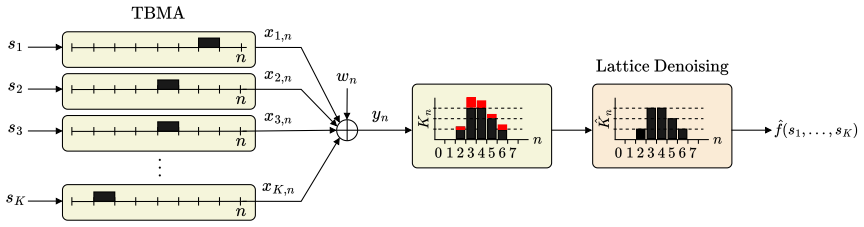
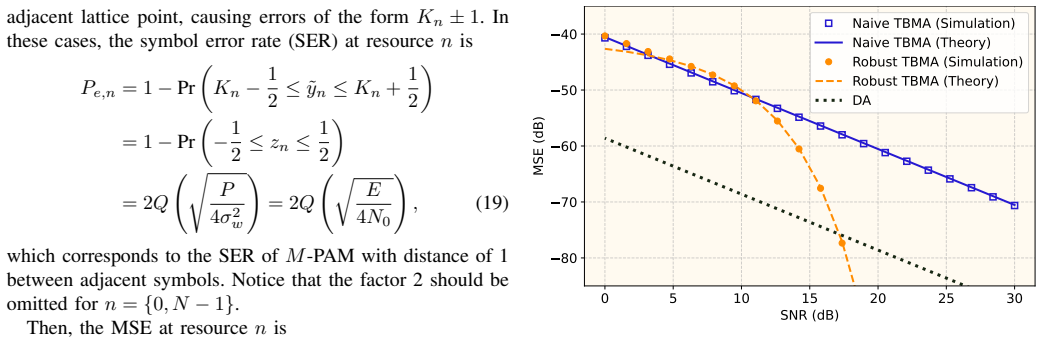
The superposition of transmitted signals in TBMA induces a discrete lattice structure in the received signal space, where each lattice point corresponds to the number of devices accessing a given channel resource. By exploiting this structure through nearest-lattice-point projection, noise effects can be substantially suppressed. The proposed technique achieves an exponential decay of the mean squared error (MSE) with respect to the energy-to-noise spectral density ratio, whereas in conventional techniques the MSE only scales inversely with this ratio. Simulation results validate the theoretical findings and demonstrate that TBMA provides a fundamental robustness advantage over traditional
What carries the argument
nearest-lattice-point projection on the discrete lattice induced by TBMA signal superposition
If this is right
- MSE decays exponentially with energy-to-noise ratio instead of inversely.
- TBMA enables reliable nonparametric estimation without prior data distribution knowledge.
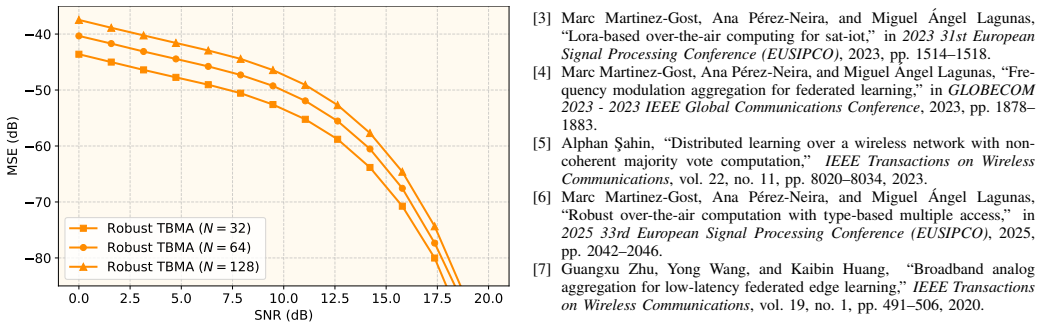
- Noise robustness holds across varying numbers of devices per channel resource.
- Performance advantage appears in simulations for multi-device wireless scenarios.
Where Pith is reading between the lines
- The lattice-counting idea could apply to other counting-based tasks such as crowd sensing or histogram estimation over wireless links.
- At very high SNR the method might approach error-free recovery of device counts, enabling zero-error aggregation in the limit.
- Hardware tests could check whether phase synchronization errors destroy the lattice structure before the exponential gain appears.
Load-bearing premise
The received signal after superposition forms a clean discrete lattice whose points can be reliably identified by nearest-point projection.
What would settle it
Measure MSE versus energy-to-noise ratio after applying nearest-lattice-point projection; if the decay remains only inverse rather than exponential at high ratios, the claim fails.
Figures

read the original abstract
This paper studies the robustness of type-based multiple access (TBMA) in over-the-air computation (AirComp) under nonparametric estimation, where no prior knowledge of the data distribution is available. While conventional AirComp approaches rely on amplitude modulations and suffer from noise sensitivity, TBMA enables the use of more structured modulation formats that can be exploited for improved performance. We show that the superposition of transmitted signals in TBMA induces a discrete lattice structure in the received signal space, where each lattice point corresponds to the number of devices accessing a given channel resource. By exploiting this structure through nearest-lattice-point projection, noise effects can be substantially suppressed. The proposed technique achieves an exponential decay of the mean squared error (MSE) with respect to the energy-to-noise spectral density ratio, whereas in conventional techniques the MSE only scales inversely with this ratio. Simulation results validate the theoretical findings and demonstrate that TBMA provides a fundamental robustness advantage over traditional AirComp.
Editorial analysis
A structured set of objections, weighed in public.
Referee Report
Summary. The paper claims that type-based multiple access (TBMA) for over-the-air computation (AirComp) under nonparametric estimation induces a discrete lattice structure in the received signal via superposition of finite-alphabet transmissions. Nearest-lattice-point projection then suppresses noise, yielding exponential MSE decay with the energy-to-noise spectral density ratio, in contrast to the inverse scaling of conventional amplitude-modulation AirComp. The claims rest on theoretical analysis of the lattice minimum distance and union-bound error probabilities, together with simulation validation.
Significance. If the central lattice-decoding argument holds, the work establishes a fundamental robustness advantage for AirComp, with exponential rather than polynomial error decay offering clear gains in noisy regimes. The nonparametric estimator and exploitation of the integer lattice arising directly from device-type superposition are notable strengths, broadening applicability beyond distribution-aware methods.
minor comments (3)
- [§2] §2 (System Model): the lattice construction assumes a known finite number of device types and perfect CSI compensation; explicitly stating these as standing assumptions would clarify the scope of the exponential-decay result.
- [§4] §4 (Theoretical Analysis): the union-bound derivation for the error probability is sketched but the precise dependence of the minimum distance on the modulation alphabet and device count could be stated as a lemma to make the exponential constant explicit.
- [§5] §5 (Simulations): the MSE curves are shown for a single parameter set; adding a table of simulation parameters (device count, alphabet size, number of Monte-Carlo trials) would improve reproducibility.
Simulated Author's Rebuttal
We thank the referee for the positive assessment of our work and the recommendation for minor revision. The referee's summary correctly captures the core contribution: that TBMA induces a lattice structure in the received signal under superposition, enabling nearest-lattice-point projection to achieve exponential MSE decay with energy-to-noise ratio in the nonparametric setting, in contrast to the inverse scaling of conventional AirComp.
Circularity Check
No significant circularity; lattice structure and exponential MSE decay follow directly from standard AWGN lattice decoding
full rationale
The derivation begins with the signal model in which each device transmits one of a finite set of type vectors; their superposition therefore produces an integer lattice in the received vector space by direct linear combination. Nearest-lattice-point projection is then applied to this received point. Under AWGN with known device count and perfect CSI compensation, the minimum distance between lattice points is positive and fixed; the union bound on the probability of decoding to an incorrect lattice point therefore decays exponentially with SNR. When decoding is correct the estimation error is bounded by the lattice spacing, so the MSE inherits the same exponential decay. This chain uses only the definition of the transmitted alphabet, the additive Gaussian channel, and the classical union-bound argument for minimum-distance decoding; no parameter is fitted to the target MSE, no self-citation supplies a uniqueness theorem, and no ansatz is smuggled in. The result is therefore self-contained against external benchmarks and receives score 0.
Axiom & Free-Parameter Ledger
axioms (1)
- domain assumption Nonparametric estimation: no prior knowledge of the data distribution is available
Lean theorems connected to this paper
-
IndisputableMonolith/Cost/FunctionalEquationwashburn_uniqueness_aczel unclearthe superposition of transmitted signals in TBMA induces a discrete lattice structure... nearest-lattice-point projection... MSE∼exp(−E/8N0)
-
IndisputableMonolith/Foundation/AlexanderDualityalexander_duality_circle_linking unclearlattice point corresponds to the number of devices accessing a given channel resource
Reference graph
Works this paper leans on
-
[1]
arXiv preprint arXiv:2405.17007 , year=
Waveforms for Computing Over the Air , author=. arXiv preprint arXiv:2405.17007 , year=
-
[2]
Hu, Changjie and Li, Quanzhong and Zhang, Qi and Li, Qiang , journal=. Robust Design for Multi-Carrier Multi-Relay Assisted Over-the-Air Computation Networks With Bounded Channel Uncertainties , year=
-
[3]
Distributionally Robust Over-the-Air Computation in Presence of Channel Uncertainties , year=
Zhang, Hongrui and Tang, Xiao and Zhang, Ruonan and Dana, Turlykozhayeva and Ussipov, Nurzhan and Han, Zhu , booktitle=. Distributionally Robust Over-the-Air Computation in Presence of Channel Uncertainties , year=
-
[4]
IEEE Transactions on Vehicular Technology , year=
OTFS-based Robust MMSE Precoding Design in Over-the-air Computation , author=. IEEE Transactions on Vehicular Technology , year=
-
[5]
2022 IEEE 32nd International Workshop on Machine Learning for Signal Processing (MLSP) , pages=
Robust federated learning via over-the-air computation , author=. 2022 IEEE 32nd International Workshop on Machine Learning for Signal Processing (MLSP) , pages=. 2022 , organization=
work page 2022
-
[6]
Robust Design for Reconfigurable Intelligent Surface Assisted Over-the-Air Computation , year=
An, Qiaochu and Zhou, Yong and Shi, Yuanming , booktitle=. Robust Design for Reconfigurable Intelligent Surface Assisted Over-the-Air Computation , year=
-
[7]
Frequency Modulation Aggregation for Federated Learning , year=
Martinez-Gost, Marc and Pérez-Neira, Ana and Lagunas, Miguel Ángel , booktitle=. Frequency Modulation Aggregation for Federated Learning , year=
-
[8]
Mergen, G. and Tong, L. , journal=. Type based estimation over multiaccess channels , year=
-
[9]
Broadband Analog Aggregation for Low-Latency Federated Edge Learning , year=
Zhu, Guangxu and Wang, Yong and Huang, Kaibin , journal=. Broadband Analog Aggregation for Low-Latency Federated Edge Learning , year=
-
[10]
IEEE Transactions on Wireless Communications , volume=
Distributed learning over a wireless network with non-coherent majority vote computation , author=. IEEE Transactions on Wireless Communications , volume=. 2023 , publisher=
work page 2023
-
[11]
Robust Over-the-Air Computation with Type-Based Multiple Access , year=
Martinez-Gost, Marc and Pérez-Neira, Ana and Lagunas, Miguel Ángel , booktitle=. Robust Over-the-Air Computation with Type-Based Multiple Access , year=
-
[12]
LoRa-Based Over-the-Air Computing for Sat-IoT , year=
Martinez-Gost, Marc and Pérez-Neira, Ana and Lagunas, Miguel Ángel , booktitle=. LoRa-Based Over-the-Air Computing for Sat-IoT , year=
discussion (0)
Sign in with ORCID, Apple, or X to comment. Anyone can read and Pith papers without signing in.