Recognition: 2 theorem links
· Lean TheoremMineral False Positives in the Search for Exoplanet Surface Biosignatures
Pith reviewed 2026-05-12 04:33 UTC · model grok-4.3
The pith
Several sulfide and tectosilicate minerals plus potassium ferrocyanide display sharp reflectance increases near 700 nm that resemble the photosynthesis red edge.
A machine-rendered reading of the paper's core claim, the machinery that carries it, and where it could break.
Core claim
We find that several sulfide and tectosilicate minerals, as well as the prebiotically important cyanide salt, potassium ferrocyanide, have PRE-like features. We characterize these features in order to assess how they may be distinguished from biopigments. We conclude that the future evaluation of the biogenicity of PRE-like features in exoplanet reflectance spectra can be informed by the atmospheric context, but may require an assessment of the prior probability of non-biological and biological hypotheses about the surface materials of exoplanets.
What carries the argument
Comparison of laboratory mineral reflectance spectra against the photosynthesis red edge (PRE), a sharp step-like reflectance increase at approximately 700 nm, to identify abiotic mimics.
If this is right
- Future visible-to-near-infrared spectra from telescopes such as the Habitable Worlds Observatory could record PRE-like features produced by surface minerals instead of pigments.
- Atmospheric composition data would provide one route to evaluate whether an observed PRE-like edge is more likely biological or mineral in origin.
- Interpretation frameworks would need to incorporate prior probabilities for both biological and non-biological surface materials when assessing edge features.
- Specific mineral classes such as certain sulfides would have to be considered and potentially excluded before attributing an edge to vegetation or other biopigments.
Where Pith is reading between the lines
- Similar database searches could be extended to other candidate surface biosignatures to map the full range of abiotic mimics.
- Expanded mineral libraries that include vacuum, radiation, and grain-size effects would tighten the false-positive assessment for real exoplanet geometries.
- If mineral mimics prove widespread, observers might need to combine the 700 nm edge with additional spectral bands or time-series data to raise in a biological interpretation.
Load-bearing premise
Laboratory and terrestrial mineral reflectance spectra accurately represent the materials and viewing conditions that would appear in disk-integrated exoplanet observations.
What would settle it
A high-confidence PRE-like reflectance edge detected on an exoplanet whose atmospheric retrievals and thermal emission data are inconsistent with the presence or stability of the identified mimicking minerals on its surface.
Figures


read the original abstract
In the search for life in the cosmos, biopigments on exoplanet surfaces are a critical target. Such pigments have been detected in Earth's spectrum (by the Galileo spacecraft and in Earthshine) via the "vegetation" or "photosynthesis red edge" (VRE or PRE), a sharp, step-like increase in reflectance with increasing wavelength at ~700 nm. Future space telescopes like the Habitable Worlds Observatory (HWO) are designed to obtain disk-integrated spectra of Earth-like exoplanets in the visible-to-near-infrared to identify such features. However, there has been no systematic analysis of the occurrence of similar reflectance edges among minerals of non-biological origin. Here, we use existing databases of mineral reflectance spectra to explore the risk that minerals may present false positives in the search for biopigments on exoplanets. We find that several sulfide and tectosilicate minerals, as well as the prebiotically important cyanide salt, potassium ferrocyanide, have PRE-like features. We characterize these features in order to assess how they may be distinguished from biopigments. We conclude that the future evaluation of the biogenicity of PRE-like features in exoplanet reflectance spectra can be informed by the atmospheric context, but may require an assessment of the prior probability of non-biological and biological hypotheses about the surface materials of exoplanets.
Editorial analysis
A structured set of objections, weighed in public.
Referee Report
Summary. The manuscript analyzes reflectance spectra from existing public mineral databases to identify non-biological minerals that display sharp reflectance increases near 700 nm, analogous to the photosynthesis red edge (PRE) observed in Earth's vegetation. The authors report that several sulfides, tectosilicates, and potassium ferrocyanide exhibit such PRE-like features and characterize them to evaluate their potential as false positives in disk-integrated exoplanet spectra targeted by future observatories such as the Habitable Worlds Observatory (HWO). They conclude that atmospheric context and prior probabilities of surface materials can aid in distinguishing biological from abiotic origins.
Significance. If the reported spectral matches hold under realistic conditions, the work supplies a valuable reference catalog for interpreting surface reflectance features in exoplanet observations, helping to mitigate misidentification risks in biosignature searches. The analysis draws strength from its direct use of independent public databases with no fitted parameters, self-referential equations, or author-derived derivations, which supports reproducibility and avoids circularity.
major comments (2)
- [§3] §3 (Mineral spectral analysis): The quantitative thresholds and selection criteria used to classify reflectance edges as 'PRE-like' (e.g., wavelength range, slope magnitude, or sharpness metric) are not specified, nor is the total number of minerals screened from the databases. This directly affects evaluation of the search completeness and the robustness of the highlighted examples as representative false-positive risks.
- [§4] §4 (Discussion of false-positive implications): The manuscript assumes laboratory and terrestrial reflectance spectra can be directly compared to disk-integrated exoplanet observations without addressing how intimate mineral mixtures, grain-size distributions, space weathering, or non-Lambertian scattering at non-zero phase angles would affect the reported edges. These factors are load-bearing for whether the identified features constitute actual risks for HWO-type spectra.
minor comments (2)
- [Figures] Figure captions (e.g., Figures 2-4): Include explicit references to the source databases (e.g., USGS, RELAB) and any preprocessing steps such as normalization or wavelength resampling to improve reproducibility.
- [Abstract] Abstract and §1: The term 'PRE-like' is used without a brief operational definition; adding one sentence on the characteristic wavelength and shape would aid readers unfamiliar with the vegetation red edge.
Simulated Author's Rebuttal
Thank you for the referee's detailed and constructive feedback on our manuscript. We have carefully considered each comment and provide the following point-by-point responses. We believe these revisions will strengthen the paper's clarity and robustness.
read point-by-point responses
-
Referee: [§3] §3 (Mineral spectral analysis): The quantitative thresholds and selection criteria used to classify reflectance edges as 'PRE-like' (e.g., wavelength range, slope magnitude, or sharpness metric) are not specified, nor is the total number of minerals screened from the databases. This directly affects evaluation of the search completeness and the robustness of the highlighted examples as representative false-positive risks.
Authors: We agree with the referee that the quantitative thresholds and selection criteria for identifying 'PRE-like' features should be explicitly stated to allow assessment of search completeness. In the revised manuscript, we will add a clear description in §3 of the criteria employed, including the specific wavelength range, minimum slope magnitude, and any sharpness metrics used to classify the reflectance edges. We will also report the total number of minerals screened from the public databases. This addition will enhance the transparency and reproducibility of our analysis. revision: yes
-
Referee: [§4] §4 (Discussion of false-positive implications): The manuscript assumes laboratory and terrestrial reflectance spectra can be directly compared to disk-integrated exoplanet observations without addressing how intimate mineral mixtures, grain-size distributions, space weathering, or non-Lambertian scattering at non-zero phase angles would affect the reported edges. These factors are load-bearing for whether the identified features constitute actual risks for HWO-type spectra.
Authors: We acknowledge that the direct applicability of laboratory reflectance spectra to disk-integrated exoplanet observations requires careful consideration of factors such as mineral mixtures, grain sizes, space weathering, and scattering properties. Our study focuses on identifying potential false-positive candidates from pure mineral spectra in existing databases. In the revised §4, we will include an expanded discussion addressing these caveats, explaining how they might modulate the observed features in realistic exoplanet contexts and emphasizing the role of atmospheric context and prior probabilities as noted in our conclusions. While a full treatment of radiative transfer effects is outside the scope of this work, we will highlight it as an important direction for future studies to better quantify the risks for HWO observations. revision: partial
Circularity Check
No circularity: direct empirical comparison to external mineral databases
full rationale
The paper's central analysis consists of querying independent, pre-existing mineral reflectance spectral databases and identifying PRE-like edges by direct visual and quantitative comparison to the known ~700 nm vegetation red edge. No equations, fitted parameters, self-referential definitions, or derivations are present. No load-bearing self-citations are invoked to justify uniqueness or ansatzes. The result is an empirical cataloging exercise whose validity rests on the representativeness of the databases (a separate scientific question) rather than any reduction to the paper's own inputs.
Axiom & Free-Parameter Ledger
axioms (1)
- domain assumption Reflectance spectra from existing mineral databases accurately represent possible exoplanet surface compositions under disk-integrated viewing conditions
Lean theorems connected to this paper
-
IndisputableMonolith/Cost/FunctionalEquation.leanwashburn_uniqueness_aczel unclear?
unclearRelation between the paper passage and the cited Recognition theorem.
We use existing databases of mineral reflectance spectra to explore the risk that minerals may present false positives... algorithmic search... ΔRmax of at least 14
-
IndisputableMonolith/Foundation/DimensionForcing.leanalexander_duality_circle_linking unclear?
unclearRelation between the paper passage and the cited Recognition theorem.
NASA Planetary Spectrum Generator... LUVOIR B-VIS template... Earth-sized planet... 10 parsecs
What do these tags mean?
- matches
- The paper's claim is directly supported by a theorem in the formal canon.
- supports
- The theorem supports part of the paper's argument, but the paper may add assumptions or extra steps.
- extends
- The paper goes beyond the formal theorem; the theorem is a base layer rather than the whole result.
- uses
- The paper appears to rely on the theorem as machinery.
- contradicts
- The paper's claim conflicts with a theorem or certificate in the canon.
- unclear
- Pith found a possible connection, but the passage is too broad, indirect, or ambiguous to say the theorem truly supports the claim.
Reference graph
Works this paper leans on
-
[1]
Introduction The search for biosignatures on extrasolar planets can encompass both the transmission spectra of their atmospheres and the spectral signatures of surface materials observable in reflected light (e.g., DesMarais et al., 2002; Kaltenegger et al., 2017; Schwieterman et al., 2018). Because Earth-sized planets in the habitable zone (e.g., Kasting...
work page 2002
-
[2]
are characterized by low contrast ratios (brightness of the planet compared to brightness of the star), especially in the visible and near infrared, direct imaging of their disks is currently precluded by the limitations of existing telescopes (e.g., Currie et al., 2023). Recognizing the compelling scientific potential for directly detecting extraterrestr...
work page 2023
-
[3]
prioritized the development of a large infrared/optical/ultraviolet (IR/O/UV) space telescope. The survey emphasized that this mission, as a top priority within a Great Observatories Mission and Technology Maturation Program, should be designed to directly search for signatures of life on approximately 25 habitable-zone planets while also transforming gen...
work page 2024
-
[4]
over the near-IR/O/UV spectral range. This will be crucial for studying the atmospheres and surface reflectance properties of Earth-like planets in their habitable zones. Perhaps surprisingly, existing models suggest that such a telescope should be capable of detecting biopigments on a planet’s surface via its contribution to the reflectance spectrum (e.g...
work page 2005
-
[5]
because photosynthetic pigments also occur in non-plants. This sharp, step-like increase in reflectance from wavelengths below ~700 nm to wavelengths above ~700 nm is characteristic of most photosynthetic organisms, which absorb predominantly in the “photosynthetically active” visible range (e.g., Coelho et al., 2022). This feature can be resolved in Eart...
work page 2022
-
[6]
and the NASA ECOSTRESS database (Meerdink et al., 2019). From the USGS database, we sourced spectra from 290 artificial materials and 1,276 minerals, which includes arsenates (1 spectrum), borates (6), carbonates (17), halides (2), hydroxides (10), oxides (13), phosphates (5), silicates (121), sulfides (8), and sulfates (20). Additionally, 1,040 vegetatio...
work page 2019
-
[7]
2.3 Simulating mineral red edge false positives on exoplanets with the NASA Planetary Spectrum Generator NASA’s Planetary Spectrum Generator (PSG) is an online radiative transfer suite developed at NASA Goddard Space Flight Center, accessible at: https://psg.gsfc.nasa.gov/ (Villanueva et al., 2018). It is designed to simulate planetary spectra for a wide ...
work page 2018
-
[8]
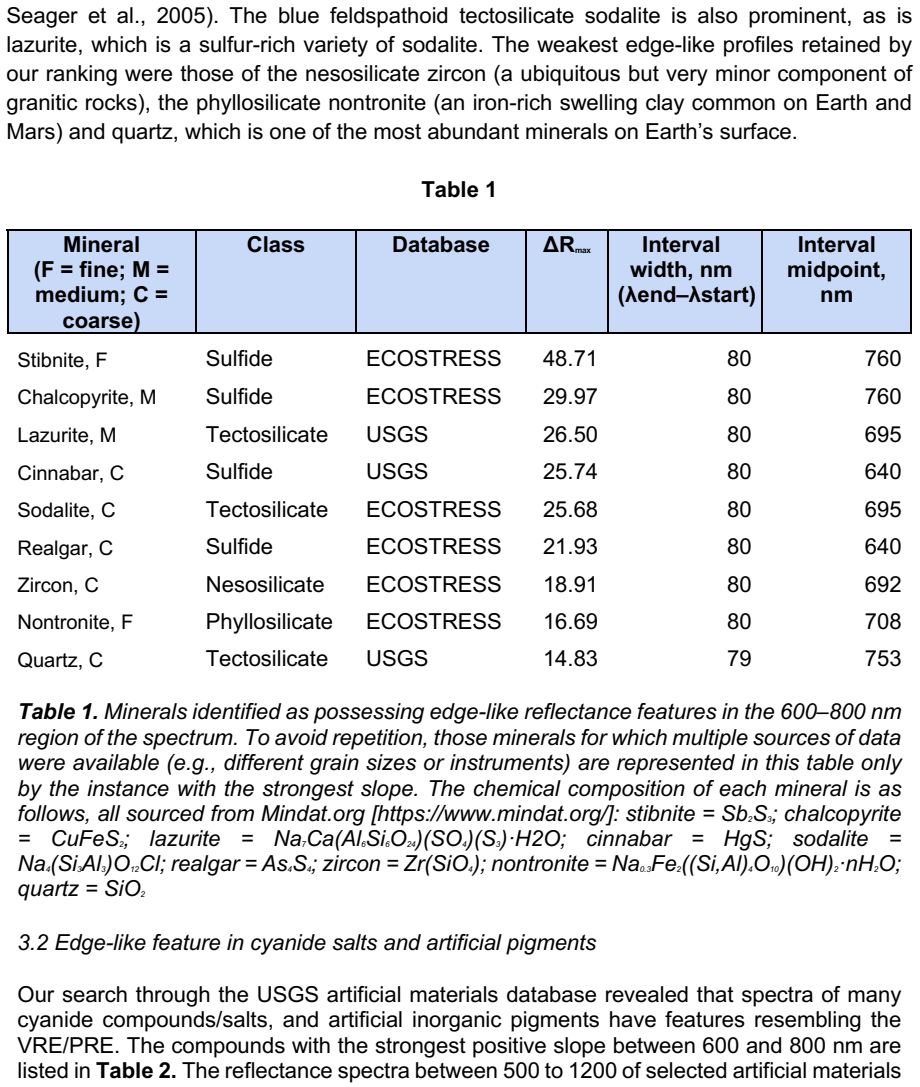
Results 3.1 Identification of VRE/PRE-like features in minerals Our algorithmic search through the ECOSTRESS and USGS spectroscopic databases identified edge-like increases in reflectance between 600 and 800 nm in numerous minerals. Minerals with the strongest positive slope in this region are listed in Table 1 and their reflectance spectra from 500 to 12...
work page 2005
-
[9]
(a) sulfide mineral spectra from Table 1 (database source: stibnite, ECOSTRESS | chalcopyrite, ECOSTRESS | cinnabar, USGS | realgar, ECOSTRESS) alongside the green leaf spectrum used to model the VRE/PRE; (b) silicate mineral spectra from Table 1 (database source: lazurite, USGS | sodalite, ECOSTRESS | zircon, ECOSTRESS | nontronite, ECOSTRESS) with the V...
work page 2017
-
[10]
Simulated reflectance spectra (I/F) of alternative Earths. The shaded errors represent telescope noise in an observation simulated with PSG with 8 hours of exposure time (LUVOIR B-VIS instrument). All simulations use modern Earth’s atmosphere with 21% oxygen. (a) Earth with neither vegetation nor VRE/PRE-like mineral edges. The “uniform surface” spectrum ...
work page 2019
-
[11]
Data were obtained using the simulated LUVOIR B-VIS instrument in the PSG for an Earth-like planet orbiting a Sun-like star at 1.A.U, viewed from a distance of 10 parsecs. Sulfide minerals were excluded because their “edges” are outside of the 685–715 nm window (as shown by Figure 1). The green maple leaf spectrum was used as the example for photosyntheti...
work page 2005
-
[12]
although the magnitude of the edge is smaller. Lazurite and especially sodalite can effectively mimic the VRE/PRE in simulated telescope data (Figure 3). 4.1 Surface composition and mineral assemblages While this study has compared the spectroscopic signals of different materials with coverage ranging from 0 to 100% of a planet’s surface, real surface cov...
work page 2022
-
[13]
Conclusion Biopigments on exoplanet surfaces are a critical target in the search for life in the cosmos. However, no in-depth study has previously been undertaken to identify minerals that could mimic the “vegetation” or “photosynthesis red edge” (VRE or PRE), a potential biosignature associated with photosynthetic biopigments. This study has filled this ...
work page 2008
-
[14]
https://doi.org/10.1007/978-0-387-77516-6_23 Arnold, L., Bréon, F., & Brewer, S
Springer, Boston, MA. https://doi.org/10.1007/978-0-387-77516-6_23 Arnold, L., Bréon, F., & Brewer, S. (2009). The Earth as an extrasolar planet: the vegetation spectral signature today and during the last Quaternary climatic extrema. International Journal of Astrobiology, 8(2), 81–94. https://doi.org/10.1017/s1473550409004406 Bohl, A., Lawrence, L., Lowr...
-
[15]
https://doi.org/10.3390/galaxies7040082. Cockell, C. S., Kaltenegger, L., Raven, J. A., Cockell, C. S., Kaltenegger, L., & Raven, J. A. (2009). Cryptic Photosynthesis—Extrasolar planetary oxygen without a surface biological signature. Astrobiology, 9(7), 623–636. https://doi.org/10.1089/ast.2008.0273 Coelho, L. F., Madden, J., Kaltenegger, L., Zinder, S. ...
-
[16]
https://doi.org/10.3847/psj/accf86 Deitrick, R., & Goldblatt, C. (2023). Effects of ozone levels on climate through Earth history. Climate of the Past, 19(6), 1201–1218. https://doi.org/10.5194/cp-19-1201-2023 DesMarais, D. J., Harwit, M., Jucks, K., Kasting, J. F., Woolf, N., Lin, D., Seager, S., Schneider, J., Traub, W., & Lunine, J., I. (2002, February...
-
[17]
https://doi.org/10.3847/psj/ad769d Michaut, C., & Neufeld, J. A. (2022). Formation of the lunar primary crust from a Long-Lived slushy magma ocean. Geophysical Research Letters, 49(2). https://doi.org/10.1029/2021gl095408 Mills, B. J., Krause, A. J., Jarvis, I., & Cramer, B. D. (2023). Evolution of atmospheric O2 through the Phanerozoic, revisited. Annual...
-
[18]
https://doi.org/10.3390/geosciences8080280 Reinhard, C. T., Olson, S. L., Schwieterman, E. W., & Lyons, T. W. (2017). False Negatives for Remote Life Detection on Ocean-Bearing Planets: Lessons from the Early Earth. Astrobiology, 17(4), 287–297. https://doi.org/10.1089/ast.2016.1598 Rodriguez, L. E., Weber, J. M., & Barge, L. M. (2024). Evaluating pigment...
discussion (0)
Sign in with ORCID, Apple, or X to comment. Anyone can read and Pith papers without signing in.