Recognition: 2 theorem links
· Lean TheoremMultifield stochastic inflation: Relevance of number of fields in statistical moments
Pith reviewed 2026-05-12 05:09 UTC · model grok-4.3
The pith
Stochastic effects in multifield inflation make the number of scalar fields affect the statistics of e-folds and primordial perturbations, unlike the classical case.
A machine-rendered reading of the paper's core claim, the machinery that carries it, and where it could break.
Core claim
While O(d) symmetry renders the number of fields irrelevant at the classical level, stochastic noise introduces an explicit dependence on d into all higher-order moments of the stochastic e-fold number N. A closed-form perturbative formula is obtained for arbitrary moments at all orders, preserving full analytical control over d. The requirement that the inflaton trajectory reaches the end of inflation then yields an upper bound on d.
What carries the argument
The general perturbative formula for arbitrary higher-order moments of the stochastic number of e-folds, which keeps the dependence on the number of fields d fully analytical at every order in the small-noise expansion.
If this is right
- The mean, variance, and all higher moments of the stochastic e-fold number acquire explicit d dependence.
- The primordial power spectrum and its spectral tilt receive stochastic corrections that scale with d.
- Successful termination of inflation requires the number of fields to lie below an upper theoretical bound.
Where Pith is reading between the lines
- The closed-form d dependence allows any other O(d)-symmetric potential to be analyzed for its moment structure without repeating the full derivation.
- The same machinery can be applied to compute stochastic corrections to other observables, such as the bispectrum, once the appropriate delta-N expansion is inserted.
- The upper bound on d supplies a new consistency condition that can be checked against concrete string-theory constructions that realize large numbers of scalar fields.
Load-bearing premise
The small-noise perturbative expansion captures all relevant stochastic corrections without non-perturbative effects or higher-order noise terms becoming important.
What would settle it
Numerical solution of the stochastic differential equations for an O(d)-symmetric potential, extraction of the moments of N for several values of d, and direct comparison against the derived analytical formula.
Figures



read the original abstract
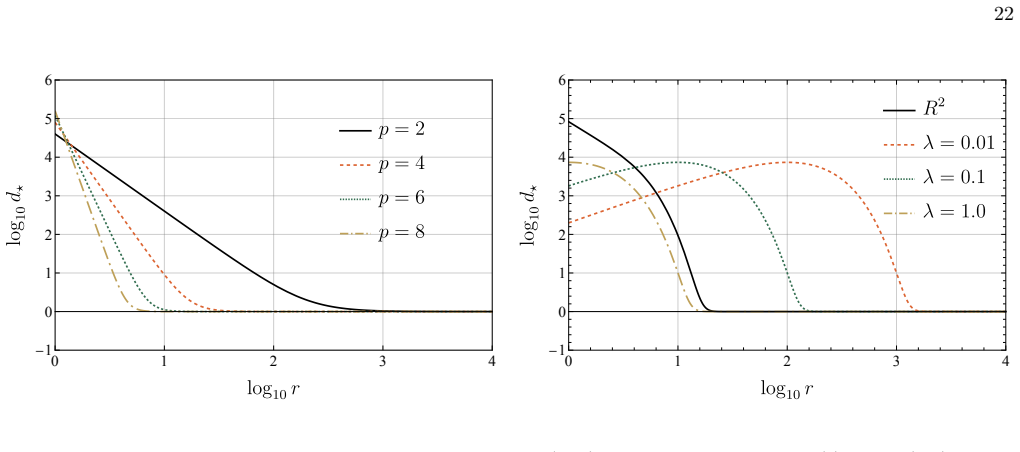
In multifield inflation driven by $d$ scalar fields, $O (d)$ symmetry renders the number of fields irrelevant at classical level. This ceases to be the case once stochastic effects are accommodated. The statistical quantities such as the mean number and the variance of $e$-folds as well as the primordial power spectrum and its scale dependence are perturbatively calculated in a small-noise regime. In particular, a general formula is derived for arbitrary higher-order statistical moments of the stochastic number of $e$-folds at all perturbative orders, keeping the dependence on the number of fields fully analytical. It is also discussed that the requirement for inflation to be successfully terminated puts a theoretical bound on the number of fields from above. Those general results are demonstrated for several $O (d)$-symmetric models.
Editorial analysis
A structured set of objections, weighed in public.
Referee Report
Summary. The paper studies multifield stochastic inflation with d scalar fields under O(d) symmetry. While the number of fields is irrelevant classically, stochastic noise makes d relevant. The authors perturbatively compute statistical quantities (mean and variance of e-folds, primordial power spectrum and tilt) in the small-noise regime, derive a general all-order formula for arbitrary higher moments of the stochastic number of e-folds that retains explicit analytic d dependence, and argue that successful termination of inflation imposes an upper theoretical bound on d. Results are illustrated on several O(d)-symmetric models.
Significance. If the central derivations hold, the work supplies a useful closed-form perturbative framework for higher statistical moments in multifield stochastic inflation with explicit d dependence. The termination bound on d is a novel theoretical constraint that could inform model viability. The all-order moment formula is a clear technical strength, as is the retention of analytic d dependence rather than numerical fitting.
major comments (2)
- [§3] §3 (radial Langevin equation): the Itô correction produces an extra drift term ∼(d−1)(H/2π)^2/r. This term grows linearly with d even when the per-field noise amplitude is small, so the small-noise ordering assumed for the perturbative moment expansion can fail exactly in the regime where the termination bound on d is applied. The manuscript demonstrates results for several models but does not quantify the d range in which neglected higher-order noise corrections remain sub-dominant.
- [§5] §5 (termination bound): the upper bound on d is derived from the requirement that inflation ends successfully, yet this bound is applied without an accompanying check that the small-noise perturbative expansion remains valid at those d values. A concrete estimate of the d at which the Itô drift becomes O(1) relative to the classical drift would be needed to substantiate the bound.
minor comments (2)
- [Abstract] The abstract states that the primordial power spectrum and its scale dependence are calculated, but the main text emphasis is on moments of N; clarify whether these spectral quantities are derived from the same moment formula or treated separately.
- [Notation] Notation: the symbol for the number of fields (d) and the stochastic e-fold variable (N) should be introduced once with consistent font and usage throughout the equations and text.
Simulated Author's Rebuttal
We thank the referee for the careful reading of our manuscript and for the constructive comments on the validity of the small-noise perturbative expansion. We address the major comments point by point below. We agree that quantitative checks on the regime of validity are needed and will incorporate the requested estimates in the revised manuscript.
read point-by-point responses
-
Referee: [§3] §3 (radial Langevin equation): the Itô correction produces an extra drift term ∼(d−1)(H/2π)^2/r. This term grows linearly with d even when the per-field noise amplitude is small, so the small-noise ordering assumed for the perturbative moment expansion can fail exactly in the regime where the termination bound on d is applied. The manuscript demonstrates results for several models but does not quantify the d range in which neglected higher-order noise corrections remain sub-dominant.
Authors: We agree that the Itô drift term scales linearly with (d−1) and that this could affect the small-noise ordering for sufficiently large d. Our perturbative expansion is performed in the noise amplitude with d kept explicit, but we acknowledge that an explicit quantification of the d range where the Itô term remains subdominant to the classical drift was not provided. In the revised manuscript we will add a dedicated paragraph (or subsection) deriving the condition under which the Itô correction is negligible compared with the classical radial drift for each of the O(d)-symmetric models considered. This will include an estimate of the maximum d for which higher-order noise corrections stay perturbatively small, thereby clarifying the domain of applicability of our results. revision: partial
-
Referee: [§5] §5 (termination bound): the upper bound on d is derived from the requirement that inflation ends successfully, yet this bound is applied without an accompanying check that the small-noise perturbative expansion remains valid at those d values. A concrete estimate of the d at which the Itô drift becomes O(1) relative to the classical drift would be needed to substantiate the bound.
Authors: We accept that the termination bound on d must be accompanied by a verification that the small-noise expansion remains valid at those values. In the revised version we will supply a concrete estimate by evaluating the ratio of the Itô drift term to the classical drift term at the d values obtained from the termination condition. For each model we will derive the inequality (d−1)(H/2π)^2/r ≪ |classical drift| and evaluate it numerically or analytically at the boundary d, thereby either confirming that the quoted bounds lie inside the perturbative regime or indicating the adjusted range where both the termination and small-noise conditions are simultaneously satisfied. revision: yes
Circularity Check
Derivation of perturbative moments from stochastic equations is self-contained
full rationale
The paper starts from the standard multifield Langevin equations under O(d) symmetry, applies Ito calculus to obtain the radial drift, and performs a perturbative expansion in the small-noise parameter to obtain all-order moments of the e-fold number N_e while retaining explicit d dependence. No quoted step reduces a claimed prediction to a fitted input by construction, nor does any load-bearing premise rest on a self-citation chain whose validity is internal to the present work. The termination bound on d is presented as a separate consistency requirement applied to the derived moments rather than an input that forces the result. The derivation therefore remains independent of the target statistical quantities.
Axiom & Free-Parameter Ledger
axioms (2)
- domain assumption O(d) symmetry in the scalar potential for the multifield models
- domain assumption Validity of perturbative expansion in the small-noise regime
Lean theorems connected to this paper
-
IndisputableMonolith/Foundation/AlexanderDuality.leanalexander_duality_circle_linking (D=3 forced topologically) contradicts?
contradictsCONTRADICTS: the theorem conflicts with this paper passage, or marks a claim that would need revision before publication.
O(d) symmetry renders the number of fields irrelevant at classical level. This ceases to be the case once stochastic effects are accommodated... general formula... keeping the dependence on the number of fields fully analytical... theoretical bound on the number of fields from above.
-
IndisputableMonolith/Cost/FunctionalEquation.leanwashburn_uniqueness_aczel (J(x) unique calibrated reciprocal cost) unclear?
unclearRelation between the paper passage and the cited Recognition theorem.
dr/dN = −v′(r)/v(r) + v(r)/2 (d−1)/r + √v(r) ξ(N) ... Itô correction term
What do these tags mean?
- matches
- The paper's claim is directly supported by a theorem in the formal canon.
- supports
- The theorem supports part of the paper's argument, but the paper may add assumptions or extra steps.
- extends
- The paper goes beyond the formal theorem; the theorem is a base layer rather than the whole result.
- uses
- The paper appears to rely on the theorem as machinery.
- contradicts
- The paper's claim conflicts with a theorem or certificate in the canon.
- unclear
- Pith found a possible connection, but the passage is too broad, indirect, or ambiguous to say the theorem truly supports the claim.
Reference graph
Works this paper leans on
-
[1]
Zeroth order As was already confirmed near the end of Section III B, at zeroth order, only the combination of the dummy indices k1 = k2 = k3 = k4 = 0 is relevant, as can also be seen from N1(0) = 1. It then follows from Eq. (4.2) that d ⟨N⟩(0) (x)/dx≃ 1/f1(x). This appropriately reproduces the classical number ofe-folds, given by Eq. (3.9)
-
[2]
First order At first order in v, the exponent of v(x) in Eq. (4.2) must be −k3 + k4 = 1. There exist N1(1) = 3 terms in Eq. (4.2), and the combinations of integers are exhausted by (k1, k 2, k 3, k 4) = (0,0,0,1), (0,1,1,2), (1,0,0,1). (4.4) The corresponding diagrammatic factors are D0,0 (x) = 1 andD 1,1 (x) = (−)2f2(x)/2! only. The result then...
-
[3]
Second order In deriving the second-order perturbative term in ⟨N⟩, there are N1(2) = 7 relevant terms that must be included in Eq. (4.2). The corresponding combinations of the integers are summarised in Appendix. Summing up all those contributions, the result is given by d⟨N⟩ (2) (x) dx = [v(x)]2 v(x) v′(x) 3 (d−1)(d−2) 4x2 + d−1 x v′(x) v(x) − 3 4 v(x) ...
-
[4]
Third order The third-order calculation includes N1(3) = 14 terms (again see Appendix), and a careful calculation leads to Eq. (4.7) below. As the pattern can be read off from Eqs. (4.5) and (4.6), the third-order result (4.7) involves the term cubic in the number of fields, which vanish at d= 1, 2, and also 3. d⟨N⟩ (3) (x) dx = [v(x)]3 v(x) v′(x) 4 (d−1)...
-
[5]
General order In principle, the procedure employed until here applies to calculate O(vk) term in the mean number of e-folds for arbitrary k≥ 0, collecting the terms corresponding to (k1, k 2, k 3, k 4) that give rise to the desired order of v. However, writing down the explicit forms of all the factors becomes more and more complicated when k gets larger....
-
[6]
The combination of the indices in Eq
Zeroth order At zeroth order in v, the evolution of the inflaton fields is deterministic, so that there is no fluctuations in the number of e-folds and its variance must vanish. The combination of the indices in Eq. (4.13) at this order is only k1 = · · · = k6 = 0, corresponding to N2(0) = 1. This gives rise to 1 2 d⟨N 2⟩(0) (x) dx ≃ ⟨N⟩(0) (x) f1(x) = 1 ...
-
[7]
First order Though Eq. (4.14) tells us that the number of the terms increases as k5, at first order, there are only 5 relevant combinations,i.e.,N 2(1) = 5, (k1, k 2, k 3, k 4, k 5, k 6) = (0,0,0,0,0,1), (0,0,0,0,1,0), (0,0,0,1,0,1), (0,1,1,0,0,2), (1,0,0,0,0,1). (4.17) Summing up all the contributions, and then simplifying the expre...
-
[8]
Second order The second-order calculation requires collecting 16 terms,i.e., N2(2) = 16. All those combinations of the indices can be found in Appendix, and subtraction of the total-derivative terms from ⟨N2⟩ (r) as was done in Eq. (4.18) arrives at d dx δN2 (2) (x) = [v(x)]2 v(x) v′(x) 4 3(d−1) 2x + 3v′(x) v(x) − 5 2 v(x) v′(x) v′′(x) v(x) .(4.20) As in ...
-
[9]
Third order The third-order term includes the N2(3) = 41 combi- nations in Eq. (4.13). The computation of this term is cumbersome, but after some algebra it results in d dx δN2 (3) (x)≃[v(x)] 3 v(x) v′(x) 5 × (d−1)(6d−11) 4x2 + d−1 2x 17 v′(x) v(x) − 25 2 v(x) v′(x) v′′(x) v(x) + 35 4 v′(x) v(x) 2 − 29 2 v′′(x) v(x) + 8 v(x) v′(x) 2 v′′(x) v(x) 2 − 7 4 v(...
-
[10]
However, at third order, a large number of terms already appears
General order The higher-order terms in the variance can also be enumerated order by order. However, at third order, a large number of terms already appears. Therefore, let us instead present the general-order formula for the variance, which comes from the total-derivative terms subtracted from ⟨N2⟩. Such total derivatives appear as the k4 = 0 term in Eq....
-
[11]
Power spectrum By virtue of the stochastic-δNformalism, it reads Pζ(x) = dδN 2(x) d⟨N⟩(x) = d⟨N⟩(x) dx −1 dδN 2(x) dx .(4.23) In Eq. (4.23), it is understood that the field value x is implicitly evaluated at the horizon crossing of a relevant mode. Provided that both factors ⟨N⟩ (x) and δN2(x) have been obtained in Sections IV A and IV B respectively, as ...
-
[12]
Tilt From the power spectrum, the spectral index nS is defined as nS −1≡ d lnPζ(k) d lnk k=aH ≃ − dx d⟨N⟩(x) · d lnPζ dx =− d lnPζ dx dN(x) dx =− 1 Pζ(x) dPζ(x) dx dN(x) dx .(4.29) Provided that the power spectrum has been obtained up to third order, the spectral index can be derived up to second order. To calculaten S, let us introduce λi(x)≡P (i) ζ (x),...
-
[13]
Mean The relevant terms for the calculation of the mean number ofe-folds are listed below. •N 1(0) = 1 term inO(v 0). (k1, k 2, k 3, k 4) = (0,0,0,0).(A1) •N 1(1) = 3 terms inO(v 1). (k1, k 2, k 3, k 4) = (0,0,0,1),(0,1,1,2),(1,0,0,1).(A2) •N 1(2) = 7 terms inO(v 2). (k1, k 2, k 3, k 4) = (0,0,0,2),(0,1,1,3),(0,2,1,3),(0,2,2,4),(1,0,0,2),(1,1,1,3), (2,0,0...
-
[14]
Variance The relevant terms for the calculation of the second moment ofNare listed below. Collecting those terms enables one to obtain the perturbative expansion of ⟨N2⟩, from which the variance δN2 can be derived. Though not listed here, a similar counting can also be performed for the formula (4.22), which directly derives the perturbative expansion of ...
-
[15]
A. A. Starobinsky, A New Type of Isotropic Cosmological Models Without Singularity, Phys. Lett. B91, 99 (1980)
work page 1980
-
[16]
Sato, First Order Phase Transition of a Vacuum and Expansion of the Universe, Mon
K. Sato, First Order Phase Transition of a Vacuum and Expansion of the Universe, Mon. Not. Roy. Astron. Soc. 195, 467 (1981)
work page 1981
-
[17]
A. H. Guth, The Inflationary Universe: A Possible Solu- tion to the Horizon and Flatness Problems, Phys. Rev. D 23, 347 (1981)
work page 1981
-
[18]
A. D. Linde, A New Inflationary Universe Scenario: A Possible Solution of the Horizon, Flatness, Homogeneity, Isotropy and Primordial Monopole Problems, Phys. Lett. B108, 389 (1982)
work page 1982
-
[19]
A. Albrecht and P. J. Steinhardt, Cosmology for Grand Unified Theories with Radiatively Induced Symmetry Breaking, Phys. Rev. Lett.48, 1220 (1982)
work page 1982
-
[20]
A. D. Linde, Chaotic Inflation, Phys. Lett. B129, 177 (1983)
work page 1983
-
[21]
V. F. Mukhanov and G. V. Chibisov, Quantum Fluctu- ations and a Nonsingular Universe, JETP Lett.33, 532 (1981)
work page 1981
-
[22]
A. A. Starobinsky, Dynamics of Phase Transition in the New Inflationary Universe Scenario and Generation of Perturbations, Phys. Lett. B117, 175 (1982)
work page 1982
-
[23]
A. H. Guth and S. Y. Pi, Fluctuations in the New Infla- tionary Universe, Phys. Rev. Lett.49, 1110 (1982)
work page 1982
-
[24]
J. M. Bardeen, P. J. Steinhardt, and M. S. Turner, Spon- taneous Creation of Almost Scale - Free Density Pertur- bations in an Inflationary Universe, Phys. Rev. D28, 679 (1983)
work page 1983
-
[25]
A. A. Starobinsky, Spectrum of relict gravitational radia- tion and the early state of the universe, JETP Lett.30, 682 (1979)
work page 1979
-
[26]
D. Polarski and A. A. Starobinsky, Semiclassicality and decoherence of cosmological perturbations, Class. Quant. Grav.13, 377 (1996), arXiv:gr-qc/9504030
-
[27]
J. Lesgourgues, D. Polarski, and A. A. Starobinsky, Quan- tum to classical transition of cosmological perturbations for nonvacuum initial states, Nucl. Phys. B497, 479 (1997), arXiv:gr-qc/9611019
-
[28]
Planck 2018 results. X. Constraints on inflation
Y. Akramiet al.(Planck), Planck 2018 results. X. Con- straints on inflation, Astron. Astrophys.641, A10 (2020), arXiv:1807.06211 [astro-ph.CO]
work page internal anchor Pith review Pith/arXiv arXiv 2018
-
[29]
Planck 2018 results. IX. Constraints on primordial non-Gaussianity
Y. Akramiet al.(Planck), Planck 2018 results. IX. Con- straints on primordial non-Gaussianity, Astron. Astro- 28 phys.641, A9 (2020), arXiv:1905.05697 [astro-ph.CO]
work page Pith review arXiv 2018
-
[30]
K. Enqvist and M. S. Sloth, Adiabatic CMB perturbations in pre - big bang string cosmology, Nucl. Phys. B626, 395 (2002), arXiv:hep-ph/0109214
-
[31]
D. H. Lyth and D. Wands, Generating the curvature perturbation without an inflaton, Phys. Lett. B524, 5 (2002), arXiv:hep-ph/0110002
work page Pith review arXiv 2002
-
[32]
T. Moroi and T. Takahashi, Effects of cosmological moduli fields on cosmic microwave background, Phys. Lett. B 522, 215 (2001), [Erratum: Phys.Lett.B 539, 303–303 (2002)], arXiv:hep-ph/0110096
-
[33]
Wands, Multiple field inflation, Lect
D. Wands, Multiple field inflation, Lect. Notes Phys.738, 275 (2008), arXiv:astro-ph/0702187
-
[34]
D. Baumann and L. McAllister,Inflation and String The- ory, Cambridge Monographs on Mathematical Physics (Cambridge University Press, 2015) arXiv:1404.2601 [hep- th]
-
[35]
Adiabatic and entropy perturbations from inflation
C. Gordon, D. Wands, B. A. Bassett, and R. Maartens, Adiabatic and entropy perturbations from inflation, Phys. Rev. D63, 023506 (2000), arXiv:astro-ph/0009131
work page Pith review arXiv 2000
-
[36]
An Observational Test of Two-field Inflation
D. Wands, N. Bartolo, S. Matarrese, and A. Riotto, An Observational test of two-field inflation, Phys. Rev. D66, 043520 (2002), arXiv:astro-ph/0205253
work page Pith review arXiv 2002
-
[37]
B. A. Bassett, S. Tsujikawa, and D. Wands, Inflation dynamics and reheating, Rev. Mod. Phys.78, 537 (2006), arXiv:astro-ph/0507632
work page Pith review arXiv 2006
- [38]
- [39]
-
[40]
C. Pattison, V. Vennin, H. Assadullahi, and D. Wands, Quantum diffusion during inflation and primordial black holes, JCAP10(2017), 046, arXiv:1707.00537 [hep-th]
-
[41]
T. Prokopec and G. Rigopoulos, ∆ N and the stochastic conveyor belt of ultra slow-roll inflation, Phys. Rev. D 104, 083505 (2021), arXiv:1910.08487 [gr-qc]
- [42]
-
[43]
C. Pattison, V. Vennin, D. Wands, and H. Assadullahi, Ultra-slow-roll inflation with quantum diffusion, JCAP 04(2021), 080, arXiv:2101.05741 [astro-ph.CO]
-
[44]
G. Rigopoulos and A. Wilkins, Inflation is always semi- classical: diffusion domination overproduces Primordial Black Holes, JCAP12(2021), 027, arXiv:2107.05317 [astro-ph.CO]
-
[45]
Y. Tada and V. Vennin, Statistics of coarse-grained cos- mological fields in stochastic inflation, JCAP02(2022), 021, arXiv:2111.15280 [astro-ph.CO]
-
[46]
S. Hooshangi, M. H. Namjoo, and M. Noorbala, Rare events are nonperturbative: Primordial black holes from heavy-tailed distributions, Phys. Lett. B834, 137400 (2022), arXiv:2112.04520 [astro-ph.CO]
-
[47]
A. Achucarro, S. Cespedes, A.-C. Davis, and G. A. Palma, The hand-made tail: non-perturbative tails from multi- field inflation, JHEP05(2022), 052, arXiv:2112.14712 [hep-th]
-
[48]
C. Animali and V. Vennin, Primordial black holes from stochastic tunnelling, JCAP02(02), 043, arXiv:2210.03812 [astro-ph.CO]
-
[49]
Tomberg, Stochastic constant-roll inflation and pri- mordial black holes, Phys
E. Tomberg, Stochastic constant-roll inflation and pri- mordial black holes, Phys. Rev. D108, 043502 (2023), arXiv:2304.10903 [astro-ph.CO]
-
[50]
V. Vennin and D. Wands, Quantum diffusion and large pri- mordial perturbations from inflation, inPrimordial Black Holes, edited by C. Byrnes, G. Franciolini, T. Harada, P. Pani, and M. Sasaki (Springer Nature Singapore, Sin- gapore, 2025) pp. 201–227
work page 2025
-
[51]
T. Murata and Y. Tada, Stochastic tail of the curvature perturbation in hybrid inflation, Phys. Rev. D113, 023552 (2026), arXiv:2507.22439 [astro-ph.CO]
-
[52]
Y. B. Zel’dovich and I. D. Novikov, The Hypothesis of Cores Retarded during Expansion and the Hot Cosmolog- ical Model, Soviet Astron. AJ (Engl. Transl. ),10, 602 (1967)
work page 1967
-
[53]
Hawking, Gravitationally collapsed objects of very low mass, Mon
S. Hawking, Gravitationally collapsed objects of very low mass, Mon. Not. Roy. Astron. Soc.152, 75 (1971)
work page 1971
-
[54]
B. J. Carr and S. W. Hawking, Black holes in the early Universe, Mon. Not. Roy. Astron. Soc.168, 399 (1974)
work page 1974
-
[55]
B. J. Carr, The Primordial black hole mass spectrum, Astrophys. J.201, 1 (1975)
work page 1975
-
[56]
V. Vennin and A. A. Starobinsky, Correlation Functions in Stochastic Inflation, Eur. Phys. J. C75, 413 (2015), arXiv:1506.04732 [hep-th]
-
[57]
A. D. Linde, Nonsingular Regenerating Inflationary Uni- verse (1982), Cambridge University preprint
work page 1982
-
[58]
Vilenkin, The Birth of Inflationary Universes, Phys
A. Vilenkin, The Birth of Inflationary Universes, Phys. Rev. D27, 2848 (1983)
work page 1983
-
[59]
Winitzki,Eternal Inflation(World Scientific, 2009)
S. Winitzki,Eternal Inflation(World Scientific, 2009)
work page 2009
-
[60]
T. Takahashi and K. Tokeshi, More fields are different: Stochastic view of multi-field inflationary scenario (2025), arXiv:2504.11158 [astro-ph.CO]
-
[61]
D. S. Salopek and J. R. Bond, Nonlinear evolution of long wavelength metric fluctuations in inflationary models, Phys. Rev. D42, 3936 (1990)
work page 1990
-
[62]
M. Sasaki and E. D. Stewart, A General analytic formula for the spectral index of the density perturbations pro- duced during inflation, Prog. Theor. Phys.95, 71 (1996), arXiv:astro-ph/9507001
work page Pith review arXiv 1996
-
[63]
Super-Horizon Scale Dynamics of Multi-Scalar Inflation
M. Sasaki and T. Tanaka, Superhorizon scale dynamics of multiscalar inflation, Prog. Theor. Phys.99, 763 (1998), arXiv:gr-qc/9801017
work page Pith review arXiv 1998
-
[64]
D. H. Lyth, K. A. Malik, and M. Sasaki, A General proof of the conservation of the curvature perturbation, JCAP 05(2005), 004, arXiv:astro-ph/0411220
work page Pith review arXiv 2005
-
[65]
A. A. Abolhasani, H. Firouzjahi, A. Naruko, and M. Sasaki,Delta N Formalism in Cosmological Perturba- tion Theory(WSP, 2019)
work page 2019
- [66]
- [67]
-
[68]
K. Ando and V. Vennin, Power spectrum in stochastic inflation, JCAP04(04), 057, arXiv:2012.02031 [astro- ph.CO]
-
[69]
A. A. Starobinsky, Stochastic de Siter (inflationary) stage in the early Universe, Lect. Notes Phys.246, 107 (1986)
work page 1986
-
[70]
A. A. Starobinsky and J. Yokoyama, Equilibrium state of a selfinteracting scalar field in the De Sitter background, Phys. Rev. D50, 6357 (1994), arXiv:astro-ph/9407016
work page Pith review arXiv 1994
-
[71]
D. Cruces, Review on Stochastic Approach to Inflation, 29 Universe8, 334 (2022), arXiv:2203.13852 [gr-qc]
-
[72]
S. Mollerach, S. Matarrese, A. Ortolan, and F. Lucchin, Stochastic inflation in a simple two field model, Phys. Rev. D44, 1670 (1991)
work page 1991
-
[73]
H. Assadullahi, H. Firouzjahi, M. Noorbala, V. Vennin, and D. Wands, Multiple Fields in Stochastic Inflation, JCAP06(2016), 043, arXiv:1604.04502 [hep-th]
- [74]
-
[75]
Generation of fluctuations during inflation: comparison of stochastic and field-theoretic approaches
F. Finelli, G. Marozzi, A. A. Starobinsky, G. P. Vacca, and G. Venturi, Generation of fluctuations during inflation: Comparison of stochastic and field-theoretic approaches, Phys. Rev. D79, 044007 (2009), arXiv:0808.1786 [hep-th]
work page Pith review arXiv 2009
-
[76]
Stochastic growth of quantum fluctuations during slow-roll inflation
F. Finelli, G. Marozzi, A. A. Starobinsky, G. P. Vacca, and G. Venturi, Stochastic growth of quantum fluctuations during slow-roll inflation, Phys. Rev. D82, 064020 (2010), arXiv:1003.1327 [hep-th]
work page Pith review arXiv 2010
-
[77]
C. Pattison, V. Vennin, H. Assadullahi, and D. Wands, Stochastic inflation beyond slow roll, JCAP07(2019), 031, arXiv:1905.06300 [astro-ph.CO]
- [78]
-
[79]
S. Winitzki and A. Vilenkin, Effective noise in stochastic description of inflation, Phys. Rev. D61, 084008 (2000), arXiv:gr-qc/9911029
-
[80]
S. Matarrese, M. A. Musso, and A. Riotto, Influence of superhorizon scales on cosmological observables gener- ated during inflation, JCAP05(2004), 008, arXiv:hep- th/0311059
discussion (0)
Sign in with ORCID, Apple, or X to comment. Anyone can read and Pith papers without signing in.