Recognition: 2 theorem links
· Lean TheoremOn the Casimir effect with mixed dynamical edge mode and perfect electromagnetic conducting boundary conditions
Pith reviewed 2026-05-12 04:25 UTC · model grok-4.3
The pith
A dynamical edge mode boundary condition produces the same Casimir force as a perfect magnetic conductor when paired with a perfect electromagnetic conductor plate.
A machine-rendered reading of the paper's core claim, the machinery that carries it, and where it could break.
Core claim
After introducing auxiliary edge fields to restore BRST invariance on the dynamical edge mode plate and enforcing the boundary conditions through Lagrange multipliers, the bulk fields can be integrated out to produce a non-local effective boundary theory. The partition function of this effective theory yields a Casimir energy whose derivative gives a force identical to the force between a perfect magnetic conductor and a perfect electromagnetic conductor. This equivalence holds from the viewpoint of the Casimir effect.
What carries the argument
Non-local effective boundary theory obtained by integrating out bulk fields after lifting the boundary conditions with Lagrange multipliers; it encodes the Casimir energy in its partition function and demonstrates the equivalence to the PMC case.
If this is right
- The Casimir force between a dynamical edge mode plate and a perfect electromagnetic conductor plate equals the force between a perfect magnetic conductor plate and a perfect electromagnetic conductor plate.
- Dynamical edge mode boundary conditions may be replaced by perfect magnetic conductor conditions when computing vacuum energies in electromagnetic configurations involving Casimir setups.
- The Lagrange-multiplier method for lifting mixed boundary conditions extends to other combinations that include dynamical edge modes.
Where Pith is reading between the lines
- If the equivalence holds, calculations of Casimir forces in systems with edge-mode-like boundaries could be simplified by mapping them to standard conductor conditions.
- The non-local character of the derived boundary theory might imply that similar non-local structures appear in other vacuum-energy problems with dynamical boundaries.
- Experimental tests of Casimir forces between specially engineered plates could check whether the predicted equivalence appears in measurable shifts of plate separation.
Load-bearing premise
The new edge fields added to restore BRST invariance, combined with the Lagrange-multiplier lifting of the boundary conditions, produce a valid non-local effective boundary theory whose partition function correctly encodes the Casimir energy.
What would settle it
An independent calculation of the Casimir energy for the dynamical edge mode plus perfect electromagnetic conductor setup, for example by direct mode summation or zeta-function regularization without the effective boundary reduction, that yields a different numerical value than the perfect magnetic conductor plus perfect electromagnetic conductor result.
Figures

read the original abstract
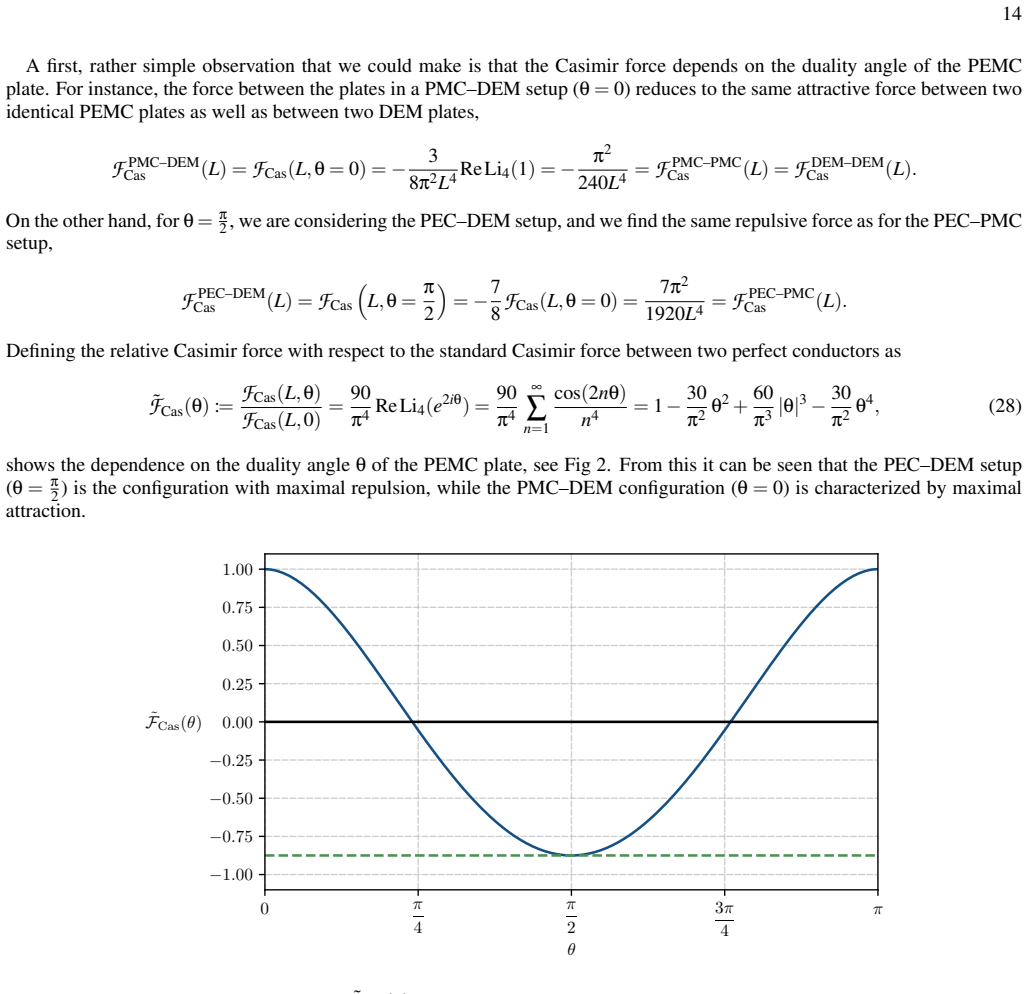
We study the Casimir effect for a parallel plate setup with one plate with dynamical edge mode (DEM) boundary conditions, and one plate with perfect electromagnetic conductor (PEMC) boundary conditions. In order to restore BRST invariance, new edge fields are introduced on the DEM plate. We then lift the boundary conditions into the action using Lagrange multiplier fields, and integrate out the bulk fields to obtain a non-local effective boundary theory from which we compute the Casimir energy. The resulting Casimir force is identical to a PMC-PEMC setup, implying that, from the point of view of the Casimir effect, a DEM plate is equivalent to a PMC plate. We also include a detailed derivation of the general functional method used to compute the Casimir energy from the partition function.
Editorial analysis
A structured set of objections, weighed in public.
Referee Report
Summary. The paper studies the Casimir effect for parallel plates with one plate obeying dynamical edge mode (DEM) boundary conditions and the other perfect electromagnetic conductor (PEMC) boundary conditions. New edge fields are introduced on the DEM plate to restore BRST invariance; boundary conditions are lifted into the action via Lagrange multipliers; bulk fields are integrated out to produce a non-local effective boundary theory; and the Casimir energy is extracted from the resulting partition function. The computed Casimir force is reported to be identical to the PMC-PEMC case, implying that a DEM plate is equivalent to a PMC plate for Casimir purposes. A general functional method for obtaining Casimir energies from partition functions is also derived in detail.
Significance. If the equivalence holds, the result clarifies how dynamical edge modes can be traded for standard perfect-conductor conditions in Casimir calculations, potentially simplifying boundary-condition choices in related problems. The explicit derivation of the general functional method for extracting the energy from the partition function is a clear strength, providing a reproducible, step-by-step procedure that other workers can follow or adapt.
major comments (1)
- [Abstract (and the derivation of the effective boundary theory)] The central equivalence claim (that the Casimir force matches the PMC-PEMC result) rests on the construction of the non-local effective boundary theory after introducing the BRST-restoring edge fields and lifting the mixed boundary conditions with Lagrange multipliers. The abstract states that bulk integration yields this theory and that its determinant reproduces the known PMC-PEMC energy, but without an explicit reduction, cancellation check, or limit verification of the auxiliary-field contributions, it remains unclear whether extra terms from the new edge degrees of freedom are absent or cancel exactly.
minor comments (1)
- [Abstract] The abstract refers to 'mixed dynamical edge mode and perfect electromagnetic conducting boundary conditions' but does not specify the precise form of the mixed conditions or the explicit action for the new edge fields; adding these definitions early would improve readability.
Simulated Author's Rebuttal
We thank the referee for their careful reading of the manuscript and for identifying the need for greater explicitness in the derivation of the effective boundary theory. We address the major comment point by point below.
read point-by-point responses
-
Referee: The central equivalence claim (that the Casimir force matches the PMC-PEMC result) rests on the construction of the non-local effective boundary theory after introducing the BRST-restoring edge fields and lifting the mixed boundary conditions with Lagrange multipliers. The abstract states that bulk integration yields this theory and that its determinant reproduces the known PMC-PEMC energy, but without an explicit reduction, cancellation check, or limit verification of the auxiliary-field contributions, it remains unclear whether extra terms from the new edge degrees of freedom are absent or cancel exactly.
Authors: We agree that the abstract is concise and that an explicit verification of the cancellation would strengthen the presentation. In Section 3 of the manuscript the bulk fields are integrated out after the introduction of the BRST-restoring edge fields and the Lagrange multipliers that enforce the mixed boundary conditions. The resulting non-local quadratic action on the boundary contains additional terms generated by these auxiliary fields. These terms cancel exactly in the functional determinant that determines the Casimir energy, leaving the same eigenvalue spectrum as the PMC-PEMC case. The cancellation can be seen by direct comparison of the operator whose determinant is taken with the corresponding PMC-PEMC operator, or by taking the appropriate limit of the DEM coupling parameters. To make this transparent we will add a dedicated subsection (or short appendix) that performs the explicit reduction, displays the cancellation of the auxiliary contributions, and verifies the limit in which the DEM plate reduces to a standard PMC plate. revision: yes
Circularity Check
No significant circularity; derivation is first-principles from action to determinant
full rationale
The paper begins with the classical action, introduces auxiliary edge fields to restore BRST invariance on the DEM plate, lifts the mixed boundary conditions via Lagrange multipliers, integrates out the bulk fields to produce a non-local effective boundary theory, and extracts the Casimir energy from the resulting functional determinant (or equivalent partition-function quantity). The reported identity with the PMC-PEMC force is a computed outcome of this chain, not a definitional equivalence or a fitted parameter renamed as a prediction. No self-citation is invoked as a load-bearing uniqueness theorem, and the method is presented as a general functional technique with an explicit derivation. The equivalence claim therefore rests on explicit calculation rather than reduction to the input assumptions by construction.
Axiom & Free-Parameter Ledger
axioms (2)
- domain assumption BRST invariance must be restored by auxiliary edge fields when dynamical edge mode boundary conditions are imposed.
- domain assumption The functional integral over bulk fields with Lagrange-multiplier-enforced boundary conditions produces a well-defined non-local effective boundary theory.
invented entities (1)
-
new edge fields on the DEM plate
no independent evidence
Lean theorems connected to this paper
-
IndisputableMonolith/Foundation/RealityFromDistinction.leanreality_from_one_distinction unclear?
unclearRelation between the paper passage and the cited Recognition theorem.
We then lift the boundary conditions into the action using Lagrange multiplier fields, and integrate out the bulk fields to obtain a non-local effective boundary theory from which we compute the Casimir energy. The resulting Casimir force is identical to a PMC-PEMC setup
-
IndisputableMonolith/Cost/FunctionalEquation.leanwashburn_uniqueness_aczel unclear?
unclearRelation between the paper passage and the cited Recognition theorem.
the Casimir force in the PEMC–DEM configuration is identical to the Casimir force in a PEMC–PMC setup
What do these tags mean?
- matches
- The paper's claim is directly supported by a theorem in the formal canon.
- supports
- The theorem supports part of the paper's argument, but the paper may add assumptions or extra steps.
- extends
- The paper goes beyond the formal theorem; the theorem is a base layer rather than the whole result.
- uses
- The paper appears to rely on the theorem as machinery.
- contradicts
- The paper's claim conflicts with a theorem or certificate in the canon.
- unclear
- Pith found a possible connection, but the passage is too broad, indirect, or ambiguous to say the theorem truly supports the claim.
Reference graph
Works this paper leans on
-
[1]
Ti j( ⃗k) +iε zi jk kk | ⃗k| # andP 2 i j( ⃗k) := 1 2
Let us now inspect the BRST invariance of the actionS Maxwell +S GF +S BC +S gh. SincesF µν =0, we immediately have s 1 4 FµνFµν =0,s Gzi(θ)b− i =0, ands(F zab+ a ) =0. In addition, because ofsbeing nilpotent, we have that s hF[A] + ξ 2 h2 +¯cδF[A] δAµ ∂µc =s 2 ¯cδF[A] δAµ Aµ + ξ 2 ¯ch =0. 6 (Here we assumed that we work in linear gauges for which δF[A] δ...
-
[2]
Adam Ball, Y . T. Albert Law, and Gabriel Wong. Dynamical edge modes and entanglement in Maxwell theory.Journal of High Energy Physics, 2024(9):1–63, September 2024
work page 2024
-
[3]
Adam Ball and Y . T. Albert Law. Dynamical edge modes in p-form gauge theories.Journal of High Energy Physics, 2025(2):182, Feb 2025
work page 2025
-
[4]
Dynamical edge modes in Yang-Mills theory.SciPost Phys., 20:013, 2026
Adam Ball and Luca Ciambelli. Dynamical edge modes in Yang-Mills theory.SciPost Phys., 20:013, 2026
work page 2026
-
[5]
William Donnelly and Aron C. Wall. Entanglement entropy of electromagnetic edge modes.Phys. Rev. Lett., 114(11):111603, 2015
work page 2015
-
[6]
William Donnelly and Aron C. Wall. Geometric entropy and edge modes of the electromagnetic field.Phys. Rev. D, 94(10):104053, 2016
work page 2016
-
[7]
Local subsystems in gauge theory and gravity.JHEP, 09:102, 2016
William Donnelly and Laurent Freidel. Local subsystems in gauge theory and gravity.JHEP, 09:102, 2016
work page 2016
-
[8]
Entanglement entropy and edge modes in topological string theory
William Donnelly, Yikun Jiang, Manki Kim, and Gabriel Wong. Entanglement entropy and edge modes in topological string theory. Part I. Generalized entropy for closed strings.JHEP, 10:201, 2021
work page 2021
-
[9]
Black hole entropy and entropy of entanglement.Nuclear Physics B, 453(1):281–299, 1995
Daniel Kabat. Black hole entropy and entropy of entanglement.Nuclear Physics B, 453(1):281–299, 1995
work page 1995
-
[10]
Dmitri V . Fursaev and Gennaro Miele. Cones, spins and heat kernels.Nuclear Physics B, 484(3):697–723, 1997
work page 1997
-
[11]
Sergey N. Solodukhin. Newton constant, contact terms, and entropy.Phys. Rev. D, 91:084028, Apr 2015
work page 2015
-
[12]
Fabrizio Canfora, David Dudal, Thomas Oosthuyse, Luigi Rosa, and Sebbe Stouten. Dynamical edge modes in Maxwell theory from a BRST perspective, with an application to the Casimir energy.Journal of High Energy Physics, 2025(3):1–27, March 2025
work page 2025
-
[13]
Oded Kenneth and Israel Klich. Opposites Attract: A Theorem about the Casimir Force.Physical Review Letters, 97(16):160401, October 2006
work page 2006
-
[14]
Stefan Rode, Robert Bennett, and Stefan Yoshi Buhmann. Casimir effect for perfect electromagnetic conductors (PEMCs): A sum rule for attractive/repulsive forces.New J. Phys., 20(4):043024, 2018
work page 2018
-
[15]
David Dudal, Aaron Gobeyn, Thomas Oosthuyse, Sebbe Stouten, and David Vercauteren. Casimir energy with perfect electromagnetic boundary conditions and duality: A field-theoretic approach.Physical Review D, 110(6):065015, September 2024
work page 2024
-
[16]
Michael E. Peskin and Daniel V . Schroeder.An Introduction to Quantum Field Theory. Advanced Book Program. Westview Press, Boulder, 1995
work page 1995
-
[17]
Cambridge University Press, University of Texas at Austin, 1995
Steven Weinberg.The Quantum Theory of Fields: V olume 1: F oundations, volume 1. Cambridge University Press, University of Texas at Austin, 1995
work page 1995
-
[18]
On the Attraction between Two Perfectly Conducting Plates.Proc
Hendrik Brugt Gerhard Casimir. On the Attraction between Two Perfectly Conducting Plates.Proc. Kon. Ned. Akad. Wet, 51(7):793–795, 1948
work page 1948
-
[19]
Ismo V Lindell and Ari H Sihvola. Perfect electromagnetic conductor.Journal of Electromagnetic Waves and Applications, 19(7):861– 869, 2005
work page 2005
-
[20]
Ian G. Moss and Pedro J. Silva. BRST-invariant boundary conditions for gauge theories.Physical Review D, 55(2):1072–1078, January 1997
work page 1997
-
[21]
Dmitri V . Vassilevich. The Faddeev–Popov trick in the presence of boundaries.Physics Letters B, 421(1):93–98, March 1998
work page 1998
-
[22]
Nirmalendu Acharyya, A. P. Balachandran, Ver ´onica Errasti D´ıez, P. N. Bala Subramanian, and Sachindeo Vaidya. BRST symmetry: Boundary conditions and edge states in QED.Physical Review D, 94(8):085026, October 2016
work page 2016
- [23]
- [24]
-
[25]
Renormalization of gauge theories.Annals of Physics, 98(2):287–321, June 1976
C Becchi, A Rouet, and R Stora. Renormalization of gauge theories.Annals of Physics, 98(2):287–321, June 1976
work page 1976
-
[26]
I. V . Tyutin. Gauge Invariance in Field Theory and Statistical Physics in Operator Formalism. 2008
work page 2008
-
[27]
John C. Collins.Renormalization : An Introduction to Renormalization, the Renormalization Group and the Operator-Product Expansion, volume 26 ofCambridge Monographs on Mathematical Physics. Cambridge University Press, Cambridge, 1984
work page 1984
-
[28]
Independently Published, Pisa, 6 edition, February 2019
Damiano Anselmi.Renormalization. Independently Published, Pisa, 6 edition, February 2019
work page 2019
-
[29]
Number 171 in International Series of Monographs on Physics
Jean Zinn-Justin.Quantum Field Theory and Critical Phenomena. Number 171 in International Series of Monographs on Physics. Oxford University Press, New York, NY , 5 edition, 2021
work page 2021
-
[30]
Fabrizio Canfora, David Dudal, Thomas Oosthuyse, Pablo Pais, and Luigi Rosa. The Casimir effect in chiral media using path integral techniques.Journal of High Energy Physics, 2022(9):1–34, September 2022
work page 2022
-
[31]
Interplay between chiral media and perfect electromagnetic conductor plates: Repulsive vs
Thomas Oosthuyse and David Dudal. Interplay between chiral media and perfect electromagnetic conductor plates: Repulsive vs. attractive Casimir force transitions.SciPost Physics, 15(5):213, November 2023
work page 2023
-
[32]
I. S. Gradshte ˘ın and I. M. Ryzhik.Table of Integrals, Series, and Products. Academic Press, Waltham, MA, 8 edition, 2015
work page 2015
discussion (0)
Sign in with ORCID, Apple, or X to comment. Anyone can read and Pith papers without signing in.