Recognition: 2 theorem links
· Lean TheoremElectron loss and target excitation in keV-energy proton collisions with B and C⁺
Pith reviewed 2026-05-12 05:05 UTC · model grok-4.3
The pith
The convergent close-coupling calculation for proton-C+ collisions produces electron-loss cross sections that agree with measurements across the full overlapping energy range.
A machine-rendered reading of the paper's core claim, the machinery that carries it, and where it could break.
Core claim
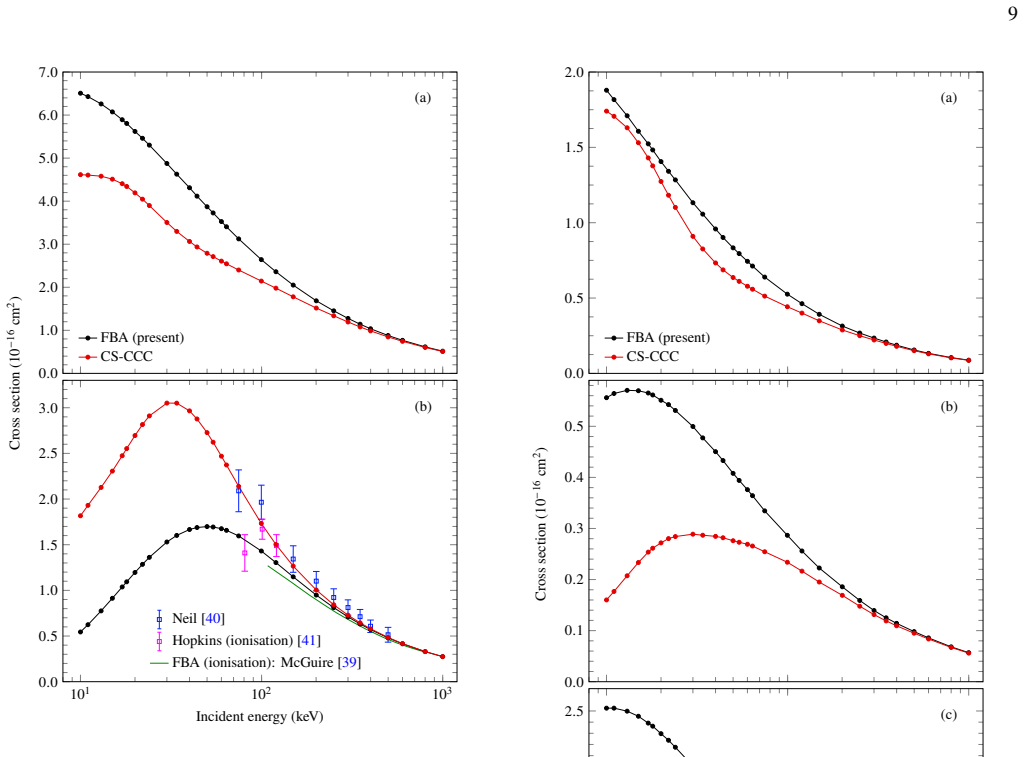
The one-centre Coulomb-Sturmian convergent close-coupling method is applied to proton collisions with the boron atom and singly charged carbon ion using configuration state functions constructed via the method of coefficients of fractional parentage. Cross sections for total and state-selective target excitation and electron loss are obtained from 10 keV to 1 MeV. For both systems the total excitation cross section is dominated by excitation of the 2s subshell. The present calculation for the electron-loss cross section in p + C+ collisions is in good agreement with the available measurements across the entire overlapping incident-energy range.
What carries the argument
The one-centre Coulomb-Sturmian convergent close-coupling method with configuration interaction target models assessed by excitation energies, oscillator strengths, and dipole polarisabilities.
If this is right
- The total excitation cross section is dominated by 2s subshell excitation for both the boron atom and the C+ ion.
- A multi-electron description of the target is required for reliable scattering calculations of these processes.
- State-selective excitation cross sections are obtained alongside the totals.
- Electron-loss cross sections for p + C+ reproduce the measured values throughout the overlapping energy range.
Where Pith is reading between the lines
- The reported dominance of 2s excitation implies that single-electron or valence-only models may systematically undercount total excitation in similar low-Z collisions.
- Agreement for the C+ case indicates the method can be applied to predict cross sections for other light atoms and ions where experimental data are sparse.
Load-bearing premise
The configuration interaction structure models, validated through excitation energies, oscillator strengths, and dipole polarisabilities, are accurate enough to make the scattering calculations reliable.
What would settle it
A new experimental measurement of the electron-loss cross section for p + C+ collisions at any energy between 10 keV and 1 MeV that deviates substantially from the calculated curve would falsify the reported agreement.
Figures


read the original abstract
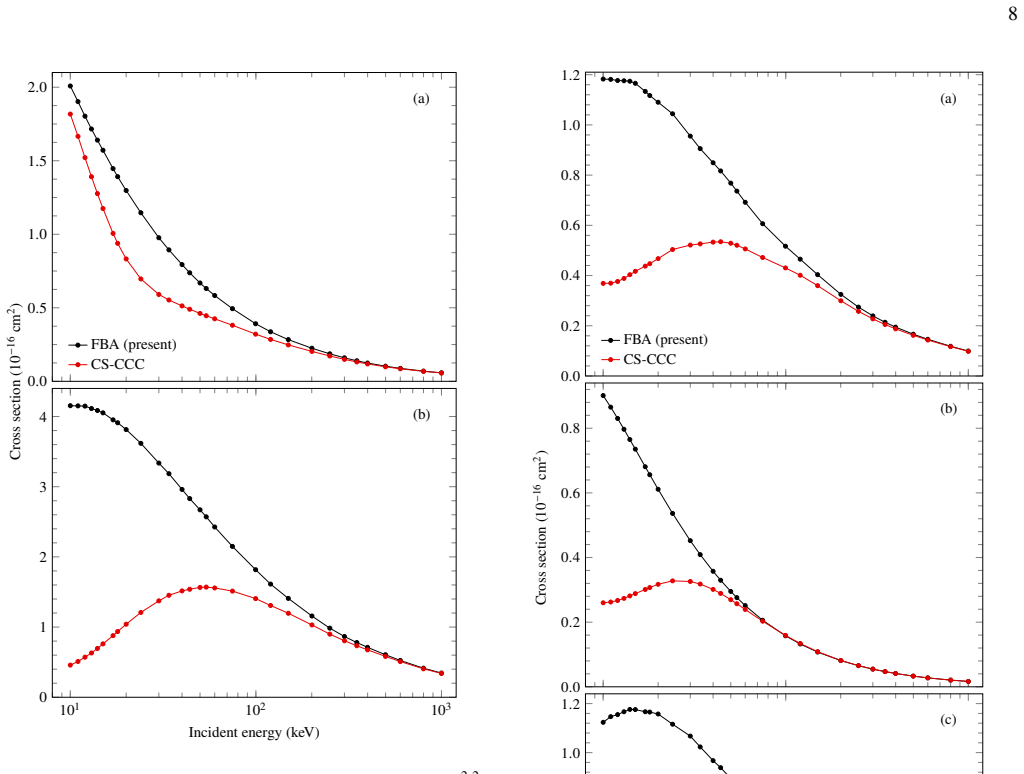
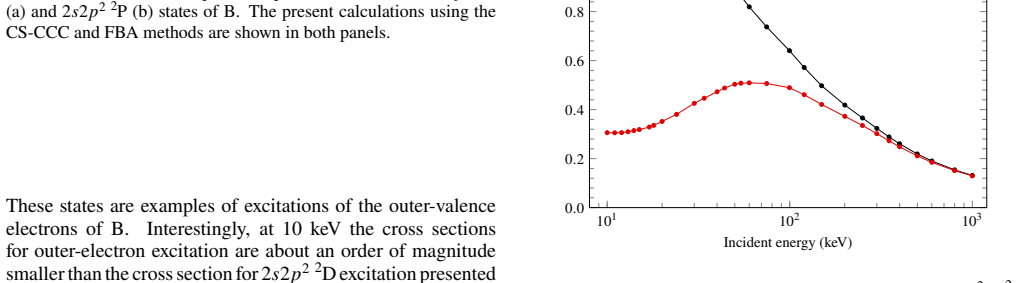
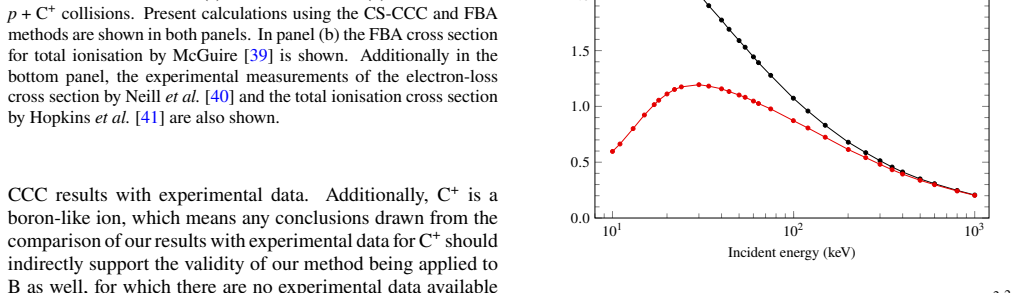
The one-centre Coulomb-Sturmian convergent close-coupling method is applied to proton collisions with the boron atom and singly charged carbon ion. Here we report an update to our target-structure implementation, in which configuration state functions are constructed using the method of coefficients of fractional parentage. To assess the quality of the structure models for the two targets, we present the excitation energies, oscillator strengths, and dipole polarisabilities obtained from the present configuration interaction calculations. Cross sections for total and state-selective target excitation and electron loss are calculated from 10 keV to 1 MeV. For both systems, the total excitation cross section is found to be dominated by excitation of the $2s$ subshell. This emphasises the importance of a multi-electron description of the target in such scattering calculations. Comparisons with previous theoretical and experimental data are presented and discussed. In particular, we find that the present calculation for the electron-loss cross section in $p$ + C$^{+}$ collisions is in good agreement with the available measurements across the entire overlapping incident-energy range.
Editorial analysis
A structured set of objections, weighed in public.
Referee Report
Summary. The manuscript applies the one-centre Coulomb-Sturmian convergent close-coupling method to proton collisions with neutral boron and C+ ions over 10 keV–1 MeV. It updates the target-structure implementation by constructing configuration state functions via coefficients of fractional parentage, presents excitation energies, oscillator strengths and dipole polarisabilities as quality diagnostics for the CI models, computes total and state-selective target excitation plus electron-loss cross sections, finds that 2s-subshell excitation dominates the total excitation for both targets, and reports that the calculated electron-loss cross section for p + C+ agrees well with available measurements across the full overlapping energy range.
Significance. If the structure models prove sufficiently accurate and the close-coupling expansions are converged, the work supplies new multi-electron theoretical data for keV proton–atom/ion collisions and underscores the necessity of treating the target beyond a single-electron approximation. The reported agreement with experiment for the C+ electron-loss channel, obtained without fitted parameters, would constitute a useful benchmark for applications in fusion-edge plasmas and astrophysical environments.
major comments (2)
- [Target structure assessment] Target-structure assessment (abstract and the section presenting CI results): excitation energies, oscillator strengths and dipole polarisabilities are tabulated, yet no remaining error estimates, basis-set convergence data, or sensitivity tests are provided showing how discrepancies in these quantities propagate into the state-selective or total electron-loss cross sections. Because the manuscript states that total excitation (and therefore the loss channels) is dominated by 2s-subshell processes, even modest wave-function errors could shift the cross sections by amounts comparable to experimental uncertainties, undermining the central claim of good agreement with measured electron-loss data for p + C+.
- [Cross-section results] Scattering calculations (results section on cross sections): the manuscript does not report the number of target states retained, the partial-wave convergence, or any test of the one-centre approximation’s adequacy for the electron-loss channel at the lowest energies (10 keV). These details are load-bearing for the quantitative comparison with experiment.
minor comments (2)
- [Abstract] The abstract and introduction would benefit from a brief statement of the maximum number of target states and the largest partial wave included in the CCC expansion.
- [Figures] Figure captions for the cross-section plots should explicitly state whether the curves include only direct excitation or also account for cascade contributions.
Simulated Author's Rebuttal
We thank the referee for the careful and constructive review of our manuscript. The comments highlight important aspects of validation that will improve the clarity and robustness of the presented results. We address each major comment below and will incorporate the suggested additions in the revised version.
read point-by-point responses
-
Referee: [Target structure assessment] Target-structure assessment (abstract and the section presenting CI results): excitation energies, oscillator strengths and dipole polarisabilities are tabulated, yet no remaining error estimates, basis-set convergence data, or sensitivity tests are provided showing how discrepancies in these quantities propagate into the state-selective or total electron-loss cross sections. Because the manuscript states that total excitation (and therefore the loss channels) is dominated by 2s-subshell processes, even modest wave-function errors could shift the cross sections by amounts comparable to experimental uncertainties, undermining the central claim of good agreement with measured electron-loss data for p + C+.
Authors: We agree that explicit quantification of remaining uncertainties in the target structure would strengthen the manuscript. The CI models were constructed using coefficients of fractional parentage to ensure proper antisymmetrisation, and the tabulated diagnostics (energies, oscillator strengths, polarisabilities) were chosen because they are directly comparable to experiment and other high-level calculations. While we did not include formal error propagation or sensitivity tests in the original submission, the agreement of these quantities with reference data is generally within a few percent for the dominant transitions. In the revision we will add a brief discussion of basis-set convergence (by comparing results obtained with progressively larger CI expansions) and a simple sensitivity estimate showing that plausible variations in the 2s excitation energies and oscillator strengths do not alter the dominance of the 2s channel or the overall agreement with the measured electron-loss cross section for C+ beyond the experimental uncertainty. revision: yes
-
Referee: [Cross-section results] Scattering calculations (results section on cross sections): the manuscript does not report the number of target states retained, the partial-wave convergence, or any test of the one-centre approximation’s adequacy for the electron-loss channel at the lowest energies (10 keV). These details are load-bearing for the quantitative comparison with experiment.
Authors: We accept that these computational parameters should have been stated explicitly. The close-coupling expansions were chosen to be large enough to achieve convergence for the total and state-selective cross sections over the reported energy range, but the precise number of target states and the maximum partial-wave angular momentum were not tabulated. In the revised manuscript we will report the size of the target-state basis for each system, demonstrate partial-wave convergence by presenting cross sections obtained with increasing L_max, and add a short paragraph addressing the one-centre approximation at 10 keV. The latter will note that the projectile velocity remains high enough that two-centre effects are expected to be small for the electron-loss channel, consistent with our earlier benchmarks on similar systems; if space permits we will also show a limited comparison with a smaller two-centre test calculation. revision: yes
Circularity Check
No significant circularity detected in the derivation or claims
full rationale
The paper applies the one-centre Coulomb-Sturmian convergent close-coupling method to compute cross sections for excitation and electron loss, using configuration-interaction target models constructed via coefficients of fractional parentage. Structure quality is assessed by directly presenting computed excitation energies, oscillator strengths, and dipole polarisabilities; cross sections are then obtained numerically from 10 keV to 1 MeV and compared to independent external measurements. The central claim of agreement for the p+C+ electron-loss cross section rests on these independent calculations rather than any fitted parameter, self-defined quantity, or load-bearing self-citation. No step reduces a reported result to its own inputs by construction, and the structure assessment does not propagate into a forced agreement with experiment.
Axiom & Free-Parameter Ledger
Lean theorems connected to this paper
-
IndisputableMonolith/Foundation/AlexanderDuality.leanalexander_duality_circle_linking unclearconfiguration state functions are constructed using the method of coefficients of fractional parentage... excitation energies, oscillator strengths, and dipole polarisabilities
-
IndisputableMonolith/Cost/FunctionalEquation.leanwashburn_uniqueness_aczel unclearone-centre Coulomb-Sturmian convergent close-coupling method... 16000 pseudostates
Reference graph
Works this paper leans on
-
[1]
Comparedwiththecoupled-clustersingle-double(CCSD) calculationofWanget al.[37],whichgivesavalueof5.77𝑎 3 0, the present result differs by about 1%. B. Convergence tests and numerical parameters As in all convergent close-coupling calculations, we ensure that the cross sections of interest converge to within a few percent with respect to increasing the size...
- [2]
-
[3]
D.Maurin,L.Audouin,E.Berti,P.Coppin,M.DiMauro,P.von Doetinchem,F.Donato,C.Evoli,Y.Génolini,P.Ghosh,I.Leya, M. Losekamm, S. Mariani, J. Norbury, L. Orusa, M. Paniccia, T.Poeschl,P.Serpico,A.Tykhonov,M.Unger,M.Vanstalle,M.- J.Zhao,D.Boncioli,M.Chiosso,D.Giordano,D.GomezCoral, G. Graziani, C. Lucarelli, P. Maestro, M. Mahlein, L. Morejon, J. Ocampo-Peleteiro...
work page 2026
-
[4]
C.Hill,Dipti,K.Heinola,A.Dubois,N.Sisourat,A.Taoutioui, H. Agueny, K. Tőkési, I. Ziaeian, C. Illescas, A. Jorge, L. Méndez, A. Kadyrov, N. Antonio, A. Kotian, T. Kirchner, A. Leung, J. Ko, J. Lee, O. Marchuk, M. O’Mullane, E. Litherland-Smith, G. Pokol, O. Asztalos, P. Balazs, Y. Wu, C. Jia, L. Liu, and J. Wang, Nucl. Fusion63, 125001 (2023)
work page 2023
-
[5]
R.Pitts,A.Loarte,T.Wauters,M.Dubrov,Y.Gribov,F.Köchl, A.Pshenov,Y.Zhang,J.Artola,X.Bonnin,L.Chen,M.Lehnen, K. Schmid, R. Ding, H. Frerichs, R. Futtersack, X. Gong, G. Hagelaar, E. Hodille, J. Hobirk, S. Krat, D. Matveev, K. Paschalidis, J. Qian, S. Ratynskaia, T. Rizzi, V. Rozhansky, P. Tamain, P. Tolias, L. Zhang, and W. Zhang, Nucl. Mater. Energy42, 101...
work page 2025
- [6]
-
[7]
N. Mukherjee, A. Bhattacharyya, and K. Chakrabarti, Phys. Plasma32(2025), 10.1063/5.0279017
-
[8]
A. Bortolon, V. Rohde, R. Maingi, E. Wolfrum, R. Dux, A. Herrmann, R. Lunsford, R. McDermott, A. Nagy, A. Kallenbach, D. Mansfield, R. Nazikian, and R. Neu, Nucl. Mater. Energy19, 384 (2019)
work page 2019
- [9]
- [10]
-
[11]
R. C. Isler, Plasma Phys. Control. Fusion36, 171 (1994)
work page 1994
-
[12]
R. McDermott, R. Dux, F. Guzman, T. Pütterich, R. Fischer, and A. Kappatou, Nucl. Fusion61, 016019 (2021)
work page 2021
-
[13]
H. Anderson, M. G. v. Hellermann, R. Hoekstra, L. D. Horton, A. C. Howman, R. W. T. Konig, R. Martin, R. E. Olson, and H. P. Summers, Plasma Phys. Control. Fusion42, 781 (2000)
work page 2000
- [14]
- [15]
- [16]
-
[17]
J. D. Garcia, Phys. Rev. A1, 280 (1970)
work page 1970
- [18]
-
[19]
W.M.AriyasingheandD.Powers,Phys.Rev.A59,1291(1999)
work page 1999
-
[20]
L. H. Toburen, Phys. Rev. A5, 2482 (1972)
work page 1972
-
[21]
N. Kobayashi, N. Maeda, H. Hori, and M. Sakisaka, J. Phys. Soc. Jpn.40, 1421 (1976)
work page 1976
-
[22]
K. Wang, O. Zatsarinny, and K. Bartschat, Phys. Rev. A93, 052715 (2016)
work page 2016
-
[23]
N. W. Antonio and A. S. Kadyrov, Phys. Rev. A111, 052806 (2025)
work page 2025
-
[24]
N. W. Antonio and A. S. Kadyrov, Phys. Rev. A112, 042816 (2025)
work page 2025
-
[25]
Advanced Micro Devices, Inc.,hipBLAS Documentation (2024), ROCm Version 6.3.0
work page 2024
-
[26]
I. B. Abdurakhmanov, N. W. Antonio, G. A. E., and A. S. Kadyrov, (2026), manuscript in preparation
work page 2026
-
[27]
R. D. Cowan,The Theory of Atomic Structure and Spectra (University of California Press, 1981)
work page 1981
-
[28]
C. F. Fischer, M. Godefroid, T. Brage, P. Jönsson, and G.Gaigalas,J.Phys.B:At.Mol.Opt.Phys.49,182004(2016)
work page 2016
-
[29]
C. F. Fischer, Comput. Phys. Commun.64, 369 (1991)
work page 1991
-
[30]
I. I. Sobelman,Atomic Spectra and Radiative Transitions (Springer Berlin Heidelberg, 1979)
work page 1979
-
[31]
J. N. Reddy,An Introduction to the Finite Element Method (McGraw-Hill, 1993)
work page 1993
- [32]
- [33]
- [34]
-
[35]
C. Froese Fischer, T. Brage, and P. Jönsson,Computational Atomic Structure(Routledge, 2019)
work page 2019
-
[36]
A. Kramida, Yu. Ralchenko, J. Reader, and and NIST ASD Team, NIST Atomic Spectra Database (ver. 5.12), [Online]. Available:https://physics.nist.gov/asd[2025, June 30]. National Institute of Standards and Technology, Gaithersburg, MD. (2024)
work page 2025
- [37]
-
[38]
K. Wang, X. Wang, Z. Fan, H.-Y. Zhao, L. Miao, G.-J. Yin, R. Moro, and L. Ma, Eur. Phys. J. D75(2021), 10.1140/epjd/s10053-021-00054-2
-
[39]
I.B.Abdurakhmanov,C.Plowman,A.S.Kadyrov,I.Bray, and A. M. Mukhamedzhanov, J. Phys. B: At. Mol. Opt. Phys.53, 145201 (2020)
work page 2020
-
[40]
E. J. McGuire, Phys. Rev. A29, 3429 (1984)
work page 1984
-
[41]
P.A.Neill,G.C.Angel,K.F.Dunn, andH.B.Gilbody,J.Phys. B: At. Mol. Phys.16, 2185 (1983)
work page 1983
-
[42]
C. J. Hopkins, M. F. Watts, K. F. Dunn, and H. B. Gilbody, J. Phys. B: At. Mol. Phys.20, 3867 (1987)
work page 1987
-
[43]
J. R. Taylor,Scattering Theory: Quantum Theory on Nonrelativistic Collisions(Wiley, 1972)
work page 1972
-
[44]
B. H. Bransden and M. R. C. McDowell,Charge Exchange and the Theory of Ion-Atom Collisions(Oxford University PressOxford, 1992)
work page 1992
-
[45]
N. W. Antonio, I. Bray, and A. S. Kadyrov, Phys. Rev. A110, 032810 (2024)
work page 2024
-
[46]
I. B. Abdurakhmanov, J. J. Bailey, A. S. Kadyrov, and I. Bray, Phys. Rev. A97, 032707 (2018)
work page 2018
discussion (0)
Sign in with ORCID, Apple, or X to comment. Anyone can read and Pith papers without signing in.