Recognition: 2 theorem links
· Lean TheoremConstruction, commissioning, and beam test of a pilot 3D-projection opaque water-based liquid scintillator detector
Pith reviewed 2026-05-12 05:12 UTC · model grok-4.3
The pith
Pilot opaque water-based scintillator detector confines light below 2 cm scattering length and times proton hits at 0.2 ns
A machine-rendered reading of the paper's core claim, the machinery that carries it, and where it could break.
Core claim
The pilot detector demonstrates that scintillation light in oWbLS is confined with an effective scattering length well below 2 cm, as the measured transverse distributions are narrower than those predicted by a Geant4 model using 2 cm scattering length. Orthogonal fiber planes enable three-dimensional event reconstruction, and proton beam data give a hit-level timing resolution of σ_t ≈ 0.17-0.28 ns with good photostatistics, confirming the viability of the technology for scalable particle detectors.
What carries the argument
Opaque water-based liquid scintillator (oWbLS) medium paired with three orthogonal planes of Kuraray Y11 multi-clad wavelength-shifting fibers read out by multi-pixel photon counters, which together provide optical confinement for 3D projection imaging.
If this is right
- The oWbLS medium supports fully active, scalable detectors without heavy external segmentation.
- Measured confinement below 2 cm enables precise three-dimensional tracking of charged particles.
- Sub-nanosecond timing resolution per channel is compatible with experiments that require event timing and good photostatistics.
- The pilot design validates the readout electronics and fiber arrangement for use at multiple proton energies.
Where Pith is reading between the lines
- This confinement approach could reduce the need for dense external shielding in compact detector systems.
- The timing performance suggests the technology may suit high-rate environments if fiber density is increased.
- Optimization of oWbLS opacity or fiber spacing could further improve position resolution in follow-on prototypes.
Load-bearing premise
The Geant4 simulation with a fixed 2 cm scattering length correctly captures light propagation in this oWbLS formulation without unmodeled contributions from the fibers or vessel walls.
What would settle it
A direct laboratory measurement of the scattering length in a sample of the same oWbLS, or construction of a larger detector in which light would visibly leak if the scattering length exceeded 2 cm.
Figures



read the original abstract
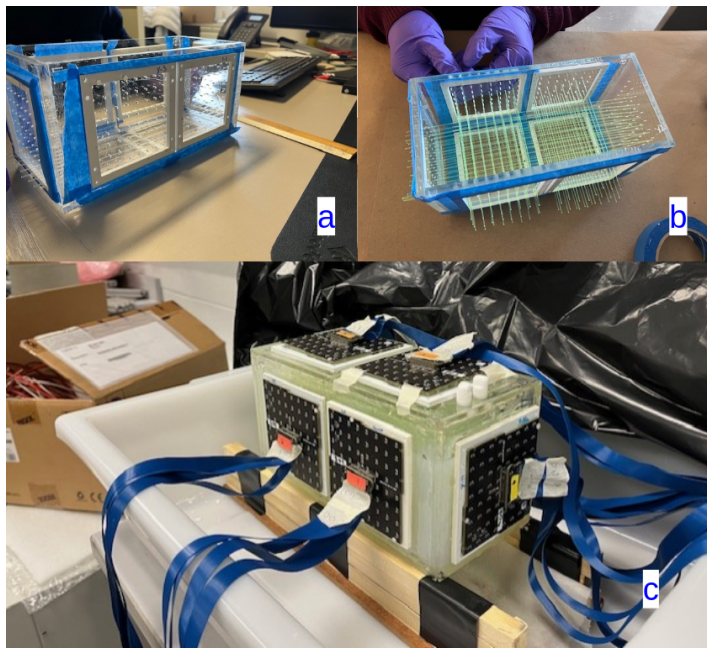
We report on the design, construction, and beam test of a pilot three-dimensional projection detector based on opaque water-based liquid scintillator (oWbLS). The detector consists of an $8 \times 8 \times 16$ cm$^3$ acrylic vessel instrumented with three orthogonal planes of Kuraray Y11 multi-clad wavelength-shifting fibers read out by Hamamatsu multi-pixel photon counters. The readout electronics are based on the CITIROC front-end boards developed for the WAGASCI and SuperFGD detectors of the T2K experiment. The detector was filled with oWbLS and tested with cosmic rays and proton beams of 50, 100, 250, and 500 MeV kinetic energy at the NASA Space Radiation Laboratory at Brookhaven National Laboratory. We present three-dimensional event displays of cosmic muon and proton beam candidates, and a study of transverse light confinement via radial charge distribution measurements. The measured data show tighter light confinement than a Geant4 simulation with a 2 cm scattering length, placing the effective scattering length well below 2 cm and confirming effective optical confinement of scintillation light in the oWbLS medium. A first measurement of the hit-level timing resolution using 500 MeV proton beam data yields a single-channel timing resolution of $\sigma_t \approx 0.17$--$0.28$ ns with good photostatistics. These results demonstrate the viability of the 3D-projection oWbLS technology as a scalable, fully-active detector concept for next-generation particle physics experiments.
Editorial analysis
A structured set of objections, weighed in public.
Referee Report
Summary. The paper reports the design, construction, and beam test of a pilot 3D-projection detector using opaque water-based liquid scintillator (oWbLS) in an 8×8×16 cm³ acrylic vessel instrumented with three orthogonal planes of Kuraray Y11 multi-clad wavelength-shifting fibers read out by Hamamatsu MPPCs and CITIROC electronics. It presents 3D event displays from cosmic-ray muons and 50–500 MeV proton beams at Brookhaven, a radial charge distribution study showing tighter light confinement in data than a Geant4 simulation with 2 cm scattering length (thereby inferring effective scattering length well below 2 cm), and a first hit-level timing resolution measurement of σ_t ≈ 0.17–0.28 ns from the 500 MeV proton data. The authors conclude that these results confirm effective optical confinement and demonstrate the viability of the oWbLS 3D-projection concept for future experiments.
Significance. If the central claims hold, the work supplies direct experimental evidence from proton beam and cosmic-ray tests that oWbLS can achieve strong transverse light confinement and usable timing resolution in a fully active, fiber-readout geometry. This is a concrete step toward scalable, high-granularity detectors for neutrino or rare-event experiments, with the empirical confinement result and timing numbers providing useful benchmarks even if further optimization is needed.
major comments (2)
- [Results section on transverse light confinement and radial distributions] The headline claim that the effective scattering length is well below 2 cm rests on the radial charge distribution in data being narrower than the Geant4 run with a fixed 2 cm scattering length. However, the manuscript provides no quantitative values or references for the optical parameters assigned to the wavelength-shifting fibers (capture efficiency, re-emission spectrum), acrylic vessel diffuse reflection, or photocathode quantum efficiency in that simulation. Without these details or a systematic variation study, it remains possible that under-modeling of fiber or boundary optics produces an artificially broad simulated distribution, weakening the inference about the oWbLS scattering length itself.
- [Timing resolution subsection] The single-channel timing resolution is stated as σ_t ≈ 0.17–0.28 ns from 500 MeV proton beam data, yet the text gives neither the number of events or channels used, visible error bars on the quoted range, nor an explicit description of how the uncertainty was propagated from photostatistics, electronics jitter, or hit selection. This makes it difficult to judge the robustness of the reported interval or to compare it quantitatively with other detectors.
minor comments (2)
- [Abstract and timing results] The abstract and results text refer to “good photostatistics” without quoting a typical number of photoelectrons per hit or per event; adding this metric would strengthen the timing claim.
- [Figure captions] Figure captions for the radial distributions and event displays should explicitly state the number of events or runs averaged and whether any selection cuts were applied beyond the basic beam trigger.
Simulated Author's Rebuttal
We thank the referee for the thorough review and constructive comments on our manuscript. We address each major comment below and agree that clarifications and additional details will strengthen the paper. We will incorporate the requested information in the revised version.
read point-by-point responses
-
Referee: [Results section on transverse light confinement and radial distributions] The headline claim that the effective scattering length is well below 2 cm rests on the radial charge distribution in data being narrower than the Geant4 run with a fixed 2 cm scattering length. However, the manuscript provides no quantitative values or references for the optical parameters assigned to the wavelength-shifting fibers (capture efficiency, re-emission spectrum), acrylic vessel diffuse reflection, or photocathode quantum efficiency in that simulation. Without these details or a systematic variation study, it remains possible that under-modeling of fiber or boundary optics produces an artificially broad simulated distribution, weakening the inference about the oWbLS scattering length itself.
Authors: We agree that the manuscript lacks explicit documentation of the optical parameters used in the Geant4 simulation, which limits the ability to fully evaluate the comparison. In the revised manuscript, we will add a dedicated subsection or table listing all relevant optical parameters, including the capture efficiency and re-emission spectrum for the Kuraray Y11 fibers, the diffuse reflection properties of the acrylic vessel, and the quantum efficiency of the MPPC photocathodes, with references to the sources or measurements used. We will also discuss any assumptions made and note that a full systematic variation study was not performed due to computational constraints, but the parameters are based on standard values from prior T2K-related simulations and manufacturer data. This addition will allow readers to assess the robustness of the scattering-length inference. revision: yes
-
Referee: [Timing resolution subsection] The single-channel timing resolution is stated as σ_t ≈ 0.17–0.28 ns from 500 MeV proton beam data, yet the text gives neither the number of events or channels used, visible error bars on the quoted range, nor an explicit description of how the uncertainty was propagated from photostatistics, electronics jitter, or hit selection. This makes it difficult to judge the robustness of the reported interval or to compare it quantitatively with other detectors.
Authors: We acknowledge that the timing resolution subsection is missing key quantitative details on statistics and uncertainty treatment. In the revised manuscript, we will specify the exact number of events and channels analyzed from the 500 MeV proton data set, include visible error bars on the reported σ_t range, and provide a step-by-step description of the timing extraction method. This will explicitly address contributions from photostatistics (via the number of photoelectrons), electronics jitter (from the CITIROC boards), and hit selection criteria, including how uncertainties were propagated. These additions will enable quantitative comparisons with other detectors. revision: yes
Circularity Check
No circularity; results are direct experimental measurements
full rationale
The paper reports empirical data from cosmic-ray and proton-beam tests, including radial charge distributions and hit-level timing. The comparison of measured light confinement to a Geant4 run with a fixed 2 cm scattering length is an external benchmark, not a derivation that reduces to fitted inputs or self-citation. No equations, ansatzes, or uniqueness theorems are invoked that would make the central claims equivalent to their own assumptions by construction. The timing resolution is extracted directly from 500 MeV proton data without intermediate modeling steps that loop back to the result.
Axiom & Free-Parameter Ledger
axioms (1)
- domain assumption Geant4 simulation with 2 cm scattering length provides a valid baseline for light propagation in this medium
Lean theorems connected to this paper
-
IndisputableMonolith/Foundation/AlexanderDuality.leanalexander_duality_circle_linking unclear?
unclearRelation between the paper passage and the cited Recognition theorem.
three orthogonal planes of Kuraray Y11 multi-clad wavelength-shifting fibers
What do these tags mean?
- matches
- The paper's claim is directly supported by a theorem in the formal canon.
- supports
- The theorem supports part of the paper's argument, but the paper may add assumptions or extra steps.
- extends
- The paper goes beyond the formal theorem; the theorem is a base layer rather than the whole result.
- uses
- The paper appears to rely on the theorem as machinery.
- contradicts
- The paper's claim conflicts with a theorem or certificate in the canon.
- unclear
- Pith found a possible connection, but the passage is too broad, indirect, or ambiguous to say the theorem truly supports the claim.
Reference graph
Works this paper leans on
-
[1]
The Super Fine-Grained Detector for the T2K neutrino oscillation experiment,
S. Abeet al., “The Super Fine-Grained Detector for the T2K neutrino oscillation experiment,” arXiv:2603.14921 [physics.ins-det] (2026). 25
-
[2]
S. Gwon, P. Granger, G. Yanget al., “Neutron detection and application with a novel 3D-projection scintillator tracker in the future long-baseline neutrino oscillation experiments,”Phys. Rev. D107 (2023) 032012, arXiv:2211.17037
-
[3]
A. Agarwal, H. Buddet al., “Total neutron cross-section measurement on CH with a novel 3D-projection scintillator detector,”Phys. Lett. B840(2023) 137843, arXiv:2207.02685
-
[4]
G. Yang, “Neutron beam test with 3D-projection scintillator tracker prototypes for long-baseline neu- trino oscillation experiments,”PoS(PANIC2021)380(2022) 101
work page 2022
-
[5]
K. Abeet al.[T2K Collaboration], “The T2K experiment,”Nucl. Instrum. Meth. A659(2011) 106
work page 2011
-
[6]
B. Abiet al.[DUNE Collaboration], “Deep Underground Neutrino Experiment (DUNE), Far Detector Technical Design Report, Volume I: Introduction to DUNE,”JINST15(2020) T08008
work page 2020
-
[7]
Hyper-Kamiokande Design Report
K. Abeet al.[Hyper-Kamiokande Proto-Collaboration], “Hyper-Kamiokande Design Report,” arXiv:1805.04163 [hep-ex] (2018)
work page Pith review arXiv 2018
-
[8]
Basic Research Needs Study on HEP Detector Research and Development,
DOE Office of Science, “Basic Research Needs Study on HEP Detector Research and Development,” DOI: 10.2172/1659761 (2020)
-
[9]
Neutrino physics with an opaque detector,
A. Cabreraet al., “Neutrino physics with an opaque detector,”Commun. Phys.4(2021) 273
work page 2021
-
[10]
LiquidO: Neutrino detection and imaging in opaque media,
D. Navas-Nicolas, C. Girard-Carillo, S. Schoppmann, “LiquidO: Neutrino detection and imaging in opaque media,” arXiv:2503.11319 [physics.ins-det] (2025)
-
[11]
Evaluation of light collection from highly scattering media using wavelength-shifting fibers,
A.S. Wilhelm, G. Wendel, B. Collins, D.F. Cowen, I. Jovanovic, “Evaluation of light collection from highly scattering media using wavelength-shifting fibers,”Nucl. Instrum. Meth. A1049(2023) 168085, arXiv:2301.09608
-
[12]
X. Xiang, G. Yanget al., “Design, construction, and operation of a 1-ton water-based liquid scintillator detector at Brookhaven National Laboratory,”JINST19(2024) P06033, arXiv:2403.13231
-
[13]
S. Andrade, A. Baldoni, D.F. Cowenet al., “Design, construction, and operation of a 30-ton water- based liquid scintillator detector at Brookhaven National Laboratory,” arXiv:2603.20019 [physics.ins- det] (2026)
-
[14]
Theia: An advanced optical neutrino detector,
M. Askinset al., “Theia: An advanced optical neutrino detector,”Eur. Phys. J. C80(2020) 416, arXiv:1911.03501
- [15]
-
[16]
Baby MIND: A magnetized segmented neutrino detector for the WAGASCI ex- periment,
M. Antonovaet al., “Baby MIND: A magnetized segmented neutrino detector for the WAGASCI ex- periment,”JINST12(2017) C07028, arXiv:1705.10406
-
[17]
Baby MIND experiment construction status,
M. Antonovaet al., “Baby MIND experiment construction status,” arXiv:1704.08917 [physics.ins-det] (2017)
-
[18]
K. Abeet al.[T2K Collaboration], “Measurement of muon neutrino induced charged current interactions without charged pions in the final state using a new T2K off-axis near detector WAGASCI-BabyMIND,” arXiv:2509.07814 [hep-ex] (2025)
-
[19]
CITIROC – Cherenkov Imaging Telescope Integrated Read Out Chip,
Weeroc, “CITIROC – Cherenkov Imaging Telescope Integrated Read Out Chip,”https://www.weeroc. com/products/citiroc. 26
-
[20]
Metal-loaded organic scintillators for neutrino physics,
C. Buck and M. Yeh, “Metal-loaded organic scintillators for neutrino physics,”J. Phys. G: Nucl. Part. Phys.43(2016) 093001
work page 2016
-
[21]
Kuraray Co. Ltd., “Plastic Scintillating Fibers,”https://www.kuraray.com/products/psf
-
[22]
Performance of new Kuraray wavelength-shifting fibers with short decay time,
S. Kodama, H. Kobayashi, W. Okinaga, K. Nakagiri, Y. Nakajima, M. Yokoyama, “Performance of new Kuraray wavelength-shifting fibers with short decay time,” arXiv:2311.07297 [physics.ins-det] (2023)
-
[23]
NASA Space Radiation Laboratory, Brookhaven National Laboratory,https://www.bnl.gov/nsrl/
-
[24]
Characterization of a radiation detector based on opaque water-based liquid scintillator,
J. Apillueloet al.[LiquidO Collaboration], “Characterization of a radiation detector based on opaque water-based liquid scintillator,”Nucl. Instrum. Meth. A1071(2025) 170075, arXiv:2406.13054
-
[25]
S. Agostinelliet al.[Geant4 Collaboration], “Geant4: a simulation toolkit,”Nucl. Instrum. Meth. A 506(2003) 250
work page 2003
-
[26]
ROOT: An object oriented data analysis framework,
R. Brun and F. Rademakers, “ROOT: An object oriented data analysis framework,”Nucl. Instrum. Meth. A389(1997) 81,https://root.cern/
work page 1997
-
[27]
O. Mineevet al., “Beam test results of 3D fine-grained scintillator detector prototype for a T2K ND280 neutrino active target,”Nucl. Instrum. Meth. A923(2019) 134, arXiv:1808.08829
-
[28]
Multi-channel front-end board for SiPM readout,
M. Auger, A. Ereditato, D. Goeldiet al., “Multi-channel front-end board for SiPM readout,” arXiv:1606.02290 [physics.ins-det] (2016)
-
[29]
H. Th. J. Steigeret al., “Development, characterization and production of a novel water-based liquid scintillator based on the surfactant Triton X-100,”JINST19(2024) P09008, arXiv:2405.05743
-
[30]
S. Gwonet al., “Measurement of light yield response of Gd-compatible water-based liquid scintillator with the Brookhaven 1-ton testbed,” arXiv:2512.15968 [physics.ins-det] (2025)
-
[31]
Baby MIND detector first physics run,
S. Parsa, “Baby MIND detector first physics run,” arXiv:2004.05245 [physics.ins-det] (2020)
-
[32]
MPPC (multi-pixel photon counter) S13360 series,
Hamamatsu Photonics K.K., “MPPC (multi-pixel photon counter) S13360 series,”https://www. hamamatsu.com/
-
[33]
R.L. Workmanet al.[Particle Data Group], “Review of Particle Physics,”Prog. Theor. Exp. Phys.2022 (2022) 083C01
work page 2022
-
[34]
A. Hahnet al., “Direct comparison of SiPM and PMT sensor performances in a large-size imaging air Cherenkov telescope,” arXiv:2404.14346 [astro-ph.IM] (2024)
-
[35]
Scintillator ageing of the T2K near detectors from 2010 to 2021,
K. Abeet al.[T2K Collaboration], “Scintillator ageing of the T2K near detectors from 2010 to 2021,” arXiv:2207.12982 [physics.ins-det] (2022)
-
[36]
X. Chenet al., “Burn-in test and thermal performance evaluation of silicon photomultipliers for the JUNO-TAO experiment,” arXiv:2406.12912 [physics.ins-det] (2024)
-
[37]
The detector system of the Daya Bay reactor neutrino experiment,
F.P. Anet al.[Daya Bay Collaboration], “The detector system of the Daya Bay reactor neutrino experiment,”Nucl. Instrum. Meth. A811(2016) 133–161. 27
work page 2016
discussion (0)
Sign in with ORCID, Apple, or X to comment. Anyone can read and Pith papers without signing in.