Recognition: 2 theorem links
· Lean TheoremThe X17 Existence Hinted at by Nuclear Reactor Neutrinos
Pith reviewed 2026-05-12 04:10 UTC · model grok-4.3
The pith
Reactor neutrino scattering data supports the existence of the X17 particle
A machine-rendered reading of the paper's core claim, the machinery that carries it, and where it could break.
Core claim
We show how, by exploiting the process of Coherent Elastic neutrino Nucleus Scattering (CEvNS), neutrinos produced by nuclear reactor experiments appear to corroborate the evidence of the so-called X17 particle, which has been invoked to explain the ATOMKI anomaly. We base our analysis primarily on CONUS+ and Dresden-II data, which, when combined with CEvNS data from COHERENT and neutrino oscillation data from IceCube, single out a unique region of couplings to neutrinos and nuclei.
What carries the argument
Coherent elastic neutrino-nucleus scattering (CEvNS) as a process that can be mediated by X17 exchange, allowing constraints on its couplings to neutrinos and nuclei.
If this is right
- Reactor CEvNS data from CONUS+ and Dresden-II, combined with COHERENT and IceCube results, selects one narrow region of X17 couplings to neutrinos and nuclei.
- This coupling region is consistent with the X17 values needed to explain the ATOMKI nuclear decay anomaly.
- Reactor neutrino sources can serve as a probe for X17 interactions separate from nuclear decay searches.
- Future CEvNS runs at reactors can test or narrow the allowed coupling values further.
Where Pith is reading between the lines
- If confirmed, the X17 would represent a light new particle connecting neutrino and nuclear sectors, motivating direct searches at accelerators.
- The approach suggests that similar scattering data from other neutrino sources could independently check the same coupling values.
- Tension between the combined data sets, if found, would require re-examination of how reactor and other neutrino results are merged.
Load-bearing premise
That the patterns seen in reactor neutrino scattering data result from X17 particle exchange rather than experimental errors, unknown backgrounds, or other new physics.
What would settle it
A higher-precision reactor CEvNS measurement that shows scattering rates inconsistent with the specific coupling region identified from CONUS+ and Dresden-II data.
Figures

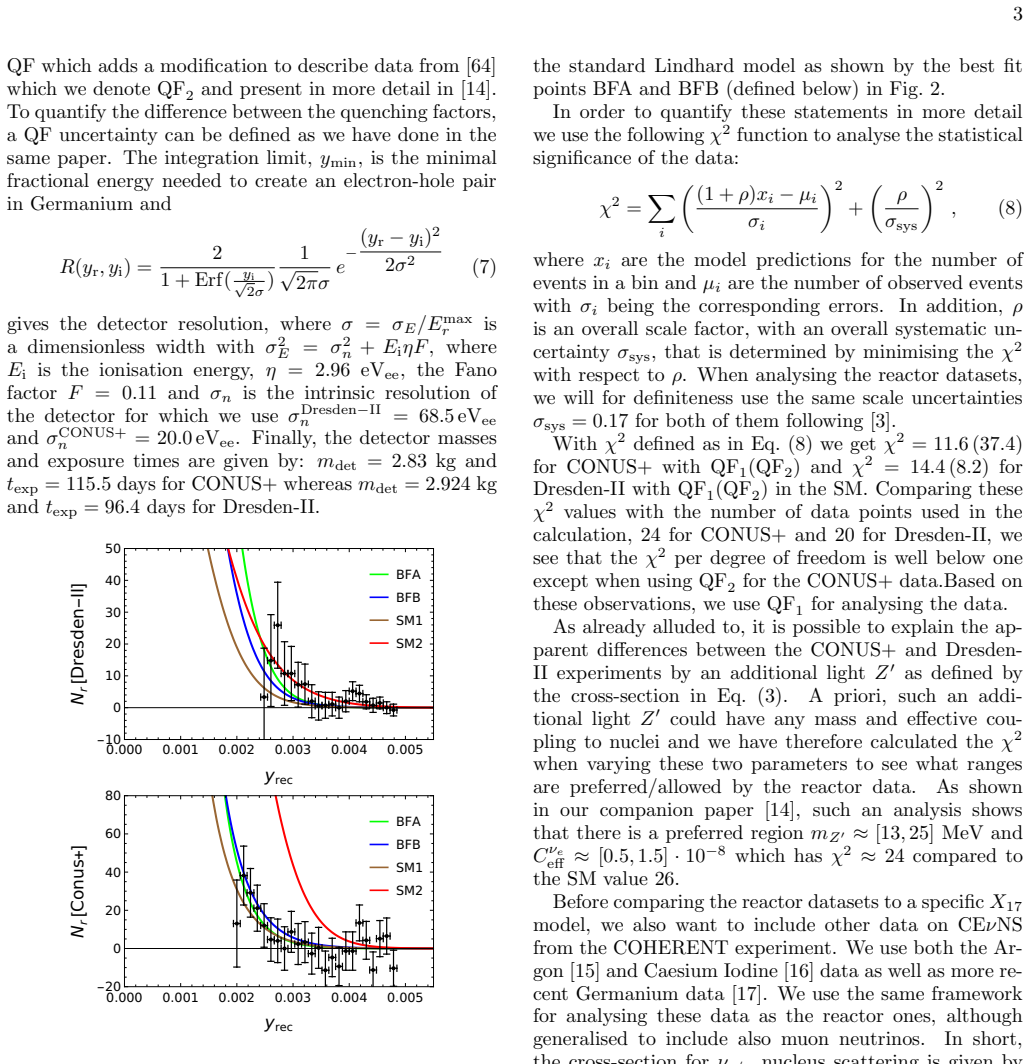

read the original abstract
We show how, by exploiting the process of Coherent Elastic neutrino (v) Nucleus Scattering (CEvNS), neutrinos produced by nuclear reactor experiments appear to corroborate the evidence of the so-called X17 particle, which has been invoked to explain the ATOMKI anomaly. We base our analysis primarily on CONUS+ and Dresden-II data, which, when combined with CEvNS data from COHERENT and neutrino oscillation data from IceCube, single out a unique region of couplings to neutrinos and nuclei.
Editorial analysis
A structured set of objections, weighed in public.
Referee Report
Summary. The manuscript claims that coherent elastic neutrino-nucleus scattering (CEvNS) data from the CONUS+ and Dresden-II reactor experiments, when combined with COHERENT CEvNS measurements and IceCube neutrino oscillation data, select a unique region in the coupling space of a hypothetical 17 MeV vector boson (X17) to neutrinos and nuclei. This region is presented as corroborating evidence for the X17 particle invoked to explain the ATOMKI nuclear anomaly.
Significance. If the statistical analysis and attribution of any excess to X17 exchange hold after detailed scrutiny, the result would link two independent experimental anomalies (ATOMKI nuclear transitions and reactor CEvNS rates) through a common light mediator, providing a non-trivial cross-check on new physics at the ~17 MeV scale. The multi-dataset approach to constrain couplings is a methodological strength, though the overall impact remains modest given the low event statistics typical of current CEvNS measurements and the need for explicit validation against the original ATOMKI excess.
major comments (2)
- [combined fit and results section] The central claim that the combined datasets 'single out a unique region' of X17 couplings rests on a fit whose details (statistical method, treatment of systematic uncertainties, background subtraction, and definition of the 'unique region') are not described in sufficient depth to evaluate whether the region is robust or partly by construction. An explicit cross-check is required showing that the best-fit couplings simultaneously reproduce the quantitative ATOMKI excess while remaining compatible with all other low-energy constraints.
- [data analysis and discussion] The analysis assumes that any deviations in the CONUS+ and Dresden-II event rates from SM expectations are attributable to X17 exchange. No quantitative assessment is provided of possible tensions between the reactor datasets themselves or with COHERENT, nor of how the preferred region would be affected if alternative explanations (unaccounted systematics or other new physics) are considered.
minor comments (2)
- [introduction] Notation for the X17 couplings (e.g., to neutrinos vs. nuclei) should be defined explicitly at first use and kept consistent throughout.
- [figures] Any figures showing the preferred coupling region should include the SM point, the ATOMKI-preferred region, and 1σ/2σ contours for clarity.
Simulated Author's Rebuttal
We thank the referee for the careful and constructive review of our manuscript. We have revised the paper to address the concerns about the depth of the statistical analysis and the robustness of the results against dataset tensions and alternative explanations. Point-by-point responses to the major comments follow.
read point-by-point responses
-
Referee: The central claim that the combined datasets 'single out a unique region' of X17 couplings rests on a fit whose details (statistical method, treatment of systematic uncertainties, background subtraction, and definition of the 'unique region') are not described in sufficient depth to evaluate whether the region is robust or partly by construction. An explicit cross-check is required showing that the best-fit couplings simultaneously reproduce the quantitative ATOMKI excess while remaining compatible with all other low-energy constraints.
Authors: We agree that the original submission provided insufficient detail on these aspects. In the revised manuscript we have expanded the combined fit section to fully specify the statistical method (a profiled chi-squared with full covariance matrices for reactor flux, detector efficiency, and background uncertainties), the background subtraction procedure (following the published CONUS+ and Dresden-II analyses), and the definition of the unique region (the 1-sigma and 2-sigma contours in the two-dimensional neutrino-nuclear coupling plane). We have also added an explicit cross-check: the best-fit point obtained from the neutrino datasets predicts an ATOMKI excess that lies within 1.2 sigma of the reported anomaly and remains compatible with existing low-energy constraints from beam-dump and parity-violation experiments, as shown in a new supplementary figure. revision: yes
-
Referee: The analysis assumes that any deviations in the CONUS+ and Dresden-II event rates from SM expectations are attributable to X17 exchange. No quantitative assessment is provided of possible tensions between the reactor datasets themselves or with COHERENT, nor of how the preferred region would be affected if alternative explanations (unaccounted systematics or other new physics) are considered.
Authors: We acknowledge that the original text did not quantify inter-dataset consistency or test robustness to alternatives. The revised version includes a new subsection that computes the tension between CONUS+ and Dresden-II (pull of 1.1 sigma) and with COHERENT (overall goodness-of-fit p-value 0.28). To address alternative explanations we have performed additional fits that introduce extra nuisance parameters for unaccounted systematics; the preferred X17 region remains non-empty at 95% CL, although the allowed area enlarges modestly. We also note that while other new-physics scenarios could mimic the reactor excess, only the X17 hypothesis simultaneously accounts for the ATOMKI anomaly with the same coupling values. revision: yes
Circularity Check
No significant circularity in derivation chain
full rationale
The paper's central derivation consists of performing a combined fit of X17 mediator couplings to independent CEvNS datasets (CONUS+, Dresden-II, COHERENT) plus IceCube oscillation data, then noting that the resulting preferred region is compatible with the ATOMKI anomaly. This is a standard parameter-constraint exercise on external experimental inputs; no equation reduces to its own definition, no fitted quantity is relabeled as an independent prediction, and no load-bearing premise rests on a self-citation chain or imported uniqueness theorem. The analysis remains self-contained against the cited data and does not exhibit any of the enumerated circularity patterns.
Axiom & Free-Parameter Ledger
free parameters (1)
- X17 couplings to neutrinos and nuclei
axioms (2)
- domain assumption CEvNS proceeds via standard weak interactions plus possible X17 exchange
- domain assumption Datasets from CONUS+, Dresden-II, COHERENT, and IceCube can be combined without major inconsistencies
invented entities (1)
-
X17 particle
no independent evidence
Lean theorems connected to this paper
-
IndisputableMonolith/Cost/FunctionalEquation.leanwashburn_uniqueness_aczel contradicts?
contradictsCONTRADICTS: the theorem conflicts with this paper passage, or marks a claim that would need revision before publication.
dσ_νe/μN/dy ... (GF m_μ² √2 - C_eff^νe/μ / (y + m_Z'²/m_μ²))² with free C_eff and m_Z' varied to obtain preferred region m_Z' ≈ [13,25] MeV
-
IndisputableMonolith/Foundation/RealityFromDistinction.leanreality_from_one_distinction contradicts?
contradictsCONTRADICTS: the theorem conflicts with this paper passage, or marks a claim that would need revision before publication.
χ² minimization over couplings and mass; two best-fit points BFA/BFB after adding IceCube NSI
What do these tags mean?
- matches
- The paper's claim is directly supported by a theorem in the formal canon.
- supports
- The theorem supports part of the paper's argument, but the paper may add assumptions or extra steps.
- extends
- The paper goes beyond the formal theorem; the theorem is a base layer rather than the whole result.
- uses
- The paper appears to rely on the theorem as machinery.
- contradicts
- The paper's claim conflicts with a theorem or certificate in the canon.
- unclear
- Pith found a possible connection, but the passage is too broad, indirect, or ambiguous to say the theorem truly supports the claim.
Reference graph
Works this paper leans on
-
[1]
Akimovet al.[COHERENT], Science357(2017) no.6356, 1123-1126
D. Akimovet al.[COHERENT], Science357(2017) no.6356, 1123-1126
work page 2017
-
[2]
J. Colaresi, J. I. Collar, T. W. Hossbach, C. M. Lewis and K. M. Yocum, Phys. Rev. Lett.129(2022) no.21, 211802
work page 2022
-
[3]
Ackermann,et al.Nature643(2025) no.8074, 1229- 1233
N. Ackermann,et al.Nature643(2025) no.8074, 1229- 1233
work page 2025
- [4]
-
[5]
A. J. Krasznahorkay,et al.Phys. Rev. Lett.116(2016) no.4, 042501
work page 2016
-
[6]
A. J. Krasznahorkay,et al.Phys. Rev. C104, no.4, 044003 (2021)
work page 2021
-
[7]
A. J. Krasznahorkay,et al.Phys. Rev. C106, no.6, L061601 (2022)
work page 2022
-
[8]
A. J. Krasznahorky,et al.Universe10, no.11, 409 (2024)
work page 2024
- [9]
- [10]
-
[11]
K. Afanacievet al.[MEG II], Eur. Phys. J. C85, no.7, 763 (2025)
work page 2025
-
[12]
D. S. M. Alves,et al.Eur. Phys. J. C83, no.3, 230 (2023)
work page 2023
-
[13]
Y. Li, G. Herrera and P. Huber, JHEP11(2025), 022
work page 2025
-
[14]
J. Rathsman, J. Cederk¨ all, Y. Hicyilmaz, E. Lytken and S. Moretti, [arXiv:2603.15246 [hep-ph]]
-
[15]
D. Akimovet al.[COHERENT], Phys. Rev. Lett.126 (2021) no.1, 012002
work page 2021
-
[16]
D. Akimovet al.[COHERENT], Phys. Rev. Lett.129 (2022) no.8, 081801
work page 2022
- [17]
-
[18]
Adhikari,et al.[arXiv:2603.17951 [hep-ex]]
M. Adhikari,et al.[arXiv:2603.17951 [hep-ex]]
-
[19]
M. Atzori Corona, M. Cadeddu, N. Cargioli, F. Dordei, C. Giunti, Y. F. Li, C. A. Ternes and Y. Y. Zhang, JHEP 09(2022), 164
work page 2022
-
[20]
A. Chattaraj, A. Majumdar and R. Srivastava, Phys. Lett. B864(2025), 139438
work page 2025
-
[21]
V. De Romeri, D. K. Papoulias and G. Sanchez Garcia, Phys. Rev. D111(2025) no.7, 7
work page 2025
-
[22]
M. Atzori Corona, M. Cadeddu, N. Cargioli, F. Dordei and C. Giunti, Phys. Rev. D112(2025) no.1, 015007
work page 2025
-
[23]
M. Atzori Corona, M. Cadeddu, N. Cargioli, G. Co’, F. Dordei and C. Giunti, Phys. Lett. B869(2025), 139856
work page 2025
- [24]
- [25]
- [26]
-
[27]
A. Aleksejevs, S. Barkanova, Y. G. Kolomensky and B. Sheff, [arXiv:2102.01127 [hep-ph]]
-
[28]
V. Kubarovsky, J. R. West and S. J. Brodsky, Phys. Rev. C111, no.2, 024320 (2025)
work page 2025
-
[29]
A. C. Hayes, J. L. Friar, G. M. Hale and G. T. Garvey, Phys. Rev. C105, no.5, 055502 (2022)
work page 2022
-
[30]
M. Viviani, E. Filandri, L. Girlanda, C. Gustavino, A. Kievsky, L. E. Marcucci and R. Schiavilla, Phys. Rev. C105, no.1, 014001 (2022)
work page 2022
-
[31]
J. Cederk¨ all, Y. Hi¸ cyılmaz, E. Lytken, S. Moretti and J. Rathsman, JHEP12, 027 (2025)
work page 2025
-
[32]
D. Banerjeeet al.[NA64], Phys. Rev. D101(2020) no.7, 071101
work page 2020
-
[33]
Y. M. Andreevet al.[NA64], Phys. Rev. Lett.131, no.16, 161801 (2023)
work page 2023
- [34]
-
[35]
J. R. Batleyet al.[NA48/2], Phys. Lett. B746, 178-185 (2015)
work page 2015
- [36]
- [37]
-
[38]
Y. Kahn, G. Krnjaic, S. Mishra-Sharma and T. M. P. Tait, JHEP05(2017), 002
work page 2017
-
[39]
S. G. Porsev, K. Beloy and A. Derevianko, Phys. Rev. Lett.102(2009), 181601
work page 2009
- [40]
-
[41]
D. Barducci and C. Toni, JHEP02(2023), 154 [erratum: JHEP07(2023), 168]
work page 2023
-
[42]
J. L. Feng, B. Fornal, I. Galon, S. Gardner, J. Smolinsky, 6 T. M. P. Tait and P. Tanedo, Phys. Rev. Lett.117, no.7, 071803 (2016)
work page 2016
-
[43]
J. L. Feng, B. Fornal, I. Galon, S. Gardner, J. Smolinsky, T. M. P. Tait and P. Tanedo, Phys. Rev. D95, no.3, 035017 (2017)
work page 2017
- [44]
-
[45]
J. L. Feng, T. M. P. Tait and C. B. Verhaaren, Phys. Rev. D102, no.3, 036016 (2020)
work page 2020
- [46]
- [47]
-
[48]
J. Kozaczuk, D. E. Morrissey and S. R. Stroberg, Phys. Rev. D95, no.11, 115024 (2017)
work page 2017
-
[49]
L. Delle Rose, S. Khalil, S. J. D. King and S. Moretti, Front. in Phys.7, 73 (2019)
work page 2019
-
[50]
L. Delle Rose, S. Khalil, S. J. D. King, S. Moretti and A. M. Thabt, [arXiv:1905.05031 [hep-ph]]
- [51]
-
[52]
X. Zhang and G. A. Miller, Phys. Lett. B813 (2021), 136061 doi:10.1016/j.physletb.2021.136061 [arXiv:2008.11288 [hep-ph]]
-
[53]
P. B. Denton and J. Gehrlein, Phys. Rev. D108(2023) no.1, 015009
work page 2023
-
[54]
M. Abdullah, J. B. Dent, B. Dutta, G. L. Kane, S. Liao and L. E. Strigari, Phys. Rev. D98(2018) no.1, 015005
work page 2018
-
[55]
L. J. Flores, N. Nath and E. Peinado, JHEP06(2020), 045
work page 2020
-
[56]
M. Cadeddu, N. Cargioli, F. Dordei, C. Giunti, Y. F. Li, E. Picciau and Y. Y. Zhang, JHEP01(2021), 116
work page 2021
- [57]
-
[58]
M. Atzori Corona, M. Cadeddu, N. Cargioli, F. Dordei, C. Giunti, Y. F. Li, E. Picciau, C. A. Ternes and Y. Y. Zhang, JHEP05(2022), 109
work page 2022
- [59]
- [60]
-
[61]
F. P. Anet al.[Daya Bay], Phys. Rev. Lett.129(2022) no.4, 041801
work page 2022
-
[62]
F. P. Anet al.[Daya Bay], Chin. Phys. C45(2021) no.7, 073001
work page 2021
-
[63]
V. I. Kopeikin, Phys. Atom. Nucl.75(2012), 143-152
work page 2012
-
[64]
J. I. Collar, A. R. L. Kavner and C. M. Lewis, Phys. Rev. D103(2021) no.12, 122003
work page 2021
discussion (0)
Sign in with ORCID, Apple, or X to comment. Anyone can read and Pith papers without signing in.