Recognition: 1 theorem link
· Lean TheoremFreestanding GdBa2Cu3O7 Thin Films via Optimized Buffer Layer Design: Preserving Superconducting Properties
Pith reviewed 2026-05-12 04:36 UTC · model grok-4.3
The pith
A LaAlO3/SrTiO3 bilayer buffer preserves 92 K superconductivity in freestanding GdBCO thin films after lift-off.
A machine-rendered reading of the paper's core claim, the machinery that carries it, and where it could break.
Core claim
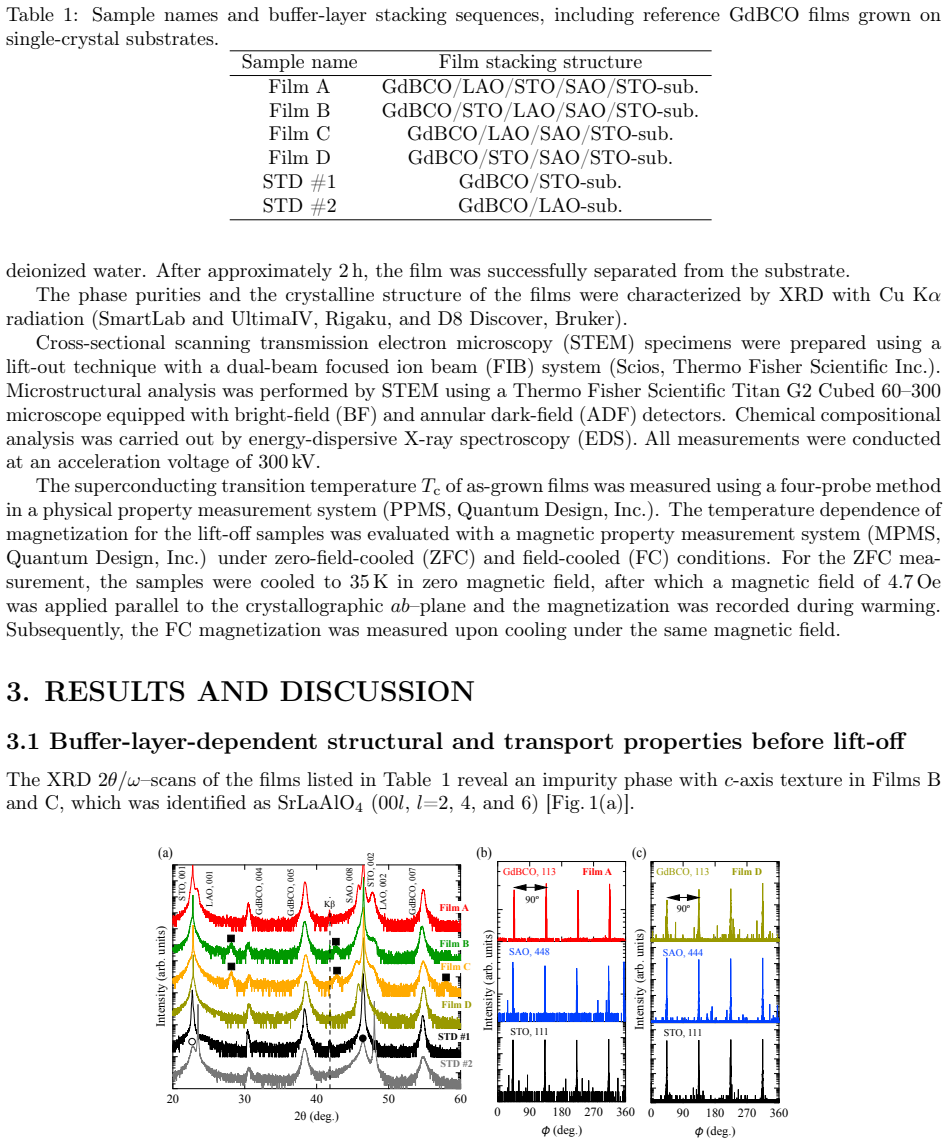
Freestanding GdBa2Cu3O7 thin films were fabricated using a water-soluble Sr3Al2O6 sacrificial layer in combination with thermal release tape. An amorphous Al2O3 capping layer was introduced to suppress crack formation during the lift-off process. Systematic investigation showed that a LaAlO3/SrTiO3 bilayer buffer between the GdBCO and SAO is essential for maintaining epitaxial growth and a superconducting transition temperature of approximately 92 K after lift-off, comparable to as-grown films, whereas a reversed SrTiO3/LaAlO3 bilayer and single-layer buffers suppress Tc.
What carries the argument
The LaAlO3/SrTiO3 bilayer buffer inserted between the GdBCO film and the SAO sacrificial layer, where the specific stacking sequence preserves epitaxial integrity and the 92 K superconducting transition during lift-off.
If this is right
- Buffer-layer optimization is required to obtain high-quality freestanding GdBCO films that retain their superconducting characteristics.
- Reversed bilayer or single-layer buffers between GdBCO and SAO result in suppressed Tc after lift-off.
- The successful LaAlO3/SrTiO3 sequence enables transfer of epitaxial GdBCO while preserving Tc near 92 K.
- This buffer design approach supports realization of transferable superconducting films for device applications.
Where Pith is reading between the lines
- The same stacking-sequence principle may apply to other cuprate superconductors when preparing freestanding films.
- Freestanding GdBCO could be placed on arbitrary substrates to study interface or strain effects without the original lattice constraint.
- Transferable high-Tc films open routes to hybrid devices combining superconductivity with flexible or dissimilar materials.
Load-bearing premise
That observed differences in Tc after lift-off arise primarily from buffer stacking sequence rather than uncontrolled variations in deposition, oxygen annealing, or measurement conditions across samples.
What would settle it
Fabricate and measure Tc on matched sets of GdBCO films that differ only in buffer stacking sequence while all other growth, annealing, and characterization steps are held identical.
Figures


read the original abstract
Freestanding GdBa2Cu3O7 (GdBCO) superconducting thin films were fabricated using a water-soluble Sr3Al2O6 (SAO) sacrificial layer in combination with thermal release tape. An amorphous Al2O3 capping layer was introduced to suppress crack formation during the lift-off process. The influence of buffer-layer design inserted between the GdBCO and SAO layers was systematically investigated with respect to structural integrity and superconducting properties after lift-off. A LaAlO3/SrTiO3 bilayer buffer was found to be essential for maintaining epitaxial growth and a superconducting transition temperature (Tc) of approximately 92 K after lift-off, comparable to that of the as-grown films. In contrast, a reversed SrTiO3/LaAlO3 bilayer and single-layer buffer structures led to a suppression of Tc, highlighting the critical role of stacking sequence. These results demonstrate that optimization of the buffer-layer design is a key factor for realizing high-quality freestanding GdBCO films while maintaining their superconducting characteristics.
Editorial analysis
A structured set of objections, weighed in public.
Referee Report
Summary. The manuscript describes the fabrication of freestanding GdBa2Cu3O7 (GdBCO) thin films using a water-soluble Sr3Al2O6 (SAO) sacrificial layer, thermal release tape, and an amorphous Al2O3 capping layer to suppress cracking. It systematically investigates buffer-layer designs inserted between GdBCO and SAO, concluding that a LaAlO3/SrTiO3 bilayer is essential for preserving epitaxial growth and a superconducting transition temperature (Tc) of approximately 92 K after lift-off, comparable to as-grown films, whereas a reversed SrTiO3/LaAlO3 bilayer or single-layer buffers lead to Tc suppression.
Significance. If the central comparison holds under controlled conditions, the work provides a practical demonstration that buffer stacking sequence can enable high-quality freestanding GdBCO films with intact superconducting properties. This could support development of flexible or transferable superconducting structures, offering a concrete optimization strategy for lift-off processes in cuprate systems.
major comments (1)
- [Abstract] Abstract: The claim that the LaAlO3/SrTiO3 bilayer is essential for maintaining Tc ~92 K (in contrast to reversed or single-layer buffers) is load-bearing, yet the text provides no indication that all buffer variants were prepared in the same deposition run or subjected to identical post-growth oxygen annealing. Without such controls, the attribution of Tc differences to stacking sequence alone cannot be distinguished from possible batch-to-batch variations in growth parameters or annealing.
minor comments (2)
- [Abstract] Abstract: No error bars, standard deviations, or statistical details accompany the reported Tc values, and there is no reference to raw resistivity data or full structural metrics (e.g., rocking curves, AFM roughness) that would quantify the claimed preservation of epitaxial quality.
- [Abstract] Abstract: The phrase 'systematically investigated' is used without citing specific figures, tables, or sections that display the comparative data for the different buffer designs, making it difficult to evaluate the strength of the contrast.
Simulated Author's Rebuttal
We thank the referee for their careful review and for highlighting the importance of explicit experimental controls to support the central claim regarding buffer-layer stacking sequence. We address this point directly below.
read point-by-point responses
-
Referee: [Abstract] Abstract: The claim that the LaAlO3/SrTiO3 bilayer is essential for maintaining Tc ~92 K (in contrast to reversed or single-layer buffers) is load-bearing, yet the text provides no indication that all buffer variants were prepared in the same deposition run or subjected to identical post-growth oxygen annealing. Without such controls, the attribution of Tc differences to stacking sequence alone cannot be distinguished from possible batch-to-batch variations in growth parameters or annealing.
Authors: We agree that the abstract does not explicitly document the controls on deposition run and annealing, which is necessary to isolate the effect of buffer stacking sequence. In the revised manuscript we will add a clarifying sentence to the abstract and expand the methods section to state that all buffer variants (LaAlO3/SrTiO3, SrTiO3/LaAlO3, and single-layer controls) were grown sequentially in the same deposition chamber during a single run and were subjected to identical post-growth oxygen annealing in the same furnace batch. These details were part of the experimental protocol but were not highlighted; making them explicit will remove any ambiguity and strengthen the attribution of Tc differences to the stacking order. revision: yes
Circularity Check
No circularity: purely experimental report with external benchmarks
full rationale
The manuscript is an experimental materials-science study reporting fabrication, lift-off, and characterization of GdBCO films with various buffer stacks. It contains no equations, derivations, fitted parameters presented as predictions, or first-principles claims. All conclusions rest on direct measurements (Tc, structural integrity) compared against as-grown reference films grown under the same nominal conditions. No self-citation chain is invoked to justify a uniqueness theorem or ansatz; the stacking-sequence effect is presented as an empirical observation. The work is therefore self-contained against external benchmarks and exhibits none of the enumerated circularity patterns.
Axiom & Free-Parameter Ledger
axioms (1)
- domain assumption Epitaxial growth of GdBCO requires lattice-matched buffers to maintain c-axis orientation and oxygen content after lift-off.
Lean theorems connected to this paper
-
IndisputableMonolith/Cost/FunctionalEquation.leanwashburn_uniqueness_aczel unclearA LaAlO3/SrTiO3 bilayer buffer was found to be essential for maintaining epitaxial growth and a superconducting transition temperature (Tc) of approximately 92 K after lift-off
Reference graph
Works this paper leans on
-
[1]
M.; Sichel-Tissot, R.; Karapetrova, E.; Stan, L.; Fong, D
Paskiewicz, D. M.; Sichel-Tissot, R.; Karapetrova, E.; Stan, L.; Fong, D. D. Single-crystalline SrRuO _3 nanomembranes: A platform for flexible oxide electronics. Nano Lett. 2016, 16(1), 534--542
work page 2016
-
[2]
Single crystal functional oxides on silicon
Bakaul, S.; Serrao, C.; Lee, M.; Yeung, C.; Sarker, A.; Hsu, S-L.; Yadav, A.; Dedon, L.; You, L.; Khan, A.; et al. Single crystal functional oxides on silicon. Nat. Commun. 2016, 7, 10547
work page 2016
-
[3]
Liu, W.; Wang, H. Flexible oxide epitaxial thin films for wearable electronics: Fabrication, physical properties, and applications. Journal of Materiomics 2020, 6(2), 385--396
work page 2020
-
[4]
Flexible strategy of epitaxial oxide thin films
Huang, J.; Chen, W. Flexible strategy of epitaxial oxide thin films. iScience 2022, 25(10), 105041
work page 2022
-
[5]
Lu, D.; Baek, D.; Hong, S.; Kourkoutis, F. K.; Hikita, Y.; Hwang, H. Y. Synthesis of freestanding single-crystal perovskite films and heterostructures by etching of sacrificial water-soluble layers. Nat. Mater. 2016, 15, 1255--1260
work page 2016
-
[6]
A versatile patterning process based on easily soluble sacrificial bilayers
Harada, T.; Tsukazaki, A. A versatile patterning process based on easily soluble sacrificial bilayers. AIP Adv. 2017, 7(8), 085011
work page 2017
-
[7]
Sacrificial Water-Soluble BaO Layer for Fabricating Free-Standing Piezoelectric Membranes
Takahashi, R; Lippmaa, M. Sacrificial Water-Soluble BaO Layer for Fabricating Free-Standing Piezoelectric Membranes. ACS Appl. Mater. Inter. 2020, 12(22), 25042--25049
work page 2020
-
[8]
H.; Lu, D.; Hong, S.; Li, D.; Kourkoutis, L
Chen, Z.; Wang, B.; Goodge, B. H.; Lu, D.; Hong, S.; Li, D.; Kourkoutis, L. F.;, Hikita, Y.; Hwang, H. Y. Freestanding crystalline YBa _2 Cu _3 O _ 7-x heterostructure membranes. Phys. Rev. Materials 2019, 3(6), 060801(R)
work page 2019
-
[9]
Self-passivated freestanding superconducting oxide film for flexible electronics
Jia, Z.; Tang, C.; Wu, J.; Li, C.; Xu, W.; Wu, K.; Zhou, D.; Yang, P.; Zeng, S.; Zeng, Z.; et al. Self-passivated freestanding superconducting oxide film for flexible electronics. Appl. Phys. Rev. 2023, 10(3), 031401
work page 2023
-
[10]
Xie, Z.; Li, Z.; Lu, H.; Wang, Y.; Liu, Y. Etching Sr _3 Al _2 O _6 sacrificial layer to prepare freestanding GBCO films with high critical current density. Ceram. Int. 2021, 47(10), 13528--13532
work page 2021
-
[11]
Freestanding single-crystal superconducting electron-doped cuprate membrane
Sandik, S.; Elshalem, B-C.; Azulay, A.; Waisbort, M.; Kohn, A.; Kalisky, B.; Dagan, Y. Freestanding single-crystal superconducting electron-doped cuprate membrane. Phys. Rev. Materials 2025, 9(2), L021802
work page 2025
-
[12]
Zhang, J.; Lin, T.; Wang, A.; Wang, X.; He, Q.; Ye, H.; Lu, J.; Wang, Q.; Liang, Z.; Jin, F.; et al. Super-tetragonal Sr _4 Al _2 O _7 as a sacrificial layer for high-integrity freestanding oxide membranes. Science 2024, 383, 388--394
work page 2024
-
[13]
Superconductivity in Freestanding Infinite-Layer Nickelate Membranes
Yan, S.; Mao, W.; Sun, W.; Li, Y.; Sun, H.; Yang, J.; Hao, B.; Guo, W.; Nian, L.; Gu, Z.; et al. Superconductivity in Freestanding Infinite-Layer Nickelate Membranes. Sci. Adv. Mater. 2024, 36(31), 2402916
work page 2024
-
[14]
Yan, M. F,; Barns, R. L.; O’Bryan, Jr. H. M.; Gallagher, P. K.; Sherwood, R. C.; Jin, S. Water interaction with the superconducting YBa _2 Cu _3 O _7 phase. Appl. Phys. Lett. 1987, 51(7), 532--534
work page 1987
-
[15]
Baek, D. J.; Lu. D,; Hikita, Y.; Hwang, H. Y.; Kourkoutis, L. F. Ultrathin Epitaxial Barrier Layer to Avoid Thermally Induced Phase Transformation in Oxide Heterostructures. ACS Appl. Mater. Interfaces 2017, 9(1), 54--59
work page 2017
-
[16]
Connell, J. G.; Isaac, B. J.; Ekanayake, G. B.; Strachan, D. R.; Seo, S. S. A. Preparation of atomically flat SrTiO _3 surfaces using a deionized-water leaching and thermal annealing procedure. Appl. Phys. Lett. 2012, 101(25), 251607
work page 2012
-
[17]
Gong, L.; Wei, M.; Yu, R.; Ohta, H.; Katayama, T. Significant Suppression of Cracks in Freestanding Perovskite Oxide Flexible Sheets Using a Capping Oxide Layer. ACS Nano 2022, 16(12), 21013--21019
work page 2022
-
[18]
Crystal Structure of the High T_c Superconductor LnBa _2 Cu _3 O _ 7- (Ln=Sm, Eu and Gd)
Asano, H.; Takita, K.; Katoh, H.; Akinaga, H.; Ishigaki, T.; Nishino, M.; Imai, M.; Masuda, K. Crystal Structure of the High T_c Superconductor LnBa _2 Cu _3 O _ 7- (Ln=Sm, Eu and Gd). Jpn. J. Appl. Phys. 1987, 26, L1410--1412
work page 1987
-
[19]
Y.; Fumagalli, R.; Braicovich, L.; Castro, C
Seibold, G.; Arpaia, R.; Peng, Y. Y.; Fumagalli, R.; Braicovich, L.; Castro, C. D.; Grilli, M.; Ghiringhelli, G. C.; Caprara, S. Strange metal behaviour from charge density fluctuations in cuprates. Commun. Phys. 2021, 4, 7
work page 2021
-
[20]
A.; Hellerbrand, B.; Steger, P
Gunasekaran, R. A.; Hellerbrand, B.; Steger, P. L. Crystal structure, oxygen stoichiometry and superconducting properties of GdBa _ 2-x Sr _x Cu _3 O _ 7- (0.0 x 1.6). Physica C 1996, 270(1--2), 25--34
work page 1996
discussion (0)
Sign in with ORCID, Apple, or X to comment. Anyone can read and Pith papers without signing in.