Recognition: no theorem link
Quantum Differential Equation Solver via Hybrid Oscillator-Qubit Linear Combination of Hamiltonian Simulations
Pith reviewed 2026-05-12 05:19 UTC · model grok-4.3
The pith
Hybrid oscillator-qubit LCHS solves linear ODEs without ancilla-qubit overhead
A machine-rendered reading of the paper's core claim, the machinery that carries it, and where it could break.
Core claim
By representing the LCHS integration kernel as a finite squeezed-Fock state in an ancillary oscillator, the hybrid oscillator-qubit method eliminates the explicit logarithmic ancilla-qubit overhead of discrete-variable LCHS, achieves superalgebraic convergence for Schwartz-class kernels, and attains at least 99.90 percent solution fidelity on heat-equation benchmarks with reduced circuit cost.
What carries the argument
The finite squeezed-Fock kernel state of stellar rank N-1 that encodes the LCHS quadrature in a continuous-variable ancillary mode.
If this is right
- The ancilla qubit count no longer scales logarithmically with the number of quadrature points M_a.
- Explicit product-formula bounds are obtained that incorporate the truncated position-operator norm.
- An epsilon-close implementation of the ideal oracle perturbs the postselection probability by only O(epsilon).
- End-to-end solution fidelity reaches at least 99.90 percent on heat-equation benchmarks with a substantially more compact oracle description than matrix-product-state DV LCHS.
Where Pith is reading between the lines
- If squeezed-Fock state preparation overhead stays modest, hybrid CV-DV platforms could become preferable for large ODE problems where qubit count is the dominant constraint.
- The stellar rank N-1 supplies a concrete discrete measure of non-Gaussian resource that could be used to compare hybrid constructions against pure qubit or pure CV alternatives.
- The same kernel-encoding technique may extend directly to other linear time-dependent ODEs by changing only the Hamiltonian terms inside the product formula.
Load-bearing premise
The finite squeezed-Fock kernel state with stellar rank N-1 can be prepared with acceptable overhead and the product-formula Trotter steps remain practical once position-operator norm truncation is taken into account.
What would settle it
Prepare the finite squeezed-Fock state for successive cutoffs N on a hybrid device, run the LCHS oracle for a fixed heat-equation instance, and check whether the observed truncation error follows the predicted superalgebraic decay while the total qubit count stays below that of an equivalent discrete-variable implementation.
Figures
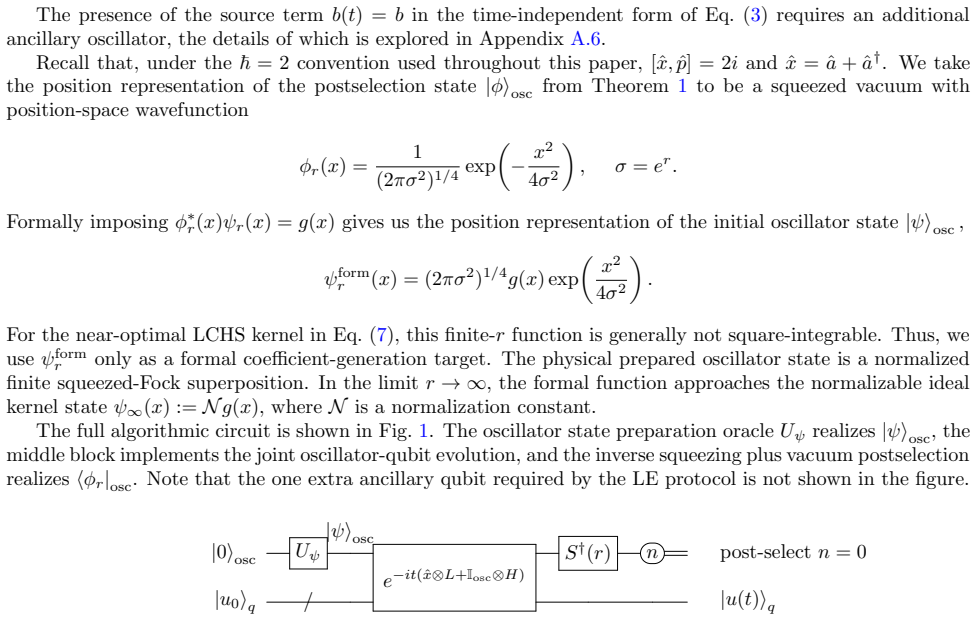


read the original abstract
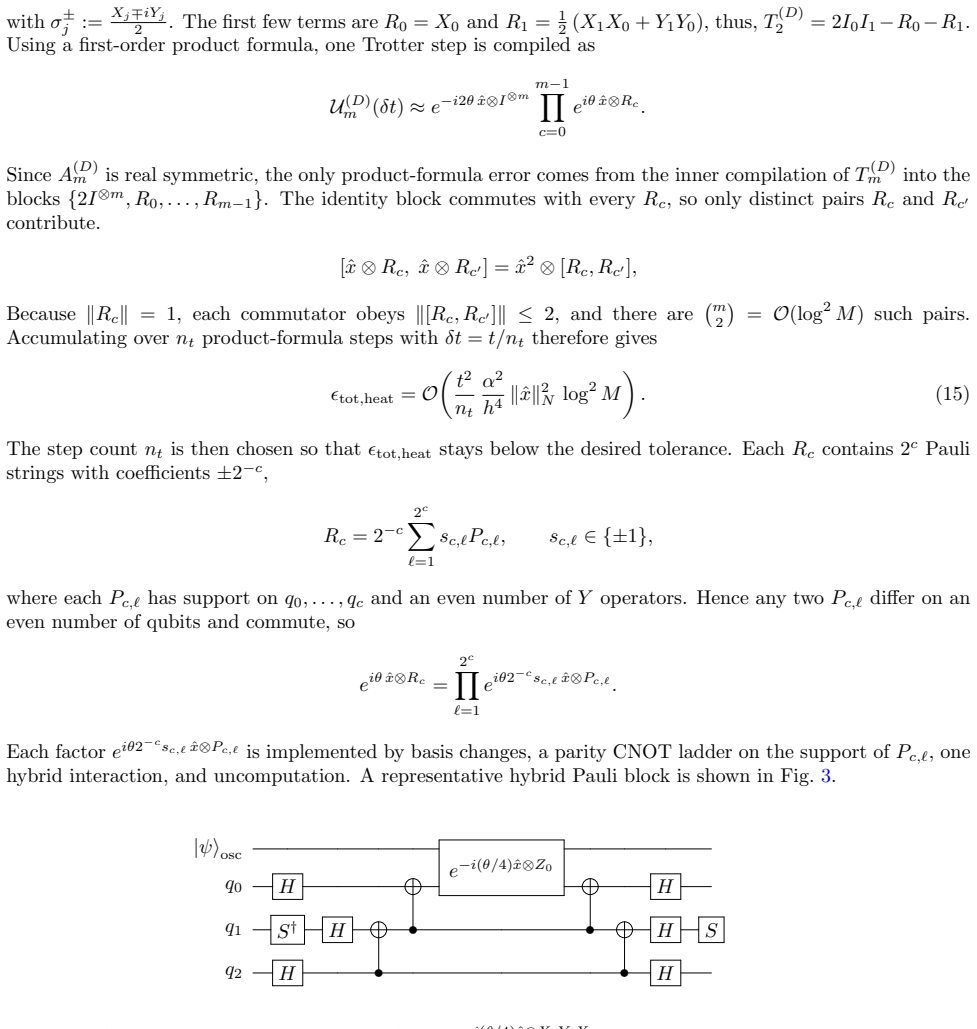
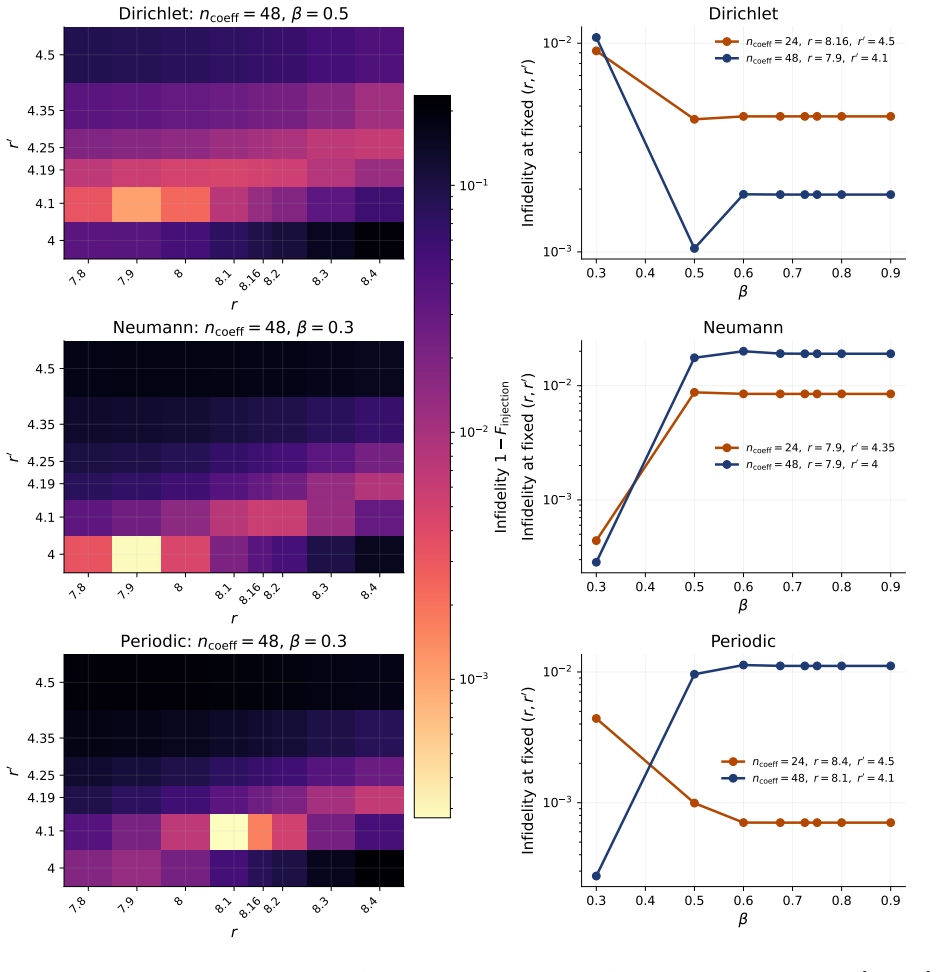
We introduce a hybrid oscillator-qubit formulation of linear combination of Hamiltonian simulation (LCHS) for solving linear ordinary differential equations. Instead of representing the quadrature rule with a discrete-variable (DV) ancilla register in qubit-only LCHS, the method encodes the LCHS kernel in a continuous-variable (CV) ancillary mode, thereby eliminating the explicit $O(\log M_a)$ ancilla-qubit overhead, where $M_a$ is the number of discretized integral terms in the DV quadrature rule. We derive analytical error bounds for two main approximation mechanisms for the ideal kernel state preparation, showing superalgebraic convergence for Schwartz-class kernels in the truncation cutoff $N$. The required CV non-Gaussianity is captured by the finite squeezed-Fock kernel state, which generically has stellar rank $N-1$, identifying the truncation cutoff as a discrete measure of the oracle's non-Gaussian resource. For the hybrid oscillator-qubit evolution, we also obtain a product-formula bound showing that a $p$th-order formula requires $O(t^{1+1/p}(\Gamma_{p,N}/\epsilon_t)^{1/p})$ Trotter steps to reach error $\epsilon_t$, where $\Gamma_{p,N}$ collects Pauli commutator terms weighted by powers of the truncated position-operator norm $\|\hat{x}\|_N$. We further derive a perturbation bound for the probability of obtaining the required oscillator measurement outcome, showing that an $\epsilon$-close implementation of the ideal LCHS oracle in operator norm induces only an $O(\epsilon)$ perturbation in the postselection probability. In the heat-equation benchmarks, the Law--Eberly protocol achieves end-to-end solution fidelity at least 99.90%. A comparison with a matrix-product-state-based DV LCHS implementation further shows that, the hybrid construction uses a substantially more compact oracle description with reduce circuit cost.
Editorial analysis
A structured set of objections, weighed in public.
Referee Report
Summary. The manuscript introduces a hybrid oscillator-qubit formulation of linear combination of Hamiltonian simulation (LCHS) for solving linear ODEs. It replaces the discrete-variable ancilla register with a continuous-variable mode to encode the LCHS kernel, eliminating the O(log M_a) ancilla-qubit overhead. Analytical error bounds are provided for kernel preparation showing superalgebraic convergence in truncation cutoff N for Schwartz-class kernels, a product-formula error bound O(t^{1+1/p} (Gamma_{p,N}/eps_t)^{1/p}) for the hybrid evolution, and a perturbation bound on post-selection probability. Benchmarks on the heat equation achieve at least 99.90% fidelity, with a more compact oracle description compared to matrix-product-state DV LCHS.
Significance. If the bounds and resource claims hold, the hybrid LCHS could meaningfully reduce qubit overhead in quantum ODE solvers by leveraging CV modes for quadrature. The explicit analytical error bounds, superalgebraic convergence for Schwartz kernels, and concrete 99.90% benchmark fidelity are strengths. The stellar-rank characterization of non-Gaussianity and the perturbation bound on post-selection are useful contributions. Significance is tempered by the need to confirm that CV truncation does not offset the ancilla savings in total cost.
major comments (2)
- Product-formula bound (abstract and associated derivation): The O(t^{1+1/p} (Gamma_{p,N}/eps_t)^{1/p}) bound incorporates Gamma_{p,N} weighted by powers of the truncated ||x||_N. For the squeezed-Fock states with stellar rank N-1 needed for 99.90% fidelity, ||x||_N typically grows at least as sqrt(N). The manuscript must demonstrate that the resulting Trotter-step count, including state-preparation overhead, remains lower than the eliminated O(log M_a) DV ancilla cost; without this explicit comparison the central resource-efficiency claim is not yet substantiated.
- Heat-equation benchmarks (abstract): The reported end-to-end fidelity of at least 99.90% and 'substantially more compact oracle' are promising, but the comparison to matrix-product-state DV LCHS lacks quantitative gate-count or depth metrics that incorporate the N-dependent truncation and product-formula steps. This data is required to evaluate whether the hybrid construction delivers a net advantage.
Simulated Author's Rebuttal
We thank the referee for the constructive feedback on our manuscript. We address each major comment point by point below and indicate the revisions we will incorporate to strengthen the presentation of resource claims.
read point-by-point responses
-
Referee: Product-formula bound (abstract and associated derivation): The O(t^{1+1/p} (Gamma_{p,N}/eps_t)^{1/p}) bound incorporates Gamma_{p,N} weighted by powers of the truncated ||x||_N. For the squeezed-Fock states with stellar rank N-1 needed for 99.90% fidelity, ||x||_N typically grows at least as sqrt(N). The manuscript must demonstrate that the resulting Trotter-step count, including state-preparation overhead, remains lower than the eliminated O(log M_a) DV ancilla cost; without this explicit comparison the central resource-efficiency claim is not yet substantiated.
Authors: We agree that an explicit end-to-end resource comparison is needed to fully substantiate the net advantage. The superalgebraic convergence established for Schwartz-class kernels permits small N to reach the reported fidelities, limiting the growth of ||x||_N and the resulting Gamma_{p,N} factors. In the revised manuscript we will add a dedicated resource-analysis subsection for the heat-equation benchmark that computes the concrete Trotter-step count (using the derived product-formula bound) together with the state-preparation overhead for the required squeezed-Fock kernel and directly contrasts the total cost against the O(log M_a) ancilla-qubit overhead of the DV implementation. revision: yes
-
Referee: Heat-equation benchmarks (abstract): The reported end-to-end fidelity of at least 99.90% and 'substantially more compact oracle' are promising, but the comparison to matrix-product-state DV LCHS lacks quantitative gate-count or depth metrics that incorporate the N-dependent truncation and product-formula steps. This data is required to evaluate whether the hybrid construction delivers a net advantage.
Authors: We concur that quantitative gate-count and depth metrics would make the advantage clearer. The present comparison emphasizes the elimination of the ancilla register and the compact oracle description, yet it does not yet fold in the N-dependent truncation and Trotter overhead. We will therefore augment the benchmark section with explicit estimates of total gate complexity and circuit depth for both the hybrid and DV approaches at the N that achieves 99.90% fidelity, thereby supplying the requested data. revision: yes
Circularity Check
No circularity in derivation chain; bounds follow from standard truncation and commutator analysis
full rationale
The paper's analytical error bounds for kernel truncation, superalgebraic convergence for Schwartz-class functions, product-formula Trotter estimates, and post-selection perturbation are obtained by applying established operator-norm techniques to the truncated position operator and ideal LCHS oracle. These steps do not reduce to self-definitions, fitted parameters renamed as predictions, or load-bearing self-citations; the stellar-rank identification is a direct consequence of the finite squeezed-Fock construction rather than a tautology. Benchmark fidelities are separate numerical validations. The central resource claim (eliminating explicit DV ancilla overhead) is a direct modeling choice, not a derived prediction that loops back to inputs.
Axiom & Free-Parameter Ledger
free parameters (1)
- N
axioms (1)
- domain assumption Schwartz-class kernels permit superalgebraic convergence under truncation
Reference graph
Works this paper leans on
-
[1]
Dominic W. Berry, Andrew M. Childs, and Robin Kothari. Hamiltonian simulation with nearly optimal dependence on all parameters. In2015 IEEE 56th Annual Symposium on Foundations of Computer Science, page 792–809. IEEE, October 2015
work page 2015
-
[2]
Andrew M. Childs and Nathan Wiebe. Hamiltonian simulation using linear combinations of unitary oper- ations.Quantum Info. Comput., 12(11–12):901–924, November 2012
work page 2012
-
[3]
Dominic W. Berry, Andrew M. Childs, Richard Cleve, Robin Kothari, and Rolando D. Somma. Simulating hamiltonian dynamics with a truncated taylor series.Physical Review Letters, 114(9), March 2015
work page 2015
-
[4]
Dominic W. Berry, Andrew M. Childs, Richard Cleve, Robin Kothari, and Rolando D. Somma. Exponential improvement in precision for simulating sparse hamiltonians. InProceedings of the forty-sixth annual ACM symposium on Theory of computing, STOC ’14, page 283–292. ACM, May 2014
work page 2014
-
[5]
Quantum algorithms and the finite element method.Physical Review A, 93(3), March 2016
Ashley Montanaro and Sam Pallister. Quantum algorithms and the finite element method.Physical Review A, 93(3), March 2016
work page 2016
-
[6]
Childs, Jin-Peng Liu, and Aaron Ostrander
Andrew M. Childs, Jin-Peng Liu, and Aaron Ostrander. High-precision quantum algorithms for partial differential equations.Quantum, 5:574, November 2021. 21
work page 2021
-
[7]
Jin-Peng Liu, Herman Øie Kolden, Hari K. Krovi, Nuno F. Loureiro, Konstantina Trivisa, and Andrew M. Childs. Efficient quantum algorithm for dissipative nonlinear differential equations.Proceedings of the National Academy of Sciences, 118(35):e2026805118, 2021
work page 2021
-
[8]
Quantum simulation of partial differential equations via schr¨ odingerization
Shi Jin, Nana Liu, and Yue Yu. Quantum simulation of partial differential equations via schr¨ odingerization. Physical Review Letters, 133(23), December 2024
work page 2024
-
[9]
Shi Jin, Nana Liu, and Chuwen Ma. On schr¨ odingerization-based quantum algorithms for linear dynamical systems with inhomogeneous terms, 2025
work page 2025
-
[10]
Dong An, Jin-Peng Liu, and Lin Lin. Linear combination of hamiltonian simulation for nonunitary dynamics with optimal state preparation cost.Physical Review Letters, 131(15):150603, 2023
work page 2023
-
[11]
Quantum algorithm for linear non-unitary dynamics with near- optimal dependence on all parameters: D
Dong An, Andrew M Childs, and Lin Lin. Quantum algorithm for linear non-unitary dynamics with near- optimal dependence on all parameters: D. an, am childs, l. lin.Communications in Mathematical Physics, 407(1):19, 2026
work page 2026
-
[12]
Braunstein and Peter van Loock
Samuel L. Braunstein and Peter van Loock. Quantum information with continuous variables.Reviews of Modern Physics, 77(2):513–577, June 2005
work page 2005
-
[13]
Christian Weedbrook, Stefano Pirandola, Ra´ ul Garc´ ıa-Patr´ on, Nicolas J. Cerf, Timothy C. Ralph, Jeffrey H. Shapiro, and Seth Lloyd. Gaussian quantum information.Reviews of Modern Physics, 84(2):621–669, May 2012
work page 2012
-
[14]
Kevin Marshall, Raphael Pooser, George Siopsis, and Christian Weedbrook. Quantum simulation of quan- tum field theory using continuous variables.Physical Review A, 92(6), December 2015
work page 2015
-
[15]
Shi Jin and Nana Liu. Analog quantum simulation of partial differential equations.Quantum Science and Technology, 9(3):035047, June 2024
work page 2024
-
[16]
Yuan Liu, Shraddha Singh, Kevin C. Smith, Eleanor Crane, John M. Martyn, Alec Eickbusch, Alexan- der Schuckert, Richard D. Li, Jasmine Sinanan-Singh, Micheline B. Soley, Takahiro Tsunoda, Isaac L. Chuang, Nathan Wiebe, and Steven M. Girvin. Hybrid oscillator-qubit quantum processors: Instruction set architectures, abstract machine models, and applications...
work page 2026
-
[17]
Matthew Pocrnic, Peter D Johnson, Amara Katabarwa, and Nathan Wiebe. Constant-factor improvements in quantum algorithms for linear differential equations.arXiv preprint arXiv:2506.20760, 2025
-
[18]
Shantanav Chakraborty. Implementing any Linear Combination of Unitaries on Intermediate-term Quan- tum Computers.Quantum, 8:1496, October 2024
work page 2024
-
[19]
Luke Bell, Yan Wang, Kevin C Smith, Yuan Liu, Eugene Dumitrescu, and SM Girvin. Co-designing spectral transformation oracles with hybrid oscillator-qubit quantum processors: From algorithms to compilation. PRX Quantum, 6(4):040359, 2025
work page 2025
-
[20]
Ulysse Chabaud, Damian Markham, and Fr´ ed´ eric Grosshans. Stellar representation of non-gaussian quan- tum states.Physical Review Letters, 124(6), February 2020
work page 2020
-
[21]
Marco G. Genoni, Matteo G. A. Paris, and Konrad Banaszek. Quantifying the non-gaussian character of a quantum state by quantum relative entropy.Phys. Rev. A, 78:060303(R), Dec 2008
work page 2008
-
[22]
Marco G. Genoni and Matteo G. A. Paris. Quantifying non-gaussianity for quantum information.Physical Review A, 82(5), November 2010
work page 2010
-
[23]
Yuki Sato, Ruho Kondo, Ikko Hamamura, Tamiya Onodera, and Naoki Yamamoto. Hamiltonian simulation for hyperbolic partial differential equations by scalable quantum circuits.Phys. Rev. Res., 6:033246, Sep 2024
work page 2024
-
[24]
Hirad Alipanah, Feng Zhang, Yong-Xin Yao, Richard Thompson, Nam Nguyen, Junyu Liu, Peyman Givi, Brian J McDermott, and Juan Jos´ e Mendoza-Arenas. Quantum dynamics simulation of the advection- diffusion equation.Physical Review Research, 7(4):043318, 2025
work page 2025
-
[25]
Arbitrary control of a quantum electromagnetic field.Physical review letters, 76(7):1055, 1996
Chi K Law and Joseph H Eberly. Arbitrary control of a quantum electromagnetic field.Physical review letters, 76(7):1055, 1996. 22
work page 1996
-
[26]
Synthesizing arbitrary quantum states in a superconducting resonator.Nature, 459(7246):546–549, 2009
Max Hofheinz, H Wang, Markus Ansmann, Radoslaw C Bialczak, Erik Lucero, Matthew Neeley, AD O’connell, Daniel Sank, J Wenner, John M Martinis, et al. Synthesizing arbitrary quantum states in a superconducting resonator.Nature, 459(7246):546–549, 2009
work page 2009
-
[27]
Cavity state manipulation using photon-number selective phase gates
Reinier W Heeres, Brian Vlastakis, Eric Holland, Stefan Krastanov, Victor V Albert, Luigi Frunzio, Liang Jiang, and Robert J Schoelkopf. Cavity state manipulation using photon-number selective phase gates. Physical review letters, 115(13):137002, 2015
work page 2015
-
[28]
Albert, Chao Shen, Chang-Ling Zou, Reinier W
Stefan Krastanov, Victor V. Albert, Chao Shen, Chang-Ling Zou, Reinier W. Heeres, Brian Vlastakis, Robert J. Schoelkopf, and Liang Jiang. Universal control of an oscillator with dispersive coupling to a qubit.Phys. Rev. A, 92:040303, Oct 2015
work page 2015
-
[29]
Timothy J Stavenger, Eleanor Crane, Kevin C Smith, Christopher T Kang, Steven M Girvin, and Nathan Wiebe. C2qa - bosonic qiskit. In2022 IEEE High Performance Extreme Computing Conference (HPEC), pages 1–8, 2022
work page 2022
-
[30]
Stavenger, Eleanor Crane, Kevin C
Timothy J. Stavenger, Eleanor Crane, Kevin C. Smith, Christopher T. Kang, Steven M. Girvin, Nathan Wiebe, et al. Bosonic-Qiskit: Extension of Qiskit to support hybrid boson-qubit simulations.https: //github.com/C2QA/bosonic-qiskit, 2022. C2QA project
work page 2022
-
[31]
Efficient cavity control with snap gates.arXiv preprint arXiv:2004.14256, 2020
Thomas F¨ osel, Stefan Krastanov, Florian Marquardt, and Liang Jiang. Efficient cavity control with snap gates.arXiv preprint arXiv:2004.14256, 2020
-
[32]
Thol´ en, Riccardo Borgani, David B
Marina Kudra, Mikael Kervinen, Ingrid Strandberg, Shahnawaz Ahmed, Marco Scigliuzzo, Amr Osman, Daniel P´ erez Lozano, Mats O. Thol´ en, Riccardo Borgani, David B. Haviland, Giulia Ferrini, Jonas Bylan- der, Anton Frisk Kockum, Fernando Quijandr´ ıa, Per Delsing, and Simone Gasparinetti. Robust preparation of wigner-negative states with optimized snap-dis...
work page 2022
-
[33]
Simulating electronic structure on bosonic quantum computers.J
Rishab Dutta, Nam P Vu, Chuzhi Xu, Delmar GA Cabral, Ningyi Lyu, Alexander V Soudackov, Xiaohan Dan, Haote Li, Chen Wang, and Victor S Batista. Simulating electronic structure on bosonic quantum computers.J. Chem. Theory Comput., 21(5):2281–2300, 2025
work page 2025
-
[34]
Kyungjoo Noh, S. M. Girvin, and Liang Jiang. Encoding an oscillator into many oscillators.Phys. Rev. Lett., 125:080503, Aug 2020
work page 2020
-
[35]
Concatenated dual displacement code for continuous-variable quantum error correction.Phys
Fucheng Guo, Frank Mueller, and Yuan Liu. Concatenated dual displacement code for continuous-variable quantum error correction.Phys. Rev. Res., pages –, Apr 2026
work page 2026
-
[36]
CV-DV-LCHS.https://github.com/Firepanda415/CV-DV-LCHS, 2026
Muqing Zheng. CV-DV-LCHS.https://github.com/Firepanda415/CV-DV-LCHS, 2026
work page 2026
-
[37]
European Mathematical Society Z¨ urich, 2008
Christian Lubich.From quantum to classical molecular dynamics: reduced models and numerical analysis, volume 12. European Mathematical Society Z¨ urich, 2008
work page 2008
-
[38]
Convergence analysis of hermite approximations for analytic functions, 2025
Haiyong Wang and Lun Zhang. Convergence analysis of hermite approximations for analytic functions, 2025
work page 2025
-
[39]
Andrew M. Childs, Yuan Su, Minh C. Tran, Nathan Wiebe, and Shuchen Zhu. Theory of trotter error with commutator scaling.Physical Review X, 11(1), February 2021. A Appendix A.1 Proof of Theorem 1 SinceA=L+iH, the solution of the initial-value problem is |u(t)⟩=e −At |u0⟩=e −t(L+iH) |u0⟩. By the LCHS representation, the non-unitary evolution generated byL+i...
work page 2021
- [40]
- [41]
-
[42]
pureB j commutators. ΓH p ≡ X j1,...,jp+1 C(B j1 , . . . , Bjp+1) . For a mixed nested commutator containing exactlyaterms of typeA i andp+ 1−aterms of typeB j, submul- tiplicativity of the operator norm implies ∥C(G1, . . . , Gp+1)∥ ≤ ∥ˆx∥a N ∥C(R1, . . . , Rp+1)∥, where eachR k is the corresponding Pauli-level operator drawn from{α iPi}i ∪ {βjQj}j. Summ...
discussion (0)
Sign in with ORCID, Apple, or X to comment. Anyone can read and Pith papers without signing in.