Recognition: 2 theorem links
· Lean TheoremOptical selection rules in hexagonal Ge polytypes and their lifting by symmetry perturbation
Pith reviewed 2026-05-12 03:58 UTC · model grok-4.3
The pith
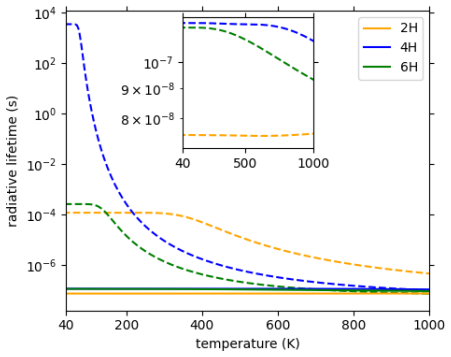
The fundamental optical transition in 4H-Ge is parity-forbidden due to matching band parities, resulting in radiative lifetimes seven orders of magnitude longer than in 2H- and 6H-Ge.
A machine-rendered reading of the paper's core claim, the machinery that carries it, and where it could break.
Core claim
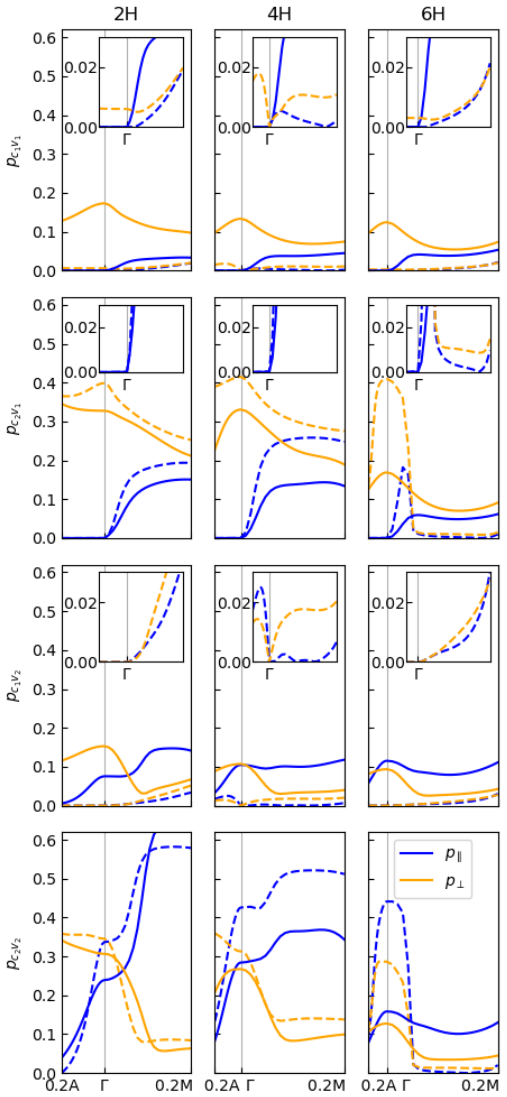
While all three polytypes exhibit direct band gaps of increasing size from 2H to 6H, the fundamental optical transition in 4H-Ge is parity-forbidden due to matching band parities at the valence and conduction band edges. This selection rule results in a radiative lifetime seven orders of magnitude longer than in 2H- and 6H-Ge, severely limiting light emission capabilities. To demonstrate that the selection rule can be lifted, controlled symmetry perturbations are introduced by substituting single Ge atoms with Si in each unit cell, breaking the crystal symmetry and increasing the optical matrix elements by up to two orders of magnitude while reducing radiative lifetimes.
What carries the argument
The parity selection rule from matching band-edge parities in the 4H structure, and its removal by single-atom Ge-to-Si substitutions that break crystal symmetry.
If this is right
- Radiative lifetimes in unperturbed 4H-Ge are seven orders of magnitude longer than in 2H- and 6H-Ge.
- Single-atom Si substitutions increase optical matrix elements by up to two orders of magnitude across the perturbed polytypes.
- Radiative lifetimes decrease for all symmetry-perturbed hexagonal Ge structures.
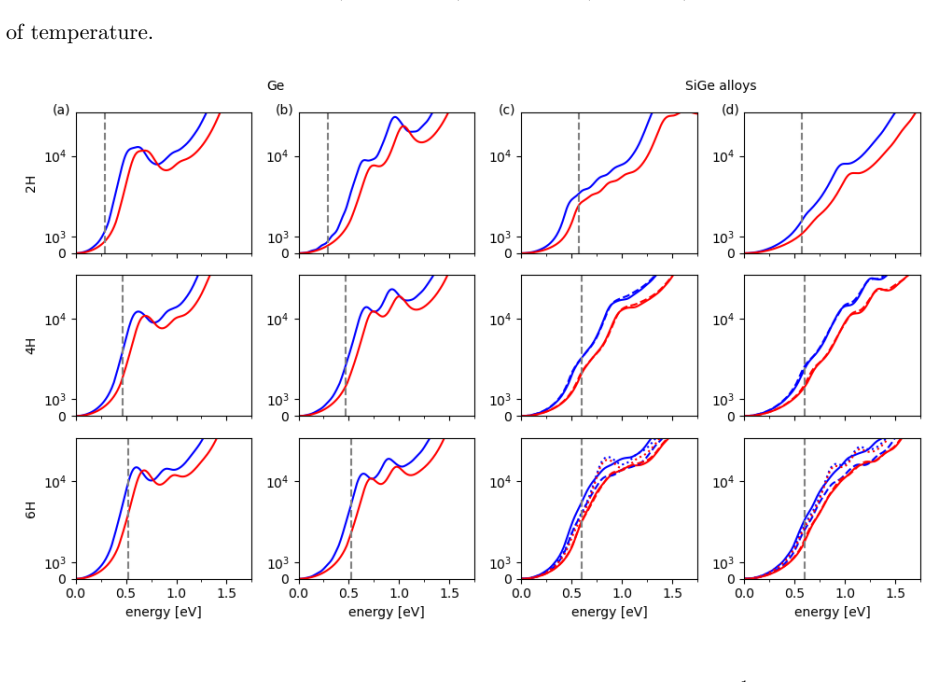
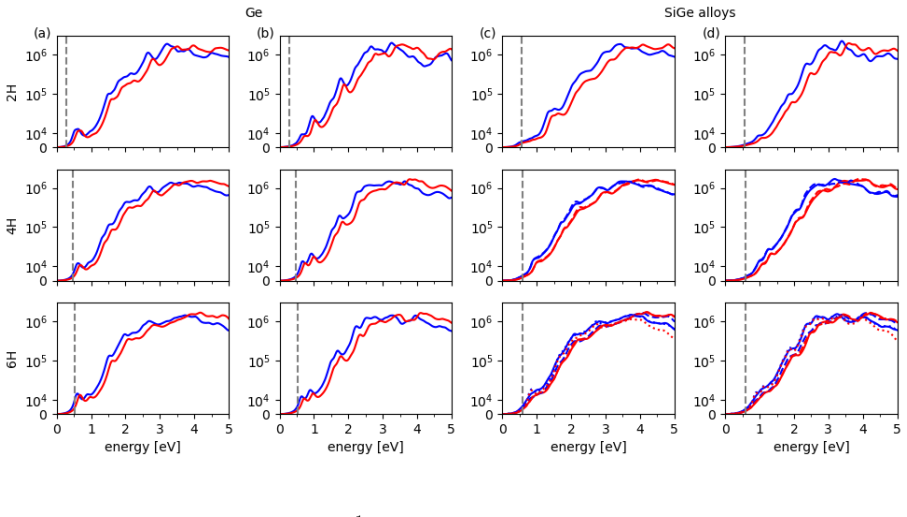
- Complete frequency-dependent absorption and dielectric tensors including excitons up to 5 eV are obtained for both light polarizations in ideal and perturbed systems.
Where Pith is reading between the lines
- Controlled Si incorporation or interface engineering could make 4H-Ge viable for efficient silicon-integrated light emitters.
- The same substitution strategy may lift forbidden transitions in other polytype or alloy systems with parity matching.
- Strain or compensating defects in real doped samples could modify the predicted lifetime reductions.
- Excitonic binding energies computed here may shift observed emission peaks in low-temperature experiments.
Load-bearing premise
The ab initio quasiparticle band structures correctly assign parities to the band edges and a single Ge-to-Si substitution per unit cell faithfully models a controllable symmetry perturbation without introducing compensating defects or strain that would alter the outcome.
What would settle it
Observation of strong absorption or short radiative lifetime at the fundamental gap edge in pure 4H-Ge without any symmetry-breaking defects would falsify the parity-forbidden claim.
Figures



read the original abstract
Hexagonal germanium polytypes have emerged as promising direct-gap semiconductors for silicon-integrated optoelectronics, yet their optical properties remain largely unexplored beyond the well-studied 2H phase. We present a comprehensive theoretical study of optical properties of hexagonal 2H-, 4H-, and 6H-Ge polytypes through ab initio calculations of quasiparticle band structures, dipole transition matrix elements, and solution of the Bethe-Salpeter equation. While all three polytypes exhibit direct band gaps of increasing size from 2H to 6H, we reveal that the fundamental optical transition in 4H-Ge is parity-forbidden due to matching band parities at the valence and conduction band edges. This selection rule results in a radiative lifetime seven orders of magnitude longer than in 2H- and 6H-Ge, severely limiting light emission capabilities. To demonstrate that the selection rule can be lifted, we introduce controlled symmetry perturbations by substituting single Ge atoms with Si in each unit cell, breaking the crystal symmetry. This perturbation increases the optical matrix elements by up to two orders of magnitude and reduces radiative lifetimes for all perturbed polytypes. We also compute absorption coefficients and frequency-dependent dielectric tensors for both light polarizations, including excitonic effects up to 5 eV, providing complete optical characterization of ideal and symmetry-perturbed hexagonal Ge systems relevant for optoelectronic applications.
Editorial analysis
A structured set of objections, weighed in public.
Referee Report
Summary. The manuscript reports ab initio GW+BSE calculations of quasiparticle bands, dipole matrix elements, and excitonic optical spectra for hexagonal 2H-, 4H-, and 6H-Ge polytypes. It claims that the fundamental direct-gap transition in 4H-Ge is strictly parity-forbidden because the valence-band maximum and conduction-band minimum share the same parity at the relevant wavevector, producing a radiative lifetime seven orders of magnitude longer than in 2H- and 6H-Ge. The authors further show that single-Ge-to-Si substitutions per unit cell break inversion symmetry, increase the optical matrix elements by up to two orders of magnitude, and shorten the lifetimes. Absorption coefficients and frequency-dependent dielectric tensors (both polarizations, with excitons up to 5 eV) are also presented for both pristine and perturbed structures.
Significance. If the parity assignment and the reported lifetime ratio are robust, the work would usefully highlight symmetry-enforced selection rules as a limiting factor for light emission in 4H-Ge and demonstrate a concrete, computationally accessible route to lift them via isovalent substitution. The calculations employ standard, parameter-free first-principles methods on well-defined supercells and include excitonic effects, which are strengths. The absence of convergence data, error bars on matrix elements, and direct experimental benchmarks, however, reduces the immediate impact for device-oriented applications.
major comments (2)
- [Results on optical matrix elements and lifetimes] § on radiative lifetimes and matrix elements: the central quantitative claim is that the 4H-Ge lifetime is seven orders of magnitude longer because the transition is parity-forbidden. In any calculation that exactly preserves inversion symmetry the dipole matrix element must vanish identically, making the lifetime formally infinite. The reported finite (but small) value that yields the factor of 10^7 therefore requires explicit justification—whether it arises from numerical tolerance in the wave functions, finite k-point sampling, basis-set incompleteness, or an alternative lifetime formula that does not rely on the single-particle |M|^2. This clarification is load-bearing for the claimed magnitude of the effect.
- [Band-structure and parity analysis] Section describing parity analysis: the assignment that VBM and CBM in 4H-Ge have identical parity at the direct-gap point must be supported by an explicit symmetry decomposition or direct inspection of the wave-function characters (e.g., under inversion). Without this, it is unclear whether the reported selection rule follows rigorously from the space-group symmetry or from the particular computational realization.
minor comments (2)
- [Methods] The abstract and methods sections omit any mention of k-point convergence, GW cutoff convergence, or BSE k-grid density. These tests should be added (or referenced) to substantiate the reliability of the small matrix elements in 4H-Ge.
- [Figures] Figure captions and axis labels for the dielectric functions and absorption spectra should explicitly state the light polarization and whether excitonic effects are included.
Simulated Author's Rebuttal
We thank the referee for the careful reading and constructive comments on our manuscript. We provide point-by-point responses to the major comments below. Where appropriate, we will revise the manuscript to incorporate additional clarifications and supporting analyses.
read point-by-point responses
-
Referee: § on radiative lifetimes and matrix elements: the central quantitative claim is that the 4H-Ge lifetime is seven orders of magnitude longer because the transition is parity-forbidden. In any calculation that exactly preserves inversion symmetry the dipole matrix element must vanish identically, making the lifetime formally infinite. The reported finite (but small) value that yields the factor of 10^7 therefore requires explicit justification—whether it arises from numerical tolerance in the wave functions, finite k-point sampling, basis-set incompleteness, or an alternative lifetime formula that does not rely on the single-particle |M|^2. This clarification is load-bearing for the claimed magnitude of the effect.
Authors: We agree that exact preservation of inversion symmetry requires the dipole matrix element to vanish identically for the fundamental transition in 4H-Ge. The small finite value in our results originates from numerical tolerances in the wave-function representation and the finite k-point sampling employed for Brillouin-zone integration; no alternative lifetime formula was used. In the revised manuscript we will add a paragraph in the relevant results section explicitly stating this numerical origin, reporting the computed matrix-element magnitude for transparency, and clarifying that the reported seven-order-of-magnitude ratio quantifies the strong suppression imposed by the parity selection rule (with the absolute 4H-Ge lifetime being effectively infinite within the method's precision). revision: yes
-
Referee: Section describing parity analysis: the assignment that VBM and CBM in 4H-Ge have identical parity at the direct-gap point must be supported by an explicit symmetry decomposition or direct inspection of the wave-function characters (e.g., under inversion). Without this, it is unclear whether the reported selection rule follows rigorously from the space-group symmetry or from the particular computational realization.
Authors: We concur that an explicit demonstration is necessary. The parity assignment follows rigorously from the space-group symmetry of 4H-Ge (P6_3/mmc), in which the VBM and CBM at the direct-gap wavevector belong to the same irreducible representation and share even parity under inversion. In the revised manuscript we will include a table that lists the parity eigenvalues of the relevant bands, obtained by direct projection of the computed wave functions onto even and odd combinations under the inversion operator. This will confirm that the selection rule is enforced by symmetry rather than being a computational artifact. revision: yes
Circularity Check
No significant circularity; derivation is self-contained first-principles computation
full rationale
The paper's central claims (parity matching at band edges in 4H-Ge, resulting lifetime ratios, and effects of Si substitution) are obtained directly from standard ab initio workflows: quasiparticle band structures via GW, dipole matrix elements from wavefunctions, and Bethe-Salpeter equation solutions. Inputs are only the ideal crystal structures of the polytypes plus conventional exchange-correlation functionals; no parameters are fitted to the target optical quantities, no equations are self-referential, and no load-bearing steps reduce to self-citations or ansatzes. The reported seven-order lifetime difference follows from the numerically computed (small but finite) matrix elements under preserved symmetry, which is a direct output rather than a redefinition of the input. This is the normal, non-circular case for DFT-based optical studies.
Axiom & Free-Parameter Ledger
axioms (2)
- domain assumption GW approximation yields accurate quasiparticle energies and band parities for these Ge polytypes
- domain assumption Bethe-Salpeter equation with the computed dipole matrix elements gives the correct optical absorption and radiative lifetimes
Lean theorems connected to this paper
-
IndisputableMonolith/Foundation/AlexanderDuality.leanalexander_duality_circle_linking unclear?
unclearRelation between the paper passage and the cited Recognition theorem.
the fundamental optical transition in 4H-Ge is parity-forbidden due to matching band parities at the valence and conduction band edges
-
IndisputableMonolith/Cost/FunctionalEquation.leanwashburn_uniqueness_aczel unclear?
unclearRelation between the paper passage and the cited Recognition theorem.
We computed dipole matrix elements... p⊥/∥ m,n(k) = ... |⟨cmi,k | p⊥/∥ | vnj,k⟩|²
What do these tags mean?
- matches
- The paper's claim is directly supported by a theorem in the formal canon.
- supports
- The theorem supports part of the paper's argument, but the paper may add assumptions or extra steps.
- extends
- The paper goes beyond the formal theorem; the theorem is a base layer rather than the whole result.
- uses
- The paper appears to rely on the theorem as machinery.
- contradicts
- The paper's claim conflicts with a theorem or certificate in the canon.
- unclear
- Pith found a possible connection, but the passage is too broad, indirect, or ambiguous to say the theorem truly supports the claim.
Reference graph
Works this paper leans on
-
[1]
Y. Shen, X. Meng, Q. Cheng, S. Rumley, N. Abrams, A. Gazman, E. Manzhosov, M. S. Glick, and K. Bergman, Silicon photonics for extreme scale systems, Journal of Lightwave Technology 37, 245 (2019)
work page 2019
-
[2]
S. Shekhar, W. Bogaerts, L. Chrostowski, J. E. Bowers, M. Hochberg, R. Soref, and B. J. Shastri, Roadmapping the next generation of silicon photonics, Nature Communications 15, 751 (2024)
work page 2024
-
[3]
E. M. T. Fadaly, A. Dijkstra, J. R. Suckert, D. Ziss, M. A. J. van Tilburg, C. Mao, Y. Ren, V. T. van Lange, K. Korzun, S. K¨ olling, M. A. Verheijen, D. Busse, C. R¨ odl, J. Furthm¨ uller, F. Bechstedt, J. Stangl, J. J. Finley, S. Botti, J. E. M. Haverkort, and E. P. A. M. Bakkers, Direct-bandgap emission from hexagonal ge and sige alloys., Nature 580, 2...
work page 2020
-
[4]
V. T. van Lange, A. Dijkstra, E. M. T. Fadaly, W. H. J. Peeters, M. A. J. van Tilburg, E. P. A. M. Bakkers, F. Bechstedt, J. J. Finley, and J. E. M. Haverkort, Nanosecond carrier lifetime of hexagonal ge, ACS Photonics 11, 4258 (2024), https://doi.org/10.1021/acsphotonics.4c01135
-
[5]
W. H. J. Peeters, V. T. van Lange, A. Belabbes, M. C. van Hemert, M. M. Jansen, R. Farina, M. A. J. van Tilburg, M. A. Verheijen, S. Botti, F. Bechstedt, J. E. M. Haverkort, and E. P. A. M. Bakkers, Direct bandgap quantum wells in hexagonal silicon germanium, Nature Communications 15, 5252 (2024)
work page 2024
- [6]
-
[7]
P. Borlido, J. R. Suckert, J. Furthm¨ uller, F. Bechstedt, S. Botti, and C. R¨ odl, From pseudo- direct hexagonal germanium to direct silicon-germanium alloys, Phys. Rev. Mater. 5, 114604 (2021)
work page 2021
-
[8]
A. Belabbes, F. Bechstedt, and S. Botti, Giant optical oscillator strengths in perturbed hexag- 18 onal germanium, Phys. Status Solidi RRL 16, 2100555 (2022)
work page 2022
-
[9]
J. R. Suckert, C. R¨ odl, J. Furthm¨ uller, F. Bechstedt, and S. Botti, Efficient strain-induced light emission in lonsdaleite germanium, Physical Review Materials 5, 024602 (2021)
work page 2021
-
[10]
L. H. G. Tizei, M. R. Fiorentin, T. Dursap, T. M. van den Berg, M. T´ unica, M. Palummo, M. Kociak, L. Vincent, and M. Amato, Optical absorption in hexagonal-diamond si and ge nanowires: Insights from stem-eels experiments and ab initio theory, Nano Letters 25, 8604 (2025), pMID: 40326737, https://doi.org/10.1021/acs.nanolett.5c01406
- [11]
-
[12]
N. Bao, F. Guo, D. Kang, Y. Feng, H. Wang, and J. Dai, Toward accurate electronic, op- tical, and vibrational properties of hexagonal si, ge, and si1-xgex alloys from first-principle simulations, Journal of Applied Physics 129, 145701 (2021)
work page 2021
-
[13]
P. Borlido, F. Bechstedt, S. Botti, and C. R¨ odl, Ensemble averages of ab initio optical, trans- port, and thermoelectric properties of hexagonal si xge1−x alloys, Phys. Rev. Mater. 7, 014602 (2023)
work page 2023
- [14]
-
[15]
V. T. van Lange, Optical Characterization of Hexagonal Silicon-Germanium Heterostructures , Ph.D. thesis, Applied Physics and Science Education (2025)
work page 2025
-
[16]
I. V. Ilkiv, K. P. Kotlyar, A. V. Osipov, R. R. Reznik, and G. E. Cirlin, Germanium polytypes formation on algaas nanowire surface, St. Petersburg State Polytechnical University Journal. Physics and Mathematics 16, 289–293 (2023)
work page 2023
- [17]
-
[18]
T. B. Shiell, L. Zhu, B. A. Cook, J. E. Bradby, D. G. McCulloch, and T. A. Strobel, Bulk crystalline 4h-silicon through a metastable allotropic transition, Phys. Rev. Lett. 126, 215701 (2021)
work page 2021
-
[19]
S. Pandolfi, C. Renero-Lecuna, Y. Le Godec, B. Baptiste, N. Menguy, M. Lazzeri, C. Gervais, 19 K. Spektor, W. A. Crichton, and O. O. Kurakevych, Nature of hexagonal silicon forming via high-pressure synthesis: Nanostructured hexagonal 4h polytype, Nano Letters 18, 5989 (2018), pMID: 30102550, https://doi.org/10.1021/acs.nanolett.8b02816
-
[20]
G. Kresse and J. Furthm¨ uller, Efficient iterative schemes for ab initio total-energy calculations using a plane-wave basis set, Phys. Rev. B 54, 11169 (1996)
work page 1996
-
[21]
G. Kresse and J. Furthm¨ uller, Efficiency of ab-initio total energy calculations for metals and semiconductors using a plane-wave basis set, Comp. Mater. Sci. 6, 15 (1996)
work page 1996
-
[22]
G. Kresse and D. Joubert, From ultrasoft pseudopotentials to the projector augmented-wave method, Phys. Rev. B 59, 1758 (1999)
work page 1999
-
[23]
J. P. Perdew, A. Ruzsinszky, G. I. Csonka, O. A. Vydrov, G. E. Scuseria, L. A. Constantin, X. Zhou, and K. Burke, Restoring the density-gradient expansion for exchange in solids and surfaces, Phys. Rev. Lett. 100, 136406 (2008)
work page 2008
-
[24]
A. D. Becke and E. R. Johnson, A simple effective potential for exchange, The Journal of Chemical Physics 124, 221101 (2006)
work page 2006
-
[25]
F. Tran, P. Blaha, and K. Schwarz, Band gap calculations with becke-johnson exchange po- tential, Journal of Physics: Condensed Matter 19, 196208 (2007)
work page 2007
-
[26]
F. Tran and P. Blaha, Accurate band gaps of semiconductors and insulators with a semilocal exchange-correlation potential, Phys. Rev. Lett. 102, 226401 (2009)
work page 2009
-
[27]
Bechstedt, Many-Body Approach to Electronic Excitations (Springer-Verlag Berlin Heidel- berg, 2015)
F. Bechstedt, Many-Body Approach to Electronic Excitations (Springer-Verlag Berlin Heidel- berg, 2015)
work page 2015
-
[28]
P. Borlido, T. Aull, A. W. Huran, F. Tran, M. A. Marques, and S. Botti, Large-scale bench- mark of exchange–correlation functionals for the determination of electronic band gaps of solids, Journal of chemical theory and computation 15, 5069 (2019)
work page 2019
- [29]
-
[30]
T. Kaewmaraya, L. Vincent, and M. Amato, Accurate estimation of band offsets in group iv polytype junctions: A first-principles study, The Journal of Physical Chemistry C 121, 5820 (2017), https://doi.org/10.1021/acs.jpcc.6b12782
-
[31]
L. H. G. Tizei and M. Amato, Electronic structure and optical properties of semiconductor nanowires polytypes, The European Physical Journal B 93, 16 (2020)
work page 2020
- [32]
- [33]
- [34]
-
[35]
P. Y. Yu and M. Cardona, Fundamentals of Semiconductors (Springer-Verlag Berlin Heidel- berg, 1996)
work page 1996
- [36]
-
[37]
N. S. Fernando, T. N. Nunley, A. Ghosh, C. M. Nelson, J. A. Cooke, A. A. Medina, S. Zollner, C. Xu, J. Menendez, and J. Kouvetakis, Temperature dependence of the interband critical points of bulk ge and strained ge on si, Applied Surface Science 421, 905 (2017)
work page 2017
-
[38]
C. Emminger, F. Abadizaman, N. S. Samarasingha, T. E. Tiwald, and S. Zollner, Tempera- ture dependent dielectric function and direct bandgap of Ge, Journal of Vacuum Science & Technology B: Nanotechnology and Microelectronics 38, 012202 (2020)
work page 2020
-
[39]
W. C. Dash and R. Newman, Intrinsic optical absorption in single-crystal germanium and silicon at 77 °k and 300 °k, Phys. Rev. 99, 1151 (1955)
work page 1955
-
[40]
N. M. Ravindra, S. Auluck, and V. K. Srivastava, On the penn gap in semiconductors, physica status solidi (b) 93, K155 (1979), https://onlinelibrary.wiley.com/doi/pdf/10.1002/pssb.2220930257. 21
discussion (0)
Sign in with ORCID, Apple, or X to comment. Anyone can read and Pith papers without signing in.