Recognition: 2 theorem links
· Lean TheoremVacuum and thermal fluctuations of a scalar field with point interactions
Pith reviewed 2026-05-12 04:48 UTC · model grok-4.3
The pith
A convergent Born series shows Casimir forces between point obstacles arise from multiple scattering and decompose into pairwise attractions.
A machine-rendered reading of the paper's core claim, the machinery that carries it, and where it could break.
Core claim
Using the relative zeta-function technique, we determine the renormalized connected partition function and derive explicit expressions for the thermodynamic observables, characterizing both their low- and high-temperature behaviours. We derive a convergent Born series expansion for the Casimir energy, which identifies multiple-scattering processes as the mechanism underlying vacuum forces. The latter decompose into pairwise contributions directed along the lines joining the obstacles, with intensities depending non-locally on the full configuration. Numerical results for identical obstacles indicate that the Casimir forces are always attractive.
What carries the argument
The convergent Born series expansion of the Casimir energy, obtained via the relative zeta-function, that encodes the multiple-scattering mechanism between point obstacles.
Load-bearing premise
The self-adjoint realizations of the Laplacian that model the point interactions are bounded from below and free of instabilities.
What would settle it
A concrete calculation for any finite set of identical point obstacles that produces a repulsive force component between at least one pair would falsify the attractiveness claim; divergence of the Born series for some stable configuration would falsify the expansion.
Figures


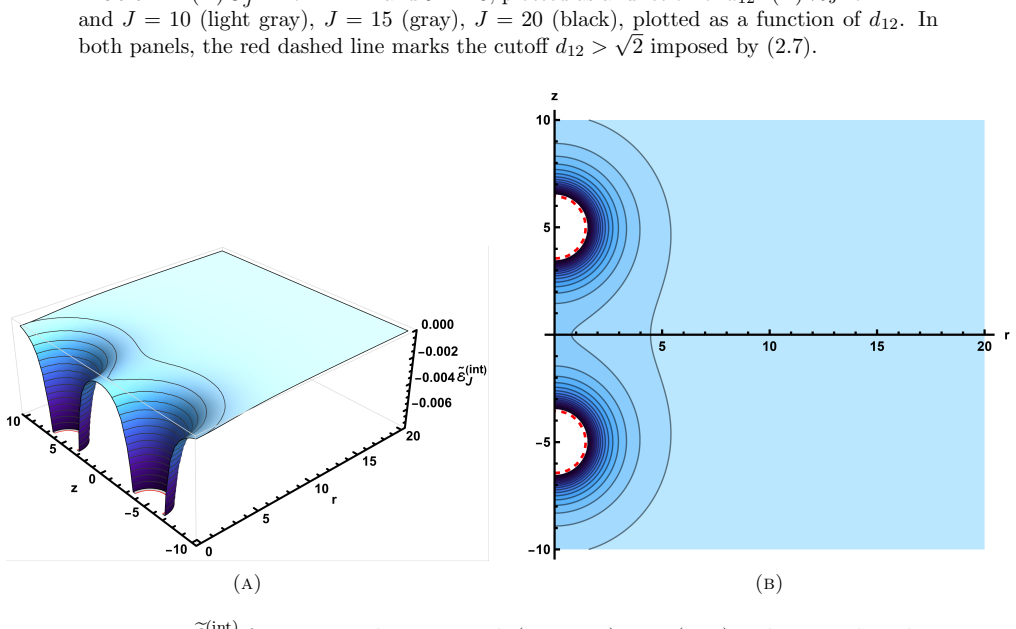

read the original abstract
We investigate the vacuum and thermal fluctuations of a neutral massless scalar field living in Minkowski spacetime and interacting with a finite number of point-like obstacles, modelled by zero-range potentials. The system is described rigorously in terms of self-adjoint realizations of the Laplacian, under assumptions ensuring the absence of instabilities. Using the relative zeta-function technique, we determine the renormalized connected partition function and derive explicit expressions for the thermodynamic observables, characterizing both their low- and high-temperature behaviours. Furthermore, we derive of a convergent Born series expansion for the Casimir energy, which identifies multiple-scattering processes as the mechanism underlying vacuum forces. The latter decompose into pairwise contributions directed along the lines joining the obstacles, with intensities depending non-locally on the full configuration. We also present some numerical results for identical obstacles, indicating that the Casimir forces are always attractive in this context.
Editorial analysis
A structured set of objections, weighed in public.
Referee Report
Summary. The manuscript investigates vacuum and thermal fluctuations of a neutral massless scalar field in Minkowski space interacting with a finite number of point-like obstacles modeled by zero-range potentials. The system is described via self-adjoint realizations of the Laplacian under assumptions ensuring no instabilities; the relative zeta-function technique yields the renormalized connected partition function and thermodynamic observables (with low- and high-temperature asymptotics). A convergent Born series for the Casimir energy is derived, identifying multiple-scattering processes and decomposing forces into pairwise, non-local contributions along lines joining the obstacles. Numerical results for identical obstacles indicate that the forces are always attractive.
Significance. If the stability assumptions hold and the derivations are rigorous, the work supplies an explicit, convergent series expansion for the Casimir energy that isolates physical multiple-scattering mechanisms and pairwise force contributions. This framework is potentially useful for computations in singular-potential Casimir problems and adds concrete numerical evidence on force signs. The relative zeta-function approach and thermodynamic characterizations are standard strengths when properly justified.
major comments (2)
- [Setup of self-adjoint realizations] Setup of self-adjoint realizations (near the beginning of the paper): The assumptions 'ensuring the absence of instabilities' are stated but no explicit, checkable criterion (e.g., bounds on coupling parameters or minimal inter-obstacle distances) is supplied or verified for the specific numerical configurations. This is load-bearing: a negative eigenvalue would make the quadratic form unbounded below, rendering the resolvent unavailable in the required half-plane and the relative zeta-function regularization (and thus the Casimir energy) ill-defined.
- [Born series derivation and numerical results] Born series and numerical results (the section deriving the series and the numerical section): The convergence of the Born series is asserted, yet the proof relies on the resolvent existing in the appropriate domain; without an explicit stability criterion verified for the plotted configurations, the claim that forces are 'always attractive' rests on an unexamined hypothesis that could be falsified by a single negative eigenvalue.
minor comments (1)
- [Notation and setup] The notation for the boundary-condition parameters at each point interaction is introduced gradually; a compact table or explicit list of symbols at the outset would improve readability.
Simulated Author's Rebuttal
We thank the referee for the detailed and insightful report. The two major comments correctly identify that the stability assumptions, while stated, lack explicit verifiable criteria and numerical checks in the current manuscript. We will revise the paper to address both points directly.
read point-by-point responses
-
Referee: [Setup of self-adjoint realizations] Setup of self-adjoint realizations (near the beginning of the paper): The assumptions 'ensuring the absence of instabilities' are stated but no explicit, checkable criterion (e.g., bounds on coupling parameters or minimal inter-obstacle distances) is supplied or verified for the specific numerical configurations. This is load-bearing: a negative eigenvalue would make the quadratic form unbounded below, rendering the resolvent unavailable in the required half-plane and the relative zeta-function regularization (and thus the Casimir energy) ill-defined.
Authors: We agree that the manuscript would benefit from explicit, checkable criteria. In the revised version we will add an appendix deriving sufficient bounds on the coupling constants and minimal separations that guarantee the absence of negative eigenvalues for the self-adjoint extensions. For the concrete numerical configurations (identical obstacles at the positions used in the plots) we will explicitly verify that these bounds are satisfied, thereby confirming that the resolvent exists in the required half-plane and that the relative zeta-function is well-defined. revision: yes
-
Referee: [Born series derivation and numerical results] Born series derivation and numerical results (the section deriving the series and the numerical section): The convergence of the Born series is asserted, yet the proof relies on the resolvent existing in the appropriate domain; without an explicit stability criterion verified for the plotted configurations, the claim that forces are 'always attractive' rests on an unexamined hypothesis that could be falsified by a single negative eigenvalue.
Authors: The convergence proof of the Born series is indeed conditional on the resolvent being defined in the appropriate domain, which follows from the stability assumptions. Once the explicit criteria and their verification for the plotted configurations are supplied (as described in the response to the first comment), the convergence is rigorously justified. We will revise the text to state clearly that the 'always attractive' conclusion holds for the class of configurations satisfying the stability bounds, and we will add a brief discussion of how the bounds can be checked for other choices of couplings and positions. revision: yes
Circularity Check
No significant circularity; derivation applies external zeta regularization to point-interaction model under stated stability assumptions.
full rationale
The paper describes the system via self-adjoint realizations of the Laplacian with assumptions for absence of instabilities, then applies the relative zeta-function technique to obtain the renormalized partition function, thermodynamic observables, and a convergent Born series for the Casimir energy. No quoted step reduces a prediction or central result to a fitted parameter, self-definition, or self-citation chain by construction. The multiple-scattering decomposition and numerical indications of attractive forces follow from the resolvent expansion and configuration-dependent pairwise terms without renaming known results or smuggling ansatzes. The derivation remains self-contained against the external mathematical framework of Krein-Vishik-Birman theory and zeta regularization.
Axiom & Free-Parameter Ledger
axioms (1)
- domain assumption Assumptions ensuring the absence of instabilities in the self-adjoint realizations of the Laplacian
Lean theorems connected to this paper
-
IndisputableMonolith/Foundation/AbsoluteFloorClosure.leanabsolute_floor_iff_bare_distinguishability unclear?
unclearRelation between the paper passage and the cited Recognition theorem.
under assumptions ensuring the absence of instabilities... α_n >0 and separation condition (2.7)
What do these tags mean?
- matches
- The paper's claim is directly supported by a theorem in the formal canon.
- supports
- The theorem supports part of the paper's argument, but the paper may add assumptions or extra steps.
- extends
- The paper goes beyond the formal theorem; the theorem is a base layer rather than the whole result.
- uses
- The paper appears to rely on the theorem as machinery.
- contradicts
- The paper's claim conflicts with a theorem or certificate in the canon.
- unclear
- Pith found a possible connection, but the passage is too broad, indirect, or ambiguous to say the theorem truly supports the claim.
Reference graph
Works this paper leans on
-
[1]
S. Albeverio, C. Cacciapuoti, M. Spreafico, Relative partition function of Coulomb plus delta interaction , pp. 1-29 in J. Dittrich, H. Kovarik, A. Laptev (Eds.) ``Functional Analysis and Operator Theory for Quantum Physics. A Festschrift in Honor of Pavel Exner'', European Mathematical Society Publishing House, Z\"urich (2016)
work page 2016
-
[2]
S. Albeverio, G. Cognola, M. Spreafico, S. Zerbini, Singular perturbations with boundary conditions and the Casimir effect in the half space , J. Math. Phys. 51 , 063502 (2010)
work page 2010
-
[3]
S. Albeverio, F. Gesztesy, R. Hoegh-Krohn, H. Holden, Solvable Models in Quantum Mechanics , Springer Berlin, Heidelberg (1988)
work page 1988
-
[4]
S. Albeverio, P. Kurasov, Singular Perturbations of Differential Operators , London Mathematical Society Lecture Notes Series 271, Cambridge University Press, Cambridge (1999)
work page 1999
-
[5]
Bennett, Born-series approach to the calculation of Casimir forces , Phys
R. Bennett, Born-series approach to the calculation of Casimir forces , Phys. Rev. A 89 , 062512 (2014)
work page 2014
- [6]
-
[7]
M. Bordag, G.L. Klimchitskaya, U. Mohideen, V.M. Mostepanenko, Advances in the Casimir Effect , Oxford University Press Inc., New York (2009)
work page 2009
- [8]
-
[9]
A.A. Bytsenko, G. Cognola, E. Elizalde, V. Moretti, S. Zerbini, Analytic aspects of quantum fields , World Scientific Publishing Co., Singapore (2003)
work page 2003
-
[10]
C. Cacciapuoti, D. Fermi, A. Posilicano, Relative-Zeta and Casimir energy for a semitransparent hyperplane selecting transverse modes , pp. 71-97 in G.F. Dell'Antonio, A. Michelangeli (Eds.), ``Advances in Quantum Mechanics: contemporary trends and open problems'', Springer (2017)
work page 2017
-
[11]
D. Cafiero, M. Correggi, D. Fermi, Homogenization of point interactions , arXiv:2603.21400 [math-ph]
-
[12]
Casimir, On the attraction between two perfectly conducting plates , Proc
H.B.G. Casimir, On the attraction between two perfectly conducting plates , Proc. Koninklijke Nederlandse Akad. van Wetenschappen 51 , 793-795 (1948)
work page 1948
-
[13]
H.B.G. Casimir, D. Polder, The Influence of Retardation on the London-van der Waals Forces , Phys. Rev. 73 , 360-372 (1948)
work page 1948
- [14]
- [15]
-
[16]
M. Dou, F. Lou, M. Bostr\"om, I. Brevik, C. Persson, Casimir quantum levitation tuned by means of material properties and geometries , Phys. Rev. B 89 , 201407 (2014)
work page 2014
- [17]
- [18]
-
[19]
E. Elizalde, S.D. Odintsov, A. Romeo, A.A. Bytsenko, S. Zerbini, Zeta regularization techniques with applications , World Scientific Publishing Co., Singapore (1994)
work page 1994
- [20]
-
[21]
T. Emig, G. Bimonte, Multiple Scattering Expansion for Dielectric Media: Casimir Effect , Phys. Rev. Lett. 130 , 200401 (2023)
work page 2023
-
[22]
Y.L. Fang, A. Strohmaier, A Mathematical Analysis of Casimir Interactions I: The Scalar Field , Ann. Henri Poincaré 23 , 1399-1449 (2022)
work page 2022
-
[23]
Fermi, Sul moto dei neutroni nelle sostanze idrogenate , Ricerca Scientifica 7 (2), 13-53 (1936)
E. Fermi, Sul moto dei neutroni nelle sostanze idrogenate , Ricerca Scientifica 7 (2), 13-53 (1936)
work page 1936
-
[24]
D. Fermi, A functional analytic framework for local zeta regularization and the scalar Casimir effect , PhD thesis, Doctoral School in Mathematics, 28 th Cycle, University of Milan (2016). https://doi.org/10.13130/d-fermi phd2016-02-22 https://doi.org/10.13130/d-fermi phd2016-02-22
-
[25]
Fermi, The Casimir energy anomaly for a point interaction , Mod
D. Fermi, The Casimir energy anomaly for a point interaction , Mod. Phys. Lett. A 35 (03), 2040008 (2020)
work page 2020
- [26]
- [27]
- [28]
-
[29]
Fermi, L., Pizzocchero, Local zeta regularization and the scalar Casimir effect
D. Fermi, L., Pizzocchero, Local zeta regularization and the scalar Casimir effect. A general approach based on integral kernels , World Scientific, Singapore (2017)
work page 2017
- [30]
- [31]
-
[32]
Gibbons, Thermal zeta functions , Phys
G. Gibbons, Thermal zeta functions , Phys. Lett. A 60 (5), 385-386 (1977)
work page 1977
- [33]
- [34]
-
[35]
R.E. Green, S.G. Krantz, Function theory of one complex variable , John Wiley & Sons Inc., New York (1997)
work page 1997
-
[36]
Hawking, Zeta function regularization of path integrals in curved spacetime , Commun
S.W. Hawking, Zeta function regularization of path integrals in curved spacetime , Commun. Math. Phys. 55 (2), 133-148 (1977)
work page 1977
-
[37]
Herdegen, Quantum backreaction (Casimir) effect I
A. Herdegen, Quantum backreaction (Casimir) effect I. What are admissible idealizations? , Ann. Henri Poincar\'e 6 , 657-695 (2005)
work page 2005
-
[38]
Herdegen, Quantum backreaction (Casimir) effect II
A. Herdegen, Quantum backreaction (Casimir) effect II. Scalar and electromagnetic fields , Ann. Henri Poincar\'e 7 , 253-301 (2006)
work page 2006
-
[39]
A. Herdegen, M. Stopa, Global versus local Casimir effect , Ann. Henri Poincar\'e 11 , 1171-1200 (2010)
work page 2010
-
[40]
D.J. Kapner, T.S. Cook, E.G. Adelberger, J.H. Gundlach, B.R. Heckel, C.D. Hoyle, H.E. Swanson, Tests of the Gravitational Inverse-Square Law below the Dark-Energy Length Scale , Phys. Rev. Lett. 98 , 021101 (2007)
work page 2007
-
[41]
J.I. Kapusta, C. Gales, Finite-Temperature Field Theory, Principles and Applications , Cambridge University Press, Cambridge (1989)
work page 1989
-
[42]
Kirsten, Spectral Functions in Mathematics and Physics , CRC Press, Boca Raton, Florida (2001)
K. Kirsten, Spectral Functions in Mathematics and Physics , CRC Press, Boca Raton, Florida (2001)
work page 2001
-
[43]
Lamoreaux, Demonstration of the Casimir Force in the 0.6 to 6 m Range , Phys
S.K. Lamoreaux, Demonstration of the Casimir Force in the 0.6 to 6 m Range , Phys. Rev. Lett. 78 (1), 8pp. (1997). Erratum Phys. Rev. Lett. 81 (24), 5475-5476 (1998)
work page 1997
-
[44]
Lamoreaux, The Casimir force: background, experiments, and applications , Rep
S.K. Lamoreaux, The Casimir force: background, experiments, and applications , Rep. Prog. Phys. 68 , 201-236 (2005)
work page 2005
-
[45]
Lifshitz, The Theory of Molecular Attractive Forces between Solids , Sov
E.M. Lifshitz, The Theory of Molecular Attractive Forces between Solids , Sov. Phys. JETP 2 (1), 73-83 (1956). See also Zh. Eksp. Teor. Fiz. 29 , 94 (1955) [in Russian]
work page 1956
-
[46]
P.W. Milonni, The Quantum Vacuum, An Introduction to Quantum Electrodynamics , Academic Press Inc., San Diego (1994)
work page 1994
-
[47]
K. A. Milton, The Casimir effect - Physical manifestations of zero-point energy , World Scientific Publishing Co., Singapore (2001)
work page 2001
-
[48]
U. Mohideen, A. Roy, Precision Measurement of the Casimir Force from 0.1 to 0.9 m , Phys. Rev. Lett. 81 (21), 4549-4552 (1998)
work page 1998
-
[49]
V.M. Mostepanenko, N.N. Trunov, The Casimir effect and its applications , Oxford University Press Inc., New York (1997)
work page 1997
-
[50]
M\"uller, Relative Zeta Functions, Relative Determinants and Scattering Theory , Commun
W. M\"uller, Relative Zeta Functions, Relative Determinants and Scattering Theory , Commun. Math. Phys. 192 , 309–347 (1998)
work page 1998
- [51]
-
[52]
F.W.J. Olver, D.W. Lozier, R.F. Boisvert, C.W. Clark, NIST Handbook of mathematical functions , Cambridge University Press, Cambridge (2010)
work page 2010
-
[53]
R. Passante, L. Rizzuto, P. Schall, E. Marino, Quantum and critical Casimir effects: bridging fluctuation physics and nanotechnology , Nanoscale 17 , 13982-13997 (2025)
work page 2025
-
[54]
S.J. Rahi, T. Emig, N. Graham, R.L. Jaffe, M. Kardar, Scattering Theory Approach to Electrodynamic Casimir Forces , Phys. Rev. D 80 , 085021 (2009)
work page 2009
- [55]
-
[56]
S. Reynaud, A. Canaguier-Durand, R. Messina, A. Lambrecht, P.A. Maia Neto, The Scattering Approach to the Casimir Force , Int. J. Mod. Phys. A 25 (11), 2201-2211 (2010)
work page 2010
-
[57]
A. Scardicchio, Casimir dynamics: interactions of surfaces with codimension > 1 due to quantum fluctuations , Phys. Rev. D 72 , 065004 (2005)
work page 2005
-
[58]
F. Schmidt, A. Callegari, A. Daddi-Moussa-Ider, B. Munkhbat, R. Verre, T. Shegai, M. K\"all, H. L\"owen, A. Gambassi, G. Volpe, Tunable critical Casimir forces counteract Casimir–Lifshitz attraction , Nature Physics 19 , 271–278 (2023)
work page 2023
-
[59]
M. Spreafico, S. Zerbini, Finite temperature quantum field theory on noncompact domains and application to delta interactions , Rep. Math. Phys. 63 (2), 163-177 (2009)
work page 2009
-
[60]
A. Strohmaier, The Classical and Quantum Photon Field for Non-compact Manifolds with Boundary and in Possibly Inhomogeneous Media , Commun. Math. Phys. 387 , 1441-1489 (2021)
work page 2021
-
[61]
Strohmaier, Dimensional reduction formulae for spectral traces and Casimir energies , Lett
A. Strohmaier, Dimensional reduction formulae for spectral traces and Casimir energies , Lett. Math. Phys. 114 , 66 (2024)
work page 2024
- [62]
-
[63]
Wald, On the Euclidean approach to quantum field theory in curved spacetime , Commun
R.M. Wald, On the Euclidean approach to quantum field theory in curved spacetime , Commun. Math. Phys. 70 (3), 221–242 (1979)
work page 1979
-
[64]
Ziemian, Algebraic approach to Casimir force between two -like potentials , Ann
K. Ziemian, Algebraic approach to Casimir force between two -like potentials , Ann. Henri Poincar\'e 22 , 1751-1781 (2021)
work page 2021
discussion (0)
Sign in with ORCID, Apple, or X to comment. Anyone can read and Pith papers without signing in.