Recognition: no theorem link
Anomalous and diode Josephson effect in junctions with inhomogeneous ferromagnetic barrier and interfacial Rashba spin-orbit coupling
Pith reviewed 2026-05-12 04:13 UTC · model grok-4.3
The pith
Tuning exchange fields, Rashba coupling and order parameter orientations in ferromagnet-barrier Josephson junctions produces anomalous and diode effects with over 40 percent nonreciprocity.
A machine-rendered reading of the paper's core claim, the machinery that carries it, and where it could break.
Core claim
By performing a symmetry analysis of the junction Hamiltonian and numerical calculations via the generalized Furusaki-Tsukada method, the authors establish that junctions with arbitrarily oriented exchange fields in the ferromagnetic barrier, interfacial Rashba spin-orbit coupling, and d-wave or s-wave superconducting electrodes can exhibit both anomalous and diode Josephson effects. The minimal symmetry-breaking conditions are identified, and tuning of the parameters allows enhancement of the nonreciprocity by over 40 percent. The phase-dependent Andreev bound states contribute to the charge transport, with continuum states playing a role when zero-energy crossings occur or in d-wave cases.
What carries the argument
Symmetry classification of the Hamiltonian under time-reversal and inversion operations together with the generalized Furusaki-Tsukada numerical evaluation of the current-phase relation in the presence of arbitrarily oriented exchange fields and interfacial Rashba coupling.
Load-bearing premise
The generalized Furusaki-Tsukada numerical method and the symmetry classification fully capture the physics of the inhomogeneous barrier and interfacial Rashba coupling without missing higher-order scattering or self-consistency effects in the superconducting order parameter.
What would settle it
Fabrication of a planar junction with independently rotatable exchange fields and controlled interfacial Rashba strength, followed by measurement of the current-phase relation showing no finite zero-phase current or no difference in critical currents when both symmetries are broken according to the classification, would falsify the claim.
Figures







read the original abstract
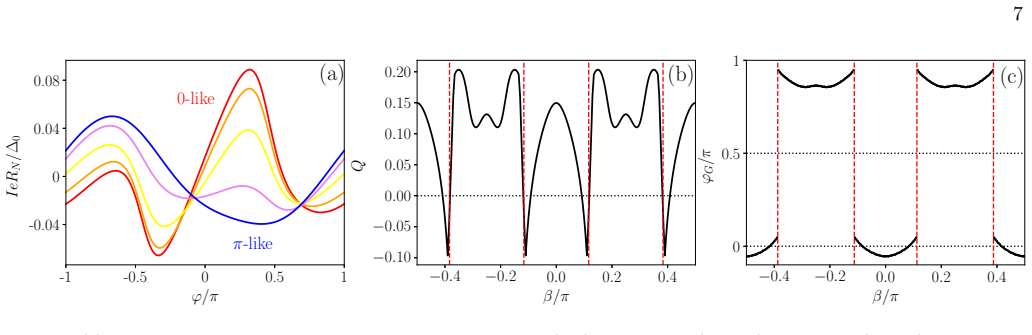
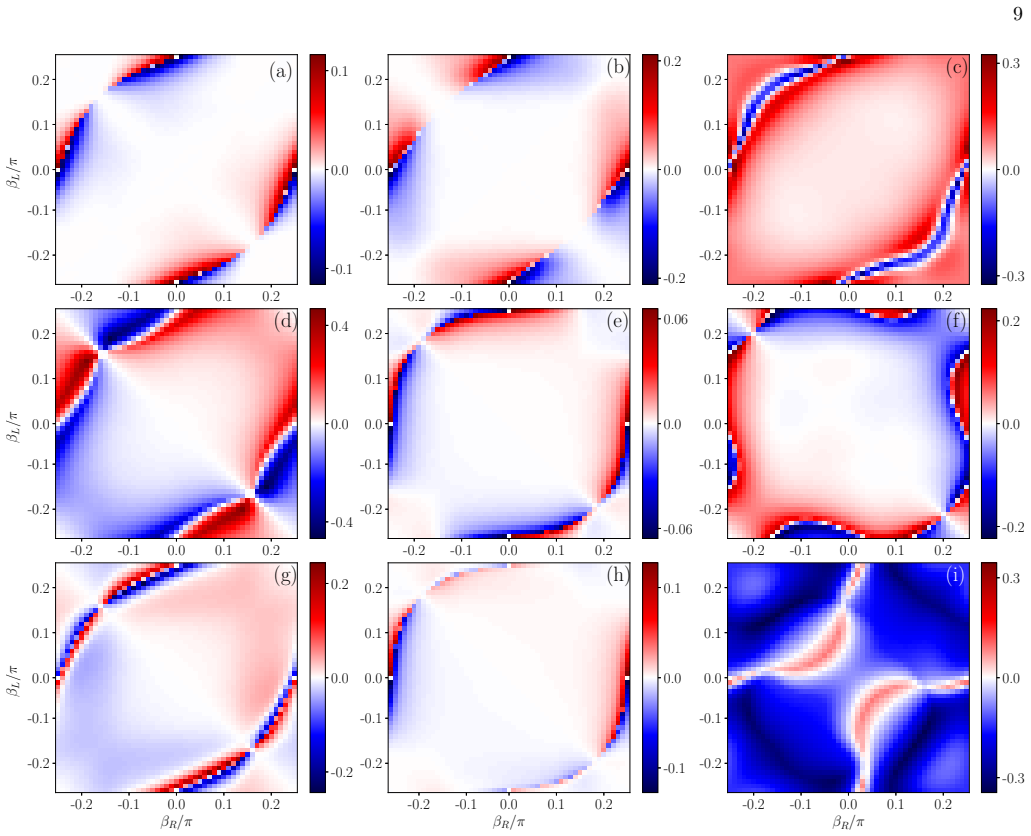
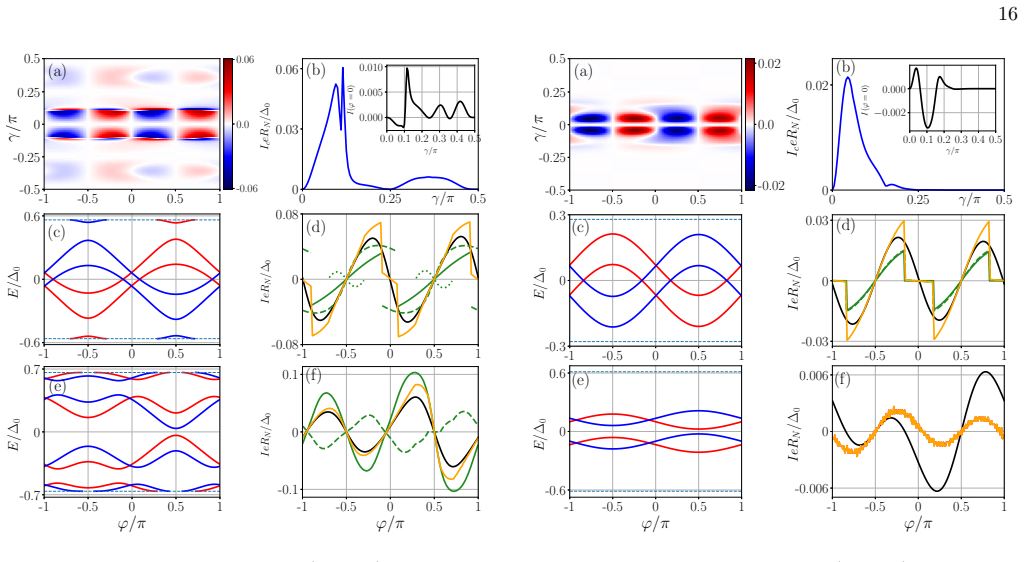
We theoretically investigate the anomalous and diode Josephson effects in planar two-dimensional Josephson junctions with arbitrarily oriented exchange fields in two ferromagnets within the barrier, and spin-orbit coupling at the superconductor/ferromagnet interfaces, where the superconducting electrodes can have $s$-wave or arbitrarily oriented $d$-wave order parameter lobes. We perform a systematic symmetry analysis of the junction Hamiltonian and identify the minimal conditions for breaking time-reversal and space-inversion symmetries, which are required for the emergence of anomalous and diode Josephson effects. We classify the junctions into three classes, with particular attention to those between $d_{x^2-y^2}$ and $d_{xy}$ oriented superconductors. Our symmetry analysis is supported by numerical calculations of the current-phase relation (CPR) obtained using a generalized Furusaki-Tsukada (F-T) approach. By tuning the directions of exchange fields in the ferromagnets, Rashba SOC at the interfaces and superconducting order parameter orientations, nonreciprocity can be enhanced by more than 40\%. We further analyze the phase-dependent Andreev bound states (ABS) spectrum and their contribution to charge transport, as well as their signatures in the nonreciprocal transport characteristics. By comparing the current carried by ABS with that obtained using the F-T technique, we find that the contribution from continuum states above the gap becomes pronounced in presence of zero energy crossings in the ABS spectrum, and in junctions with $d$-wave superconducting electrodes due to the narrower superconducting gap, which may become closed. In the nonreciprocal regime, the ABS spectra show an asymmetric profile with respect to phase inversion, indicating the presence of a finite current at zero phase difference and unequal critical currents in opposite directions.
Editorial analysis
A structured set of objections, weighed in public.
Referee Report
Summary. The manuscript investigates anomalous and diode Josephson effects in planar 2D Josephson junctions with an inhomogeneous ferromagnetic barrier containing two ferromagnets with arbitrarily oriented exchange fields and interfacial Rashba spin-orbit coupling. Superconducting electrodes are s-wave or d-wave with arbitrary lobe orientations. A symmetry analysis of the junction Hamiltonian identifies minimal conditions for breaking time-reversal and inversion symmetries and classifies junctions into three classes, with emphasis on d_{x^2-y^2} and d_{xy} pairings. Numerical current-phase relations are computed via a generalized Furusaki-Tsukada method, showing that tuning exchange-field directions, Rashba SOC strength, and order-parameter orientations enhances nonreciprocity by more than 40%. The work further analyzes phase-dependent Andreev bound states, their asymmetry under phase inversion, and the growing role of continuum states above the gap, especially in d-wave cases where the gap may close.
Significance. If the quantitative results survive self-consistent treatment of the order parameter, the paper would deliver a useful symmetry classification together with concrete numerical evidence for strong tunability of the Josephson diode effect in hybrid ferromagnetic junctions. The >40% enhancement figure, the explicit comparison of ABS versus continuum contributions, and the focus on d-wave orientations with possible gap closure constitute concrete advances that could inform device design. The systematic symmetry analysis and use of an established numerical technique are clear strengths.
major comments (2)
- [Abstract] Abstract: The central quantitative claim that nonreciprocity can be enhanced by more than 40% rests on CPRs obtained with the generalized Furusaki-Tsukada method under fixed superconducting order parameters. The abstract itself notes that in d-wave electrodes the gap 'may become closed', implying that spatial suppression or phase winding of Δ induced by the inhomogeneous barrier and interfacial Rashba SOC could shift zero-energy crossings and alter the extracted diode efficiency. A self-consistent treatment of the order parameter is therefore required to substantiate the tuning result.
- [Abstract] Abstract and numerical section: The reported asymmetry of the ABS spectrum and the pronounced continuum contribution in the presence of zero-energy crossings are physically plausible, yet the manuscript does not specify how the numerical implementation distinguishes continuum states from ABS or demonstrates convergence with respect to the number of transverse modes and discretization parameters. These details are load-bearing for the claim that continuum states dominate the nonreciprocal transport in d-wave junctions.
minor comments (2)
- A schematic diagram showing the junction geometry, the two ferromagnets, the interfacial Rashba regions, and the definitions of the exchange-field angles and d-wave lobe orientations would improve readability.
- The abstract states that the junctions are classified into three classes; an explicit table or short paragraph mapping each class to the minimal symmetry-breaking conditions and to the parameter regimes explored numerically would help the reader connect the symmetry analysis to the CPR results.
Simulated Author's Rebuttal
We thank the referee for the careful reading and constructive comments on our manuscript. We address each major comment below with clarifications on our approach and planned revisions.
read point-by-point responses
-
Referee: [Abstract] Abstract: The central quantitative claim that nonreciprocity can be enhanced by more than 40% rests on CPRs obtained with the generalized Furusaki-Tsukada method under fixed superconducting order parameters. The abstract itself notes that in d-wave electrodes the gap 'may become closed', implying that spatial suppression or phase winding of Δ induced by the inhomogeneous barrier and interfacial Rashba SOC could shift zero-energy crossings and alter the extracted diode efficiency. A self-consistent treatment of the order parameter is therefore required to substantiate the tuning result.
Authors: We thank the referee for this observation. Our numerical results for the current-phase relation and the reported >40% enhancement of nonreciprocity are obtained within the standard fixed-order-parameter approximation, which is widely used to isolate the effects of the inhomogeneous ferromagnetic barrier and interfacial Rashba SOC. The symmetry analysis that classifies the junctions and identifies minimal conditions for breaking time-reversal and inversion symmetries is independent of self-consistency and remains valid. For the parameter regimes we consider, the superconducting gap stays open; the abstract's remark on possible gap closure in d-wave cases is a cautionary note rather than an indication that our quoted enhancement occurs near closure. A fully self-consistent treatment would indeed be desirable for quantitative device modeling but lies beyond the scope of the present work due to the added computational complexity. We will revise the abstract and add a paragraph in the discussion section to explicitly state the fixed-Δ approximation and outline self-consistency as a natural extension. revision: partial
-
Referee: [Abstract] Abstract and numerical section: The reported asymmetry of the ABS spectrum and the pronounced continuum contribution in the presence of zero-energy crossings are physically plausible, yet the manuscript does not specify how the numerical implementation distinguishes continuum states from ABS or demonstrates convergence with respect to the number of transverse modes and discretization parameters. These details are load-bearing for the claim that continuum states dominate the nonreciprocal transport in d-wave junctions.
Authors: We appreciate the request for additional technical detail. In the generalized Furusaki-Tsukada implementation, the total CPR is obtained by summing the contributions of all quasiparticle states (bound and continuum) over the transverse modes. Andreev bound states are identified as the discrete, phase-dependent solutions of the Bogoliubov-de Gennes equation lying inside the gap (|E| < Δ_local). Their current contribution is computed directly from the phase derivative of the bound-state energies. The continuum contribution is then obtained by subtracting the ABS current from the total current. Convergence has been checked explicitly: increasing the number of transverse modes from 50 to 200 and refining the spatial grid from 100 to 500 points alters the extracted diode efficiency by less than 2% for the representative parameter sets. We will insert a short subsection (or appendix) describing this separation procedure and the convergence tests. revision: yes
Circularity Check
Symmetry classification and numerical CPR evaluation are independent of self-defined or fitted inputs
full rationale
The paper's derivation proceeds via explicit symmetry analysis of the junction Hamiltonian (identifying minimal conditions for breaking TRS and IS) followed by direct numerical computation of the CPR using a generalized Furusaki-Tsukada method with fixed order parameters. These steps do not reduce by construction to quantities defined in terms of the target observables, nor do they rely on fitted parameters renamed as predictions. No load-bearing self-citations, uniqueness theorems imported from the authors' prior work, or smuggled ansatzes appear in the provided text. The >40% nonreciprocity enhancement is obtained by varying external parameters (exchange-field directions, Rashba strength, order-parameter orientations) inside the Hamiltonian and recomputing the diode efficiency; the ABS/continuum comparison is a post-hoc diagnostic, not a definitional loop. The fixed-Δ limitation in d-wave cases is a modeling choice affecting accuracy, not a circular reduction.
Axiom & Free-Parameter Ledger
free parameters (3)
- exchange-field directions
- Rashba SOC strength
- d-wave lobe orientations
axioms (2)
- domain assumption The junction can be described by a Bogoliubov-de Gennes Hamiltonian with piecewise-constant exchange fields and interfacial Rashba terms.
- domain assumption The Furusaki-Tsukada scattering method remains accurate for the inhomogeneous barrier geometry and for d-wave gaps that may close.
Reference graph
Works this paper leans on
- [1]
-
[2]
Eschrig, Spin-polarized supercurrents for spintron- ics, Physics Today 64, 43 (2011)
M. Eschrig, Spin-polarized supercurrents for spintron- ics, Physics Today 64, 43 (2011)
work page 2011
-
[3]
J. Linder and J. W. A. Robinson, Superconducting spin- tronics, Nature Physics 11, 307 (2015)
work page 2015
-
[4]
M. Eschrig, Spin-polarized supercurrents for spintron- ics: a review of current progress, Reports on Progress in Physics 78, 104501 (2015)
work page 2015
-
[5]
A. S. Mel’nikov, S. V. Mironov, A. V. Samokhvalov, and A. I. Buzdin, Superconducting spintronics: state of the art and prospects, Phys. Usp. 65, 1248 (2022)
work page 2022
-
[6]
R. Cai, I. Žutić, and W. Han, Superconduc- tor/ferromagnet heterostructures: A platform for su- perconducting spintronics and quantum computation, Advanced Quantum Technologies 6, 2200080 (2023)
work page 2023
-
[7]
S. De Franceschi, L. Kouwenhoven, C. Schönenberger, and W. Wernsdorfer, Hybrid superconductor–quantum dot devices, Nature Nanotechnology 5, 703 (2010)
work page 2010
-
[8]
M. H. Devoret and R. J. Schoelkopf, Superconducting circuits for quantum information: An outlook, Science 339, 1169 (2013)
work page 2013
-
[9]
T. Golod and V. M. Krasnov, Demonstration of a su- perconducting diode-with-memory, operational at zero magnetic field with switchable nonreciprocity, Nature Communications 13, 3658 (2022)
work page 2022
-
[10]
S. Alam, M. S. Hossain, S. R. Srinivasa, and A. Aziz, Cryogenic memory technologies, Nature Electronics 6, 185 (2023)
work page 2023
-
[11]
A. I. Buzdin, Proximity effects in superconductor- ferromagnet heterostructures, Reviews of Modern Physics 77, 935 (2005)
work page 2005
-
[12]
F. S. Bergeret, A. F. Volkov, and K. B. Efetov, Odd triplet superconductivity and related phenomena in superconductor-ferromagnet structures, Reviews of Modern Physics 77, 1321 (2005)
work page 2005
-
[13]
B. D. Josephson, Possible new effects in superconductive tunnelling, Physics Letters 1, 251 (1962)
work page 1962
-
[14]
A. A. Golubov, M. Y. Kupriyanov, and E. Il’ichev, The current-phase relation in Josephson junctions, Reviews of Modern Physics 76, 411 (2004)
work page 2004
-
[15]
A. I. Buzdin, L. N. Bulaevskii, and S. V. Panyukov, Critical-current oscillations as a function of the ex- change field and thickness of the ferromagnetic metal (F) in an S-F-S Josephson junction, JETP Lett. (Engl. Transl.); (United States) 35:4 (1982)
work page 1982
-
[16]
Y. Tanaka and S. Kashiwaya, Theory of Joseph- son effect in superconductor-ferromagnetic-insulator- superconductor junction, Physica C: Superconductivity 274, 357 (1997)
work page 1997
-
[17]
V. V. Ryazanov, V. A. Oboznov, A. Y. Rusanov, A. V. 23 Veretennikov, A. A. Golubov, and J. Aarts, Coupling of two superconductors through a ferromagnet: Evidence for a π junction, Phys. Rev. Lett. 86, 2427 (2001)
work page 2001
- [18]
-
[19]
Y. Blum, A. Tsukernik, M. Karpovski, and A. Palevski, Oscillations of the superconducting critical current in Nb-Cu-Ni-Cu-Nb junctions, Phys. Rev. Lett. 89, 187004 (2002)
work page 2002
-
[20]
D. J. Van Harlingen, Phase-sensitive tests of the sym- metry of the pairing state in the high-temperature superconductors—Evidence for dx2−y2 symmetry, Rev. Mod. Phys. 67, 515 (1995)
work page 1995
-
[21]
Y. Tanaka and S. Kashiwaya, Theory of the Joseph- son effect in d-wave superconductors, Phys. Rev. B 53, R11957 (1996)
work page 1996
-
[22]
Y. Tanaka and S. Kashiwaya, Theory of Josephson ef- fects in anisotropic superconductors, Phys. Rev. B 56, 892 (1997)
work page 1997
-
[23]
Asano, Numerical method for dc Josephson cur- rent between d-wave superconductors, Phys
Y. Asano, Numerical method for dc Josephson cur- rent between d-wave superconductors, Phys. Rev. B 63, 052512 (2001)
work page 2001
-
[24]
T. Löfwander, V. S. Shumeiko, and G. Wendin, Andreev bound states in high-Tc superconducting junctions, Su- perconductor Science and Technology 14, R53 (2001)
work page 2001
-
[25]
E. Il’ichev, M. Grajcar, R. Hlubina, R. P. J. IJssel- steijn, H. E. Hoenig, H.-G. Meyer, A. Golubov, M. H. S. Amin, A. M. Zagoskin, A. N. Omelyanchouk, and M. Y. Kupriyanov, Degenerate ground state in a meso- scopic YBa2Cu3O7−x grain boundary Josephson junc- tion, Phys. Rev. Lett. 86, 5369 (2001)
work page 2001
- [26]
-
[27]
S. Djurdjević and Z. Popović, Influence of d-wave super- conductor orientation on Josephson current and phase difference in junctions with inhomogeneous ferromag- net, Progress of Theoretical and Experimental Physics 2021, 083I02 (2021)
work page 2021
-
[28]
Yip, Josephson current-phase relationships with un- conventional superconductors, Phys
S. Yip, Josephson current-phase relationships with un- conventional superconductors, Phys. Rev. B 52, 3087 (1995)
work page 1995
-
[29]
M. Sigrist, Time-reversal symmetry breaking states in high-temperature superconductors, Progress of Theo- retical Physics 99, 899 (1998)
work page 1998
-
[30]
S. Kashiwaya and Y. Tanaka, Tunnelling effects on sur- face bound states in unconventional superconductors, Reports on Progress in Physics 63, 1641 (2000)
work page 2000
-
[31]
A. Buzdin, Direct coupling between magnetism and su- perconducting current in the Josephson φ0 junction, Phys. Rev. Lett. 101, 107005 (2008)
work page 2008
-
[32]
A. Zazunov, R. Egger, T. Jonckheere, and T. Martin, Anomalous Josephson current through a spin-orbit cou- pled quantum dot, Phys. Rev. Lett. 103, 147004 (2009)
work page 2009
-
[33]
A. A. Reynoso, G. Usaj, C. A. Balseiro, D. Feinberg, and M. A vignon, Anomalous Josephson current in junctions with spin polarizing quantum point contacts, Phys. Rev. Lett. 101, 107001 (2008)
work page 2008
- [34]
- [35]
-
[36]
A. A. Reynoso, G. Usaj, C. A. Balseiro, D. Feinberg, and M. A vignon, Spin-orbit-induced chirality of An- dreev states in Josephson junctions, Phys. Rev. B 86, 214519 (2012)
work page 2012
-
[37]
A. Brunetti, A. Zazunov, A. Kundu, and R. Egger, Anomalous Josephson current, incipient time-reversal symmetry breaking, and Majorana bound states in in- teracting multilevel dots, Phys. Rev. B 88, 144515 (2013)
work page 2013
-
[38]
T. Yokoyama, M. Eto, and Y. V. Nazarov, Anomalous Josephson effect induced by spin-orbit interaction and Zeeman effect in semiconductor nanowires, Phys. Rev. B 89, 195407 (2014)
work page 2014
-
[39]
F. Konschelle, I. V. Tokatly, and F. S. Bergeret, Theory of the spin-galvanic effect and the anomalous phase shift φ0 in superconductors and Josephson junctions with intrinsic spin-orbit coupling, Phys. Rev. B 92, 125443 (2015)
work page 2015
-
[40]
F. S. Bergeret and I. V. Tokatly, Theory of diffusive φ0 Josephson junctions in the presence of spin-orbit cou- pling, Europhysics Letters 110, 57005 (2015)
work page 2015
-
[41]
B. Lu, K. Yada, A. A. Golubov, and Y. Tanaka, Anoma- lous Josephson effect in d-wave superconductor junc- tions on a topological insulator surface, Phys. Rev. B 92, 100503 (2015)
work page 2015
-
[42]
K. N. Nesterov, M. Houzet, and J. S. Meyer, Anomalous Josephson effect in semiconducting nanowires as a sig- nature of the topologically nontrivial phase, Phys. Rev. B 93, 174502 (2016)
work page 2016
-
[43]
M. A. Silaev, I. V. Tokatly, and F. S. Bergeret, Anoma- lous current in diffusive ferromagnetic Josephson junc- tions, Phys. Rev. B 95, 184508 (2017)
work page 2017
-
[44]
M. Minutillo, D. Giuliano, P. Lucignano, A. Taglia- cozzo, and G. Campagnano, Anomalous Josephson ef- fect in S/SO/F/S heterostructures, Phys. Rev. B 98, 144510 (2018)
work page 2018
-
[45]
M. Alidoust, C. Shen, and I. Žutić, Cubic spin-orbit coupling and anomalous Josephson effect in planar junc- tions, Phys. Rev. B 103, L060503 (2021)
work page 2021
-
[46]
H. Meng, X. Wu, Y. Ren, and J. Wu, Anomalous su- percurrent modulated by interfacial magnetizations in Josephson junctions with ferromagnetic bilayers, Phys. Rev. B 106, 174502 (2022)
work page 2022
-
[47]
J. Hu, C. Wu, and X. Dai, Proposed design of a Joseph- son diode, Phys. Rev. Lett. 99, 067004 (2007)
work page 2007
-
[48]
A. Rasmussen, J. Danon, H. Suominen, F. Nichele, M. Kjaergaard, and K. Flensberg, Effects of spin-orbit coupling and spatial symmetries on the Josephson cur- rent in SNS junctions, Phys. Rev. B 93, 155406 (2016)
work page 2016
-
[49]
K. Misaki and N. Nagaosa, Theory of the nonreciprocal Josephson effect, Phys. Rev. B 103, 245302 (2021)
work page 2021
-
[50]
M. Davydova, S. Prembabu, and L. Fu, Universal Josephson diode effect, Science Advances 8, eabo0309 (2022)
work page 2022
- [51]
-
[52]
J. J. He, Y. Tanaka, and N. Nagaosa, A phenomeno- logical theory of superconductor diodes, New Journal of Physics 24, 053014 (2022) . 24
work page 2022
-
[53]
K. Iang and J. Hu, Superconducting diode effects, Na- ture Physics 18, 1145 (2022)
work page 2022
- [54]
- [55]
-
[56]
A. S. Osin, A. Levchenko, and M. Khodas, Anomalous Josephson diode effect in superconducting multilayers, Phys. Rev. B 109, 184512 (2024)
work page 2024
-
[57]
F. Ando, Y. Miyasaka, T. Li, S. Arakawa, Y. Shiota, T. Moriyama, T. Ono, T. Yokoyama, Y. Nakamura, and E. Saitoh, Observation of superconducting diode effect, Nature 584, 373 (2020)
work page 2020
-
[58]
C. Baumgartner, L. Fuchs, A. Costa, S. Reinhardt, S. Gronin, G. C. Gardner, T. Lindemann, M. J. Manfra, P. E. Faria Junior, D. Kochan, J. Fabian, N. Paradiso, and C. Strunk, Supercurrent rectification and magne- tochiral effects in symmetric Josephson junctions, Na- ture Nanotechnology 17, 39 (2022)
work page 2022
- [59]
-
[60]
T. H. Kokkeler, A. A. Golubov, and F. S. Berg- eret, Field-free anomalous junction and superconduct- ing diode effect in spin-split superconductor/topological insulator junctions, Phys. Rev. B 106, 214504 (2022)
work page 2022
-
[61]
C. Baumgartner, L. Fuchs, A. Costa, J. Picó-Cortés, S. Reinhardt, S. Gronin, G. C. Gardner, T. Lindemann, M. J. Manfra, P. E. Faria Junior, D. Kochan, J. Fabian, N. Paradiso, and C. Strunk, Effect of Rashba and Dres- selhaus spin–orbit coupling on supercurrent rectifica- tion and magnetochiral anisotropy of ballistic Joseph- son junctions, Journal of Phys...
work page 2022
-
[62]
H. Wu, Y. Wang, Y. Xu, J. Liu, Q. Zhang, S. Zhao, H. Chen, Z. Lin, P. Li, T. Cao, X. Zhang, P. Jarillo- Herrero, and L. He, The field-free Josephson diode in a van der Waals heterostructure, Nature 604, 653 (2022)
work page 2022
-
[63]
B. Pal, A. Chakraborty, P. K. Sivakumar, M. Davydova, A. K. Gopi, A. K. Pandeya, J. A. Krieger, Y. Zhang, M. Date, S. Ju, N. Yuan, N. B. M. Schröter, L. Fu, and S. S. P. Parkin, Josephson diode effect from Cooper pair momentum in a topological semimetal, Nature Physics 18, 1228 (2022)
work page 2022
- [64]
-
[65]
K. R. Jeon, J. K. Kim, J. Yoon, G. H. Lee, K. M. Song, S. J. Kim, J. H. Park, Y. J. Shin, S. Lee, M. S. Choi, T. Y. Kim, and C. S. Hwang, Zero-field polarity- reversible Josephson supercurrent diodes enabled by a proximity-magnetized Pt barrier, Nature Materials 21, 1008 (2022)
work page 2022
- [66]
-
[67]
B. Lu, S. Ikegaya, P. Burset, Y. Tanaka, and N. Na- gaosa, Tunable Josephson diode effect on the surface of topological insulators, Phys. Rev. Lett. 131, 096001 (2023)
work page 2023
- [68]
- [69]
-
[70]
N. Lotfizadeh, W. F. Schiela, B. Pekerten, A. Banerjee, M. C. Dartiailh, A. Matos-Abiague, and J. Shabani, Su- perconducting diode effect sign change in epitaxial Al- InAs Josephson junctions, Communications Physics 7, 120 (2024)
work page 2024
-
[71]
J. Wang, Y. Jiang, J. J. Wang, and J.-F. Liu, Efficient Josephson diode effect on a two-dimensional topological insulator with asymmetric magnetization, Phys. Rev. B 109, 075412 (2024)
work page 2024
-
[72]
S. Ilić, P. Virtanen, D. Crawford, T. T. Heikkilä, and F. S. Bergeret, Superconducting diode effect in diffusive superconductors and Josephson junctions with Rashba spin-orbit coupling, Phys. Rev. B 110, L140501 (2024)
work page 2024
-
[73]
N. L. Schulz, D. Nikolić, and M. Eschrig, Quantum- geometric spin and charge Josephson diode effects, Phys. Rev. B 112, 104514 (2025)
work page 2025
- [74]
-
[75]
S. Djurdjević and Z. Popović, Josephson diode effect in d-wave superconductor/ferromagnet/d-wave supercon- ductor junction with interfacial Rashba spin–orbit cou- pling, Progress of Theoretical and Experimental Physics 2025, 103I01 (2025)
work page 2025
-
[76]
B. Zhang, Z. Li, V. Aguilar, P. Zhang, M. Pendharkar, C. Dempsey, J. S. Lee, S. D. Harrington, S. Tan, J. S. Meyer, M. Houzet, C. J. Palmstrom, and S. M. Frolov, Evidence of ϕ0-Josephson junction from skewed diffrac- tion patterns in Sn-InSb nanowires, SciPost Phys. 18, 013 (2025)
work page 2025
-
[77]
D. Wang, Q.-H. Wang, and C. Wu, Josephson diode effect: a phenomenological perspective (2025), arXiv:2506.23200 [cond-mat.supr-con]
- [78]
-
[79]
J. Cayao and M. Sato, Nonlocal Josephson diode effect in minimal Kitaev chains, Phys. Rev. Res. 8, 013326 (2026)
work page 2026
-
[80]
J. Bardeen and J. L. Johnson, Josephson current flow in pure superconducting-normal-superconducting junc- tions, Phys. Rev. B 5, 72 (1972)
work page 1972
discussion (0)
Sign in with ORCID, Apple, or X to comment. Anyone can read and Pith papers without signing in.