Recognition: 2 theorem links
· Lean TheoremTheory of Spin-splitter Magnetoresistance in Altermagnets
Pith reviewed 2026-05-12 04:07 UTC · model grok-4.3
The pith
Spin-splitter magnetoresistance in metallic altermagnets depends only on the relative angle between magnetization and Néel vector, shows opposite-sign longitudinal response, and has proportional longitudinal and transverse signals.
A machine-rendered reading of the paper's core claim, the machinery that carries it, and where it could break.
Core claim
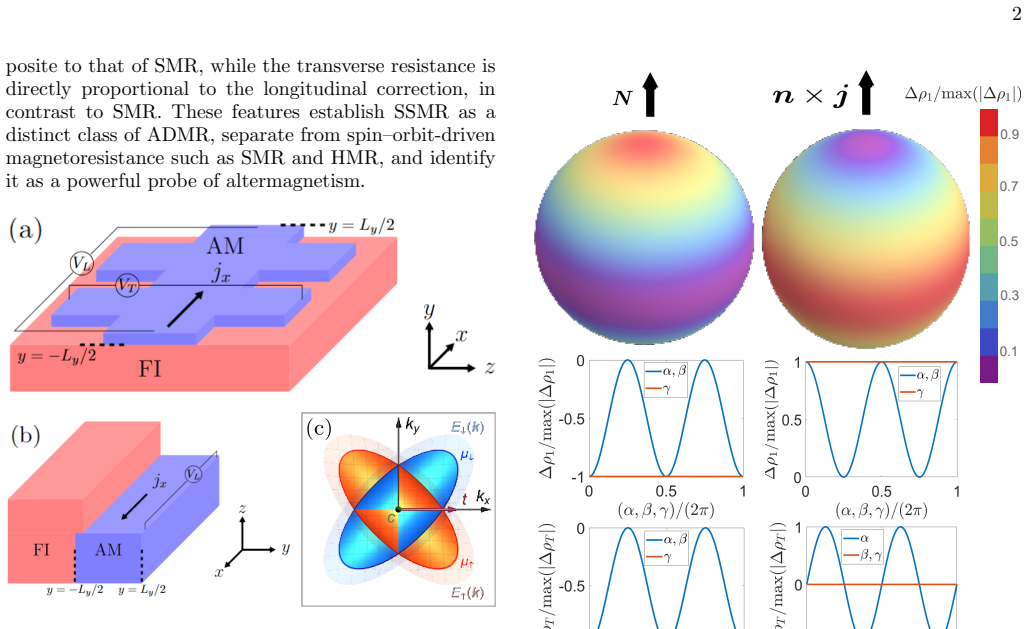
In a metallic altermagnet interfaced with a ferromagnetic insulator the angle-dependent magnetoresistance takes the form of spin-splitter magnetoresistance generated by the exchange coupling between the altermagnet's spin-split bands and the insulator magnetization. This resistance depends only on the relative angle between the ferromagnetic magnetization and the altermagnetic Néel vector, produces a longitudinal response of opposite sign to that found in spin-Hall magnetoresistance, and yields longitudinal and transverse components that are directly proportional.
What carries the argument
Spin-splitter magnetoresistance (SSMR) at the altermagnet-ferromagnetic insulator interface, arising from the altermagnet's spin splitting and its exchange coupling to the adjacent magnetization.
If this is right
- SSMR provides an unambiguous transport signature for identifying collinear altermagnetism in metallic systems.
- The longitudinal component of the angle-dependent magnetoresistance has the opposite sign to the conventional spin-Hall case.
- Longitudinal and transverse angle-dependent magnetoresistance signals are directly proportional under SSMR but not under spin-Hall magnetoresistance.
- The resistance depends solely on the relative orientation of the ferromagnetic magnetization and the altermagnetic Néel vector.
Where Pith is reading between the lines
- Transport measurements alone could serve as a practical method to confirm altermagnetic order in metallic samples.
- The predicted proportionality and sign reversal offer concrete experimental checks that can be performed on bilayer devices.
- Similar distinctions may appear in other hybrid structures that combine altermagnets with insulating magnets.
- Real-device interface disorder could reduce the visibility of the predicted signatures.
Load-bearing premise
The interface transport is governed by the altermagnet's spin splitting and its coupling to the ferromagnet without confounding contributions from spin-orbit coupling or disorder that could produce similar angular dependencies.
What would settle it
Observation of a longitudinal angle-dependent magnetoresistance signal with the same sign as in conventional spin-Hall magnetoresistance, or absence of direct proportionality between longitudinal and transverse signals, in an altermagnet-ferromagnetic insulator structure would contradict the predicted distinctions.
Figures

read the original abstract
We develop a theory of angle-dependent magnetoresistance (ADMR) in metallic altermagnets coupled to ferromagnetic insulators and establish criteria that distinguish them from conventional compensated magnets with spin-orbit coupling. We show that the spin-splitter magnetoresistance (SSMR) reported by H. Chen et al. [Adv. Mater. 37, 2507764 (2025)] constitutes a smoking-gun signature of collinear altermagnetism in metallic systems. In contrast to spin-Hall magnetoresistance (SMR), SSMR exhibits three key distinctions: it depends solely on the relative orientation between the ferromagnetic magnetization and the altermagnetic N\'eel vector, yields a longitudinal ADMR response of opposite sign, and features a direct proportionality between longitudinal and transverse ADMR signals, absent in SMR. These results provide a clear route to unambiguously identify altermagnets in transport.
Editorial analysis
A structured set of objections, weighed in public.
Referee Report
Summary. The manuscript develops a symmetry-based transport theory for angle-dependent magnetoresistance (ADMR) at the interface between a metallic altermagnet and a ferromagnetic insulator. It derives the angular dependence of the spin-splitter magnetoresistance (SSMR) and establishes three distinguishing criteria from conventional spin-Hall magnetoresistance (SMR): sole dependence on the relative orientation of the ferromagnetic magnetization and altermagnetic Néel vector, opposite sign in the longitudinal ADMR response, and direct proportionality between longitudinal and transverse ADMR signals. These features are presented as smoking-gun signatures for identifying collinear altermagnetism in metallic systems.
Significance. If the central derivations hold, the work provides a clear, falsifiable route to distinguish altermagnets from compensated magnets with spin-orbit coupling via transport measurements, directly addressing recent experimental reports of SSMR. The symmetry-based construction of the conductivity tensor yields parameter-free angular dependencies in the ideal limit, offering strong predictive power without fitted parameters.
minor comments (2)
- The abstract and introduction would benefit from a brief explicit statement of the key assumptions in the interface transport model (e.g., absence of additional SOC or disorder terms) to make the scope of the distinctions immediately clear to readers.
- Notation for the Néel vector and magnetization directions should be standardized across figures and equations to avoid any ambiguity in the angular dependence plots.
Simulated Author's Rebuttal
We thank the referee for their positive assessment of our manuscript, including the recognition that our symmetry-based theory provides clear, falsifiable criteria to distinguish spin-splitter magnetoresistance in altermagnets from conventional spin-Hall magnetoresistance. We appreciate the recommendation for minor revision.
Circularity Check
No significant circularity; derivation is forward from model to signatures
full rationale
The manuscript constructs a symmetry-based transport model for the metallic altermagnet/ferromagnetic-insulator interface and derives the angular dependence of the conductivity tensor from spin-splitter scattering terms. The three claimed distinctions (sole dependence on relative M/N orientation, opposite-sign longitudinal ADMR, and direct longitudinal-transverse proportionality) emerge directly as consequences of that tensor without any fitted parameters, self-referential definitions, or load-bearing self-citations. The reference to Chen et al. is an external experimental report being interpreted, not an internal premise. No step reduces by construction to its own inputs; the central results are independent predictions of the chosen Hamiltonian and scattering assumptions.
Axiom & Free-Parameter Ledger
Lean theorems connected to this paper
-
IndisputableMonolith/Cost/FunctionalEquation.leanwashburn_uniqueness_aczel unclear?
unclearRelation between the paper passage and the cited Recognition theorem.
We compute the longitudinal and transverse resistances... ρ_L = σ^{-1} + Δρ_L and ρ_T = T_yz / T_xy Δρ_L with Δρ_L containing tanh(L_y / 2 l_s∥) and sin²φ terms
-
IndisputableMonolith/Foundation/RealityFromDistinction.leanreality_from_one_distinction unclear?
unclearRelation between the paper passage and the cited Recognition theorem.
For d-wave altermagnets, the charge and spin current densities... j_k = σ/e (∂_k μ + 1/2 N_a T_kj ∂_j μ_s^a)
What do these tags mean?
- matches
- The paper's claim is directly supported by a theorem in the formal canon.
- supports
- The theorem supports part of the paper's argument, but the paper may add assumptions or extra steps.
- extends
- The paper goes beyond the formal theorem; the theorem is a base layer rather than the whole result.
- uses
- The paper appears to rely on the theorem as machinery.
- contradicts
- The paper's claim conflicts with a theorem or certificate in the canon.
- unclear
- Pith found a possible connection, but the passage is too broad, indirect, or ambiguous to say the theorem truly supports the claim.
Reference graph
Works this paper leans on
- [1]
-
[2]
T. Jungwirth, R. M. Fernandes, J. Sinova, and L. Smejkal, arXiv preprint arXiv:2409.10034 10.48550/arXiv.2409.10034 (2024)
-
[3]
R. Zarzuela, R. Jaeschke-Ubiergo, O. Gomonay, L. ˇSmejkal, and J. Sinova, Phys. Rev. B111, 064422 (2025)
work page 2025
-
[4]
M. Leivisk¨ a, J. Rial, A. Bad’ura, R. L. Seeger, I. Kounta, S. Beckert, D. Kriegner, I. Joumard, E. Schmoranzerov´ a, J. Sinova, O. Gomonay, A. Thomas, S. T. B. Goennen- wein, H. Reichlov´ a, L.ˇSmejkal, L. Michez, T. c. v. Jung- wirth, and V. Baltz, Phys. Rev. B109, 224430 (2024)
work page 2024
- [5]
-
[6]
F. Liu, Z. Zhang, X. Yuan, Y. Liu, S. Zhu, Z. Lu, and R. Xiong, Phys. Rev. B110, 134437 (2024)
work page 2024
-
[7]
T. Kokkeler, I. Tokatly, and F. S. Bergeret, SciPost Phys. 18, 178 (2025)
work page 2025
-
[8]
M. Naka, Y. Motome, T. Miyazaki, and H. Seo, Journal of the Physical Society of Japan94, 083702 (2025)
work page 2025
-
[9]
N. Sigales, T. Kokkeler, G. De Polsi, and S. Bergeret, arXiv preprint arXiv:2602.07779 10.48550/arXiv.2602.07779 (2026)
- [10]
-
[11]
S. Das, D. Suri, and A. Soori, Journal of Physics: Con- densed Matter35, 435302 (2023)
work page 2023
-
[12]
Gonz´ alez-Hern´ andez, L.ˇSmejkal, K
R. Gonz´ alez-Hern´ andez, L.ˇSmejkal, K. V´ yborn´ y, Y. Ya- hagi, J. Sinova, T. Jungwirth, and J. ˇZelezn´ y, Phys. Rev. Lett.126, 127701 (2021)
work page 2021
-
[13]
R. He, Z. Duan, B. Lei, N. Luo, J. Zeng, K.-Q. Chen, and L.-M. Tang, Phys. Rev. B112, 064423 (2025)
work page 2025
-
[14]
A. Herasymchuk, K. B. Hallberg, E. W. Hodt, J. Lin- der, E. V. Gorbar, and P. Sukhachov, Phys. Rev. B112, L220404 (2025)
work page 2025
-
[15]
K. B. Hallberg, E. W. Hodt, and J. Linder, Phys. Rev. B111, 174431 (2025). 7
work page 2025
-
[16]
E. W. Hodt, A. Qaiumzadeh, and J. Linder, Phys. Rev. B113, 054403 (2026)
work page 2026
-
[17]
R. de las Heras, T. Kokkeler, S. Ili´ c, I. V. Tokatly, and F. S. Bergeret, Phys. Rev. B113, 144516 (2026)
work page 2026
-
[18]
S. Reimers, L. Odenbreit, L. ˇSmejkal, V. N. Strocov, P. Constantinou, A. B. Hellenes, R. Jaeschke Ubiergo, W. H. Campos, V. K. Bharadwaj, A. Chakraborty,et al., Nature Communications15, 2116 (2024)
work page 2024
-
[19]
O. Fedchenko, J. Min´ ar, A. Akashdeep, S. W. D’Souza, D. Vasilyev, O. Tkach, L. Odenbreit, Q. Nguyen, D. Kut- nyakhov, N. Wind,et al., Science advances10, eadj4883 (2024)
work page 2024
-
[20]
C. He, Z. Wen, J. Okabayashi, Y. Miura, T. Ma, T. Ohkubo, T. Seki, H. Sukegawa, and S. Mitani, Na- ture Communications16, 8235 (2025)
work page 2025
-
[21]
J. Mencos, A. Badura, E. Dolan, S. Beckert, R. Gonzalez- Hernandez, I. Kounta, M. Petit, C. Guillemard, A. B. Hellenes, W. Campos,et al., arXiv preprint arXiv:2512.17427 10.48550/arXiv.2512.17427 (2025)
-
[22]
Y. Guo, J. Zhang, Z. Zhu, Y.-y. Jiang, L. Jiang, C. Wu, J. Dong, X. Xu, W. He, B. He,et al., Advanced Science , 2400967 (2024)
work page 2024
-
[23]
H. Chen, Z.-A. Wang, P. Qin, Z. Meng, X. Zhou, X. Wang, L. Liu, G. Zhao, Z. Duan, T. Zhang,et al., Advanced Materials37, 2507764 (2025)
work page 2025
- [24]
-
[25]
A. B. Hellenes, T. Jungwirth, J. Sinova, and L. ˇSmejkal, arXiv preprint arXiv:2309.01607v3 10.48550/arXiv.2309.01607 (2023)
-
[26]
R. D. Gonzalez Betancourt, J. Zub´ ac, K. Geishendorf, P. Ritzinger, B. Ruuzickov´ a, T. Kotte, J. Velezn` y, K. Olejn´ ık, G. Springholz, B. B¨ uchner,et al., npj Spin- tronics2, 45 (2024)
work page 2024
-
[27]
Y.-F. Sun, Y. Mao, Y.-C. Zhuang, and Q.-F. Sun, Phys. Rev. B112, 094411 (2025)
work page 2025
-
[28]
Thomson, Proceedings of the Royal Society of London , 546 (1857)
W. Thomson, Proceedings of the Royal Society of London , 546 (1857)
-
[29]
M. N. Baibich, J. M. Broto, A. Fert, F. N. Van Dau, F. Petroff, P. Etienne, G. Creuzet, A. Friederich, and J. Chazelas, Phys. Rev. Lett.61, 2472 (1988)
work page 1988
-
[30]
G. Binasch, P. Gr¨ unberg, F. Saurenbach, and W. Zinn, Phys. Rev. B39, 4828 (1989)
work page 1989
-
[31]
R. E. Camley and J. Barna´ s, Phys. Rev. Lett.63, 664 (1989)
work page 1989
-
[32]
Julliere, Physics Letters A54, 225 (1975)
M. Julliere, Physics Letters A54, 225 (1975)
work page 1975
-
[33]
M. I. Dyakonov, Phys. Rev. Lett.99, 126601 (2007)
work page 2007
-
[34]
S. V´ elez, V. N. Golovach, A. Bedoya-Pinto, M. Isasa, E. Sagasta, M. Abadia, C. Rogero, L. E. Hueso, F. S. Bergeret, and F. Casanova, Phys. Rev. Lett.116, 016603 (2016)
work page 2016
-
[36]
Y.-T. Chen, S. Takahashi, H. Nakayama, M. Althammer, S. T. B. Goennenwein, E. Saitoh, and G. E. W. Bauer, Phys. Rev. B87, 144411 (2013)
work page 2013
-
[37]
C. Hahn, G. de Loubens, O. Klein, M. Viret, V. V. Nale- tov, and J. Ben Youssef, Phys. Rev. B87, 174417 (2013)
work page 2013
-
[38]
M. Althammer, S. Meyer, H. Nakayama, M. Schreier, S. Altmannshofer, M. Weiler, H. Huebl, S. Gepr¨ ags, M. Opel, R. Gross, D. Meier, C. Klewe, T. Kuschel, J.-M. Schmalhorst, G. Reiss, L. Shen, A. Gupta, Y.-T. Chen, G. E. W. Bauer, E. Saitoh, and S. T. B. Goennenwein, Phys. Rev. B87, 224401 (2013)
work page 2013
-
[39]
M. Isasa, A. Bedoya-Pinto, S. V´ elez, F. Gol- mar, F. S´ anchez, L. E. Hueso, J. Fontcuberta, and F. Casanova, Applied Physics Letters105, 10.1063/1.4897544 (2014)
-
[40]
S. Meyer, M. Althammer, S. Gepr¨ ags, M. Opel, R. Gross, and S. T. Goennenwein, Applied Physics Letters104, 10.1063/1.4885086 (2014)
-
[41]
S. R. Marmion, M. Ali, M. McLaren, D. A. Williams, and B. J. Hickey, Phys. Rev. B89, 220404 (2014)
work page 2014
-
[42]
J. Kim, P. Sheng, S. Takahashi, S. Mitani, and M. Hayashi, Phys. Rev. Lett.116, 097201 (2016)
work page 2016
-
[43]
S. V´ elez, V. N. Golovach, J. M. Gomez-Perez, A. Chuvilin, C. T. Bui, F. Rivadulla, L. E. Hueso, F. S. Bergeret, and F. Casanova, Phys. Rev. B100, 180401 (2019)
work page 2019
-
[44]
K.-i. Uchida, Z. Qiu, T. Kikkawa, R. Iguchi, and E. Saitoh, Applied Physics Letters106, 10.1063/1.4907546 (2015)
- [45]
-
[46]
H. Nakayama, M. Althammer, Y.-T. Chen, K. Uchida, Y. Kajiwara, D. Kikuchi, T. Ohtani, S. Gepr¨ ags, M. Opel, S. Takahashi, R. Gross, G. E. W. Bauer, S. T. B. Goennenwein, and E. Saitoh, Phys. Rev. Lett. 110, 206601 (2013)
work page 2013
- [47]
-
[48]
F. S. Bergeret and I. V. Tokatly, Phys. Rev. Lett.110, 117003 (2013)
work page 2013
-
[49]
M. M. Vasiakin and A. S. Mel’nikov, Phys. Rev. B111, L100502 (2025)
work page 2025
-
[50]
Kitz, physica status solidi (b)10, 455 (1965)
A. Kitz, physica status solidi (b)10, 455 (1965)
work page 1965
-
[51]
W. Brinkman and R. Elliott, Journal of Applied Physics 37, 1457 (1966)
work page 1966
-
[52]
W. Brinkman and R. J. Elliott, Proceedings of the Royal Society of London. Series A. Mathematical and Physical Sciences294, 343 (1966)
work page 1966
-
[53]
D. B. Litvin and W. Opechowski, Physica76, 538 (1974)
work page 1974
-
[54]
D. B. Litvin, Acta Crystallographica Section A: Crystal Physics, Diffraction, Theoretical and General Crystallog- raphy33, 279 (1977)
work page 1977
-
[55]
P. Liu, J. Li, J. Han, X. Wan, and Q. Liu, Phys. Rev. X 12, 021016 (2022)
work page 2022
- [56]
-
[57]
X. Chen, J. Ren, Y. Zhu, Y. Yu, A. Zhang, P. Liu, J. Li, Y. Liu, C. Li, and Q. Liu, Phys. Rev. X14, 031038 (2024)
work page 2024
-
[58]
Z. Xiao, J. Zhao, Y. Li, R. Shindou, and Z.-D. Song, Phys. Rev. X14, 031037 (2024)
work page 2024
-
[59]
K. Shinohara, A. Togo, H. Watanabe, T. Nomoto, I. Tanaka, and R. Arita, Acta Crystallograph- ica Section A: Foundations and Advances80, 10.1107/S2053273323009257 (2024)
- [60]
- [61]
-
[62]
M. B. Lifshits and M. I. Dyakonov, Phys. Rev. Lett.103, 186601 (2009)
work page 2009
-
[63]
A. Brataas, Y. V. Nazarov, and G. E. Bauer, Physical Review Letters84, 2481 (2000). 8
work page 2000
-
[64]
F. K. Dejene, N. Vlietstra, D. Luc, X. Waintal, J. Ben Youssef, and B. J. van Wees, Phys. Rev. B91, 100404 (2015)
work page 2015
-
[65]
T. Shang, Q. Zhan, H. Yang, Z. Zuo, Y. Xie, L. Liu, S. Zhang, Y. Zhang, H. Li, B. Wang,et al., Applied Physics Letters109, 10.1063/1.4959573 (2016)
-
[66]
D. Hou, Z. Qiu, J. Barker, K. Sato, K. Yamamoto, S. V´ elez, J. M. Gomez-Perez, L. E. Hueso, F. Casanova, and E. Saitoh, Phys. Rev. Lett.118, 147202 (2017)
work page 2017
-
[67]
G. R. Hoogeboom, A. Aqeel, T. Kuschel, T. Palstra, and B. J. van Wees, Applied Physics Letters111, 10.1063/1.4997588 (2017)
-
[68]
L. Baldrati, A. Ross, T. Niizeki, C. Schneider, R. Ramos, J. Cramer, O. Gomonay, M. Filianina, T. Savchenko, D. Heinze, A. Kleibert, E. Saitoh, J. Sinova, and M. Kl¨ aui, Phys. Rev. B98, 024422 (2018)
work page 2018
- [69]
-
[70]
J. Fischer, M. Althammer, N. Vlietstra, H. Huebl, S. T. Goennenwein, R. Gross, S. Gepr¨ ags, and M. Opel, Phys. Rev. Appl.13, 014019 (2020)
work page 2020
-
[71]
Y. Wu, J. Zhou, X. Shi, Y. Liu, Q. Liu, K. K. Meng, J. K. Chen, X. G. Xu, Y. Jiang, and M. Yang, Advanced Functional Materials , 2425280 (2025)
work page 2025
-
[72]
J. M. Gomez-Perez, X.-P. Zhang, F. Calavalle, M. Ilyn, C. Gonz´ alez-Orellana, M. Gobbi, C. Rogero, A. Chuvilin, V. N. Golovach, L. E. Hueso,et al., Nano Letters20, 6815 (2020). Appendix A: Arbitrary anisotropy of spin-relaxation In this Appendix we provide the details of the calculation of the spin-splitter magnetoresistance, SSMR. Specifically, starting...
work page 2020
discussion (0)
Sign in with ORCID, Apple, or X to comment. Anyone can read and Pith papers without signing in.