Recognition: no theorem link
Revisiting the greenhouse effect of non-greenhouse gases in the atmospheres of Earth-like planets
Pith reviewed 2026-05-12 04:15 UTC · model grok-4.3
The pith
Increasing background N2 pressure affects climate on Earth-like planets mainly by changing atmospheric water vapor amounts, with the net warming or cooling depending on CO2 levels.
A machine-rendered reading of the paper's core claim, the machinery that carries it, and where it could break.
Core claim
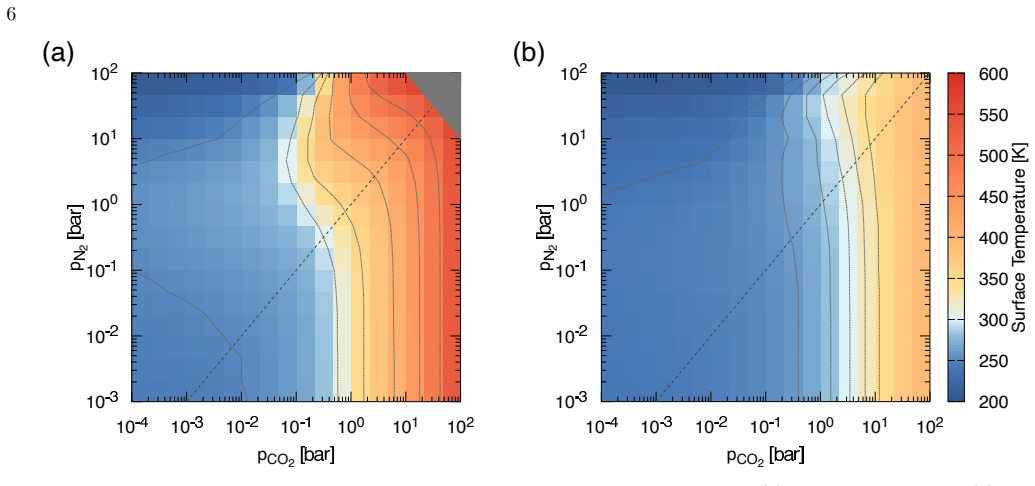
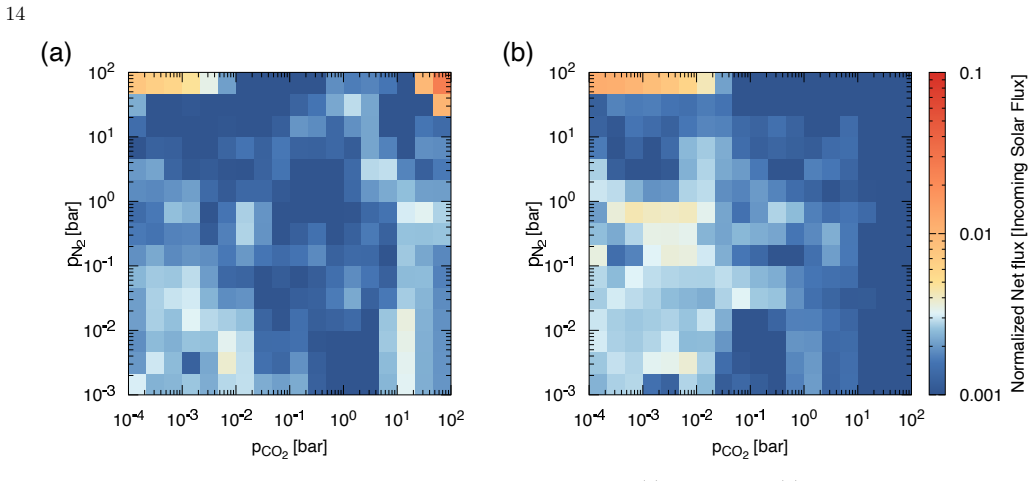
In one-dimensional N2-CO2-H2O model atmospheres, changes in background N2 pressure influence climate by modifying the amount of atmospheric H2O, producing two effects: altering the thermodynamic lapse rate (H2O-dilute warming) and changing the radiative contribution of H2O to the greenhouse effect (H2O-load warming). The resulting climate response to increasing N2 depends on the CO2 abundance. Under low CO2 conditions, dilution of atmospheric H2O leads to warming, whereas under high CO2 conditions, increased H2O loading also produces warming. At sufficiently high N2 abundances, Rayleigh scattering induces cooling, an effect further amplified by the accompanying decrease in atmospheric H2O. 3
What carries the argument
The H2O-dilute warming mechanism (change in thermodynamic lapse rate from water vapor dilution) and H2O-load warming mechanism (change in H2O radiative contribution), together with Rayleigh scattering of stellar radiation.
If this is right
- Under low CO2 conditions, increasing N2 warms the planet through dilution of H2O that changes the lapse rate.
- Under high CO2 conditions, increasing N2 warms the planet through greater H2O loading that enhances the greenhouse effect and stellar absorption.
- At high enough N2 levels, Rayleigh scattering cools the surface, with the cooling strengthened by reduced H2O unless high CO2 boosts H2O absorption enough to cancel it.
- These multiple pathways through non-greenhouse gases provide a framework for understanding climate responses across varied Earth-like atmospheric compositions.
- Assessments of planetary habitability must incorporate how N2 influences H2O and the resulting temperature outcomes that depend on CO2.
Where Pith is reading between the lines
- The identified dependence on CO2 could help interpret why some planets with thick inert gas envelopes remain habitable while others do not.
- Similar dilution and loading effects might apply when varying other non-greenhouse gases such as argon in model atmospheres.
- Incorporating these N2-H2O interactions into studies of early Earth or Mars atmospheres could refine estimates of past climate stability.
- Future observations of exoplanet spectra could test the predictions by checking for correlations between inferred N2 pressure and surface temperature indicators.
Load-bearing premise
One-dimensional radiative-convective models of N2-CO2-H2O atmospheres capture the dominant physical pathways for how N2 affects climate without needing three-dimensional dynamics or clouds.
What would settle it
Three-dimensional climate simulations or direct observations of a planet with known N2 and CO2 abundances that show surface temperatures independent of N2 pressure or that lack the predicted switch from warming to cooling as CO2 increases.
Figures


read the original abstract
Although non-greenhouse gases can vary substantially in abundance in Earth-like atmospheres, their climatic influences remain insufficiently understood. To investigate how such gases regulate climate, we vary the abundance of N$_2$ as a representative non-greenhouse component in one-dimensional N$_2$--CO$_2$--H$_2$O model atmospheres. Beyond pressure broadening of absorption lines and Rayleigh scattering emphasized in previous studies, our results show that changes in background N$_2$ pressure influence climate by modifying the amount of atmospheric H$_2$O, producing two effects: altering the thermodynamic lapse rate (H$_2$O-dilute warming) and changing the radiative contribution of H$_2$O to the greenhouse effect (H$_2$O-load warming). The resulting climate response to increasing N$_2$ depends on the CO$_2$ abundance. Under low CO$_2$ conditions, dilution of atmospheric H$_2$O leads to warming, whereas under high CO$_2$ conditions, increased H$_2$O loading also produces warming. At sufficiently high N$_2$ abundances, Rayleigh scattering induces cooling, an effect further amplified by the accompanying decrease in atmospheric H$_2$O. Under high CO$_2$ conditions, however, enhanced H$_2$O loading increases the absorption of stellar radiation and overwhelms the contribution of Rayleigh scattering, causing the cooling response to disappear. These results reveal multiple physical pathways through which non-greenhouse gases influence climate and provide a framework for understanding climate responses and habitability in diverse Earth-like atmospheres.
Editorial analysis
A structured set of objections, weighed in public.
Referee Report
Summary. The manuscript uses one-dimensional radiative-convective N2-CO2-H2O model atmospheres to examine how varying background N2 pressure affects climate on Earth-like planets. Beyond pressure broadening and Rayleigh scattering, the central claim is that N2 changes modify atmospheric H2O abundance, producing an H2O-dilute warming effect (via thermodynamic lapse-rate alteration) and an H2O-load warming effect (via H2O's radiative contribution); the net response to increasing N2 is warming under low-CO2 conditions but can be modulated or reversed under high-CO2 conditions, with Rayleigh scattering cooling appearing only at sufficiently high N2.
Significance. If the modeled pathways hold, the work identifies additional physical mechanisms by which non-greenhouse gases regulate climate and habitability, extending beyond the pressure-broadening and scattering effects emphasized in prior literature and offering a conceptual framework for diverse atmospheric compositions.
major comments (3)
- [Model description] The central claim requires the 1D model to isolate H2O-dilute and H2O-load effects without confounding from surface-temperature feedbacks or mean-molecular-weight changes. The manuscript does not report sensitivity tests to the moist-adiabat formulation, fixed-RH assumption, or cp when N2 dominates (see model description and methods sections).
- [Results] The decomposition into H2O-dilute warming and H2O-load warming is load-bearing for the CO2-dependent response claim, yet the paper provides no controlled experiments (e.g., fixed-H2O-column runs or explicit lapse-rate versus radiative forcing breakdowns) to quantify their separate contributions (see results section and associated figures).
- [Discussion] The weakest assumption is that the 1D N2-CO2-H2O setup captures dominant pathways without 3D dynamics or clouds. Given that H2O column changes drive the reported effects, the manuscript should demonstrate that omitting these processes does not reverse the sign of the N2 response under the CO2 regimes examined (see discussion of limitations).
minor comments (3)
- [Abstract] Abstract states qualitative outcomes but supplies no quantitative metrics (e.g., surface-temperature changes, H2O column deltas, or CO2 thresholds) or error estimates; adding these would improve verifiability.
- [Figures] Figure captions and legends should explicitly list the CO2 mixing ratios, N2 pressure ranges, and fixed parameters (e.g., surface gravity, stellar spectrum) for each panel to allow direct connection to the text.
- [Methods] Notation for the two warming mechanisms (H2O-dilute and H2O-load) is introduced in the abstract but should be defined with a short equation or schematic in the methods to avoid ambiguity.
Simulated Author's Rebuttal
We thank the referee for their insightful comments on our manuscript. We have revised the paper to include additional sensitivity tests and controlled experiments as suggested, strengthening our analysis of the H2O-dilute and H2O-load effects. We address the limitations of the 1D model in the discussion.
read point-by-point responses
-
Referee: [Model description] The central claim requires the 1D model to isolate H2O-dilute and H2O-load effects without confounding from surface-temperature feedbacks or mean-molecular-weight changes. The manuscript does not report sensitivity tests to the moist-adiabat formulation, fixed-RH assumption, or cp when N2 dominates (see model description and methods sections).
Authors: We agree that reporting sensitivity tests is necessary to robustly isolate the effects. In the revised manuscript, we have added sensitivity tests to the moist-adiabat formulation by comparing different lapse rate calculations, to the fixed-RH assumption by varying the relative humidity profile, and to cp by adjusting for N2 dominance. These tests confirm that the H2O-dilute warming and H2O-load warming mechanisms are not confounded by these factors, and the CO2-dependent response holds. We have also clarified how surface temperature feedbacks are handled in the model iteration. revision: yes
-
Referee: [Results] The decomposition into H2O-dilute warming and H2O-load warming is load-bearing for the CO2-dependent response claim, yet the paper provides no controlled experiments (e.g., fixed-H2O-column runs or explicit lapse-rate versus radiative forcing breakdowns) to quantify their separate contributions (see results section and associated figures).
Authors: We acknowledge this point and have added controlled experiments in the revised results section. Specifically, we include fixed-H2O-column runs to isolate the dilute effect from the load effect, and explicit breakdowns separating the lapse-rate changes from the radiative forcing changes due to H2O. These additions quantify the contributions and support the claim that the net response depends on CO2 abundance, with dilution dominating at low CO2 and loading at high CO2. revision: yes
-
Referee: [Discussion] The weakest assumption is that the 1D N2-CO2-H2O setup captures dominant pathways without 3D dynamics or clouds. Given that H2O column changes drive the reported effects, the manuscript should demonstrate that omitting these processes does not reverse the sign of the N2 response under the CO2 regimes examined (see discussion of limitations).
Authors: We agree that 1D models have limitations regarding 3D dynamics and clouds. We have expanded the discussion of limitations to include more detailed arguments based on prior 3D studies of Earth-like atmospheres, suggesting that the sign of the N2 response is unlikely to reverse. However, a complete demonstration would require 3D simulations with clouds, which is not within the scope of this study. revision: partial
- Demonstrating that the omission of 3D dynamics and clouds does not reverse the sign of the N2 response under the examined CO2 regimes, as this requires dedicated 3D modeling efforts beyond the current 1D radiative-convective framework.
Circularity Check
No circularity: model outputs on N2-driven H2O changes are independent of inputs
full rationale
The paper's derivation relies on numerical integration of a 1D radiative-convective N2-CO2-H2O atmosphere model to compute equilibrium temperature profiles, H2O columns, and decomposed lapse-rate versus radiative effects. No equations, fitted parameters, or self-citations are shown that reduce any claimed prediction (e.g., sign of climate response to N2) to a definition or input by construction. The H2O-dilute and H2O-load mechanisms emerge from the model's moist adiabat and radiative transfer calculations rather than being presupposed; external benchmarks such as line-by-line radiative codes and observed Earth profiles remain available for falsification. Self-citations, if present, are not load-bearing for the central result.
Axiom & Free-Parameter Ledger
axioms (1)
- domain assumption One-dimensional radiative-convective equilibrium governs the temperature structure
Reference graph
Works this paper leans on
-
[1]
2022, Journal of the Atmospheric Sciences, 79, 2243, doi: 10.1175/JAS-D-21-0270.1
Abraham, C., & Goldblatt, C. 2022, Journal of the Atmospheric Sciences, 79, 2243, doi: 10.1175/JAS-D-21-0270.1
-
[2]
Adams, D., Scheucher, M., Hu, R., et al. 2025, Nature Geoscience, 1
work page 2025
-
[3]
Arney, G., Domagal-Goldman, S. D., Meadows, V. S., et al. 2016, Astrobiology, 16, 873, doi: 10.1089/ast.2015.1422
-
[4]
Berner, R. A., Lasaga, A. C., & Garrels, R. M. 1983, American Journal of Science, 283, 641, doi: 10.2475/ajs.283.7.641
-
[5]
Catling, D. C., & Kasting, J. F. 2017, Atmospheric Evolution on Inhabited and Lifeless Worlds
work page 2017
-
[6]
2022, A&A, 658, A40, doi: 10.1051/0004-6361/202142286
Chaverot, G., Turbet, M., Bolmont, E., & Leconte, J. 2022, A&A, 658, A40, doi: 10.1051/0004-6361/202142286
-
[7]
Ehlmann, B. L., Anderson, F. S., Andrews-Hanna, J., et al. 2016, Journal of Geophysical Research (Planets), 121, 1927, doi: 10.1002/2016JE005134
-
[8]
2009, Earth and Planetary Science Letters, 286, 503, doi: 10.1016/j.epsl.2009.07.016
Gillmann, C., Chassefi` ere, E., & Lognonn´ e, P. 2009, Earth and Planetary Science Letters, 286, 503, doi: 10.1016/j.epsl.2009.07.016
-
[9]
Gillmann, C., Golabek, G. J., Raymond, S. N., et al. 2020, Nature Geoscience, 13, 265, doi: 10.1038/s41561-020-0561-x
-
[10]
Godolt, M., Grenfell, J. L., Kitzmann, D., et al. 2016, A&A, 592, A36, doi: 10.1051/0004-6361/201628413
-
[11]
Goldblatt, C., Claire, M. W., Lenton, T. M., et al. 2009, Nature Geoscience, 2, 891, doi: 10.1038/ngeo692
-
[12]
Goldblatt, C., Robinson, T. D., Zahnle, K. J., & Crisp, D. 2013, Nature Geoscience, 6, 661, doi: 10.1038/ngeo1892
-
[13]
2013, Nature, 497, 607, doi: 10.1038/nature12163
Hamano, K., Abe, Y., & Genda, H. 2013, Nature, 497, 607, doi: 10.1038/nature12163
-
[14]
Harman, C. E., Schwieterman, E. W., Schottelkotte, J. C., & Kasting, J. F. 2015, ApJ, 812, 137, doi: 10.1088/0004-637X/812/2/137
-
[15]
Hirschmann, M. M. 2016, American Mineralogist, 101, 540
work page 2016
-
[16]
Hu, R., Peterson, L., & Wolf, E. T. 2020, ApJ, 888, 122, doi: 10.3847/1538-4357/ab5f07
-
[17]
Hu, R., & Thomas, T. B. 2022, Nature Geoscience, 15, 106, doi: 10.1038/s41561-021-00886-y
-
[18]
Jakosky, B. M., Pepin, R. O., Johnson, R. E., & Fox, J. L. 1994, Icarus, 111, 271, doi: 10.1006/icar.1994.1145
-
[19]
2015, Earth Science Reviews, 148, 150, doi: 10.1016/j.earscirev.2015.05.006
Johnson, B., & Goldblatt, C. 2015, Earth Science Reviews, 148, 150, doi: 10.1016/j.earscirev.2015.05.006
-
[20]
Kasting, J. F. 1988, Icarus, 74, 472, doi: 10.1016/0019-1035(88)90116-9
-
[21]
Kasting, J. F., & Ackerman, T. P. 1986, Science, 234, 1383, doi: 10.1126/science.11539665
-
[22]
Kato, S., Ackerman, T. P., Mather, J. H., & Clothiaux, E. E. 1999, JQSRT, 62, 109, doi: 10.1016/S0022-4073(98)00075-2
-
[23]
2015, Earth and Planetary Science Letters, 413, 51, doi: 10.1016/j.epsl.2014.12.032
Kavanagh, L., & Goldblatt, C. 2015, Earth and Planetary Science Letters, 413, 51, doi: 10.1016/j.epsl.2014.12.032
-
[24]
L., Godolt, M., Stracke, B., & Rauer, H
Keles, E., Grenfell, J. L., Godolt, M., Stracke, B., & Rauer, H. 2018, Astrobiology, 18, 116, doi: 10.1089/ast.2016.1632
-
[25]
Kite, E. S., Steele, L. J., Mischna, M. A., & Richardson, M. I. 2021, Proceedings of the National Academy of Science, 118, e2101959118, doi: 10.1073/pnas.2101959118
-
[26]
Koll, D. D. B., & Cronin, T. W. 2019, ApJ, 881, 120, doi: 10.3847/1538-4357/ab30c4 15
-
[27]
Kopparapu, R. K., Ramirez, R., Kasting, J. F., et al. 2013, ApJ, 765, 131, doi: 10.1088/0004-637X/765/2/131
-
[28]
2018, Icarus, 299, 443, doi: 10.1016/j.icarus.2017.08.020
Kurokawa, H., Kurosawa, K., & Usui, T. 2018, Icarus, 299, 443, doi: 10.1016/j.icarus.2017.08.020
-
[29]
Kurokawa, H., Laneuville, M., Li, Y., et al. 2022,
work page 2022
-
[30]
Geochemistry, Geophysics, Geosystems, 23, e2021GC010295, doi: 10.1029/2021GC010295
-
[31]
2014, Earth and Planetary Science Letters, 394, 179, doi: 10.1016/j.epsl.2014.03.027
Kurokawa, H., Sato, M., Ushioda, M., et al. 2014, Earth and Planetary Science Letters, 394, 179, doi: 10.1016/j.epsl.2014.03.027
-
[32]
Lammer, H., Sproß, L., Grenfell, J. L., et al. 2019, Astrobiology, 19, 927, doi: 10.1089/ast.2018.1914
-
[33]
2025, PSJ, 6, 212, doi: 10.3847/PSJ/adf7a1
Landry, J., Kurokawa, H., Taki, T., et al. 2025, PSJ, 6, 212, doi: 10.3847/PSJ/adf7a1
-
[34]
2015, Astrobiology, 15, 119, doi: 10.1089/ast.2014.1231
Luger, R., & Barnes, R. 2015, Astrobiology, 15, 119, doi: 10.1089/ast.2014.1231
-
[35]
Manabe, S., & Wetherald, R. T. 1967, Journal of the Atmospheric Sciences, 24, 241, doi: 10.1175/1520-0469(1967)024⟨0241: TEOTAW⟩2.0.CO;2
-
[36]
2012, Earth and Planetary Science Letters, 313, 56, doi: 10.1016/j.epsl.2011.10.040
Marty, B. 2012, Earth and Planetary Science Letters, 313, 56, doi: 10.1016/j.epsl.2011.10.040
-
[37]
2013, Science, 342, 101, doi: 10.1126/science.1240971
Philippot, P. 2013, Science, 342, 101, doi: 10.1126/science.1240971
-
[38]
Paynter, D. J., & Ramaswamy, V. 2011, Journal of Geophysical Research (Atmospheres), 116, D20302, doi: 10.1029/2010JD015505
-
[39]
Ramirez, R. M. 2020, MNRAS, 494, 259, doi: 10.1093/mnras/staa603
-
[40]
Ramirez, R. M., & Craddock, R. A. 2018, Nature Geoscience, 11, 230, doi: 10.1038/s41561-018-0093-9
-
[41]
Ramirez, R. M., Kopparapu, R. K., Lindner, V., & Kasting, J. F. 2014, Astrobiology, 14, 714, doi: 10.1089/ast.2014.1153
-
[42]
2021, Scientific Reports, 11, 20894, doi: 10.1038/s41598-021-99240-w
Sakuraba, H., Kurokawa, H., Genda, H., & Ohta, K. 2021, Scientific Reports, 11, 20894, doi: 10.1038/s41598-021-99240-w
-
[43]
Seeley, J. T., & Wordsworth, R. D. 2023, PSJ, 4, 34, doi: 10.3847/PSJ/acb0cb
-
[44]
Serov, E. A., Galanina, T. A., Koroleva, A. O., et al. 2024, JQSRT, 328, 109172, doi: 10.1016/j.jqsrt.2024.109172
-
[45]
Catling, D. C. 2017, Icarus, 290, 46, doi: 10.1016/j.icarus.2017.02.022
-
[46]
Som, S. M., Buick, R., Hagadorn, J. W., et al. 2016, Nature Geoscience, 9, 448, doi: 10.1038/ngeo2713
-
[47]
Som, S. M., Catling, D. C., Harnmeijer, J. P., Polivka, P. M., & Buick, R. 2012, Nature, 484, 359, doi: 10.1038/nature10890
-
[48]
Thomas, T. B., Hu, R., & Lo, D. Y. 2023, PSJ, 4, 41, doi: 10.3847/PSJ/acb924
-
[49]
Vieytes, M. C. 2014, Earth and Planetary Science Letters, 385, 22, doi: 10.1016/j.epsl.2013.10.024
-
[50]
Santhanam, K. 1989, J. Geophys. Res., 94, 16287, doi: 10.1029/JD094iD13p16287
-
[51]
2021, Nature, 598, 276, doi: 10.1038/s41586-021-03873-w
Turbet, M., Bolmont, E., Chaverot, G., et al. 2021, Nature, 598, 276, doi: 10.1038/s41586-021-03873-w
-
[52]
Ueno, Y., Schmidt, J. A., Johnson, M. S., et al. 2024, Nature Geoscience, 17, 503, doi: 10.1038/s41561-024-01443-z
-
[53]
2013, ApJ, 767, 65, doi: 10.1088/0004-637X/767/1/65 von Paris, P., Grenfell, J
Vladilo, G., Murante, G., Silva, L., et al. 2013, ApJ, 767, 65, doi: 10.1088/0004-637X/767/1/65 von Paris, P., Grenfell, J. L., Rauer, H., & Stock, J. W. 2013, Planet. Space Sci., 82, 149, doi: 10.1016/j.pss.2013.04.009
-
[54]
Walker, J. C. G., Hays, P. B., & Kasting, J. F. 1981, J. Geophys. Res., 86, 9776, doi: 10.1029/JC086iC10p09776
-
[55]
The Astrophysical Journal , abstract =
Watanabe, Y., & Ozaki, K. 2024, ApJ, 961, 1, doi: 10.3847/1538-4357/ad10a2
-
[56]
Way, M. J., & Del Genio, A. D. 2020, Journal of Geophysical Research (Planets), 125, e06276, doi: 10.1029/2019JE00627610.1002/essoar.10501118.3
work page doi:10.1029/2019je00627610.1002/essoar.10501118.3 2020
-
[57]
Way, M. J., Del Genio, A. D., Kiang, N. Y., et al. 2016, Geophys. Res. Lett., 43, 8376, doi: 10.1002/2016GL069790
-
[58]
2014, ApJL, 785, L20, doi: 10.1088/2041-8205/785/2/L20
Wordsworth, R., & Pierrehumbert, R. 2014, ApJL, 785, L20, doi: 10.1088/2041-8205/785/2/L20
-
[59]
Wordsworth, R. D., & Pierrehumbert, R. T. 2013, ApJ, 778, 154, doi: 10.1088/0004-637X/778/2/154
-
[60]
Yang, J., Leconte, J., Wolf, E. T., et al. 2016, ApJ, 826, 222, doi: 10.3847/0004-637X/826/2/222
-
[61]
Zahnle, K., Haberle, R. M., Catling, D. C., & Kasting, J. F. 2008, Journal of Geophysical Research (Planets), 113, E11004, doi: 10.1029/2008JE003160
discussion (0)
Sign in with ORCID, Apple, or X to comment. Anyone can read and Pith papers without signing in.