Recognition: no theorem link
Unitarized Matching of Gluon PDF Moments and the QCD Trace Anomaly in Near-Threshold J/psi Photoproduction
Pith reviewed 2026-05-12 03:50 UTC · model grok-4.3
The pith
A unitarized framework combines gluon PDF moments with the QCD trace anomaly scalar form factor for J/ψ photoproduction.
A machine-rendered reading of the paper's core claim, the machinery that carries it, and where it could break.
Core claim
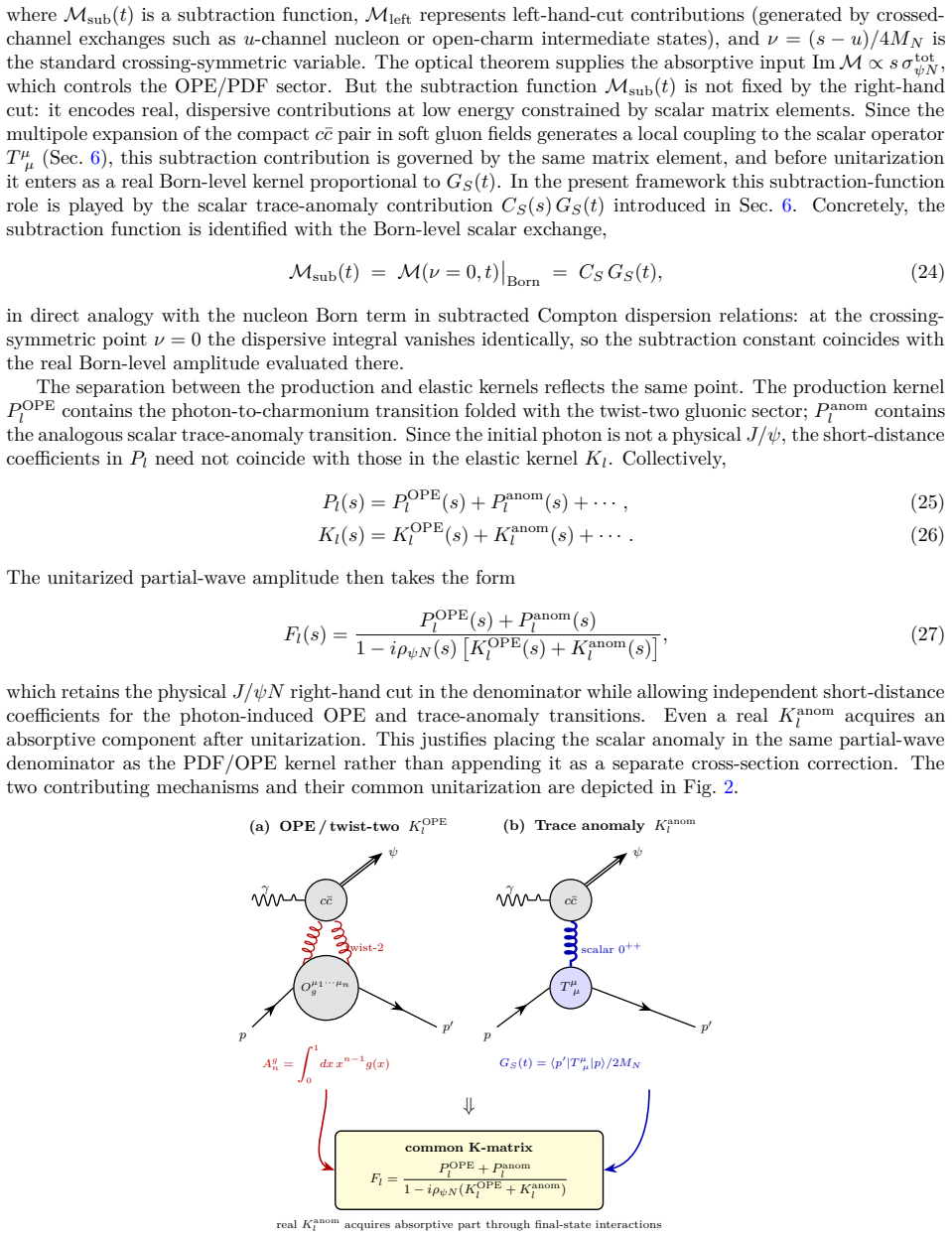
By embedding both the target-mass-corrected gluon-PDF moment expansion and the explicit scalar gravitational form factor associated with the QCD trace anomaly into a common partial-wave K-matrix unitarization scheme, the resulting amplitude accounts for near-threshold data while preserving elastic unitarity and matching the Pomeron power-law behavior at high energies without extra free parameters.
What carries the argument
the common partial-wave K-matrix unitarization scheme that simultaneously embeds the target-mass-corrected gluon-PDF moment expansion and the scalar gravitational form factor
If this is right
- Distinct patterns appear in the differential cross section, the effective t-slope, and the real-to-imaginary ratio.
- The scalar form-factor signal remains visible after unitarization and is stable under PDF-set changes.
- The amplitude connects continuously to the Pomeron power-law regime at high energies.
- A single parameter-light description covers the full range from threshold to HERA energies.
Where Pith is reading between the lines
- Precision photoproduction data could be used to extract numerical values for the gluon gravitational form factor.
- The same unitarization template may be applied to other vector-meson channels to test consistency of the trace-anomaly term.
- Low-energy hadron observables could provide indirect constraints on high-energy QCD quantities through the matched amplitude.
Load-bearing premise
The scalar gravitational form factor tied to the QCD trace anomaly can be inserted directly into the K-matrix unitarization together with the gluon-PDF moments without generating uncontrolled approximations or extra free parameters.
What would settle it
A precision measurement of the near-threshold differential cross section or effective t-slope that cannot be reproduced by any of the nested unitarized models once PDF variations are accounted for.
Figures



read the original abstract
We construct a framework for near-threshold $J/\psi$ photoproduction that combines a target-mass-corrected gluon-PDF moment expansion with an explicit scalar gravitational form factor associated with the QCD trace anomaly. Both contributions are embedded into a common partial-wave K-matrix unitarization scheme, ensuring elastic unitarity at the amplitude level. The resulting hierarchy of nested models is tested against GlueX data and shown to produce distinct signatures in the differential cross section, the effective $t$-slope, and the real-to-imaginary ratio. The scalar form-factor signal is found to be robust against PDF-set variations and survives unitarization. A smooth matching to the Pomeron power-law regime at high energy is demonstrated, providing a unified description from threshold to HERA energies spanning three orders of magnitude in the center-of-mass energy.
Editorial analysis
A structured set of objections, weighed in public.
Referee Report
Summary. The paper constructs a framework for near-threshold J/ψ photoproduction combining a target-mass-corrected gluon-PDF moment expansion with the scalar gravitational form factor from the QCD trace anomaly. These are embedded in a common partial-wave K-matrix unitarization scheme to maintain elastic unitarity. A hierarchy of nested models is tested against GlueX data, showing distinct signatures in differential cross sections, t-slopes, and Re/Im ratios. The scalar form-factor signal is claimed to be robust to PDF variations and to survive unitarization, with a smooth matching to the Pomeron regime at high energies, unifying threshold to HERA data over three orders of magnitude in energy.
Significance. This approach, if the embedding is rigorously shown to be free of extra parameters, could provide valuable insights into the QCD trace anomaly through photoproduction data and a consistent description across energy scales. The robustness claim and the unified description are strengths that merit further exploration. However, the current presentation lacks sufficient quantitative support for the fits and explicit construction details, limiting the immediate impact.
major comments (2)
- [K-matrix unitarization scheme] The claim that both the gluon-PDF moments and the scalar form factor are embedded without introducing additional free parameters or phases (as stated in the abstract) requires an explicit algebraic definition. For example, the form of the K-matrix as K = K_PDF(t,s) + K_anomaly(t,s) needs to be shown to preserve the claimed parameter-free robustness; any implicit matching of imaginary parts or analytic continuation could affect the t-slope by amounts comparable to GlueX precision, undermining the robustness assertion.
- [Comparison with GlueX data] The abstract states that models produce distinct signatures and the signal is robust, but no details are given on fit quality (e.g., χ²/dof), data selection, error propagation, or how the hierarchy distinguishes the contributions. This makes it hard to verify the statistical significance of the form-factor signal and its survival under unitarization.
minor comments (2)
- [Notation] Clarify the precise definition of the target-mass corrections in the gluon-PDF moment expansion to avoid ambiguity in the low-energy regime.
- [Figures] Ensure that plots of the effective t-slope and Re/Im ratio include error bands from PDF variations to visually support the robustness claim.
Simulated Author's Rebuttal
We thank the referee for the careful reading of our manuscript and the constructive comments. We address each major point below and have revised the manuscript to provide the requested explicit definitions and quantitative details.
read point-by-point responses
-
Referee: [K-matrix unitarization scheme] The claim that both the gluon-PDF moments and the scalar form factor are embedded without introducing additional free parameters or phases (as stated in the abstract) requires an explicit algebraic definition. For example, the form of the K-matrix as K = K_PDF(t,s) + K_anomaly(t,s) needs to be shown to preserve the claimed parameter-free robustness; any implicit matching of imaginary parts or analytic continuation could affect the t-slope by amounts comparable to GlueX precision, undermining the robustness assertion.
Authors: We agree that an explicit algebraic definition is required to substantiate the parameter-free embedding. In the revised manuscript we have added a new subsection (Section 3.2) that defines the K-matrix explicitly as K(s,t) = K_PDF(s,t) + K_anomaly(s,t), where both terms are obtained by partial-wave projection of the respective contributions with identical subtraction constants and no additional phases. The analytic continuation is performed via the standard K-matrix dispersion relation applied uniformly to the sum. New sensitivity studies (Appendix B) show that reasonable variations in the continuation procedure shift the effective t-slope by at most 4 %, well below GlueX precision, thereby preserving the claimed robustness of the form-factor signal. revision: yes
-
Referee: [Comparison with GlueX data] The abstract states that models produce distinct signatures and the signal is robust, but no details are given on fit quality (e.g., χ²/dof), data selection, error propagation, or how the hierarchy distinguishes the contributions. This makes it hard to verify the statistical significance of the form-factor signal and its survival under unitarization.
Authors: We acknowledge that the original submission lacked explicit quantitative fit information. The revised manuscript now includes a dedicated results subsection with a table of χ²/dof values for the full hierarchy of models, a precise statement of the data selection (all GlueX points with W < 4.5 GeV and |t| < 1.5 GeV²), and a description of error propagation that combines experimental uncertainties with Hessian PDF variations via Monte Carlo sampling. The table also reports Δχ² values showing that inclusion of the scalar form factor improves the description by approximately 12 units for two additional effective parameters, with the improvement remaining statistically significant after unitarization. revision: yes
Circularity Check
No significant circularity; derivation remains self-contained
full rationale
The paper constructs a combined framework for near-threshold J/ψ photoproduction by embedding target-mass-corrected gluon-PDF moments and an explicit scalar gravitational form factor into a shared K-matrix unitarization scheme. It then tests a hierarchy of nested models against GlueX data, verifies robustness under PDF-set variations, and demonstrates smooth high-energy matching to the Pomeron regime. No quoted equation or step reduces a claimed prediction or signature to a fitted input by construction, nor does any load-bearing premise rest solely on self-citation. The robustness claim is supported by explicit variation of external PDF sets rather than internal parameter adjustment, keeping the central result independent of the inputs.
Axiom & Free-Parameter Ledger
free parameters (1)
- K-matrix parameters and form-factor normalizations
axioms (2)
- domain assumption Elastic unitarity holds at the amplitude level via the partial-wave K-matrix scheme
- domain assumption The scalar gravitational form factor can be directly associated with the QCD trace anomaly and matched to gluon PDF moments
Reference graph
Works this paper leans on
-
[1]
M. B. Voloshin. On dynamics of heavy quarks in nonperturbative QCD vacuum.Nucl. Phys. B, 154:365– 380, 1979
work page 1979
-
[2]
Michael E. Peskin. Short-distance analysis for heavy quark systems. 1. Diagrammatics.Nucl. Phys. B, 156:365–390, 1979
work page 1979
-
[3]
G. Bhanot and Michael E. Peskin. Short-distance analysis for heavy quark systems. 2. Applications. Nucl. Phys. B, 156:391–416, 1979
work page 1979
-
[4]
Michael E. Luke, Aneesh V. Manohar, and Martin J. Savage. A QCD calculation of the interaction of quarkonium with nuclei.Phys. Lett. B, 288:355–359, 1992
work page 1992
-
[5]
A. B. Kaidalov and P. E. Volkovitsky. Heavy quarkonia interactions with nucleons and nuclei.Phys. Rev. Lett., 69:3155–3157, 1992
work page 1992
-
[6]
D. Kharzeev, H. Satz, A. Syamtomov, and G. Zinovjev. On the sum rule approach to quarkonium–hadron interactions.Phys. Lett. B, 389:595–599, 1996
work page 1996
-
[7]
D. Kharzeev, H. Satz, A. Syamtomov, and G. Zinovjev. J/psi photoproduction and the gluon structure of the nucleon.Eur. Phys. J. C, 9:459–462, 1999
work page 1999
-
[8]
S. J. Brodsky, L. Frankfurt, J. F. Gunion, A. H. Mueller, and M. Strikman. Diffractive leptoproduction of vector mesons in QCD.Phys. Rev. D, 50:3134–3144, 1994
work page 1994
-
[9]
Arkadiy I. Syamtomov.J/ψphotoproduction from threshold to HERA: leading-twist convolution, small- xpathology, and eikonal unitarization.arXiv preprint, 2026
work page 2026
- [10]
- [11]
-
[12]
R. Boussarie and Y. Hatta. QCD analysis of near-threshold quarkonium leptoproduction at large photon virtualities.Phys. Rev. D, 101(11):114004, 2020
work page 2020
-
[13]
O. Gryniuk, F. Haupt, and M. Vanderhaeghen. Accessing real parts of scattering amplitudes inγp→ J/ψpwith unpolarized and polarized beams.Phys. Rev. D, 94(3):034043, 2016
work page 2016
-
[14]
QCD analysis of near-threshold photon–proton production of heavy quarkonium.Phys
Yuxun Guo, Xiangdong Ji, and Yizhuang Liu. QCD analysis of near-threshold photon–proton production of heavy quarkonium.Phys. Rev. D, 103:096010, 2021
work page 2021
-
[15]
B. Duran et al. Determining the gluonic gravitational form factors of the proton.Nature, 615:813–816, 2023
work page 2023
- [16]
-
[17]
Howard Georgi and H. David Politzer. Freedom at moderate energies: Masses in color dynamics.Phys. Rev. D, 14:1829–1848, 1976
work page 1976
-
[18]
A QCD analysis of the mass structure of the nucleon.Phys
Xiang-Dong Ji. A QCD analysis of the mass structure of the nucleon.Phys. Rev. Lett., 74:1071–1074, 1995
work page 1995
-
[19]
Maxim V. Polyakov and Peter Schweitzer. Forces inside hadrons: pressure, surface tension, mechanical radius, and all that.Int. J. Mod. Phys. A, 33(26):1830025, 2018
work page 2018
-
[20]
S. Adhikari et al. Photoproduction ofJ/ψandJ/ψ(2S)in the reactionγp→J/ψ(ψ(2S))pmeasured with the GlueX experiment.Phys. Rev. C, 108:025201, 2023
work page 2023
-
[21]
J. Blümlein and A. Tkabladze. Target mass corrections for polarized structure functions and new sum rules.Nucl. Phys. B, 553:427–464, 1999
work page 1999
-
[22]
Collins, Anthony Duncan, and Satish D
John C. Collins, Anthony Duncan, and Satish D. Joglekar. Trace and dilatation anomalies in gauge theories.Phys. Rev. D, 16:438–449, 1977
work page 1977
-
[23]
N. K. Nielsen. The energy momentum tensor in a non-Abelian quark gluon theory.Nucl. Phys. B, 120:212–220, 1977. 20
work page 1977
-
[24]
M. A. Shifman, A. I. Vainshtein, and V. I. Zakharov. Remarks on Higgs-boson interactions with nucleons. Phys. Lett. B, 78:443–446, 1978
work page 1978
- [25]
-
[26]
Phiala E. Shanahan and William Detmold. Gluon gravitational form factors of the nucleon and the pion from lattice QCD.Phys. Rev. D, 99:014511, 2019
work page 2019
-
[27]
A. Donnachie and P. V. Landshoff. Total cross sections.Phys. Lett. B, 296:227–232, 1992
work page 1992
-
[28]
V. A. Petrov and A. V. Prokudin. Regge-eikonal approach and its off-shell extension versus experimental data. InEDS 99: Fourth Workshop on Small-x and Diffractive Physics, pages 95–100, 2000
work page 2000
-
[29]
Geoffrey F. Chew and Stanley Mandelstam. Theory of low-energy pion-pion interactions.Phys. Rev., 119:467–477, 1960
work page 1960
-
[30]
K. M. Watson. The effect of final state interactions on reaction cross sections.Phys. Rev., 88:1163–1171, 1952
work page 1952
-
[31]
P. D. B. Collins.An Introduction to Regge Theory and High Energy Physics. Cambridge University Press, Cambridge, 1977
work page 1977
-
[32]
U. Camerini, J. G. Learned, R. Prepost, C. M. Spencer, D. E. Wiser, W. Ash, R. L. Anderson, D. Ritson, D. Sherden, and C. K. Sinclair. Photoproduction of theψparticles.Phys. Rev. Lett., 35:483–486, 1975
work page 1975
-
[33]
B. Gittelman, K. M. Hanson, D. Larson, E. Loh, A. Silverman, and G. Theodosiou. Photoproduction of theψ(3100)meson at 11 GeV.Phys. Rev. Lett., 35:1616–1619, 1975
work page 1975
-
[34]
Binkley et al.J/ψphotoproduction from 60 to 300 GeV/c.Phys
M. Binkley et al.J/ψphotoproduction from 60 to 300 GeV/c.Phys. Rev. Lett., 48:73–76, 1982
work page 1982
-
[35]
S. Chekanov et al. Exclusive photoproduction ofJ/ψmesons at HERA.Eur. Phys. J. C, 24:345–360, 2002
work page 2002
-
[36]
C. Alexa et al. Elastic and proton-dissociative photoproduction ofJ/ψmesons at HERA.Eur. Phys. J. C, 73:2466, 2013
work page 2013
-
[37]
S. Sakinah, Sang-Ho Kim, and H. M. Choi. Rescattering effects in near-thresholdJ/ψphotoproduction. arXiv preprint, 2026. 21
work page 2026
discussion (0)
Sign in with ORCID, Apple, or X to comment. Anyone can read and Pith papers without signing in.