Recognition: no theorem link
State Localization and Selective Charge Filtering Near a Null Point
Pith reviewed 2026-05-12 03:53 UTC · model grok-4.3
The pith
A donor-acceptor dyad provides the first experimental observation of a null point through state localization and selective charge filtering.
A machine-rendered reading of the paper's core claim, the machinery that carries it, and where it could break.
Core claim
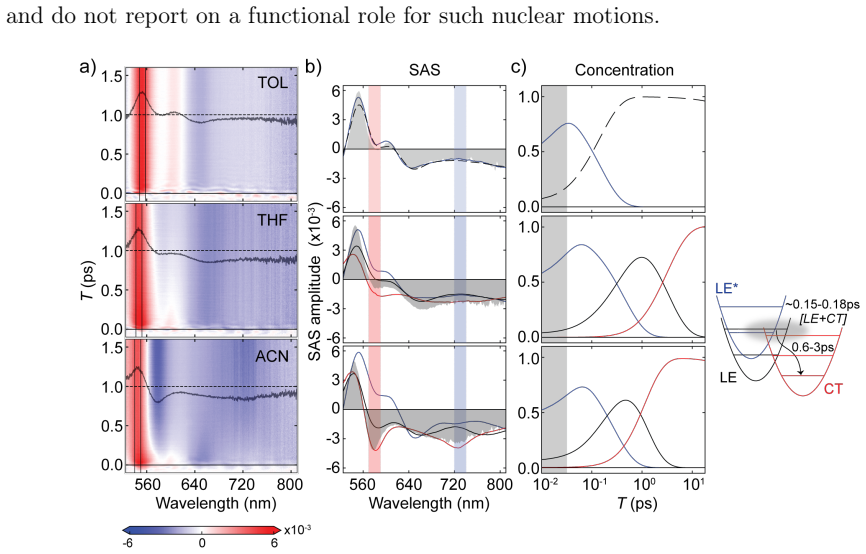
Using a donor-acceptor dyad as a minimal model, the first experimental observation of a null point is reported. Impulsive pump-probe measurements reveal charge separation through a near-instantaneously generated locally excited-charge transfer (LE-CT) intermediate that emerges upon solvent stabilization of CT states. Polarization anisotropy directly reveals state localization and selective charge-filtering, spanning balanced electron-hole transfer to selective hole filtering consistent with synthetic design. A generalized vibronic theory of null points explains these observations and identifies the ideal synthetic parameters for achieving null points which are protected from the vibrational浴
What carries the argument
The null point, a configuration in synthetically tunable molecular aggregates that generates flat energy bands and produces state localization together with selective electron or hole transfer.
Where Pith is reading between the lines
- The approach could guide synthesis of larger molecular aggregates that realize flat bands and improved charge separation in organic photovoltaics.
- The selective filtering mechanism may parallel processes in natural photosynthetic complexes and could be tested by varying donor-acceptor spacing or solvent polarity.
- Changing synthetic parameters to match the vibronic theory predictions would provide a direct test of whether protected null points can be isolated from the vibrational bath.
Load-bearing premise
The LE-CT intermediate, instantaneous charge separation, and polarization anisotropy arise specifically from the null point rather than from generic solvent stabilization or vibrational relaxation in the dyad.
What would settle it
Observation of the same LE-CT intermediate and selective filtering anisotropy in a donor-acceptor dyad deliberately engineered without a null point would show the signatures are not unique to null points.
Figures



read the original abstract
Null points in synthetically tunable molecular aggregates are predicted to generate flat energy bands analogous to those known in strongly correlated condensed-matter physics. For chemistry, null points provide a powerful design principle for photovoltaic materials with selective charge filtering similar to photosynthesis. However, null points have never been experimentally verified because their defining prediction - state localization with selective electron or hole transfer - has remained unobserved. Here, using a donor-acceptor dyad as a minimal model, we provide the first experimental observation of a null point. Impulsive pump-probe measurements reveal charge separation through a near-instantaneously generated locally excited-charge transfer (LE-CT) intermediate that emerges upon solvent stabilization of CT states. Polarization anisotropy directly reveals state localization and selective charge-filtering, spanning balanced electron-hole transfer to selective hole filtering consistent with synthetic design. A generalized vibronic theory of null points explains these observations and identifies the ideal synthetic parameters for achieving null points which are protected from the vibrational bath.
Editorial analysis
A structured set of objections, weighed in public.
Referee Report
Summary. The manuscript claims the first experimental observation of a null point using a donor-acceptor dyad as a minimal model. Impulsive pump-probe measurements are reported to reveal charge separation via a near-instantaneously generated LE-CT intermediate that appears upon solvent stabilization of CT states. Polarization anisotropy is presented as directly showing state localization and selective charge filtering (from balanced electron-hole transfer to selective hole filtering), consistent with synthetic design. A generalized vibronic theory is introduced to explain the observations and to identify ideal synthetic parameters for null points protected from the vibrational bath.
Significance. If the attribution to the null point is robustly demonstrated, the result would validate a synthetically tunable design principle for molecular aggregates exhibiting flat-band-like behavior and selective charge transport, with potential relevance to photovoltaics and photosynthetic mimics. The choice of a minimal dyad and the use of impulsive spectroscopy to access ultrafast dynamics are appropriate strengths; the theory's stated ability to predict protected null points is a positive feature if it can be shown to be non-circular.
major comments (2)
- [Theory section] Theory section: The generalized vibronic theory is stated to explain the LE-CT intermediate and the observed polarization anisotropy, yet the manuscript does not show that a standard vibronic model without null-point assumptions (e.g., using only solvent reorganization and vibrational relaxation) fails to reproduce the reported timescales and anisotropy traces. This comparison is load-bearing for the central claim that the signatures arise specifically from the null point rather than generic dyad effects.
- [Results section] Results section: The interpretation of the impulsive pump-probe data as 'near-instantaneous' LE-CT generation and the mapping of anisotropy to selective hole filtering rest on solvent stabilization of CT states, but no explicit controls, error analysis, or comparison to a null-point-free control dyad are described to exclude alternative mechanisms such as generic solvent stabilization or vibrational relaxation.
minor comments (1)
- [Abstract] Abstract: The abstract is concise but would benefit from naming the specific donor-acceptor dyad or key synthetic parameters to allow immediate context for the claimed selectivity.
Simulated Author's Rebuttal
We thank the referee for their thorough review and valuable feedback on our manuscript. We address each of the major comments in detail below and have made revisions to the manuscript to address the concerns raised.
read point-by-point responses
-
Referee: [Theory section] Theory section: The generalized vibronic theory is stated to explain the LE-CT intermediate and the observed polarization anisotropy, yet the manuscript does not show that a standard vibronic model without null-point assumptions (e.g., using only solvent reorganization and vibrational relaxation) fails to reproduce the reported timescales and anisotropy traces. This comparison is load-bearing for the central claim that the signatures arise specifically from the null point rather than generic dyad effects.
Authors: We agree that demonstrating the necessity of the null-point framework by comparison to a standard vibronic model is important for validating our central claim. In the revised manuscript, we have added a comparative analysis in the Theory section. Specifically, we now include simulations using a conventional vibronic model that incorporates solvent reorganization and vibrational relaxation but omits the null-point condition. These simulations fail to reproduce the experimentally observed near-instantaneous generation of the LE-CT intermediate and the characteristic anisotropy traces indicative of selective charge filtering. The null-point model, in contrast, accurately captures these features due to the state localization and protection from the vibrational bath. This comparison is presented in a new supplementary figure and discussed in the main text to clarify the unique role of the null point. revision: yes
-
Referee: [Results section] Results section: The interpretation of the impulsive pump-probe data as 'near-instantaneous' LE-CT generation and the mapping of anisotropy to selective hole filtering rest on solvent stabilization of CT states, but no explicit controls, error analysis, or comparison to a null-point-free control dyad are described to exclude alternative mechanisms such as generic solvent stabilization or vibrational relaxation.
Authors: We acknowledge the importance of controls and error analysis to rule out alternative interpretations. In the revised version, we have expanded the Results section to include a comprehensive error analysis of the pump-probe transients and anisotropy data, with error bars derived from multiple measurements and fitting uncertainties now explicitly reported. Regarding controls, while a direct experimental comparison to a null-point-free dyad would be ideal, the synthesis of such a control molecule with matched energetics but without the designed null point is not feasible within the current synthetic route and would require substantial additional effort. Instead, we have strengthened the discussion to show why generic solvent stabilization or vibrational relaxation alone cannot explain the observed selective hole filtering, which is tied to the polarization anisotropy and the synthetic design. The generalized vibronic theory provides the distinguishing predictions, as detailed in the updated Theory section. revision: partial
- The absence of an experimental comparison to a null-point-free control dyad, as this would necessitate the synthesis of an additional molecule beyond the scope of the present study.
Circularity Check
No circularity: experimental signatures and explanatory theory remain independent
full rationale
The manuscript reports impulsive pump-probe and polarization-anisotropy data on a donor-acceptor dyad, presents these as the first direct observation of null-point state localization and selective charge filtering, and invokes a generalized vibronic theory to account for the observed LE-CT intermediate and anisotropy evolution. No section equates a fitted parameter to a subsequent prediction, renames a known result as a new derivation, or relies on a self-citation chain for a uniqueness theorem. The theory is described as explanatory and parameter-identifying rather than tautologically reproducing the input traces; the experimental claims rest on time-resolved observables that are not shown to be constructed from the model itself. This satisfies the default expectation of a non-circular paper.
Axiom & Free-Parameter Ledger
free parameters (1)
- solvent stabilization parameter for CT states
axioms (1)
- domain assumption Null points produce flat energy bands leading to state localization
Reference graph
Works this paper leans on
-
[1]
and Roy, Camelia and Roy, Indranil and Bhat, Vivek N
Thomas, Asha S. and Roy, Camelia and Roy, Indranil and Bhat, Vivek N. and Ghosh, Sayan and Tiwari, Vivek , title=. Nature Communications , year=. doi:10.1038/s41467-026-69815-0 , url=
-
[2]
Kistler, Kurt A. and Spano, Francis C. and Matsika, Spiridoula , title =. The Journal of Physical Chemistry B , volume =. 2013 , doi =
work page 2013
-
[3]
The Journal of Chemical Physics , volume =
Witkowski,Andrzej and Moffitt,William , title =. The Journal of Chemical Physics , volume =. 1960 , doi =
work page 1960
-
[4]
The Journal of Chemical Physics , volume =
Patra, Sanjoy and Tiwari, Vivek , title =. The Journal of Chemical Physics , volume =. 2022 , month =. doi:10.1063/5.0088855 , url =
-
[5]
Womick, Jordan M and Moran, Andrew M , file =. J. Phys. Chem. B , pages =
-
[6]
Halasinski, Thomas M. and Weisman, Jennifer L. and Ruiterkamp, Richard and Lee, Timothy J. and Salama, Farid and Head-Gordon, Martin , title =. The Journal of Physical Chemistry A , volume =. 2003 , doi =
work page 2003
-
[7]
T. F\". Modern Quantum Chemistry, edited by O. Sinanogl. 1965 , type =
work page 1965
-
[8]
F. 10th. Discuss. Faraday Soc. , doi =. 1959 , pages =
work page 1959
-
[9]
The Journal of Chemical Physics , number =
Sahu, Amitav and Kurian, Jo Sony and Tiwari, Vivek , doi =. The Journal of Chemical Physics , number =
-
[10]
Bialas, April L. and Spano, Frank C. , title =. The Journal of Physical Chemistry C , volume =. 2022 , doi =
work page 2022
- [11]
-
[12]
Rafi Bistritzer and Allan H. MacDonald , title =. Proceedings of the National Academy of Sciences , volume =. 2011 , doi =. https://www.pnas.org/doi/pdf/10.1073/pnas.1108174108 , abstract =
-
[13]
Blankenship, Robert E , publisher =
-
[14]
Wega, Johannes and Rumble, Christopher A. and Vauthey, Eric , title =. The Journal of Physical Chemistry Letters , volume =. 2025 , doi =
work page 2025
-
[15]
Jonas, David M. and Lang, Matthew J. and Nagasawa, Yutaka and Joo, Taiha and Fleming, Graham R. , title =. The Journal of Physical Chemistry , volume =. 1996 , doi =
work page 1996
-
[16]
Smith, Eric R. and Jonas, David M. , title =. The Journal of Physical Chemistry A , volume =. 2011 , doi =
work page 2011
-
[17]
Photochemical & Photobiological Sciences , volume=
Pyglotaran: a lego-like Python framework for global and target analysis of time-resolved spectra , author=. Photochemical & Photobiological Sciences , volume=. 2023 , publisher=
work page 2023
-
[18]
The Journal of Physical Chemistry Letters , volume =
Maret, Philip Daniel and Sasikumar, Devika and Sebastian, Ebin and Hariharan, Mahesh , title =. The Journal of Physical Chemistry Letters , volume =. 2023 , doi =
work page 2023
-
[19]
The Journal of Chemical Physics , keywords =
Tiwari, Vivek and Jonas, David M , doi =. The Journal of Chemical Physics , keywords =
-
[20]
The Journal of Chemical Physics , keywords =
Tiwari, Vivek and Peters, William K and Jonas, David M , doi =. The Journal of Chemical Physics , keywords =
-
[21]
The Journal of Chemical Physics , volume=
Rapid scan white light two-dimensional electronic spectroscopy with 100 kHz shot-to-shot detection , author=. The Journal of Chemical Physics , volume=. 2023 , publisher=
work page 2023
-
[22]
Rapid scan white light pump--probe spectroscopy with 100 kHz shot-to-shot detection , author=. Optics Continuum , volume=. 2023 , publisher=
work page 2023
-
[23]
Ralph and von Berlepsch, Hans and Duppen, Koos and Knoester, Jasper , title =
Didraga, Cǎtǎlin and Pugžlys, Audrius and Hania, P. Ralph and von Berlepsch, Hans and Duppen, Koos and Knoester, Jasper , title =. The Journal of Physical Chemistry B , volume =. 2004 , doi =
work page 2004
-
[24]
Journal of Statistical Software , author=
Glotaran: A Java-Based Graphical User Interface for the R Package TIMP , volume=. Journal of Statistical Software , author=. 2012 , pages=. doi:10.18637/jss.v049.i03 , abstract=
- [25]
-
[26]
Oscillating anisotropies in a bacteriochlorophyll protein: Evidence for quantum beating between exciton levels , journal =. 1997 , issn =. doi:https://doi.org/10.1016/S0301-0104(97)00223-1 , url =
-
[27]
Schlesinger, Itai and Powers-Riggs, Natalia E. and Logsdon, Jenna L. and Qi, Yue and Miller, Stephen A. and Tempelaar, Roel and Young, Ryan M. and Wasielewski, Michael R. Charge-transfer biexciton annihilation in a donor–acceptor co-crystal yields high-energy long-lived charge carriers. Chem. Sci. 2020. doi:10.1039/D0SC03301D
-
[28]
Angewandte Chemie International Edition , volume =
Markovic, Vesna and Villamaina, Diego and Barabanov, Igor and Lawson Daku, Latevi Max and Vauthey, Eric , title =. Angewandte Chemie International Edition , volume =. doi:https://doi.org/10.1002/anie.201102601 , url =. https://onlinelibrary.wiley.com/doi/pdf/10.1002/anie.201102601 , abstract =
-
[29]
The Journal of Physical Chemistry C , number =
Andrzejak, Marcin and Sk. The Journal of Physical Chemistry C , number =. doi:10.1021/acs.jpcc.8b09124 , file =
-
[30]
The Journal of Physical Chemistry Letters , number =
Kim, So Young and Kim, Chul Hoon and Park, Myeongkee and Ko, Kyoung Chul and Lee, Jin Yong and Joo, Taiha , doi =. The Journal of Physical Chemistry Letters , number =
-
[31]
The Journal of Physical Chemistry Letters , number =
Kim, JunWoo and Kim, Chul Hoon and Burger, Christian and Park, Myeongkee and Kling, Matthias F and Kim, Dong Eon and Joo, Taiha , doi =. The Journal of Physical Chemistry Letters , number =
- [32]
-
[33]
The Journal of Physical Chemistry Letters , volume =
Sahu, Amitav and Tiwari, Vivek , title =. The Journal of Physical Chemistry Letters , volume =. 2023 , doi =
work page 2023
-
[34]
The Journal of Chemical Physics , year =
Shaul Mukamel , title =. The Journal of Chemical Physics , year =
-
[35]
The Journal of Chemical Physics , year =
Yong-Jie Yan and Shaul Mukamel , title =. The Journal of Chemical Physics , year =
-
[36]
The Journal of Chemical Physics , year =
Yoshitaka Tanimura and Shaul Mukamel , title =. The Journal of Chemical Physics , year =
-
[37]
Farrow, Darcie A. and Smith, Eric R. and Qian, Wei and Jonas, David M. , title =. The Journal of Chemical Physics , volume =. 2008 , month =. doi:10.1063/1.2982160 , url =
-
[38]
Qian, Wei and Jonas, David M. , title =. The Journal of Chemical Physics , volume =. 2003 , month =. doi:10.1063/1.1581854 , url =
-
[39]
Policht and Andrew Niedringhaus and Rhiannon Willow and Philip D
Veronica R. Policht and Andrew Niedringhaus and Rhiannon Willow and Philip D. Laible and David F. Bocian and Christine Kirmaier and Dewey Holten and Tomáš Mančal and Jennifer P. Ogilvie , title =. Science Advances , volume =. 2022 , doi =. https://www.science.org/doi/pdf/10.1126/sciadv.abk0953 , abstract =
-
[40]
David Paleček and Petra Edlund and Sebastian Westenhoff and Donatas Zigmantas , title =. Science Advances , volume =. 2017 , doi =. https://www.science.org/doi/pdf/10.1126/sciadv.1603141 , abstract =
-
[41]
Sebastian, Ebin and Hariharan, Mahesh , doi =. ACS Energy Letters , number =
-
[42]
Accounts of Chemical Research , number =
Young, Ryan M and Wasielewski, Michael R , doi =. Accounts of Chemical Research , number =
-
[43]
Aster, Alexander and Licari, Giuseppe and Zinna, Francesco and Brun, Elodie and Kumpulainen, Tatu and Tajkhorshid, Emad and Lacour, J. Chemical Science , number =. doi:10.1039/c9sc03913a , file =
-
[44]
Journal of Physical Chemistry Letters , number =
Kong, Jie and Zhang, Wei and Li, Gang and Huo, Dayujia and Guo, Yuanyuan and Niu, Xinmiao and Wan, Yan and Tang, Bo and Xia, Andong , doi =. Journal of Physical Chemistry Letters , number =
-
[45]
and Frasconi, Marco and Schneebeli, Severin T
Wu, Yilei and Young, Ryan M. and Frasconi, Marco and Schneebeli, Severin T. and Spenst, Peter and Gardner, Daniel M. and Brown, Kristen E. and W. Journal of the American Chemical Society , number =. doi:10.1021/jacs.5b08386 , file =
-
[46]
Chemistry of Materials , number =
Zhang, Bolong and Soleimaninejad, Hamid and Jones, David J and White, Jonathan M and Ghiggino, Kenneth P and Smith, Trevor A and Wong, Wallace W H , doi =. Chemistry of Materials , number =
-
[47]
Nicholas Hestand and Frank C. Spano , title =. Chemical Reviews , year =. doi:10.1021/acs.chemrev.7b00581 , url =
-
[48]
Bialas, April L. and Spano, Frank C. , doi =. Journal of Physical Chemistry C , number =
-
[49]
Lin, Chenjian and Kim, Taeyeon and Schultz, Jonathan D. and Young, Ryan M. and Wasielewski, Michael R. , doi =. Nature Chemistry , number =
-
[50]
Journal of the American Chemical Society , number =
Hong, Yongseok and Schlosser, Felix and Kim, Woojae and W. Journal of the American Chemical Society , number =. doi:10.1021/jacs.2c03916 , file =
-
[51]
Annual Review of Physical Chemistry , number =
Jonas, David M , doi =. Annual Review of Physical Chemistry , number =
-
[52]
and Ferretti, Marco and Thieme, Jos and Zigmantas, Donatas and van Grondelle, Rienk , title=
Romero, Elisabet and Augulis, Ramunas and Novoderezhkin, Vladimir I. and Ferretti, Marco and Thieme, Jos and Zigmantas, Donatas and van Grondelle, Rienk , title=. Nature Physics , year=. doi:10.1038/nphys3017 , url=
-
[53]
Fuller and Jie Pan and Andrius Gelzinis and Vytautas Butkus and S
Franklin D. Fuller and Jie Pan and Andrius Gelzinis and Vytautas Butkus and S. Seckin Senlik and Daniel E. Wilcox and Leonas Valkunas and Darius Abramavicius and Jennifer P. Ogilvie , booktitle =. Coherence in Oxygenic Photosynthesis , year =. 19th International Conference on Ultrafast Phenomena , keywords =. doi:10.1364/UP.2014.08.Tue.C.1 , abstract =
-
[54]
Ryu, Ian Seungwan and Dong, Hui and Fleming, Graham R. Role of electronic-vibrational mixing in enhancing vibrational coherences in the ground electronic states of photosynthetic bacterial reaction center. J Phys Chem B
-
[55]
Vivek Tiwari and William K. Peters and David M. Jonas , title =. Proceedings of the National Academy of Sciences , volume =. 2013 , doi =. https://www.pnas.org/doi/pdf/10.1073/pnas.1211157110 , abstract =
-
[56]
Kitney-Hayes, Katherine A. and Ferro, Allison A. and Tiwari, Vivek and Jonas, David M. , title =. The Journal of Chemical Physics , volume =. 2014 , month =. doi:10.1063/1.4867996 , url =
-
[57]
and Qian, Wei and Smith, Eric R
Farrow, Darcie A. and Qian, Wei and Smith, Eric R. and Ferro, Allison A. and Jonas, David M. , title =. The Journal of Chemical Physics , volume =. 2008 , month =. doi:10.1063/1.2837471 , url =
-
[58]
The Journal of Chemical Physics , volume =
Sahu, Amitav and Tiwari, Vivek , title =. The Journal of Chemical Physics , volume =. 2025 , month =. doi:10.1063/5.0253269 , url =
-
[59]
Proceedings of the National Academy of Sciences , volume =
Atandrita Bhattacharyya and Amitav Sahu and Sanjoy Patra and Vivek Tiwari , title =. Proceedings of the National Academy of Sciences , volume =. 2023 , doi =. https://www.pnas.org/doi/pdf/10.1073/pnas.2310124120 , abstract =
-
[60]
Lijina, M. P. and Benny, Alfy and Sebastian, Ebin and Hariharan, Mahesh , doi =. Chemical Society Reviews , number =
-
[61]
Journal of the American Chemical Society , number =
Kaufmann, Christina and Bialas, David and Stolte, Matthias and W. Journal of the American Chemical Society , number =. doi:10.1021/jacs.8b05490 , file =
-
[62]
Journal of the American Chemical Society , number =
Hong, Yongseok and Kim, Juno and Kim, Woojae and Kaufmann, Christina and Kim, Hyungjun and W. Journal of the American Chemical Society , number =. doi:10.1021/jacs.0c00870 , file =
-
[63]
Journal of the American Chemical Society , number =
Sebastian, Ebin and Hariharan, Mahesh , doi =. Journal of the American Chemical Society , number =
-
[64]
Lijina, M. P. and Benny, Alfy and Ramakrishnan, Remya and Nair, Nanditha G. and Hariharan, Mahesh , doi =. Journal of the American Chemical Society , number =
-
[65]
Angewandte Chemie International Edition , keywords =
Sebastian, Ebin and Philip, Abbey M and Benny, Alfy and Hariharan, Mahesh , doi =. Angewandte Chemie International Edition , keywords =
-
[66]
Hestand, Nicholas J. and Spano, Frank C. , title=. Accounts of Chemical Research , year=. doi:10.1021/acs.accounts.6b00576 , url=
discussion (0)
Sign in with ORCID, Apple, or X to comment. Anyone can read and Pith papers without signing in.