Recognition: 2 theorem links
· Lean TheoremQlustering for Data Clustering via Network-Based Quantum Transport
Pith reviewed 2026-05-12 04:13 UTC · model grok-4.3
The pith
Unlabeled data can be clustered by reading steady-state output currents from quantum networks under GKSL evolution, without full state tomography.
A machine-rendered reading of the paper's core claim, the machinery that carries it, and where it could break.
Core claim
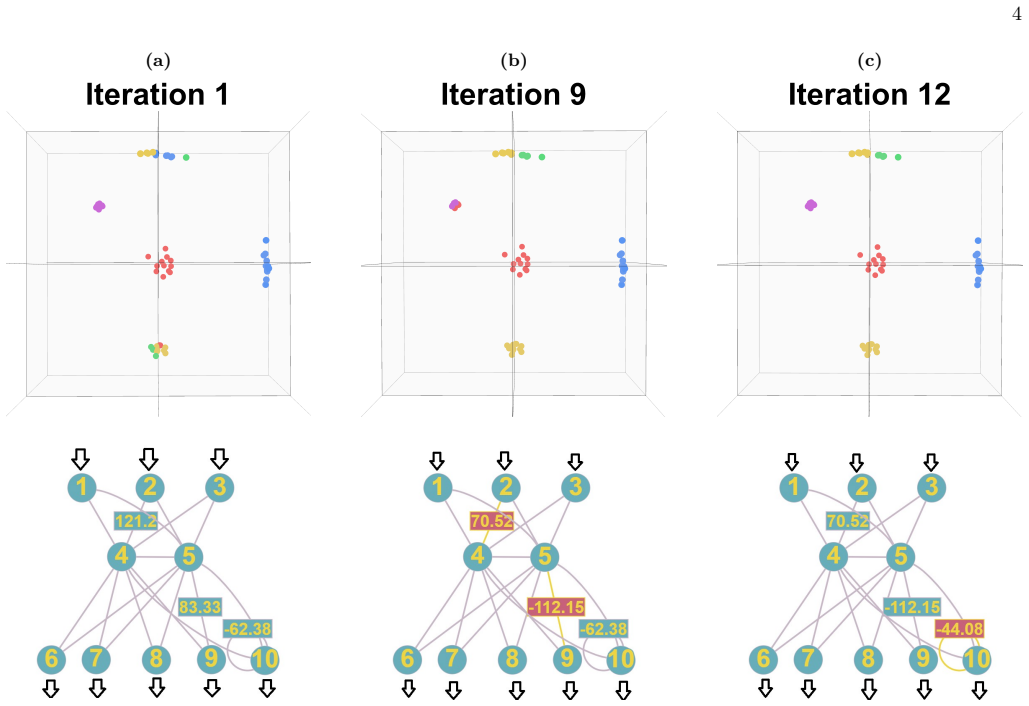
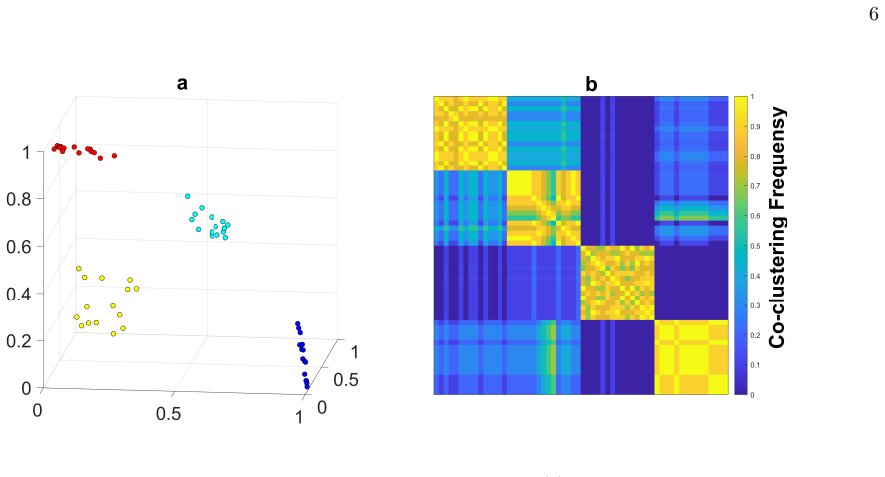
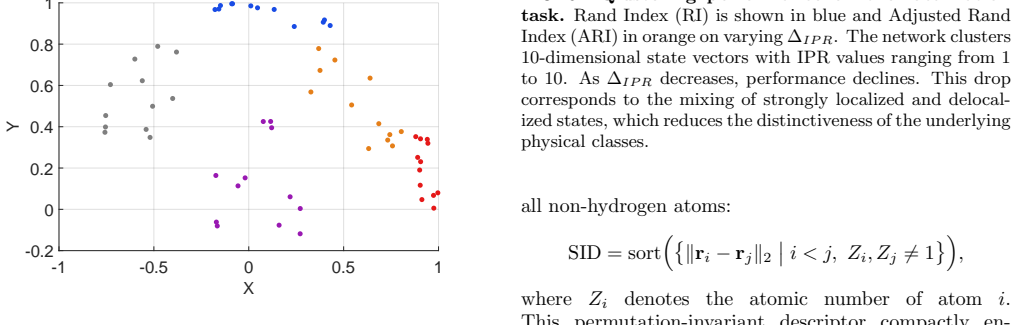
Qlustering encodes data as input states in open quantum networks and infers clusters from steady-state output currents under GKSL evolution. Benchmarks on synthetic data, localization tasks, QM9 molecules, and the Iris dataset show competitive performance stable across dephasing strengths. This demonstrates that unlabeled data structure can be extracted directly from transport observables in a tomography-free manner.
What carries the argument
Steady-state output currents at the terminals of a quantum network governed by the GKSL master equation, which directly supply the cluster assignments once data are encoded as input states.
If this is right
- Clustering becomes possible using only terminal-current readouts, removing the need for full state tomography in unsupervised tasks.
- The same transport dynamics remain effective across synthetic, localization, molecular (QM9), and standard (Iris) datasets.
- Performance stays competitive and stable over a broad interval of dephasing strengths.
- Data preparation and parameter tuning stay classical while the core assignment step runs on the quantum network dynamics.
- The workflow forms a hybrid loop in which classical steps feed the network and classical post-processing is limited to reading currents.
Where Pith is reading between the lines
- The same current-based readout could be tested on other open-system platforms where terminal measurements are easier than full tomography.
- If network topology can be chosen to match dataset geometry, the method might reduce the classical overhead for high-dimensional clustering.
- Extending the approach to time-dependent or driven networks could allow clustering of sequential or streaming data without retraining.
- Because currents are linear observables, the scheme might combine naturally with other quantum transport tasks such as sensing or simulation.
Load-bearing premise
That the steady-state currents produced by GKSL dynamics on a given network reliably reflect the underlying cluster structure of the input data across many different datasets.
What would settle it
On the Iris dataset, if the terminal currents produce cluster assignments whose agreement with known labels is no better than random guessing or a simple classical baseline, the claimed mapping from transport observables to clusters would fail.
Figures




read the original abstract
Analog quantum computation offers a route to machine learning using controllable physical dynamics as a computational resource. However, many existing approaches rely on task-specific protocols or observables that are difficult to access experimentally, limiting generality and implementation. Here we introduce Qlustering, an unsupervised clustering framework based on steady-state quantum transport in quantum networks governed by the GKSL master equation, developed through algorithm-hardware co-design. Data are encoded as input states, and cluster assignments are inferred from steady-state output currents, avoiding full state tomography in favor of accessible transport observables. The method realizes a hybrid classical-quantum workflow in which data preparation and training are performed classically, while clustering is carried out by transport dynamics. We benchmark the method on synthetic datasets, localization, and QM9 and Iris, finding competitive performance and stability over a broad range of dephasing strengths. These results show that unlabeled data structure can be extracted directly from steady-state transport observables, identifying terminal-current readout as a native, tomography-free mechanism for unsupervised learning in open quantum networks.
Editorial analysis
A structured set of objections, weighed in public.
Referee Report
Summary. The manuscript introduces Qlustering, an unsupervised clustering method that encodes unlabeled data as input states on a quantum network and extracts cluster assignments from steady-state output currents under GKSL open-system evolution. The approach is presented as a hybrid classical-quantum workflow in which network construction and data preparation are classical while the clustering step uses quantum transport dynamics, avoiding full state tomography. Competitive performance and stability under dephasing are reported on synthetic datasets, localization problems, QM9, and the Iris dataset.
Significance. If the central claim holds, the work identifies terminal currents as a native, tomography-free observable for unsupervised learning in open quantum networks. This could provide a physically grounded alternative to classical post-processing in quantum machine learning and demonstrate robustness of transport-based readout to dephasing noise. The hybrid workflow and empirical benchmarks on standard datasets are strengths that would be of interest to the quantum information and quantum machine learning communities.
major comments (3)
- [theoretical framework and data-encoding sections] The manuscript provides no general derivation linking network topology, GKSL dissipators, and the steady-state current vector to the underlying data manifold. Without such an argument, it remains possible that cluster structure is already embedded in the classical choices of network construction and state encoding rather than emerging from the quantum transport dynamics (see skeptic note on absence of general argument).
- [results and benchmarks] The abstract asserts competitive performance and stability but supplies no quantitative metrics, error bars, baseline comparisons, or details on how cluster assignments are extracted from the current vector. Full results sections must be examined to determine whether the data support the claim of a native unsupervised mechanism.
- [cluster-assignment procedure] The extraction procedure for cluster labels from terminal currents is described only at a high level. For multi-cluster cases it is unclear whether simple thresholding, k-means on the current vector, or another post-processing step is used, and whether this step is parameter-free or requires classical tuning that could undermine the tomography-free claim.
minor comments (2)
- [methods] Notation for the GKSL operators and the mapping from data points to network nodes should be introduced earlier and used consistently to improve readability.
- [figures] Figure captions for the network diagrams and current heatmaps should explicitly state the dephasing strength and dataset used in each panel.
Simulated Author's Rebuttal
We are grateful to the referee for their detailed and insightful review. Their comments have helped us identify areas where the manuscript can be clarified and strengthened. Below we provide point-by-point responses to the major comments.
read point-by-point responses
-
Referee: [theoretical framework and data-encoding sections] The manuscript provides no general derivation linking network topology, GKSL dissipators, and the steady-state current vector to the underlying data manifold. Without such an argument, it remains possible that cluster structure is already embedded in the classical choices of network construction and state encoding rather than emerging from the quantum transport dynamics (see skeptic note on absence of general argument).
Authors: We agree that a general theoretical derivation linking arbitrary network topologies and GKSL dissipators to the data manifold is not included in the manuscript. The current work focuses on a specific co-designed framework where the network is constructed classically based on data similarities, and the quantum transport is used to extract clusters via currents. To address the concern, we will expand the theoretical framework section to include a more detailed explanation of how the steady-state currents arise from the interplay between the encoded states and the network structure, supported by analytical considerations for simple cases. We will also add a discussion acknowledging that while the quantum dynamics are central to the readout, a fully general proof for all possible encodings remains an open question for future work. This does not undermine the empirical demonstration that the method works as a tomography-free approach. revision: partial
-
Referee: [results and benchmarks] The abstract asserts competitive performance and stability but supplies no quantitative metrics, error bars, baseline comparisons, or details on how cluster assignments are extracted from the current vector. Full results sections must be examined to determine whether the data support the claim of a native unsupervised mechanism.
Authors: The full manuscript includes detailed results with quantitative metrics such as clustering accuracy, adjusted Rand index, and comparisons to classical baselines like k-means and spectral clustering, along with error bars from multiple runs. Stability under dephasing is shown with plots for various noise strengths. However, we acknowledge that the abstract is too high-level. We will revise the abstract to include specific quantitative highlights from the results and a brief mention of the extraction method. This will make the claims more substantiated. revision: yes
-
Referee: [cluster-assignment procedure] The extraction procedure for cluster labels from terminal currents is described only at a high level. For multi-cluster cases it is unclear whether simple thresholding, k-means on the current vector, or another post-processing step is used, and whether this step is parameter-free or requires classical tuning that could undermine the tomography-free claim.
Authors: The cluster labels are assigned by selecting the output terminal with the maximum steady-state current for each input data point, which is a direct argmax operation on the current vector. This procedure is parameter-free and requires no additional classical post-processing such as k-means or thresholding beyond identifying the peak current. For multi-cluster scenarios, each input state is associated with the terminal exhibiting the highest current, directly yielding the cluster assignment. We will clarify this in the methods section by providing explicit pseudocode and examples, emphasizing that no classical tuning is involved in the assignment step, thereby preserving the tomography-free nature of the approach. revision: yes
Circularity Check
No circularity: derivation relies on standard GKSL transport without self-referential reduction
full rationale
The provided abstract and description show a method that encodes data into input states of an open quantum network, evolves under the standard GKSL master equation, and extracts cluster labels from steady-state terminal currents. No equations, parameters, or claims are shown to reduce to their own inputs by construction. Benchmarks use external datasets (synthetic, localization, QM9, Iris) rather than fitted subsets renamed as predictions. No self-citation chains, uniqueness theorems, or ansatze smuggled from prior author work are invoked to justify the central mapping. The workflow is hybrid classical-quantum with classical data preparation, but the transport dynamics themselves are not tautological; they follow from the Lindblad equation applied to the network. This satisfies the default expectation of a non-circular paper.
Axiom & Free-Parameter Ledger
Lean theorems connected to this paper
-
IndisputableMonolith/Cost/FunctionalEquation.leanwashburn_uniqueness_aczel unclear?
unclearRelation between the paper passage and the cited Recognition theorem.
Data are encoded as input states, and cluster assignments are inferred from steady-state output currents... governed by the GKSL master equation
-
IndisputableMonolith/Foundation/RealityFromDistinction.leanreality_from_one_distinction unclear?
unclearRelation between the paper passage and the cited Recognition theorem.
The clustering cost function CF(J,N)=∑(I_n−J_n)²
What do these tags mean?
- matches
- The paper's claim is directly supported by a theorem in the formal canon.
- supports
- The theorem supports part of the paper's argument, but the paper may add assumptions or extra steps.
- extends
- The paper goes beyond the formal theorem; the theorem is a base layer rather than the whole result.
- uses
- The paper appears to rely on the theorem as machinery.
- contradicts
- The paper's claim conflicts with a theorem or certificate in the canon.
- unclear
- Pith found a possible connection, but the passage is too broad, indirect, or ambiguous to say the theorem truly supports the claim.
Reference graph
Works this paper leans on
-
[1]
The propagation, injection, and extraction of a particle are modeled by Eq. 3. Here,Ldenotes the number of input nodes and also the dimensionality of the state vectors,qis the number of output nodes (i.e., clusters), andMis the number of hidden nodes. After reaching a steady state, the current from each output node is computed. The state is then assigned ...
work page 1936
-
[2]
Quantum simu- lators: Architectures and opportunities
Ehud Altman, Kenneth R. Brown, Giuseppe Carleo, Lin- coln D. Carr, Eugene Demler, Cheng Chin, Brian De- Marco, Sophia E. Economou, Mark A. Eriksson, Kai- Mei C. Fu, Markus Greiner, Kaden R.A. Hazzard, Randall G. Hulet, Alicia J. Koll´ ar, Benjamin L. Lev, Mikhail D. Lukin, Ruichao Ma, Xiao Mi, Shashank Misra, Christopher Monroe, Kater Murch, Zaira Nazario...
work page 2021
-
[3]
Practical quantum advantage in quantum simulation
Andrew J. Daley, Immanuel Bloch, Christian Kokail, Si- mon Flannigan, Nathan Pearson, Matthias Troyer, and Peter Zoller. “Practical quantum advantage in quantum simulation”. Nature607, 667–676 (2022)
work page 2022
-
[4]
Jacob Biamonte, Peter Wittek, Nicola Pancotti, Patrick Rebentrost, Nathan Wiebe, and Seth Lloyd. “Quantum machine learning”. Nature549, 195–202 (2017)
work page 2017
-
[5]
Arnab Das and Bikas K. Chakrabarti. “Colloquium: 16 10-2 100 102 104 0 0.2 0.4 0.6 0.8 1 Index Values Position, = 0.25 RI Consensus ARI Consensus RI Mean ARI Mean Γdep (¯t−1) 10-4 10-2 100 102 104 0 0.2 0.4 0.6 0.8Index Values QM9, RotC clustering RI Consensus ARI Consensus RI Mean ARI Mean Γdep (¯t−1) FIG. 10.Top: Effect of dephasing on the position- bas...
work page 2008
-
[6]
Quantum state tomog- raphy with locally purified density operators and local measurements
Yuchen Guo and Shuo Yang. “Quantum state tomog- raphy with locally purified density operators and local measurements”. Communications Physics7, 322 (2024)
work page 2024
-
[7]
Efficient learning of mixed-state tomography for photonic quan- tum walk
Qin-Qin Wang, Shaojun Dong, Xiao-Wei Li, Xiao-Ye Xu, Chao Wang, Shuai Han, Man-Hong Yung, Yong-Jian Han, Chuan-Feng Li, and Guang-Can Guo. “Efficient learning of mixed-state tomography for photonic quan- tum walk”. Science Advances (2024)
work page 2024
-
[8]
Adiabatic quan- tum computation
Tameem Albash and Daniel A. Lidar. “Adiabatic quan- tum computation”. Reviews of Modern Physics90, 015002 (2018)
work page 2018
-
[9]
Quantum computing in the nisq era and beyond
John Preskill. “Quantum computing in the nisq era and beyond”. Quantum2, 79 (2018)
work page 2018
-
[10]
Quantum state discrimination on reconfigurable noise-robust quantum networks
Nicola Dalla Pozza and Filippo Caruso. “Quantum state discrimination on reconfigurable noise-robust quantum networks”. Physical Review Research2, 043011 (2020)
work page 2020
-
[11]
Lu-Ji Wang, Jia-Yi Lin, and Shengjun Wu. “Imple- mentation of quantum stochastic walks for function ap- proximation, two-dimensional data classification, and sequence classification”. Physical Review Research4, 023058 (2022)
work page 2022
-
[12]
Shmuel Lorber, Oded Zimron, Inbal Lorena Zak, Anat Milo, and Yonatan Dubi. “Using quantum transport net- works for classification: A path toward quantum comput- ing for machine learning”. Physical Review Applied22, 014041 (2024)
work page 2024
-
[13]
Unsupervised clas- sification of quantum data
Gael Sent´ ıs, Alex Monras, Ramon Mu˜ noz-Tapia, John Calsamiglia, and Emilio Bagan. “Unsupervised clas- sification of quantum data”. Physical Review X9, 041029 (2019)
work page 2019
-
[14]
Yaswitha Gujju, Atsushi Matsuo, and Rudy Raymond. “Quantum machine learning on near-term quantum de- vices: Current state of supervised and unsupervised tech- niques for real-world applications”. Physical Review Ap- plied21, 067001 (2024)
work page 2024
-
[15]
Hybrid quantum-classical unsuper- vised data clustering based on the self-organizing feature map
Ilia D Lazarev, Marek Narozniak, Tim Byrnes, and Alexey N Pyrkov. “Hybrid quantum-classical unsuper- vised data clustering based on the self-organizing feature map”. Physical Review A111, 012416 (2025)
work page 2025
-
[16]
Experimental unsupervised learning of non- hermitian knotted phases with solid-state spins
Yefei Yu, Li-Wei Yu, Wengang Zhang, Huili Zhang, Xi- aolong Ouyang, Yanqing Liu, Dong-Ling Deng, and L- M Duan. “Experimental unsupervised learning of non- hermitian knotted phases with solid-state spins”. npj Quantum Information8, 116 (2022)
work page 2022
-
[17]
Fast escape of a quantum walker from an integrated photonic maze
Filippo Caruso, Andrea Crespi, Anna Gabriella Ciriolo, Fabio Sciarrino, and Roberto Osellame. “Fast escape of a quantum walker from an integrated photonic maze”. Nature communications7, 11682 (2016)
work page 2016
-
[18]
Linear programmable nanophotonic processors
Nicholas C Harris, Jacques Carolan, Darius Bunandar, Mihika Prabhu, Michael Hochberg, Tom Baehr-Jones, Michael L Fanto, A Matthew Smith, Christopher C Tison, Paul M Alsing, et al. “Linear programmable nanophotonic processors”. Optica5, 1623–1631 (2018)
work page 2018
-
[19]
Quantum transport simula- tions in a programmable nanophotonic processor
Nicholas C Harris, Gregory R Steinbrecher, Mihika Prabhu, Yoav Lahini, Jacob Mower, Darius Bunandar, Changchen Chen, Franco NC Wong, Tom Baehr-Jones, Michael Hochberg, et al. “Quantum transport simula- tions in a programmable nanophotonic processor”. Na- ture Photonics11, 447–452 (2017)
work page 2017
-
[20]
Subhajit Sarkar and Yonatan Dubi. “Emergence and dy- namical stability of a charge time-crystal in a current- carrying quantum dot simulator”. Nano Letters (2022)
work page 2022
-
[21]
Do photo- synthetic complexes use quantum coherence to increase their efficiency? probably not
Elinor Zerah Harush and Yonatan Dubi. “Do photo- synthetic complexes use quantum coherence to increase their efficiency? probably not”. Science advances7, eabc4631 (2021)
work page 2021
-
[22]
Optical pulse propagation in the tight-binding approximation
Shayan Mookherjea and Amnon Yariv. “Optical pulse propagation in the tight-binding approximation”. Optics Express9, 91–96 (2001)
work page 2001
-
[23]
Yang Chen, Xiaoman Chen, Xifeng Ren, Ming Gong, and Guang-can Guo. “Tight-binding model in optical waveg- uides: Design principle and transferability for simulation of complex photonics networks”. Physical Review A104, 023501 (2021)
work page 2021
-
[24]
Variational tight-binding method for simulat- ing large superconducting circuits
DK Weiss, Wade DeGottardi, Jens Koch, and DG Fer- guson. “Variational tight-binding method for simulat- ing large superconducting circuits”. Physical Review Re- search3, 033244 (2021)
work page 2021
-
[25]
On the generators of quantum dy- 17 namical semigroups
Goran Lindblad. “On the generators of quantum dy- 17 namical semigroups”. Communications in Mathematical Physics48, 119–130 (1976)
work page 1976
-
[26]
Completely positive dy- namical semigroups of n-level systems
Vittorio Gorini, Andrzej Kossakowski, and Ennackal Chandy George Sudarshan. “Completely positive dy- namical semigroups of n-level systems”. Journal of Math- ematical Physics17, 821–825 (1976)
work page 1976
-
[27]
A survey of clustering algorithms for big data: Taxonomy and empirical analysis
Adil Fahad, Najlaa Alshatri, Zahir Tari, Abdullah Alamri, Ibrahim Khalil, Albert Y Zomaya, Sebti Foufou, and Abdelaziz Bouras. “A survey of clustering algorithms for big data: Taxonomy and empirical analysis”. IEEE transactions on emerging topics in computing2, 267– 279 (2014)
work page 2014
-
[28]
Quantum chem- istry structures and properties of 134 kilo molecules
Raghunathan Ramakrishnan, Pavlo O Dral, Matthias Rupp, and O Anatole Von Lilienfeld. “Quantum chem- istry structures and properties of 134 kilo molecules”. Scientific data1, 1–7 (2014)
work page 2014
- [29]
-
[30]
An introduction to random index- ing
Magnus Sahlgren. “An introduction to random index- ing”. In Methods and Applications of Semantic In- dexing Workshop at the 7th International Conference on Terminology and Knowledge Engineering. (2005). url:https://www.diva-portal.org/smash/get/diva2: 1041127/FULLTEXT01.pdf
work page 2005
-
[31]
Lawrence Hubert and Phipps Arabie. “Comparing par- titions”. Journal of Classification2, 193–218 (1985)
work page 1985
-
[32]
Some methods for classification and analysis of multivariate observations,
J. MacQueen. “Some methods for classification and analysis of multivariate observations”. In Lucien M. Le Cam and Jerzy Neyman, editors, Proceedings of the Fifth Berkeley Symposium on Mathematical Statistics and Probability. Volume 1, pages 281–297. Berkeley, CA (1967). University of California Press. url:https: //projecteuclid.org/euclid.bsmsp/1200512992
-
[33]
Some new in- dexes of cluster validity
James C Bezdek and Nikhil R Pal. “Some new in- dexes of cluster validity”. IEEE Transactions on Sys- tems, Man, and Cybernetics, Part B (Cybernetics)28, 301–315 (1998)
work page 1998
-
[34]
Well-separated clusters and optimal fuzzy partitions
J. C. Dunn. “Well-separated clusters and optimal fuzzy partitions”. Journal of Cybernetics4, 95–104 (1974)
work page 1974
-
[35]
Clustering with the average silhouette width
Fatima Batool and Christian Hennig. “Clustering with the average silhouette width”. Computational Statistics & Data Analysis158, 107190 (2021)
work page 2021
-
[36]
Silhouettes: A graphical aid to the interpretation and validation of cluster analysis
Peter J. Rousseeuw. “Silhouettes: A graphical aid to the interpretation and validation of cluster analysis”. Jour- nal of Computational and Applied Mathematics20, 53– 65 (1987)
work page 1987
-
[37]
Stability estimation for unsupervised clustering: A re- view
Tianmou Liu, Han Yu, and Rachael Hageman Blair. “Stability estimation for unsupervised clustering: A re- view”. Wiley Interdisciplinary Reviews: Computational Statistics14, e1575 (2022)
work page 2022
-
[38]
Stefano Monti, Pablo Tamayo, Jill Mesirov, and Todd Golub. “Consensus clustering: a resampling-based method for class discovery and visualization of gene ex- pression microarray data”. Machine learning52, 91– 118 (2003)
work page 2003
-
[39]
Localization: theory and experiment
Bernhard Kramer and Angus MacKinnon. “Localization: theory and experiment”. Reports on Progress in Physics 56, 1469 (1993)
work page 1993
-
[40]
Enumeration of 166 billion organic small molecules in the chemical universe database gdb-17
Lars Ruddigkeit, Ruud Van Deursen, Lorenz C Blum, and Jean-Louis Reymond. “Enumeration of 166 billion organic small molecules in the chemical universe database gdb-17”. Journal of chemical information and modeling 52, 2864–2875 (2012)
work page 2012
-
[41]
David Weininger. “Smiles, a chemical language and in- formation system. 1. introduction to methodology and encoding rules”. Journal of chemical information and computer sciences28, 31–36 (1988)
work page 1988
-
[42]
Struc- ture and energetics of ni clusters with up to 150 atoms
Valeri G Grigoryan and Michael Springborg. “Struc- ture and energetics of ni clusters with up to 150 atoms”. Chemical physics letters375, 219–226 (2003)
work page 2003
-
[43]
Metrics for measuring distances in configuration spaces
Ali Sadeghi, S Alireza Ghasemi, Bastian Schaefer, Stephan Mohr, Markus A Lill, and Stefan Goedecker. “Metrics for measuring distances in configuration spaces”. The Journal of chemical physics139(2013)
work page 2013
-
[44]
K. Hansen, G. Montavon, F. Biegler, et al. “Ma- chine learning predictions of molecular properties: Ac- curate many-body potentials and nonlocality in chemical space”. Journal of Physical Chemistry Letters6, 2326– 2331 (2015)
work page 2015
-
[45]
The use of multiple measurements in taxonomic problems
Ronald A. Fisher. “The use of multiple measurements in taxonomic problems”. Annals of Eugenics7, 179– 188 (1936)
work page 1936
-
[46]
A comparison of k-means clustering algorithm and clara clustering algo- rithm on iris dataset
Tanvi Gupta and Supriya P Panda. “A comparison of k-means clustering algorithm and clara clustering algo- rithm on iris dataset”. International Journal of Engi- neering & Technology7, 4766–4768 (2018). url:https: //doi.org/10.14419/ijet.v7i4.21472
-
[47]
Comparative study of k-means clus- tering using iris data set for various distances
Adrija Chakraborty, Neetu Faujdar, Akash Punhani, and Shipra Saraswat. “Comparative study of k-means clus- tering using iris data set for various distances”. In 2020 10th International Conference on Cloud Comput- ing, Data Science & Engineering (Confluence). Pages 332–335. IEEE (2020)
work page 2020
-
[48]
Performance evaluation of threshold-based and k-means clustering algorithms using iris dataset
Mamta Mittal, Rajendra K Sharma, and Varinder Pal Singh. “Performance evaluation of threshold-based and k-means clustering algorithms using iris dataset”. Recent Patents on Engineering13, 131–135 (2019)
work page 2019
-
[49]
Comparison of clustering methods on iris dataset
Mingrui Ye, Ziqian Zhou, Yijie Zhou, and Yiran Huang. “Comparison of clustering methods on iris dataset”. In 2023 5th International Conference on Frontiers Technol- ogy of Information and Computer (ICFTIC). Pages 86–
work page 2023
-
[50]
Enhancing accuracy: Iris flower classification with ensemble models
Nishanthini Mani, Premkumar Murugiah, Vethavarna Veeraraghavan, Nuzha Razia, and Shashank Ramesh. “Enhancing accuracy: Iris flower classification with ensemble models”. In 2024 International Conference on Cognitive Robotics and Intelligent Systems (ICC- ROBINS). Pages 547–554. IEEE (2024)
work page 2024
-
[51]
A quantum engineer’s guide to superconducting qubits
Philip Krantz, Morten Kjaergaard, Fei Yan, Terry P Or- lando, Simon Gustavsson, and William D Oliver. “A quantum engineer’s guide to superconducting qubits”. Applied physics reviews6(2019)
work page 2019
-
[52]
Universal ori- gin for environment-assisted quantum transport in exci- ton transfer networks
Elinor Zerah-Harush and Yonatan Dubi. “Universal ori- gin for environment-assisted quantum transport in exci- ton transfer networks”. The journal of physical chemistry letters9, 1689–1695 (2018)
work page 2018
-
[53]
Effects of dis- order and interactions in environment assisted quantum transport
Elinor Zerah-Harush and Yonatan Dubi. “Effects of dis- order and interactions in environment assisted quantum transport”. Physical Review Research2, 023294 (2020)
work page 2020
-
[54]
Signature of quantum coherence in the exciton energy pathways of the lh2 photosynthetic complex
Elinor Zerah Harush and Yonatan Dubi. “Signature of quantum coherence in the exciton energy pathways of the lh2 photosynthetic complex”. ACS omega8, 38871– 38878 (2023)
work page 2023
-
[55]
Subhajit Sarkar and Yonatan Dubi. “Environment- assisted and environment-hampered efficiency at maxi- mum power in a molecular photocell”. The Journal of Physical Chemistry C124, 15115–15122 (2020)
work page 2020
-
[56]
The theory of open quantum systems
Heinz-Peter Breuer and Francesco Petruccione. “The theory of open quantum systems”. Oxford University 18 Press, USA. (2002)
work page 2002
discussion (0)
Sign in with ORCID, Apple, or X to comment. Anyone can read and Pith papers without signing in.