Recognition: no theorem link
Exact steady states of interacting driven dissipative fermionic systems with hidden time-reversal symmetry
Pith reviewed 2026-05-12 04:08 UTC · model grok-4.3
The pith
Generalizing the coherent quantum absorber technique yields exact steady states for driven-dissipative spinless fermions, revealing a persistent first-order density transition and hidden time-reversal symmetry.
A machine-rendered reading of the paper's core claim, the machinery that carries it, and where it could break.
Core claim
Exact solutions exist for the steady states of dissipative spinless fermionic systems featuring arbitrary pairing terms in the Hamiltonian, global charging energy interactions, and uniform single-particle loss. These solutions come from extending the coherent quantum absorber technique to fermionic cases and demonstrate the presence of hidden time-reversal symmetry. The steady-state density undergoes a first-order phase transition whose discontinuity remains even at finite dissipation strengths. Mean-field approximations capture bistability but not the exact transition location, and the symmetry enforces Onsager relations in certain correlation functions.
What carries the argument
The generalization of the coherent quantum absorber technique to fermionic systems, which exploits hidden time-reversal symmetry to obtain the exact steady state.
If this is right
- The particle density in the steady state shows a first-order phase transition with a jump that persists at finite dissipation rates.
- Mean-field theory predicts a bistable regime encompassing the transition but does not accurately locate it using a Maxwell construction.
- The hidden time-reversal symmetry implies Onsager symmetry for certain two-time correlation functions.
- These exact solutions apply to models with arbitrary Hamiltonian pairing and global interactions under uniform loss.
Where Pith is reading between the lines
- Similar hidden symmetries could allow exact solutions in other classes of open quantum systems beyond the spinless uniform-loss case considered here.
- Quantum simulators could test the density jump directly by varying interaction strength or loss rate.
- The discrepancy with mean-field suggests that fluctuation effects are crucial near the transition even at moderate dissipation.
Load-bearing premise
The coherent quantum absorber technique, when generalized, gives an exact steady state only when the fermions are spinless, interactions are global charging energy, and loss is uniform across sites.
What would settle it
Numerical computation of the steady-state density versus a control parameter such as interaction strength or chemical potential, to check if a sharp discontinuity appears at finite dissipation rate.
Figures




read the original abstract
We present exact solutions for the non-equilibrium steady states of a class of dissipative spinless fermionic systems with arbitrary Hamiltonian pairing terms, global charging energy interactions, and uniform single particle loss on every site. Our exact solution is found by generalizing the coherent quantum absorber technique to fermionic systems, and our result establishes the existence of hidden time-reversal symmetry in driven-dissipative fermionic models. The steady state exhibits a first order phase transition in the particle density, with the resulting jump discontinuity in density persisting even for finite dissipation rates. A mean-field description of the model exhibits a bistable regime that encompasses the first-order transition line yet which fails to accurately predict its precise location via a Maxwell construction. We also show that the model's hidden time-reversal symmetry results in an Onsager symmetry of certain two-time correlation functions.
Editorial analysis
A structured set of objections, weighed in public.
Referee Report
Summary. The manuscript derives exact non-equilibrium steady states (NESS) for driven-dissipative spinless fermionic systems that include arbitrary Hamiltonian pairing terms, global charging-energy interactions, and uniform single-particle loss. The central construction generalizes the coherent quantum absorber technique to fermions, identifies a hidden time-reversal symmetry, and obtains a closed-form steady-state density that exhibits a first-order phase transition whose jump discontinuity survives at finite dissipation rate gamma. Mean-field theory is shown to be bistable in a region containing the transition line but to mislocate the transition under a Maxwell construction; the hidden symmetry is further used to derive Onsager reciprocity for selected two-time correlators.
Significance. If the exact NESS construction is verified to hold for arbitrary pairing and finite gamma, the result would be significant: exact closed-form steady states remain rare for interacting open fermionic systems, and the persistence of a first-order density jump beyond the gamma to 0 limit supplies a concrete counter-example to mean-field expectations. The identification of hidden time-reversal symmetry and its consequences for Onsager relations adds a symmetry-based tool that could be portable to other driven-dissipative models.
major comments (2)
- [derivation of the steady-state solution] The load-bearing step is the claim that the generalized coherent quantum absorber produces a rho_ss that lies exactly in the kernel of the Lindblad superoperator for arbitrary pairing terms and finite uniform loss gamma > 0. Because the jump operators are fermionic, the anticommutators {c_i, c_j^dagger} = delta_ij must be tracked when the absorber state is inserted into L[rho]; any residual term that fails to cancel would invalidate both the exact solution and the asserted density discontinuity. An explicit term-by-term cancellation (or a compact algebraic identity) demonstrating L[rho_ss] = 0 for generic parameters is required.
- [phase-transition analysis] The first-order transition is stated to persist at finite gamma, yet the location of the jump is determined by the exact rho_ss. If the construction of rho_ss implicitly restricts the allowed pairing amplitudes or requires gamma to satisfy an auxiliary condition, the discontinuity would not be generic; the manuscript must state the precise domain of validity and show that the jump survives inside that domain.
minor comments (2)
- [mean-field section] The mean-field comparison asserts that bistability encompasses the transition line but that a Maxwell construction fails to locate it accurately; quantitative measures (e.g., the difference in critical chemical potential between exact and mean-field results) or an explicit figure would make the discrepancy concrete.
- [symmetry discussion] Notation for the hidden time-reversal operator and its action on the Lindblad operators should be introduced once and used consistently; at present the symmetry is invoked without a compact definition that readers can apply to the two-time correlators.
Simulated Author's Rebuttal
We thank the referee for the careful reading and constructive comments, which help clarify the presentation of our exact NESS construction. We address each major comment below and will revise the manuscript to incorporate the requested details.
read point-by-point responses
-
Referee: [derivation of the steady-state solution] The load-bearing step is the claim that the generalized coherent quantum absorber produces a rho_ss that lies exactly in the kernel of the Lindblad superoperator for arbitrary pairing terms and finite uniform loss gamma > 0. Because the jump operators are fermionic, the anticommutators {c_i, c_j^dagger} = delta_ij must be tracked when the absorber state is inserted into L[rho]; any residual term that fails to cancel would invalidate both the exact solution and the asserted density discontinuity. An explicit term-by-term cancellation (or a compact algebraic identity) demonstrating L[rho_ss] = 0 for generic parameters is required.
Authors: We agree that an explicit verification is necessary to establish rigor. The manuscript derives the generalized coherent quantum absorber by extending the bosonic construction, ensuring that the fermionic anticommutators are preserved in the definition of the absorber state. To address this point directly, we will add a dedicated appendix containing the full term-by-term expansion of L[rho_ss]. This calculation explicitly tracks all {c_i, c_j^dagger} contributions and demonstrates that every residual term cancels identically for arbitrary pairing amplitudes and any finite gamma > 0, yielding the compact identity L[rho_ss] = 0 without further restrictions. revision: yes
-
Referee: [phase-transition analysis] The first-order transition is stated to persist at finite gamma, yet the location of the jump is determined by the exact rho_ss. If the construction of rho_ss implicitly restricts the allowed pairing amplitudes or requires gamma to satisfy an auxiliary condition, the discontinuity would not be generic; the manuscript must state the precise domain of validity and show that the jump survives inside that domain.
Authors: The rho_ss construction holds for arbitrary real pairing amplitudes and all gamma >= 0 (recovering the closed-system limit at gamma = 0). No auxiliary condition on gamma is imposed by the absorber method. The first-order density jump occurs along the line where the two candidate steady-state weights become equal, as determined directly from the closed-form expression. We will revise the main text to state this domain of validity explicitly and add a new subsection with an analytic argument (plus supporting numerical evaluation) confirming that the discontinuity in particle density remains finite for any gamma > 0 within the stated domain. revision: yes
Circularity Check
No circularity: exact solution obtained via independent generalization of absorber technique
full rationale
The paper derives exact non-equilibrium steady states by generalizing the coherent quantum absorber technique to fermionic systems with the specified interactions and loss, then establishes hidden time-reversal symmetry as a consequence. No load-bearing step reduces by construction to a fitted input, self-definition, or self-citation chain; the steady-state expressions and density discontinuity are presented as outputs of the generalized construction rather than inputs renamed. The mean-field comparison is separate and does not substitute for or force the exact result. This is a standard non-circular generalization with independent content.
Axiom & Free-Parameter Ledger
axioms (1)
- domain assumption The system is described by a Lindblad master equation with arbitrary pairing terms, global charging energy, and uniform single-particle loss.
Reference graph
Works this paper leans on
-
[1]
Coherent quantum absorber The coherent quantum absorber (CQA) system is con- structed for Eq. (2) by introducing an absorber with Hamiltonian ˆHB =− ˆHA and cascading the dissipation: ∂t ˆρcqa =−i[ ˆHcqa,ˆρcqa] + X j κD[ˆcj,A −ˆcj,B]ˆρcqa,(A1) ˆHcqa = ˆHA − ˆHB − iκ 2 X j ˆc† j,Aˆcj,B −H.c. ,(A2) where the final term in ˆHcqa is the cascaded interaction. ...
-
[2]
Wavefunction ansatz and the defect operator The most general ansatz for the CQA wavefunction is Eq. (A6) wherenindexes the number of fermions and α(n) j1,...,jn records the amplitude for thosenfermions to be on the specific sitesj 1, . . . , jn. In its most general form,|ψ cqa⟩could be a mixed parity state with all pos- sible numbers of fermionsn= 0,1,2, ...
-
[3]
The factor of 1/2 in ˆB† accounts for the double countingM jiˆb† ji =M ijˆb† ij
General exact solution Consider the following ansatz for|ψ cqa⟩consisting of all possible number of dark pairs delocalized across the 11 system according to the pairing matrixM ij = ∆ij/∆: |ψcqa⟩= ∞X n=0 αn n! ˆB† n |0⟩, ˆB† ≡ 1 2 X ij Mijˆb† ij (A17) Hereα n is the state vector coefficient for the state with ndark pairs and ˆB† is the delocalized dark-pa...
-
[4]
Nonreciprocity in quantum systems Nonreciprocity in spin and bosonic systems is easy to characterize: a nonreciprocal interaction between two isolated systemsAandBin one for which systemA influences systemBbut not vice versa, as measured by the equations of motion for system-local operators (e.g., ˆXA = ( ˆX) A ⊗( ˆ1)B). If the equations of motion for all...
-
[5]
The standard formulation The general standard formulation to engineer a nore- ciprocal interaction is as follows [31]: Given two quan- tum systemsAandBthat have no existing interactions 12 or couplings between them, we seek to make the interac- tion Eq. (B1) between the systems nonreciprocal First, we assume that [ ˆA, ˆXB] = [ ˆB, ˆXA] = [ ˆA, ˆB] = 0 fo...
-
[6]
(B1) between two fermionic systemsAandB for which ˆAand ˆBare odd in fermionic ladder opera- tors
Nonreciprocal odd fermionic interactions Suppose now that we seek the nonreciprocal interac- tion Eq. (B1) between two fermionic systemsAandB for which ˆAand ˆBare odd in fermionic ladder opera- tors. For example, consider a nonreciprocal tunneling ˆHint =λ(ˆc† i,Bˆcj,A + H.c.) where fermions can tunnel only from systemAto systemB. Clearly, the assumption...
-
[7]
Normalization: the combinatorics of dimers on a chain To compute observables and correlation functions of the steady state, the steady state must be normalized: Ncqa ≡ ⟨ψcqa|ψcqa⟩= ∞X n=0 |αn|2N(L, n),(C4) N(L, n) =|| 1 n!( ˆB†)n|0⟩||2 = 1 (n!)2 ⟨0|( ˆB)n( ˆB†)n|0⟩, whereN(L, n) is the state norm of the delocalizedn-pair state. The problem of computing th...
-
[8]
Global expectation values Global expectation values, such as total particle num- ber⟨ ˆNA⟩= P j⟨ˆnj,A⟩(of the physical systemA) or pair- ing operator⟨ ˆB†⟩(of the CQA system), are readily com- puted using their algebraic properties and the form of the wavefunction. First note that since the wavefunc- tion only contains dark mode excitations, any expecta- ...
-
[9]
The physical sys- tem correlations are scaled: 1 2 ⟨ˆciˆcj⟩
Anomalous correlation functions The anomalous correlation functions are the expecta- tion values ⟨ˆciˆcj⟩ ≡ ⟨ψ cqa|ˆci,+ˆcj,+|ψcqa⟩(C12) for any pair of dark mode sitesiandj. The physical sys- tem correlations are scaled: 1 2 ⟨ˆciˆcj⟩. For the arguments that follow, it is more physically transparent to consider the conjugate anomalous correlations⟨ˆc † i ...
-
[10]
(C12) for even-length PBC chains, as this is relevant to the discussion in Sec
Anomalous correlations in even-length PBC chains Here, we compute Eq. (C12) for even-length PBC chains, as this is relevant to the discussion in Sec. IV. The basic arguments employed here carry over to OBC chains and odd-length PBC chains with minor modifica- tions. Due to the translational invariance of the PBC chain and the fact that only cross-sublatti...
-
[11]
Normal correlations in even-length PBC chains The reasoning used to compute anomalous correlations can be adapted to compute normal correlations ⟨ˆc† i ˆcj⟩ ≡ ⟨ψ cqa|ˆc† i ˆcj|ψcqa⟩.(C22) In OBC chains and even-length PBC chains, the only nonzero normal correlations are of the form⟨ˆc † jˆcj+2m⟩ using similar arguments as above regarding contiguous string...
-
[12]
(D5), is system-size-dependent
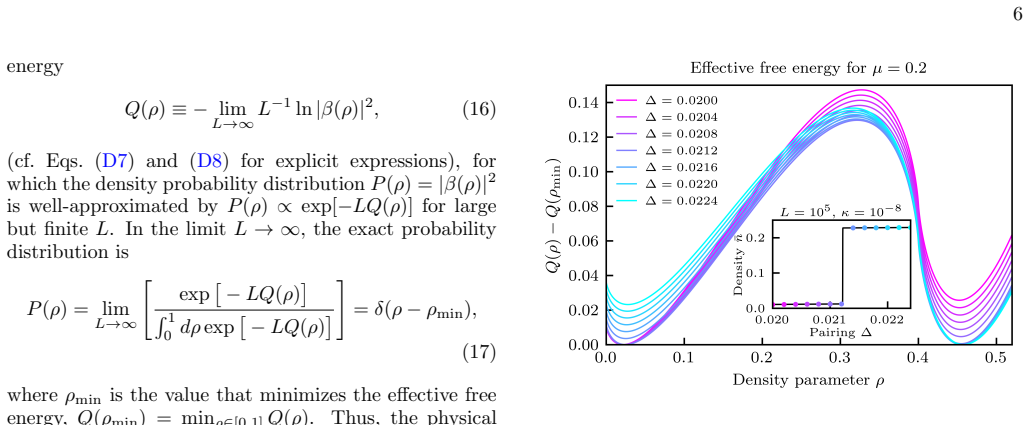
Effective free energy The density probability distributionP(ρ) =|β(ρ)| 2, forβ(ρ) given by Eq. (D5), is system-size-dependent. However, in the limitL→ ∞, its functional form is dom- inated by the bracketed factor raised to the power ofL. Thus, we can define the effective free energy Q(ρ) =−lim L→∞ L−1 lnP(ρ),(D6) which has a well-defined limit: Q(ρ) = (D7...
-
[13]
Finite dissipation When we consider finite dissipation, we must use the full effective free energy Eq. (D7) instead of Eq. (D8). The qualitative features of the phase transition, includ- ing the jump discontinuity of particle density across the critical line, remain intact. The thermodynamic limit probability distribution remainsP(ρ) =δ(ρ−ρ min), and near...
-
[14]
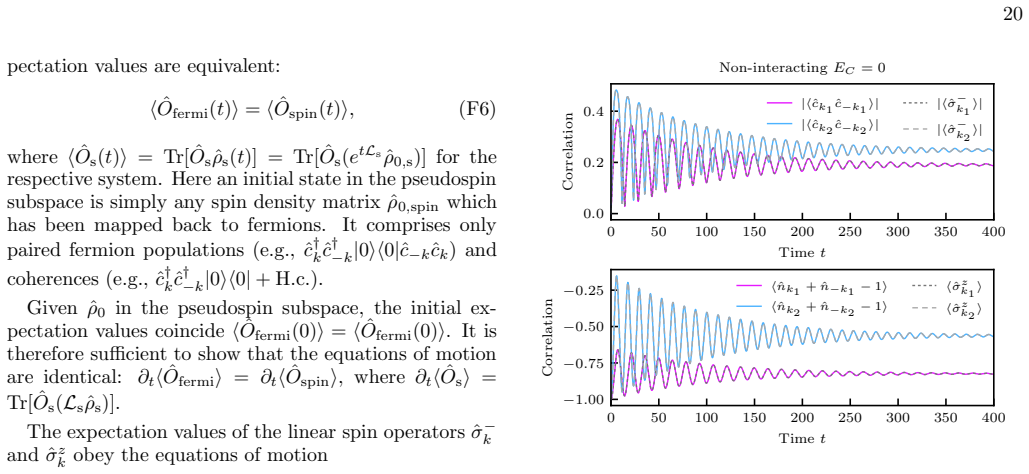
Mean-field expectation value equivalence Unlike the Hamiltonians, the single particle fermion dissipation does not have an exact mapping to spins as there is no way to represent ˆck in terms of the spin oper- ators. Nevertheless, we can show that for an initial state ˆρ0 in the pseudospin subspace, there is a correspondence between equations of motion for...
-
[15]
weak” interactionsE C = 0.1 and the bot- tom two panels are for “strong
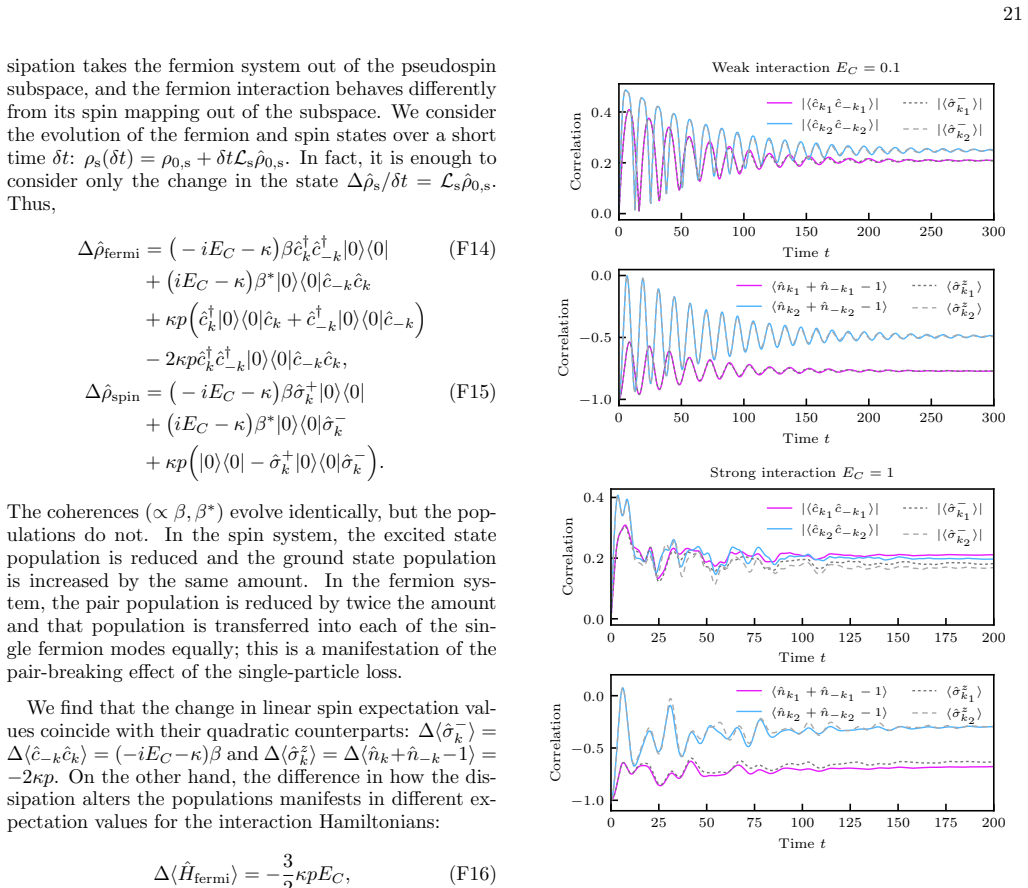
Breakdown of the mapping with interactions To illustrate how the mapping breaks down for the interacting system, it is sufficient to consider a single momentum pair±kinitialized in an arbitrary pseudospin state ˆρ0 = (1−p)|0⟩⟨0|+pˆc † kˆc† −k|0⟩⟨0|ˆc−kˆck (F9) + βˆc† kˆc† −k|0⟩⟨0|+ H.c. , 0 50 100 150 200 250 300 350 400 Time t 0.0 0.2 0.4 Correlation Non...
- [16]
- [17]
-
[18]
S. Hamanaka, K. Yamamoto, and T. Yoshida, Physical Review B108, 155114 (2023)
work page 2023
- [19]
- [20]
- [21]
- [22]
-
[23]
M. Vanhoecke, N. Tsuji, and M. Schir` o, Dissipative Kondo physics in the Anderson Impurity Model with two- body losses (2025), arXiv:2506.22302 [cond-mat]
-
[24]
E. Starchl and L. M. Sieberer, Physical Review Letters 129, 220602 (2022)
work page 2022
-
[25]
E. Starchl and L. M. Sieberer, Physical Review Research 6, 013016 (2024)
work page 2024
- [26]
-
[27]
P. Borchia, J. Knolle, and A. Nunnenkamp, Interaction- Mediated Non-Reciprocal Dynamics in Open Quantum Systems: From an Exactly Solvable Model to Generic Behavior (2026), arXiv:2604.07346 [quant-ph]
work page internal anchor Pith review Pith/arXiv arXiv 2026
- [28]
-
[29]
A. McDonald and A. A. Clerk, Physical Review Letters 128, 033602 (2022)
work page 2022
-
[30]
D. Roberts, A. Lingenfelter, and A. A. Clerk, PRX Quan- tum2, 020336 (2021)
work page 2021
-
[31]
K. Stannigel, P. Rabl, and P. Zoller, New Journal of Physics14, 063014 (2012)
work page 2012
- [32]
- [33]
-
[34]
D. Roberts and A. A. Clerk, Physical Review Letters 23 131, 190403 (2023)
work page 2023
-
[35]
A. Lingenfelter, M. Yao, A. Pocklington, Y.-X. Wang, A. Irfan, W. Pfaff, and A. A. Clerk, Physical Review X 14, 021028 (2024)
work page 2024
-
[36]
M. Yao, A. Lingenfelter, R. Belyansky, D. Roberts, and A. A. Clerk, Physical Review Letters134, 130404 (2025)
work page 2025
- [37]
- [38]
-
[39]
S. Lieu, M. McGinley, O. Shtanko, N. R. Cooper, and A. V. Gorshkov, Physical Review B105, L121104 (2022)
work page 2022
-
[40]
A. Y. Kitaev, Physics-Uspekhi44, 131 (2001)
work page 2001
-
[41]
M. F. Lapa and M. Levin, Physical Review Letters124, 257002 (2020)
work page 2020
-
[42]
P. W. Anderson, Physical Review112, 1900 (1958)
work page 1900
-
[43]
Nigro, Journal of Statistical Mechanics: Theory and Experiment2019, 043202 (2019)
D. Nigro, Journal of Statistical Mechanics: Theory and Experiment2019, 043202 (2019)
work page 2019
-
[44]
C. W. Gardiner, Physical Review Letters70, 2269 (1993)
work page 1993
-
[45]
H. J. Carmichael, Physical Review Letters70, 2273 (1993)
work page 1993
- [46]
- [47]
-
[48]
The step-like behavior of|α n|is not a sharp feature for finiteκ; instead, it occurs over a range of values approxi- matelyµ−2κ < n/L < µ+2κ(in units ofE C). Moreover, the functional form of the|α n|can obscure the step, mak- ing it difficult to discern on a plot for generic parameters
-
[49]
M. Marcuzzi, E. Levi, S. Diehl, J. P. Garrahan, and I. Lesanovsky, Physical Review Letters113, 210401 (2014)
work page 2014
-
[50]
C. Carr, R. Ritter, C. G. Wade, C. S. Adams, and K. J. Weatherill, Physical Review Letters111, 113901 (2013)
work page 2013
-
[51]
T. E. Lee, H. H¨ affner, and M. C. Cross, Physical Review A84, 031402 (2011)
work page 2011
-
[52]
G. C. Wick, A. S. Wightman, and E. P. Wigner, Physical Review88, 101 (1952)
work page 1952
-
[53]
M. E. Fisher and H. N. V. Temperley, Reviews of Modern Physics32, 1029 (1960)
work page 1960
-
[54]
M. E. Fisher, Physical Review124, 1664 (1961)
work page 1961
discussion (0)
Sign in with ORCID, Apple, or X to comment. Anyone can read and Pith papers without signing in.