Recognition: no theorem link
New perspective on cold fusion reactions: A microscopic description
Pith reviewed 2026-05-12 03:45 UTC · model grok-4.3
The pith
A microscopic framework using Hartree-Fock-Bogoliubov potential-energy surfaces in the fusion-by-diffusion model describes cold fusion reactions without phenomenological tuning at the fusion stage.
A machine-rendered reading of the paper's core claim, the machinery that carries it, and where it could break.
Core claim
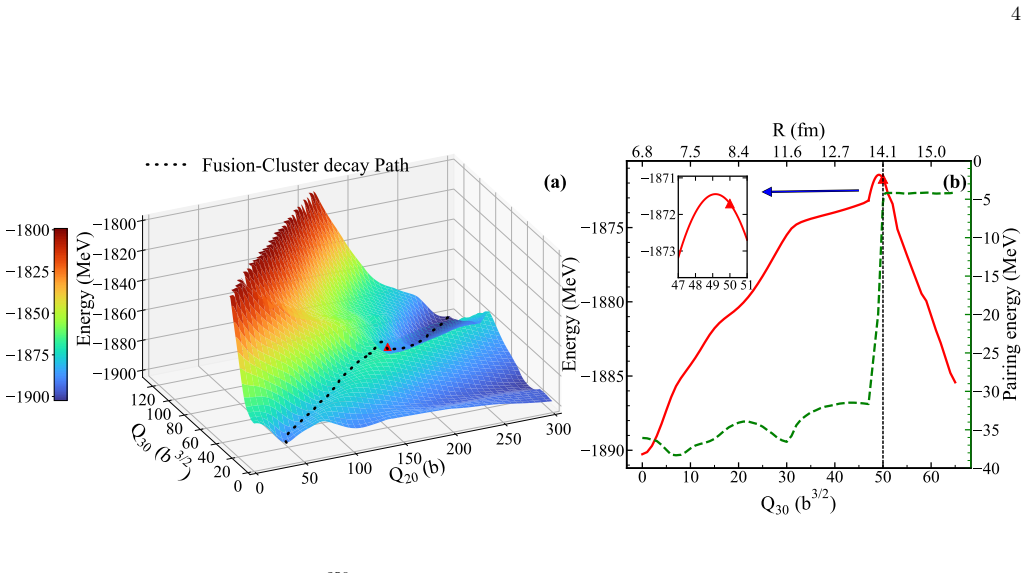
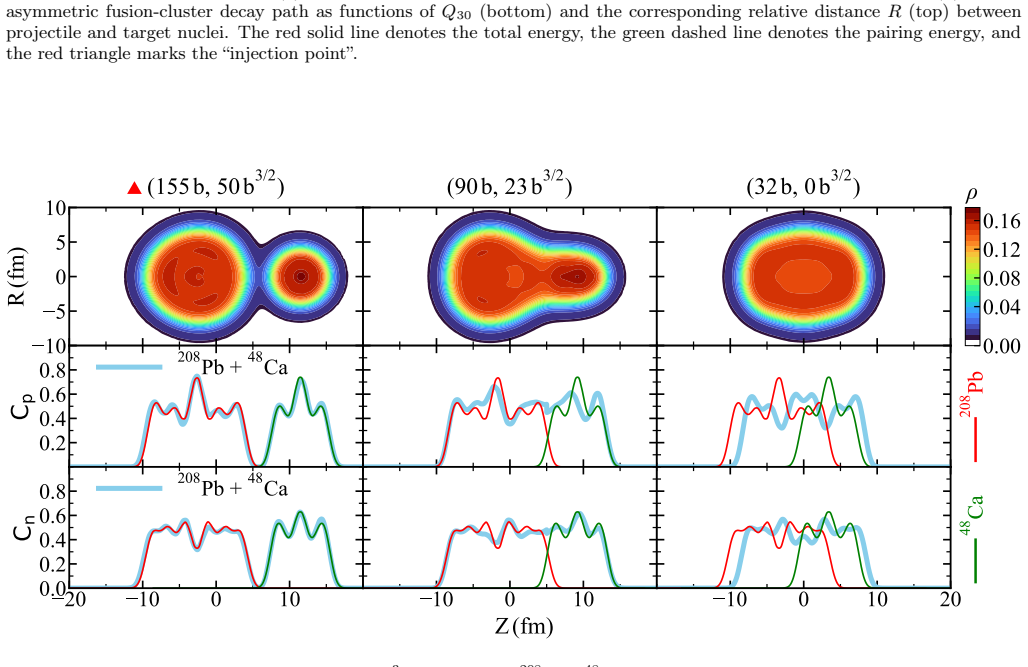
The authors show that Hartree-Fock-Bogoliubov potential-energy surfaces for cold-fusion reactions exhibit a hyperasymmetric valley anchored at lead-208 that connects the entrance channel to compound-nucleus formation. By feeding these surfaces directly into the fusion-by-diffusion model, the injection point and inner barrier can be extracted self-consistently, eliminating the need for phenomenological adjustments. This framework reproduces the experimental evaporation-residue cross section for 48Ca + 208Pb and yields a near-exponential decrease in compound-nucleus formation probability with increasing Z for the reactions 54Cr + 208Pb and 58Fe + 208Pb.
What carries the argument
The Hartree-Fock-Bogoliubov potential-energy surface, from which the fusion injection point and inner barrier are extracted self-consistently for use in the fusion-by-diffusion model.
Load-bearing premise
The Hartree-Fock-Bogoliubov potential-energy surfaces accurately represent the dynamical path from the entrance channel through the hyperasymmetric valley all the way to compound-nucleus formation.
What would settle it
If an independent calculation or measurement shows that the inner barrier height extracted from the HFB surface for 48Ca + 208Pb differs substantially from the value needed to match the observed evaporation-residue cross section, the self-consistent extraction would be called into question.
Figures

read the original abstract
A microscopic framework that combines the Hartree-Fock-Bogoliubov (HFB) approach with the fusion by diffusion (FBD) model is proposed to investigate the synthesis mechanism of superheavy nuclei (SHN). For the reaction $^{48}\text{Ca}+^{208}\text{Pb}$, the calculated evaporation-residue cross section (ERCS) reproduces the experimental data reasonably well. The method enables self-consistent extraction of the fusion injection point and inner barrier from HFB potential-energy surfaces (PES), thereby incorporating nuclear structure effects while eliminating phenomenological tuning at the fusion stage. For cold-fusion reactions, the PES features a hyperasymmetric valley driven by shell effects. This $^{208}$Pb anchored valley connects the entrance channel to compound nucleus formation and provides an exit channel for cluster decay. We further investigate the cold-fusion reactions $^{54}\text{Cr}+^{208}\text{Pb}$ and $^{58}\text{Fe}+^{208}\text{Pb}$, obtaining a near-exponential decrease of $P_{\text{CN}}$ with compound-nucleus charge $Z$, consistent with established systematics. This approach demonstrates a self-consistent framework that can reduce uncertainties in the fusion stage of SHN production.
Editorial analysis
A structured set of objections, weighed in public.
Referee Report
Summary. The paper proposes combining Hartree-Fock-Bogoliubov (HFB) potential-energy surfaces with the fusion-by-diffusion (FBD) model to provide a microscopic description of cold fusion reactions for superheavy nuclei. For the benchmark reaction 48Ca+208Pb, the calculated evaporation-residue cross section is stated to reproduce experimental data reasonably well. The central claim is that the fusion injection point and inner barrier can be extracted self-consistently from the HFB PES, incorporating nuclear structure effects (including a hyperasymmetric valley driven by shell effects) while eliminating phenomenological tuning at the fusion stage. The approach is then applied to 54Cr+208Pb and 58Fe+208Pb, yielding a near-exponential decrease in P_CN with compound-nucleus charge Z that is consistent with established systematics.
Significance. If the mapping from static HFB surfaces to the FBD dynamical inputs proves robust, the framework could reduce uncertainties in the fusion stage of superheavy-element production by directly incorporating microscopic shell effects rather than adjustable parameters. The reported consistency with P_CN systematics for cold-fusion reactions is a modest positive indicator, but the absence of quantitative benchmarks and dynamical validation limits the assessed significance.
major comments (4)
- [Abstract] The claim of eliminating phenomenological tuning at the fusion stage (abstract) is undercut by the continued use of the FBD model, whose parameters (diffusion coefficient, barrier penetration factors, etc.) are not specified or shown to be fixed independently of the reactions studied.
- [PES analysis] No validation is provided that the hyperasymmetric valley identified in the static constrained HFB PES coincides with the actual collective fusion trajectory; static HFB calculations omit inertia, friction, and time-dependent mean-field evolution, so the valley may be an artifact of the chosen collective coordinates rather than the minimum-action path required by the FBD model.
- [Results for 48Ca+208Pb] The reproduction of the 48Ca+208Pb ERCS is described only qualitatively as 'reasonably well' (abstract) without numerical values, experimental comparison with uncertainties, or side-by-side results from standard phenomenological FBD calculations.
- [P_CN results] The near-exponential decrease of P_CN with Z for the Cr and Fe reactions is asserted to be consistent with systematics (abstract), yet no specific P_CN values, fitting details, or quantitative comparison to literature data are supplied.
minor comments (2)
- A table listing the extracted injection points, inner barrier heights, and resulting P_CN for all three reactions would improve clarity and allow direct assessment of the self-consistency claim.
- The collective coordinates and constraint scheme used to generate the HFB PES should be stated explicitly to permit evaluation of whether the hyperasymmetric valley is robust.
Simulated Author's Rebuttal
We thank the referee for the careful reading and constructive comments on our manuscript. We address each major comment point by point below, indicating where revisions will be made to strengthen the presentation.
read point-by-point responses
-
Referee: [Abstract] The claim of eliminating phenomenological tuning at the fusion stage (abstract) is undercut by the continued use of the FBD model, whose parameters (diffusion coefficient, barrier penetration factors, etc.) are not specified or shown to be fixed independently of the reactions studied.
Authors: We appreciate this clarification. The FBD model serves as the dynamical framework, but the fusion-specific inputs—the injection point and inner barrier—are extracted directly from the HFB PES without reaction-dependent phenomenological fitting. Other FBD parameters are drawn from standard literature values and held fixed. In the revised manuscript we will explicitly tabulate all FBD parameters used and state that no additional tuning was performed for the reactions considered. revision: partial
-
Referee: [PES analysis] No validation is provided that the hyperasymmetric valley identified in the static constrained HFB PES coincides with the actual collective fusion trajectory; static HFB calculations omit inertia, friction, and time-dependent mean-field evolution, so the valley may be an artifact of the chosen collective coordinates rather than the minimum-action path required by the FBD model.
Authors: We acknowledge the limitation of static calculations. The hyperasymmetric valley arises from constrained HFB energy minimization and is driven by shell effects near 208Pb. While full dynamical confirmation would require time-dependent microscopic evolution, the present framework uses the static PES to supply microscopically grounded inputs to the FBD model. We will add a paragraph in the revised manuscript explicitly discussing this assumption and the scope of the static approach. revision: partial
-
Referee: [Results for 48Ca+208Pb] The reproduction of the 48Ca+208Pb ERCS is described only qualitatively as 'reasonably well' (abstract) without numerical values, experimental comparison with uncertainties, or side-by-side results from standard phenomenological FBD calculations.
Authors: We agree that quantitative detail is needed. The revised manuscript will include a table of calculated evaporation-residue cross sections with direct numerical comparison to experimental data (including uncertainties) and a side-by-side comparison against standard phenomenological FBD results for the same system. revision: yes
-
Referee: [P_CN results] The near-exponential decrease of P_CN with Z for the Cr and Fe reactions is asserted to be consistent with systematics (abstract), yet no specific P_CN values, fitting details, or quantitative comparison to literature data are supplied.
Authors: We will revise the text to report the explicit P_CN values obtained for 54Cr+208Pb and 58Fe+208Pb, describe the exponential fit, and provide a quantitative comparison with published systematics for cold-fusion reactions. revision: yes
Circularity Check
No circularity: HFB PES computed independently then fed into standard FBD
full rationale
The derivation begins with standard HFB calculations of potential-energy surfaces (independent of the fusion outcome), followed by extraction of injection point and inner barrier from those surfaces for input to the established fusion-by-diffusion model. No step reduces the final ERCS or P_CN to a fit of the same quantity, no self-citation supplies a uniqueness theorem that forces the result, and no ansatz is smuggled via prior work by the same authors. The reported agreement with 48Ca+208Pb data is presented as a consistency check rather than a definitional input, leaving the framework self-contained against external benchmarks.
Axiom & Free-Parameter Ledger
axioms (2)
- domain assumption Hartree-Fock-Bogoliubov calculations yield potential-energy surfaces that correctly locate the fusion injection point and inner barrier for cold-fusion entrance channels.
- ad hoc to paper The fusion-by-diffusion model remains valid when its inputs are taken directly from microscopic PES without additional phenomenological adjustment.
Reference graph
Works this paper leans on
-
[1]
O. R. Smits, C. E. Düllmann, P. Indelicato, W. Nazarewicz, and P. Schwerdtfeger, Nature Re- views Physics6, 86 (2024)
work page 2024
-
[2]
Schwerdtfeger, Reviews of Modern Physics91, 011001 (2019)
S.A.Giuliani, Z.Matheson, W.Nazarewicz, E.Olsen, P.- G.Reinhard, J.Sadhukhan, B.Schuetrumpf, N.Schunck, and P. Schwerdtfeger, Reviews of Modern Physics91, 011001 (2019)
work page 2019
-
[3]
B. Back, H. Esbensen, C. Jiang, and K. Rehm, Reviews of Modern Physics86, 317 (2014)
work page 2014
- [4]
-
[5]
Oganessian, Journal of Physics G: Nuclear and Parti- cle Physics34, R165 (2007)
Y. Oganessian, Journal of Physics G: Nuclear and Parti- cle Physics34, R165 (2007)
work page 2007
- [6]
-
[7]
Yu. Ts. Oganessian, F. Sh. Abdullin, P. D. Bailey, D. E. Benker, M. E. Bennett, S. N. Dmitriev, J. G. Ezold, J. H. Hamilton, R. A. Henderson, M. G. Itkis, Yu. V. Lobanov, A. N. Mezentsev, K. J. Moody, S. L. Nelson, A. N. Polyakov, C. E. Porter, A. V. Ramayya, F. D. Ri- ley, J. B. Roberto, M. A. Ryabinin, K. P. Rykaczewski, R. N. Sagaidak, D. A. Shaughness...
work page 2010
-
[8]
Zhu, Physical Review Research5, L022030 (2023)
L. Zhu, Physical Review Research5, L022030 (2023)
work page 2023
-
[9]
J. M. Gates, R. Orford, D. Rudolph, C. Appleton, B. M. Barrios, J. Y. Benitez, M. Bordeau, W. Botha, C. M. Campbell, J. Chadderton, A. T. Chemey, R. M. Clark, H. L. Crawford, J. D. Despotopulos, O. Dorvaux, N. E. Esker, P. Fallon, C. M. Folden, B. J. P. Gall, F. H. Gar- cia, P. Golubev, J. A. Gooding, M. Grebo, K. E. Gre- gorich, M. Guerrero, R. A. Hender...
work page 2024
-
[10]
Y. Fang, Z. Gao, Y. Zhang, Z. Liao, Y. Yang, J. Su, and L. Zhu, Physics Letters B858, 139069 (2024)
work page 2024
-
[11]
X. J. Bao, Y. Gao, J. Q. Li, and H. F. Zhang, Phys. Rev. C91, 064612 (2015)
work page 2015
- [12]
-
[13]
W. Świątecki, K. Siwek-Wilczyńska, and J. Wilczyński, Physical Review C—Nuclear Physics71, 014602 (2005)
work page 2005
-
[14]
T. Cap, K. Siwek-Wilczyńska, and J. Wilczyński, Phys. Rev. C83, 054602 (2011)
work page 2011
- [15]
-
[16]
T. Cap, M. Kowal, and K. Siwek-Wilczyńska, Phys. Rev. C105, L051601 (2022)
work page 2022
-
[17]
T. Cap, M. Kowal, and K. Siwek-Wilczyńska, The Euro- pean Physical Journal A58, 231 (2022)
work page 2022
- [18]
- [19]
- [20]
- [21]
-
[22]
D. N. Poenaru, Y. Nagame, R. A. Gherghescu, and W. Greiner, Phys. Rev. C65, 054308 (2002)
work page 2002
-
[23]
D. N. Poenaru, R. A. Gherghescu, and W. Greiner, Phys. Rev. Lett.107, 062503 (2011)
work page 2011
-
[24]
D. N. Poenaru, R. A. Gherghescu, and W. Greiner, Phys. Rev. C85, 034615 (2012)
work page 2012
-
[25]
X. J. Bao, H. F. Zhang, J. M. Dong, J. Q. Li, and H. F. Zhang, Phys. Rev. C89, 067301 (2014)
work page 2014
- [26]
-
[27]
Z. Matheson, S. A. Giuliani, W. Nazarewicz, J. Sad- hukhan,andN.Schunck,Phys.Rev.C99,041304(2019)
work page 2019
-
[28]
Armbruster, Il Nuovo Cimento A (1971-1996)110, 1111 (1997)
P. Armbruster, Il Nuovo Cimento A (1971-1996)110, 1111 (1997)
work page 1971
-
[29]
P. Ring and P. Schuck,The nuclear many-body problem (Springer Science & Business Media, 2004)
work page 2004
-
[30]
M.Bender, P.-H.Heenen,andP.-G.Reinhard,Rev.Mod. Phys.75, 121 (2003). 7
work page 2003
-
[31]
A. Zdeb, M. Warda, and L. M. Robledo, Phys. Rev. C 104, 014610 (2021)
work page 2021
-
[32]
C. Simenel, P. McGlynn, A. Umar, and K. Godbey, Physics Letters B822, 136648 (2021)
work page 2021
- [33]
-
[34]
S.A.GiulianiandL.M.Robledo,TheEuropeanPhysical Journal A59, 301 (2023)
work page 2023
-
[35]
B. Wang, K. Wen, W.-J. Zhao, E.-G. Zhao, and S.-G. Zhou, Atomic Data and Nuclear Data Tables114, 281 (2017)
work page 2017
-
[36]
F. Li, L. Zhu, Z.-H. Wu, X.-B. Yu, J. Su, and C.-C. Guo, Phys. Rev. C98, 014618 (2018)
work page 2018
-
[37]
H. Lü, D. Boilley, Y. Abe, and C. Shen, Phys. Rev. C 94, 034616 (2016)
work page 2016
-
[38]
D. Boilley, H. Lü, C. Shen, Y. Abe, and B. G. Giraud, Physical Review C84, 054608 (2011)
work page 2011
- [39]
-
[40]
M.V.Stoitsov, J.Dobaczewski, W.Nazarewicz, S.Pittel, and D. J. Dean, Phys. Rev. C68, 054312 (2003)
work page 2003
-
[41]
P. Marević, N. Schunck, E. Ney, R. Navarro Pérez, M. Verriere, and J. O’Neal, Computer Physics Commu- nications276, 108367 (2022)
work page 2022
-
[42]
J. Zhao, J.-P. Ebran, L. Heitz, E. Khan, F. Mercier, T. Nikšić, and D. Vretenar, Phys. Rev. C107, 034311 (2023)
work page 2023
- [43]
-
[44]
P. Magierski, K. Sekizawa, and G. Wlazłowski, Phys. Rev. Lett.119, 042501 (2017)
work page 2017
- [45]
- [46]
-
[47]
A. Zdeb, A. Baran, S. A. Giuliani, L. M. Robledo, and M. Warda, Phys. Rev. C112, 044602 (2025)
work page 2025
- [48]
-
[49]
P.-G. Reinhard, J. A. Maruhn, A. S. Umar, and V. E. Oberacker, Phys. Rev. C83, 034312 (2011)
work page 2011
- [50]
-
[51]
C. L. Zhang, B. Schuetrumpf, and W. Nazarewicz, Phys. Rev. C94, 064323 (2016)
work page 2016
-
[52]
J. Sadhukhan, C. Zhang, W. Nazarewicz, and N. Schunck, Phys. Rev. C96, 061301 (2017)
work page 2017
-
[53]
J. Sadhukhan, S. A. Giuliani, Z. Matheson, and W. Nazarewicz, Phys. Rev. C101, 065803 (2020)
work page 2020
- [54]
-
[55]
E. Prokhorova, A. Bogachev, M. Itkis, I. Itkis, G. Knyazheva, N. Kondratiev, E. Kozulin, L. Krupa, Y. T. Oganessian, I. Pokrovsky,et al., Nuclear Physics A802, 45 (2008)
work page 2008
-
[56]
H. Gäggeler, D. Jost, A. Türler, P. Armbruster, W. Brüchle, H. Folger, F. Heßberger, S. Hofmann, G. Münzenberg, V. Ninov,et al., Nuclear Physics A502, 561 (1989)
work page 1989
-
[57]
A. J. Sierk, Phys. Rev. C33, 2039 (1986)
work page 2039
-
[58]
Y. G. Huang, F. C. Gu, Y. J. Feng, H. Wang, E. X. Xiao, X. Lei, L. Zhu, and J. Su, Phys. Rev. C109, 034609 (2024)
work page 2024
-
[59]
Loveland, Physical Review C76, 014612 (2007)
W. Loveland, Physical Review C76, 014612 (2007)
work page 2007
-
[60]
K. Siwek-Wilczyńska, I. Skwira-Chalot, and J. Wilczyński, International Journal of Modern Physics E16, 483 (2007)
work page 2007
- [61]
-
[62]
Z.-Q. Feng, G.-M. Jin, J.-Q. Li, and W. Scheid, Physical Review C76, 044606 (2007)
work page 2007
- [63]
discussion (0)
Sign in with ORCID, Apple, or X to comment. Anyone can read and Pith papers without signing in.