Recognition: 2 theorem links
· Lean TheoremCusp Formation in Merging Black Hole Horizons
Pith reviewed 2026-05-12 03:52 UTC · model grok-4.3
The pith
Cusps form on merging black hole horizons and connect the two initial black holes to the final remnant via specific mass and multipole evolution.
A machine-rendered reading of the paper's core claim, the machinery that carries it, and where it could break.
Core claim
In the head-on collision of two non-spinning black holes, cusps develop on the evolving horizons. These cusps play a central role in connecting the two initially separate black holes with the final remnant. The mass and higher mass multipole moments exhibit specific behaviors at the cusp that can be described by a phenomenological model.
What carries the argument
Cusp formation on quasi-local apparent horizons during merger, acting as the junction that unites the initial separate horizons into the final merged horizon.
If this is right
- The mass of the horizon changes according to a describable pattern at the cusp.
- Higher mass multipole moments display distinct evolution exactly at cusp formation.
- The observed cusp behavior directly links properties of the initial black holes to those of the remnant.
- A phenomenological model can approximate the multipole transitions observed at the cusp.
Where Pith is reading between the lines
- The cusp model might allow prediction of excited quasi-normal modes and their amplitudes from initial horizon data alone.
- The same cusp analysis could be tested in mergers with spin or non-zero impact parameter.
- If the model holds, it offers a way to interpret numerical horizon data for remnant properties independent of far-zone wave extraction.
Load-bearing premise
Numerical simulations can accurately track quasi-local horizons and resolve cusp formation without significant artifacts or dependence on gauge choices.
What would settle it
A higher-resolution simulation or one with a different gauge choice for the same head-on non-spinning merger that shows smooth horizon evolution without cusp formation or different multipole behavior would falsify the claim.
Figures






read the original abstract
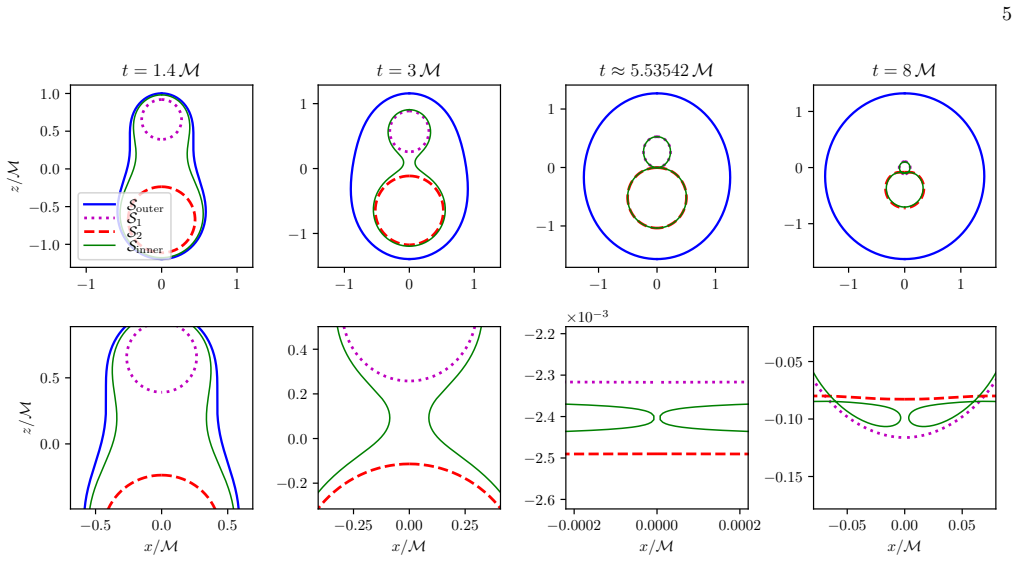
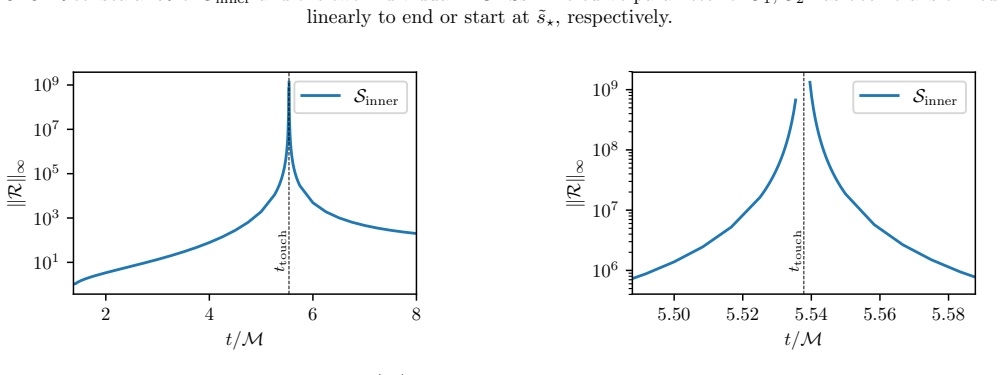
An important question in binary black hole mergers is to connect properties of the remnant black hole to those of the two initial black holes. These properties include not only the final mass and spin of the remnant, but also higher multipoles and answers to other questions such as, for a given initial configuration, which quasi-normal modes of the final black hole are excited, and what are the amplitudes of these modes? Such questions have thus far been primarily addressed through a study of the emitted gravitational wave signal. In this paper we consider a different alternative, namely using quasi-local black hole horizons themselves to establish the link between the initial and final states. Recent work has elucidated the behavior of black hole horizons in a merger. Cusps forming in such otherwise smoothly evolving horizons have been shown to play a central role in connecting the two initially separate black holes with the final remnant. In the present work, we will discuss from a numerical perspective how such cusps form in detail for the head-on collision of two non-spinning black holes. We show how the mass and higher mass multipole moments behave at the cusp and suggest a phenomenological model.
Editorial analysis
A structured set of objections, weighed in public.
Referee Report
Summary. The paper claims that cusps form on quasi-local horizons during the head-on merger of two non-spinning black holes in numerical relativity simulations. These cusps are argued to play a central role in connecting the initial separate horizons to the final remnant horizon. The authors examine the behavior of the horizon mass and higher multipole moments at the cusp and propose a phenomenological model based on the observed numerical evolution.
Significance. If the numerical results hold under scrutiny, this work would supply a quasi-local, horizon-based framework for linking initial binary parameters to remnant properties, complementing gravitational-wave analyses and potentially clarifying quasi-normal mode excitations without relying solely on asymptotic signals.
major comments (3)
- [§3] §3 (Numerical Setup and Horizon Tracking): The description of the apparent/dynamical horizon finder and 1+log slicing lacks explicit convergence tests or resolution studies focused on the cusp pinch-off region. This is load-bearing because horizon location algorithms are known to be sensitive to gauge and grid resolution, directly affecting whether the reported cusp formation and its multipole signatures are physical.
- [§4.2] §4.2 (Multipole Evolution at the Cusp): The time series for mass and higher multipoles are shown without error bars, convergence plots, or cross-validation against an independent horizon finder. This undermines the central claim that the cusp behavior reliably connects initial and final states and supports the phenomenological model.
- [§5] §5 (Phenomenological Model): The model is constructed by fitting the numerical multipole data at the cusp but provides no derivation from horizon geometry or first-principles arguments, nor does it include falsifiable predictions for other initial data (e.g., spinning or unequal-mass cases). This limits its utility for the claimed connection between initial and remnant black holes.
minor comments (2)
- [Figure 2] Figure 2 caption: the time coordinate at which the cusp is identified should be stated explicitly rather than left to visual inspection.
- [§4] Notation for multipole moments: the normalization convention for the higher moments is not stated in the text, making direct comparison with other literature difficult.
Simulated Author's Rebuttal
We thank the referee for the thoughtful and constructive comments on our manuscript. We address each major point below, indicating revisions where appropriate to strengthen the presentation of our numerical results on cusp formation during head-on black hole mergers.
read point-by-point responses
-
Referee: [§3] §3 (Numerical Setup and Horizon Tracking): The description of the apparent/dynamical horizon finder and 1+log slicing lacks explicit convergence tests or resolution studies focused on the cusp pinch-off region. This is load-bearing because horizon location algorithms are known to be sensitive to gauge and grid resolution, directly affecting whether the reported cusp formation and its multipole signatures are physical.
Authors: We agree that targeted convergence tests in the cusp pinch-off region are essential given the sensitivity of horizon finders. The original manuscript includes overall resolution studies for the binary evolution, but we will add a dedicated subsection in the revised §3 with explicit resolution series focused on the horizon finder. This will include plots demonstrating convergence of the cusp formation time, location, and associated multipole signatures under 1+log slicing, confirming that the reported features are robust and physical. revision: yes
-
Referee: [§4.2] §4.2 (Multipole Evolution at the Cusp): The time series for mass and higher multipoles are shown without error bars, convergence plots, or cross-validation against an independent horizon finder. This undermines the central claim that the cusp behavior reliably connects initial and final states and supports the phenomenological model.
Authors: We will revise §4.2 to include error bars estimated from variations across resolutions, along with dedicated convergence plots for the mass and multipole time series at the cusp. We will also report results from cross-validation using an independent apparent horizon finder to confirm the robustness of the cusp signatures and their role in linking initial and final black hole states. revision: yes
-
Referee: [§5] §5 (Phenomenological Model): The model is constructed by fitting the numerical multipole data at the cusp but provides no derivation from horizon geometry or first-principles arguments, nor does it include falsifiable predictions for other initial data (e.g., spinning or unequal-mass cases). This limits its utility for the claimed connection between initial and remnant black holes.
Authors: The model is explicitly phenomenological, constructed from fits to the observed numerical multipole evolution at the cusp and motivated by the local horizon geometry rather than a first-principles derivation (which is beyond the scope of this numerical study). In the revision we will clarify this motivation with additional geometric interpretation and add a discussion of falsifiable predictions, including preliminary extensions or tests for spinning and unequal-mass cases that can be validated in follow-up work, thereby reinforcing the connection to initial and remnant properties. revision: partial
Circularity Check
No significant circularity; results grounded in independent numerical simulations
full rationale
The paper presents numerical results from simulations of head-on non-spinning black hole collisions, tracking quasi-local horizons to describe cusp formation and multipole behavior, then suggesting a phenomenological model based on those observations. No steps reduce by construction to self-definitions, fitted inputs relabeled as predictions, or load-bearing self-citation chains. The cited recent work provides context but is not invoked as an unverified uniqueness theorem or ansatz that forces the present conclusions. The derivation chain is self-contained and externally falsifiable via simulation data.
Axiom & Free-Parameter Ledger
Lean theorems connected to this paper
-
IndisputableMonolith/Foundation/AlexanderDuality.leanalexander_duality_circle_linking unclear?
unclearRelation between the paper passage and the cited Recognition theorem.
Cusps forming in such otherwise smoothly evolving horizons have been shown to play a central role in connecting the two initially separate black holes with the final remnant. We show how the mass and higher mass multipole moments behave at the cusp
-
IndisputableMonolith/Foundation/RealityFromDistinction.leanreality_from_one_distinction unclear?
unclearRelation between the paper passage and the cited Recognition theorem.
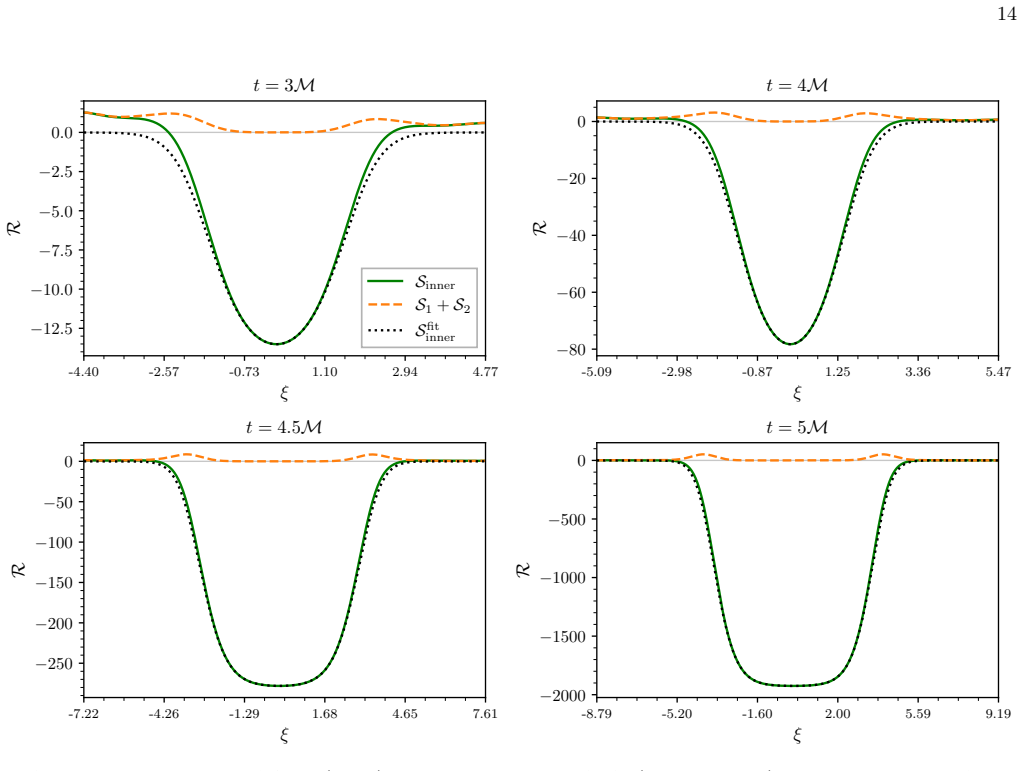
We define the geometric multipole moments on S by decomposing R using the spherical harmonics
What do these tags mean?
- matches
- The paper's claim is directly supported by a theorem in the formal canon.
- supports
- The theorem supports part of the paper's argument, but the paper may add assumptions or extra steps.
- extends
- The paper goes beyond the formal theorem; the theorem is a base layer rather than the whole result.
- uses
- The paper appears to rely on the theorem as machinery.
- contradicts
- The paper's claim conflicts with a theorem or certificate in the canon.
- unclear
- Pith found a possible connection, but the passage is too broad, indirect, or ambiguous to say the theorem truly supports the claim.
Reference graph
Works this paper leans on
-
[1]
for two non-spinning and uncharged black holes. Thus, we consider Euclidean spaceR 3 with two points (the “punctures”)x 1,2 excluded. Letδ ij be the Euclidean metric onR 3, anddthe Euclidean distance between the punctures:d=|x 1 −x 2|. The extrinsic curvature is trivial:K ij = 0, and the 3-metric is conformally flat: hij = Φ4δij. The conformal factor whic...
-
[2]
Thus, since these are non-spinning black holes, att touch, the mass ofS inner is obtained from the masses ofS 1 andS 2 as Min = q M 2 1 +M 2 2 .(23) This value ofM in can then be used as an initial value as we followS inner, initially backwards in time, through tbifurcate and then eventually towards the final black hole. It follows thatM in < M 1 +M 2 and...
-
[3]
For highly asymmet- ric systems, i.e
(this is the same limit as obtained in [65]). For highly asymmet- ric systems, i.e. smallη, we will haveM in ≈M 1 +M 2. When we connect this to the final remnant mass (by trac- ingS inner backwardsin time till we reacht bifurcate, and then forward in time till we reach the final state of the remnant) the final mass will be larger than the above value ofM ...
-
[4]
The behavior ofS 1 andS 2: the mass isM 1 +M 2 which increases monotonically for−∞< t < t touch, as the two horizons absorb infalling radiation
-
[5]
Att touch: A discontinuous decrease in the mass when we go fromM 1 +M 2 →M in
-
[6]
Approach to equilibrium:M in generally increases till we reach the final equilibrium state (this in- crease is however not always monotonic [33]). The discontinuous jump in (2) above is larger (in abso- lute value) than the mass increases in (1) and (3), so that the final remnant mass is less than the sum of the initial masses. This is consistent with the...
-
[7]
Thus: ζ⋆ = 2R2 1 R2 in −1 = 2 M 2 1 M 2 in −1 = M 2 1 −M 2 2 M 2 1 +M 2 2 .(29) V. THE MASS MUL TIPOLE MOMENTS A T THE MERGER In this section we present analytical results regarding the mass multipole moments ofS inner at the merger, i.e. att=t touch. A. The mass dipole moment at the merger The mass dipole momentM 1 (or alternatively the geo- metric momen...
work page 2000
-
[8]
R. Emparan, M. Martinez, and M. Zilhao, Black hole fusion in the extreme mass ratio limit, Phys. Rev. D97, 044004 (2018), arXiv:1708.08868 [gr-qc]
-
[9]
U. Sperhake, The numerical relativity breakthrough for binary black holes, Class. Quant. Grav.32, 124011 (2015), arXiv:1411.3997 [gr-qc]
-
[10]
J. Centrella, J. G. Baker, B. J. Kelly, and J. R. van Meter, Black-hole binaries, gravitational waves, and nu- merical relativity, Rev. Mod. Phys.82, 3069 (2010), arXiv:1010.5260 [gr-qc]
-
[11]
D. Merritt and M. Milosavljevi´ c, Massive Black Hole Bi- nary Evolution, Living Reviews in Relativity8, 8 (2005), arXiv:astro-ph/0410364 [astro-ph]
-
[12]
C. L. Rodriguez, M. Zevin, P. Amaro-Seoane, S. Chat- terjee, K. Kremer, F. A. Rasio, and C. S. Ye, Black holes: The next generation—repeated mergers in dense star clusters and their gravitational-wave properties, Phys. Rev. D100, 043027 (2019)
work page 2019
- [13]
-
[14]
Spectroscopy of Kerr black holes with Earth- and space-based interferometers
E. Berti, A. Sesana, E. Barausse, V. Cardoso, and K. Bel- czynski, Spectroscopy of Kerr black holes with Earth- and space-based interferometers, Phys. Rev. Lett.117, 101102 (2016), arXiv:1605.09286 [gr-qc]
work page Pith review arXiv 2016
-
[15]
Y. Zlochower and C. O. Lousto, Modeling the rem- nant mass, spin, and recoil from unequal-mass, precess- ing black-hole binaries: The Intermediate Mass Ratio Regime, Phys. Rev. D92, 024022 (2015), [Erratum: Phys.Rev.D 94, 029901 (2016)], arXiv:1503.07536 [gr-qc]
- [16]
- [17]
-
[18]
The final spin from binary black holes in quasi-circular orbits
F. Hofmann, E. Barausse, and L. Rezzolla, The final spin from binary black holes in quasi-circular orbits, Astro- phys. J. Lett.825, L19 (2016), arXiv:1605.01938 [gr-qc]
work page Pith review arXiv 2016
-
[19]
W. Tichy and P. Marronetti, The Final mass and spin of black hole mergers, Phys. Rev. D78, 081501 (2008), arXiv:0807.2985 [gr-qc]
-
[20]
E. Barausse and L. Rezzolla, Predicting the direction of the final spin from the coalescence of two black holes, Astrophys. J. Lett.704, L40 (2009), arXiv:0904.2577 [gr- qc]
-
[21]
Rezzolla, Modelling the final state from binary black- hole coalescences, Class
L. Rezzolla, Modelling the final state from binary black- hole coalescences, Class. Quant. Grav.26, 094023 (2009), arXiv:0812.2325 [gr-qc]. 18 4.5 5.0 5.5 6.0 t/M 1.25 1.50 1.75 2.00 2.25 R ttouch 4.5 5.0 5.5 6.0 t/M −5 −4 −3 −2 ∂2 s R ttouch 4.5 5.0 5.5 6.0 t/M 20 40 60 ∂4 s R ttouch 4.5 5.0 5.5 6.0 t/M −1.5 −1.0 −0.5 ∂6 s R ×103 ttouch FIG. 12: Even der...
-
[22]
L. Rezzolla, P. Diener, E. N. Dorband, D. Pollney, C. Reisswig, E. Schnetter, and J. Seiler, The Final spin from the coalescence of aligned-spin black-hole binaries, Astrophys. J. Lett.674, L29 (2008), arXiv:0710.3345 [gr- qc]
-
[23]
High-accuracy mass, spin, and recoil predictions of generic black-hole merger remnants
V. Varma, D. Gerosa, L. C. Stein, F. H´ ebert, and H. Zhang, High-accuracy mass, spin, and recoil predic- tions of generic black-hole merger remnants, Phys. Rev. Lett.122, 011101 (2019), arXiv:1809.09125 [gr-qc]
work page Pith review arXiv 2019
-
[24]
L. Boyle and M. Kesden, The spin expansion for binary black hole merger: new predictions and future directions, Phys. Rev. D78, 024017 (2008), arXiv:0712.2819 [astro- ph]
- [25]
-
[26]
Z.-J. Cao and C.-Z. Liu, Spin expansion for head-on col- lision of two black holes, Int. J. Mod. Phys. D20, 43 (2011)
work page 2011
-
[27]
T. Damour and A. Nagar, Final spin of a coalesc- ing black-hole binary: An Effective-one-body approach, Phys. Rev. D76, 044003 (2007), arXiv:0704.3550 [gr-qc]
- [28]
-
[29]
Isolated and dynamical horizons and their applications
A. Ashtekar and B. Krishnan, Isolated and dynamical horizons and their applications, Living Rev. Rel.7, 10 (2004), arXiv:gr-qc/0407042
work page Pith review arXiv 2004
-
[30]
Krishnan, Fundamental properties and applications of quasi-local black hole horizons, Class
B. Krishnan, Fundamental properties and applications of quasi-local black hole horizons, Class. Quant. Grav.25, 114005 (2008), arXiv:0712.1575 [gr-qc]
-
[31]
A. Ashtekar and B. Krishnan, Dynamical horizons and their properties, Phys. Rev.D68, 104030 (2003), arXiv:gr-qc/0308033
-
[32]
A. Ashtekar and B. Krishnan, Quasi-Local Black Hole Horizons: Recent Advances (2025), arXiv:2502.11825 [gr- qc]
-
[33]
Booth, Black hole boundaries, Can
I. Booth, Black hole boundaries, Can. J. Phys.83, 1073 (2005), arXiv:gr-qc/0508107
-
[34]
T. A. Apostolatos, C. Cutler, G. J. Sussman, and K. S. Thorne, Spin induced orbital precession and its modula- tion of the gravitational wave forms from merging bina- ries, Phys. Rev. D49, 6274 (1994)
work page 1994
- [35]
- [36]
-
[37]
D. Pook-Kolb, O. Birnholtz, B. Krishnan, and E. Schnet- ter, Existence and stability of marginally trapped sur- faces in black-hole spacetimes, Phys. Rev. D99, 064005 (2019), arXiv:1811.10405 [gr-qc]
-
[38]
D. Pook-Kolb, O. Birnholtz, B. Krishnan, and E. Schnet- ter, Self-intersecting marginally outer trapped surfaces, Phys. Rev. D100, 084044 (2019)
work page 2019
-
[39]
D. Pook-Kolb, O. Birnholtz, B. Krishnan, and E. Schnet- ter, MOTS Finder version 1.1 (2019), 10.5281/zen- odo.2591105
-
[40]
D. Pook-Kolb, O. Birnholtz, B. Krishnan, and E. Schnet- ter, Interior of a binary black hole merger, Phys. Rev. Lett.123, 171102 (2019)
work page 2019
-
[41]
D. Pook-Kolb, O. Birnholtz, J. L. Jaramillo, B. Krishnan, and E. Schnetter, Horizons in a binary black hole merger I: Geometry and area increase (2020), arXiv:2006.03939 [gr-qc]
-
[42]
D. Pook-Kolb, O. Birnholtz, J. L. Jaramillo, B. Kr- ishnan, and E. Schnetter, Horizons in a binary black hole merger II: Fluxes, multipole moments and stability (2020), arXiv:2006.03940 [gr-qc]
- [43]
-
[44]
D. Pook-Kolb, I. Booth, and R. A. Hennigar, Ultimate fate of apparent horizons during a binary black hole merger. II. The vanishing of apparent horizons, Phys. Rev. D104, 084084 (2021), arXiv:2104.11344 [gr-qc]
-
[45]
D. Pook-Kolb, R. A. Hennigar, and I. Booth, What Happens to Apparent Horizons in a Binary Black Hole Merger?, Phys. Rev. Lett.127, 181101 (2021), arXiv:2104.10265 [gr-qc]
- [46]
-
[47]
P. Mourier, X. Jim´ enez Forteza, D. Pook-Kolb, B. Kr- ishnan, and E. Schnetter, Quasinormal modes and their overtones at the common horizon in a binary black hole merger, Phys. Rev. D103, 044054 (2021), arXiv:2010.15186 [gr-qc]
-
[48]
Nonlinear Ringdown at the Black Hole Horizon,
N. Khera, A. Ribes Metidieri, B. Bonga, X. Jim´ enez Forteza, B. Krishnan, E. Poisson, D. Pook- Kolb, E. Schnetter, and H. Yang, Nonlinear Ringdown at the Black Hole Horizon, Phys. Rev. Lett.131, 231401 (2023), arXiv:2306.11142 [gr-qc]
-
[49]
L. Rezzolla, R. P. Macedo, and J. L. Jaramillo, Un- derstanding the ’anti-kick’ in the merger of binary black holes, Phys. Rev. Lett.104, 221101 (2010), arXiv:1003.0873 [gr-qc]
-
[50]
J. L. Jaramillo, R. P. Macedo, P. M¨ osta, and L. Rezzolla, Towards a cross-correlation approach to strong-field dy- namics in Black Hole spacetimes,Proceedings, Span- ish Relativity Meeting : Towards new paradigms. (ERE 2011): Madrid, Spain, August 29-September 2, 2011, AIP Conf. Proc.1458, 158 (2011), arXiv:1205.3902 [gr-qc]
- [51]
-
[52]
Y. Chen, P. Kumar, N. Khera, N. Deppe, A. Dhani, M. Boyle, M. Giesler, L. E. Kidder, H. P. Pfeiffer, M. A. Scheel, and S. A. Teukolsky, Multipole moments on the common horizon in a binary-black-hole simulation, Phys- ical Review D106, 10.1103/physrevd.106.124045 (2022)
-
[53]
Gourgoulhon, A Generalized Damour-Navier-Stokes equation applied to trapping horizons, Phys
E. Gourgoulhon, A Generalized Damour-Navier-Stokes equation applied to trapping horizons, Phys. Rev. D72, 104007 (2005), arXiv:gr-qc/0508003
-
[54]
A. Ashtekar, N. Khera, M. Kolanowski, and J. Lewandowski, Charges and fluxes on (perturbed) non- expanding horizons, JHEP02, 066, arXiv:2112.05608 [gr-qc]
-
[55]
A. Ashtekar, M. Campiglia, and S. Shah, Dynamical Black Holes: Approach to the Final State, Phys. Rev. D88, 064045 (2013), arXiv:1306.5697 [gr-qc]
-
[56]
L. Andersson, M. Mars, and W. Simon, Local existence of dynamical and trapping horizons, Phys.Rev.Lett.95, 111102 (2005), arXiv:gr-qc/0506013 [gr-qc]
-
[57]
L. Andersson, M. Mars, and W. Simon, Stability of marginally outer trapped surfaces and existence of marginally outer trapped tubes, Adv.Theor.Math.Phys. 12(2008), arXiv:0704.2889 [gr-qc]
-
[58]
I. Booth and S. Fairhurst, Isolated, slowly evolving, and dynamical trapping horizons: geometry and mechan- ics from surface deformations, Phys. Rev.D75, 084019 (2007), arXiv:gr-qc/0610032
-
[59]
J. Thornburg, A Fast apparent horizon finder for three- dimensional Cartesian grids in numerical relativity, Class. Quant. Grav.21, 743 (2004), arXiv:gr-qc/0306056
-
[60]
Event and apparent horizon finders for 3+1 numerical relativity,
J. Thornburg, Event and Apparent Horizon Finders for 3+1 Numerical Relativity, Living Rev. Rel.10, 3 (2007), arXiv:gr-qc/0512169
-
[61]
P. M¨ osta, L. Andersson, J. Metzger, B. Szil´ agyi, and J. Winicour, The Merger of Small and Large Black Holes, Class. Quant. Grav.32, 235003 (2015), arXiv:1501.05358 [gr-qc]
-
[62]
L. Andersson, M. Mars, J. Metzger, and W. Simon, The Time evolution of marginally trapped surfaces, Class. Quant. Grav.26, 085018 (2009), arXiv:0811.4721 [gr-qc]. 20
-
[63]
A. Ashtekar, J. Engle, T. Paw lowski, and C. Van Den Broeck, Multipole moments of isolated hori- zons, Class. Quant. Grav.21, 2549 (2004), arXiv:gr- qc/0401114
-
[64]
D. R. Brill and R. W. Lindquist, Interaction energy in geometrostatics, Phys. Rev.131, 471 (1963)
work page 1963
-
[65]
D. Pook-Kolb, O. Birnholtz, B. Krishnan, E. Schnetter, and V. Zhang, MOTS Finder version 1.3 (2019)
work page 2019
-
[66]
F. L¨ offler, J. Faber, E. Bentivegna, T. Bode, P. Diener, R. Haas, I. Hinder, B. C. Mundim, C. D. Ott, E. Schnet- ter, G. Allen, M. Campanelli, and P. Laguna, The Ein- stein Toolkit: A Community Computational Infrastruc- ture for Relativistic Astrophysics, Class. Quantum Grav. 29, 115001 (2012), arXiv:1111.3344 [gr-qc]
-
[67]
EinsteinToolkit, Einstein Toolkit: Open software for rel- ativistic astrophysics,http://einsteintoolkit.org/
- [68]
- [69]
- [70]
-
[71]
Kranc, Kranc: Kranc assembles numerical code
-
[72]
S. W. Hawking, Gravitational radiation from colliding black holes, Phys. Rev. Lett.26, 1344 (1971)
work page 1971
-
[73]
S. Bhagavan, B. de Koning, S. Maddhashiya, and C. Rackauckas, Datainterpolations.jl: Fast interpolations of 1d data, Journal of Open Source Software9, 6917 (2024)
work page 2024
-
[74]
S. Borhanian, K. G. Arun, H. P. Pfeiffer, and B. S. Sathyaprakash, Comparison of post-Newtonian mode amplitudes with numerical relativity simulations of bi- nary black holes, Class. Quant. Grav.37, 065006 (2020), arXiv:1901.08516 [gr-qc]
- [75]
-
[76]
Black hole spectroscopy: from theory to experiment
E. Bertiet al., Black hole spectroscopy: from theory to experiment (2025), arXiv:2505.23895 [gr-qc]
work page internal anchor Pith review Pith/arXiv arXiv 2025
discussion (0)
Sign in with ORCID, Apple, or X to comment. Anyone can read and Pith papers without signing in.