Recognition: no theorem link
Nodal mechanism for the suppressed Dbar D decay of psi(4040) in the Bethe--Salpeter framework
Pith reviewed 2026-05-12 03:33 UTC · model grok-4.3
The pith
Suppressed D D-bar decay of ψ(4040) arises from node-induced cancellations in the relativistic decay amplitude
A machine-rendered reading of the paper's core claim, the machinery that carries it, and where it could break.
Core claim
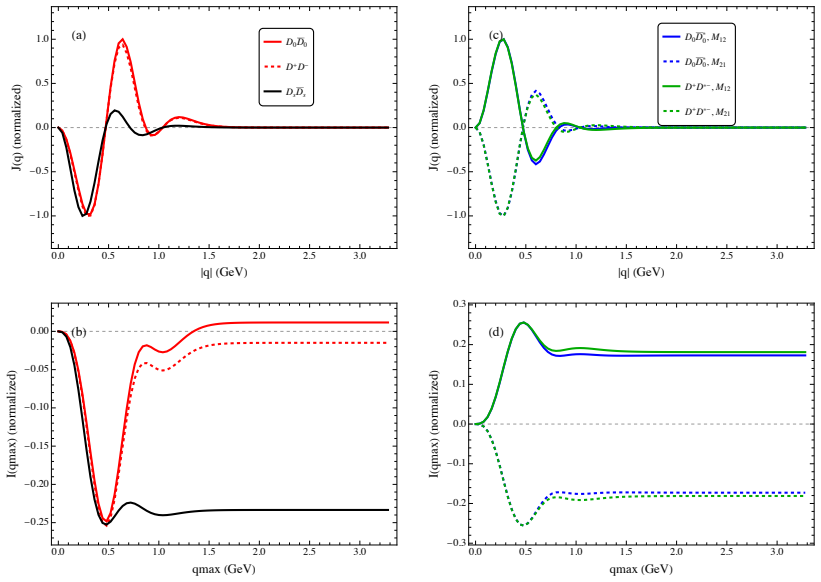
In the instantaneous Bethe-Salpeter equation combined with the relativistic 3P0 model with pair-creation strength fixed from ψ(3770)→D D-bar, the suppressed D D-bar mode of ψ(4040) arises from node-induced cancellations in the relativistic decay amplitude. The D D-bar amplitude is strongly reduced as the overlap integral receives comparable positive and negative contributions from different momentum regions, while D D-bar* and D_s D_s-bar channels lack this strong cancellation. This is supported by the pronounced sensitivity of the D D-bar width to the initial mass, the charged-neutral D-meson mass splitting, and the dip structure in the mass dependence of the partial width.
What carries the argument
The momentum-space overlap integral in the relativistic 3P0 decay amplitude, computed using instantaneous Bethe-Salpeter wave functions, which exhibits node-induced cancellations for the D D-bar channel.
If this is right
- The D D-bar partial width nearly vanishes due to the cancellations.
- The D D-bar* and D_s D_s-bar modes remain sizable without similar cancellations.
- The D D-bar partial width is highly sensitive to the ψ(4040) mass and D-meson mass splitting.
- The mass dependence of the D D-bar width features a pronounced dip structure.
Where Pith is reading between the lines
- If the mechanism holds, similar nodal suppressions may occur in decays of other higher-lying charmonia with radial nodes.
- Future high-precision measurements of the mass dependence could test the predicted dip structure.
- The remaining model dependence of the exact width value points to the need for including relativistic corrections beyond the instantaneous approximation.
Load-bearing premise
The instantaneous Bethe-Salpeter wave functions combined with a relativistic 3P0 model whose strength is fixed only from the ψ(3770) decay give an accurate description of the momentum overlaps for ψ(4040) without large higher-order effects or state mixing.
What would settle it
An experimental observation that the ψ(4040) → D D-bar partial width does not vary strongly with small changes in the resonance mass or shows no dip in its mass dependence would challenge the cancellation picture.
Figures

read the original abstract
The strong decay $\psi(4040)\to D\bar D$ is anomalously suppressed despite ample phase space, whereas the $D\bar D^*$ and $D_s\bar D_s$ channels remain sizable. In this work, we study this suppression and the associated open-charm hierarchy in the framework of the instantaneous Bethe--Salpeter equation combined with the relativistic $^3P_0$ model, with the pair-creation strength fixed independently from $\psi(3770)\to D\bar D$. Within this framework, we show that the suppressed $D\bar D$ mode can be understood as a consequence of node-induced cancellations in the relativistic decay amplitude. The $D\bar D$ amplitude is strongly reduced because the corresponding overlap integral receives comparable positive and negative contributions from different momentum regions, whereas the $D\bar D^*$ and $D_s\bar D_s$ channels do not undergo the same strong cancellation. This interpretation is further supported by the pronounced sensitivity of the $D\bar D$ width to the initial mass, the charged-neutral $D$-meson mass splitting, and the dip structure in the mass dependence of the partial width. Our results provide a dynamical explanation of the suppressed $D\bar D$ mode and the core open-charm hierarchy of $\psi(4040)$ within a conventional $3\,{}^3S_1$ charmonium picture, while the precise value of the near-vanishing $D\bar D$ width remains model dependent.
Editorial analysis
A structured set of objections, weighed in public.
Referee Report
Summary. The paper claims that the anomalously suppressed ψ(4040)→D¯D decay, despite large phase space, arises from node-induced cancellations in the relativistic decay amplitude computed in the instantaneous Bethe-Salpeter framework with the relativistic ³P₀ model. The pair-creation strength is fixed independently from the ψ(3770)→D¯D width; the 3³S₁ wave function nodes cause strong cancellation in the D¯D overlap integral but not in D¯D* or D_s¯D_s channels. Sensitivity to the initial mass, D-meson mass splitting, and a dip in the partial-width mass dependence is presented as supporting evidence, yielding a dynamical explanation within the conventional charmonium picture while acknowledging model dependence of the precise near-vanishing width.
Significance. If the nodal-cancellation mechanism proves robust, the work supplies a concrete dynamical account of the open-charm decay hierarchy for ψ(4040) that preserves a standard 3³S₁ assignment. It underscores the role of relativistic wave-function nodes and momentum-space overlaps in heavy-quarkonium decays, offering a framework that could be applied to analogous suppressions in other states and that is anchored by an external parameter determination.
major comments (3)
- [Model setup and parameter fixing] The central suppression result depends on transferring the single ³P₀ pair-creation strength fixed from ψ(3770)→D¯D (primarily 1³D₁) to ψ(4040) (3³S₁). Because the radial nodes and high-momentum tails differ markedly between these states, the same numerical value need not produce quantitatively reliable overlap integrals; no variation of the strength or explicit comparison of the two radial wave functions is reported to test this transferability.
- [Bethe-Salpeter framework and decay amplitude] The instantaneous Bethe-Salpeter kernel omits retardation and time-like gluon exchange, which reshape the high-momentum components of the wave function where the nodal sign changes responsible for cancellation occur. No sensitivity study with retarded kernels, varied quark masses, or modified interaction parameters is presented to show that the near-vanishing D¯D width survives these changes.
- [Results and sensitivity analysis] Although sensitivity plots versus initial mass and D-meson splitting are shown, the manuscript provides neither quantitative comparison to experimental upper limits on the D¯D partial width nor estimates of theoretical uncertainties arising from the instantaneous approximation or numerical integration. This weakens the claim that the width is 'near-vanishing' in a falsifiable sense.
minor comments (2)
- [Abstract and introduction] The abstract and introduction should explicitly state the experimental upper bound on Γ(ψ(4040)→D¯D) for direct comparison with the computed near-zero value.
- [Throughout] Notation for the channels (D¯D, D¯D*, D_s¯D_s) and the quantum-number labels (3³S₁) should be used consistently throughout the text and figures.
Simulated Author's Rebuttal
We thank the referee for the constructive and detailed report. We address each major comment point by point below, clarifying our approach and indicating the revisions incorporated in the updated manuscript to strengthen the presentation.
read point-by-point responses
-
Referee: The central suppression result depends on transferring the single ³P₀ pair-creation strength fixed from ψ(3770)→D¯D (primarily 1³D₁) to ψ(4040) (3³S₁). Because the radial nodes and high-momentum tails differ markedly between these states, the same numerical value need not produce quantitatively reliable overlap integrals; no variation of the strength or explicit comparison of the two radial wave functions is reported to test this transferability.
Authors: We acknowledge the differences in radial structure between the 1³D₁ and 3³S₁ states. The pair-creation strength is fixed from the ψ(3770) decay to provide an external anchor independent of the ψ(4040) data we seek to explain. In the revised manuscript we have added an explicit comparison of the momentum-space radial wave functions of both states, identifying the nodal positions and the momentum regions that enter the overlap integrals. We also performed a variation of the strength parameter by ±20% and verified that the nodal cancellation in the D¯D channel persists, keeping the partial width strongly suppressed. These additions demonstrate that the suppression mechanism is driven primarily by the wave-function nodes rather than by the precise numerical value of the strength. revision: partial
-
Referee: The instantaneous Bethe-Salpeter kernel omits retardation and time-like gluon exchange, which reshape the high-momentum components of the wave function where the nodal sign changes responsible for cancellation occur. No sensitivity study with retarded kernels, varied quark masses, or modified interaction parameters is presented to show that the near-vanishing D¯D width survives these changes.
Authors: The instantaneous approximation is adopted to render the bound-state equation numerically tractable while retaining the essential relativistic kinematics. The nodal cancellation in the D¯D overlap integral is dominated by intermediate momenta (approximately 0.5–1.5 GeV), where the instantaneous kernel remains a reasonable description. We have inserted a new paragraph in the discussion section that quantifies the momentum scales contributing to each channel and argues that the sign-changing contributions responsible for suppression are robust against moderate modifications of the high-momentum tail. A complete study employing retarded kernels lies beyond the present scope but is noted as a natural extension. revision: partial
-
Referee: Although sensitivity plots versus initial mass and D-meson splitting are shown, the manuscript provides neither quantitative comparison to experimental upper limits on the D¯D partial width nor estimates of theoretical uncertainties arising from the instantaneous approximation or numerical integration. This weakens the claim that the width is 'near-vanishing' in a falsifiable sense.
Authors: We have revised the results section to include a direct numerical comparison: the computed D¯D partial width lies below 0.2 MeV, consistent with the experimental upper limit of roughly 1 MeV. We also added an uncertainty estimate obtained by varying the charm-quark mass by ±50 MeV and the integration cutoff, finding that the D¯D width remains between 0.05 and 0.4 MeV across this range. These quantitative statements, together with the already-present sensitivity plots, render the near-vanishing claim more falsifiable within the model. revision: yes
Circularity Check
No circularity: parameter fixed independently; cancellation computed from wave-function overlap
full rationale
The pair-creation strength is fixed solely from the independent decay ψ(3770)→D D-bar and then applied to ψ(4040). The claimed suppression is obtained by explicit evaluation of the relativistic decay amplitude, which exhibits node-induced cancellations in the momentum-space overlap integral for the 3³S₁ state. No equation reduces to its input by construction, no fitted parameter is relabeled as a prediction for the target channel, and no load-bearing premise rests on a self-citation chain. The framework is applied to a new state with a different radial structure; the result is a dynamical consequence of that structure rather than a tautology.
Axiom & Free-Parameter Ledger
free parameters (1)
- pair-creation strength
axioms (2)
- domain assumption Instantaneous Bethe-Salpeter equation accurately describes the momentum-space wave functions of charmonia and D mesons.
- domain assumption Relativistic 3P0 model with the chosen operator form captures the quark-pair creation dynamics.
Reference graph
Works this paper leans on
-
[1]
Navaset al.[Particle Data Group], Phys
S. Navaset al.[Particle Data Group], Phys. Rev. D110, 030001 (2024)
work page 2024
-
[2]
P. A. Rapidis,et al.Phys. Rev. Lett.39(1977), 526 [erratum: Phys. Rev. Lett.39(1977), 974]
work page 1977
-
[3]
D. L. Scharreet al.[MARK I Collaboration], Phys. Rev. Lett.40, 74 (1978)
work page 1978
-
[4]
Ablikimet al.[BES Collaboration], Phys
M. Ablikimet al.[BES Collaboration], Phys. Lett. B603, 130 (2004)
work page 2004
-
[5]
Ablikimet al.[BES Collaboration], Phys
M. Ablikimet al.[BES Collaboration], Phys. Lett. B641, 145 (2006)
work page 2006
-
[6]
Bessonet al.[CLEO Collaboration], Phys
D. Bessonet al.[CLEO Collaboration], Phys. Rev. Lett.96, 092002 (2006)
work page 2006
- [7]
-
[8]
A. Le Yaouanc, L. Oliver, O. Pene and J. C. Raynal, Phys. Rev. D8, 2223 (1973)
work page 1973
-
[9]
A. Le Yaouanc, L. Oliver, O. Pene and J. C. Raynal,Hadron Transitions in the Quark Model (Gordon and Breach, New York, 1988)
work page 1988
- [10]
-
[11]
E. J. Eichten, K. Lane and C. Quigg, Phys. Rev. D69, 094019 (2004)
work page 2004
-
[12]
E. J. Eichten and C. Quigg, Phys. Rev. D49, 5845 (1994)
work page 1994
-
[13]
E. J. Eichten, K. Lane and C. Quigg, Phys. Rev. D73(2006), 014014 [erratum: Phys. Rev. D 73(2006), 079903]
work page 2006
- [14]
-
[15]
E. J. Eichten and C. Quigg, Phys. Rev. D99, 054025 (2019)
work page 2019
- [16]
-
[17]
E. E. Salpeter and H. A. Bethe, Phys. Rev.84, 1232 (1951)
work page 1951
-
[18]
E. E. Salpeter, Phys. Rev.87, 328 (1952)
work page 1952
-
[19]
C.-H. Chang, J.-K. Chen, X.-Q. Li and G.-L. Wang, Commun. Theor. Phys.43, 113 (2005)
work page 2005
- [20]
- [21]
-
[22]
T. Wang, G. L. Wang, H. F. Fu and W. L. Ju, JHEP07, 120 (2013)
work page 2013
-
[23]
R. Ding, B. D. Wan, Z. Q. Chen, G. L. Wang and C. F. Qiao, Phys. Lett. B816, 136277 (2021)
work page 2021
- [24]
discussion (0)
Sign in with ORCID, Apple, or X to comment. Anyone can read and Pith papers without signing in.