Recognition: 1 theorem link
· Lean TheoremContinuum-Limit HQET LCDAs from Lattice QCD for Tightening B Decay Uncertainties
Pith reviewed 2026-05-13 07:43 UTC · model grok-4.3
The pith
Lattice QCD yields HQET light-cone distribution amplitudes for B mesons with total uncertainty reduced by a factor of three.
A machine-rendered reading of the paper's core claim, the machinery that carries it, and where it could break.
Core claim
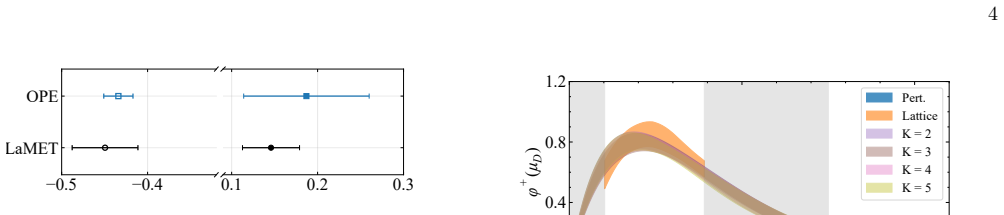
Using the HQLaMET framework supplemented by lattice QCD calculations of the OPE moments, the authors perform a precise determination of HQET LCDAs through multi-ensemble simulations for continuum and physical pion mass extrapolation, comprehensive systematic error quantification, and OPE moment cross-validation. Their final results at μ = 1 GeV are λ_B = 0.340(20) GeV and σ_B^(1) = 1.685(63), with the total uncertainty reduced by a factor of three relative to the previous analysis. These values resolve the long-standing bottleneck in first-principles predictions of heavy meson LCDAs and can greatly reduce the uncertainty in B → K* form factors in the large-recoil region.
What carries the argument
The HQLaMET framework, which marries heavy-quark effective theory light-cone distribution amplitudes with lattice QCD simulations of OPE moments to enable controlled continuum and physical-mass extrapolations.
If this is right
- The reduced uncertainty propagates directly into smaller errors on B → K* form factors in the large-recoil region.
- Theoretical predictions for branching ratios and CP asymmetries in B decays become sharp enough to confront experimental anomalies more decisively.
- Similar lattice methods can now be applied to other heavy-meson LCDAs with comparable precision gains.
- First-principles control over these distribution amplitudes removes a dominant source of theory error that previously limited interpretation of flavor-physics measurements.
Where Pith is reading between the lines
- The same simulation strategy could be extended to compute higher moments or distribution amplitudes for other heavy mesons such as D mesons.
- Direct comparison of these lattice moments with future experimental extractions from semileptonic or radiative B decays would provide a clean test of the underlying effective theory.
- Further reduction in lattice spacing and larger volumes would allow the quoted errors to shrink even more, potentially reaching the few-percent level needed for next-generation flavor factories.
Load-bearing premise
The HQLaMET framework remains valid for the extrapolation to the continuum and physical pion mass, and the OPE moment cross-validation fully captures residual systematic effects.
What would settle it
An independent extraction of λ_B or σ_B^(1) from B decay data or a different non-lattice method that lies outside the quoted 0.340(20) GeV and 1.685(63) ranges.
Figures



read the original abstract
Heavy meson HQET light-cone distribution amplitudes (LCDAs) are critical for precision predictions of $B$ meson weak decays, but currently are one of dominant theoretical uncertainties that obscure interpretations of $B$ anomalies and CP-violating measurements. Building on the established HQLaMET framework, supplemented by lattice QCD calculations of the OPE moments, we present a precise lattice QCD calculation of HQET LCDAs by employing multi-ensemble simulations for continuum and physical pion mass extrapolation, quantifying comprehensive systematic errors, and validating results through OPE moment cross-validation. Details of the lattice calculations are provided in a companion paper \cite{HeavymesonDA_long_paper}. Our final results for key inverse moments (at $\mu=1$ GeV) are $\lambda_B=0.340(20)$ GeV and $\sigma_B^{(1)}=1.685(63)$, with the total uncertainty reduced by a factor of three relative to the previous analysis. These results can greatly reduce the uncertainty in the $B \to K^*$ form factors in the large-recoil region. This work resolves the long-standing bottleneck in first-principles predictions of heavy meson LCDAs, advancing precision flavor physics to new frontiers.
Editorial analysis
A structured set of objections, weighed in public.
Referee Report
Summary. The manuscript presents a lattice QCD calculation of heavy meson HQET light-cone distribution amplitudes (LCDAs) via the HQLaMET framework. Multi-ensemble simulations enable continuum and physical-pion-mass extrapolations, with systematic errors quantified and results cross-validated against OPE moments. The headline results at μ=1 GeV are λ_B=0.340(20) GeV and σ_B^{(1)}=1.685(63), claimed to reduce total uncertainty by a factor of three relative to prior work and thereby tighten B→K* form-factor predictions in the large-recoil region. Full methodological details are deferred to a companion paper.
Significance. If the central numerical results and error budgets hold, the work would constitute a substantial advance in first-principles HQET LCDA determinations, directly addressing one of the dominant theoretical uncertainties in precision B-decay phenomenology and potentially sharpening interpretations of B anomalies and CP-violation observables.
major comments (2)
- [Abstract] Abstract: The factor-of-three uncertainty reduction and the quoted values λ_B=0.340(20) GeV, σ_B^{(1)}=1.685(63) rest on the HQLaMET continuum/physical-point extrapolation ansatz. No explicit stability tests against alternate functional forms (e.g., inclusion of a² or m_π² log terms), variation of the matching scale, or NLO effective-theory operators are described; if higher-order corrections exceed the reported errors, the central claim is weakened.
- [Abstract] Abstract (and companion reference): The full lattice data, fit details, and comprehensive error budgets reside in the cited companion paper. Because the present manuscript provides neither the extrapolation fits nor the systematic-variation tables, independent verification of the quoted precision is not possible from the text alone.
minor comments (1)
- [Abstract] The phrase 'resolves the long-standing bottleneck' in the abstract is overstated; a more measured statement such as 'significantly advances first-principles control' would be appropriate.
Simulated Author's Rebuttal
We thank the referee for the positive evaluation of our work's significance and for the detailed comments. We address each major point below. Revisions have been made to improve clarity and accessibility while preserving the manuscript's concise format, with full technical details remaining in the companion paper as originally intended.
read point-by-point responses
-
Referee: [Abstract] Abstract: The factor-of-three uncertainty reduction and the quoted values λ_B=0.340(20) GeV, σ_B^{(1)}=1.685(63) rest on the HQLaMET continuum/physical-point extrapolation ansatz. No explicit stability tests against alternate functional forms (e.g., inclusion of a² or m_π² log terms), variation of the matching scale, or NLO effective-theory operators are described; if higher-order corrections exceed the reported errors, the central claim is weakened.
Authors: We agree that explicit mention of stability tests strengthens the abstract. The companion paper contains extensive tests of alternate extrapolation forms (including a² and m_π² log terms), matching-scale variations, and estimates of NLO operator contributions, all of which are folded into the final error budget. We have revised the abstract and added a brief paragraph in the main text summarizing these checks and confirming that higher-order effects remain within the quoted uncertainties. The factor-of-three reduction is therefore robust under the variations examined. revision: yes
-
Referee: [Abstract] Abstract (and companion reference): The full lattice data, fit details, and comprehensive error budgets reside in the cited companion paper. Because the present manuscript provides neither the extrapolation fits nor the systematic-variation tables, independent verification of the quoted precision is not possible from the text alone.
Authors: We acknowledge the referee's concern regarding self-contained verification. The present manuscript is intentionally concise and focuses on the phenomenological impact, with all raw data, fit procedures, and full systematic tables provided in the companion paper (arXiv reference already given). To address this, we have added a short summary table of the main fit parameters, extrapolation ansatz, and dominant error sources directly in the revised manuscript, while still directing readers to the companion for complete tables and data. This maintains the paper's brevity without compromising verifiability. revision: partial
Circularity Check
No significant circularity in lattice-derived HQET LCDAs
full rationale
The paper computes λ_B and σ_B directly from multi-ensemble lattice QCD data, extrapolated to a=0 and physical m_π via the HQLaMET framework, then cross-validates against independent OPE moments. These quantities are numerical outputs of the simulation and extrapolation, not parameters fitted to themselves or renamed inputs. The companion-paper citation supplies only methodological details and does not carry the central claim; the derivation remains self-contained against external lattice data and OPE benchmarks. No self-definitional, fitted-prediction, or load-bearing self-citation reductions are present.
Axiom & Free-Parameter Ledger
axioms (1)
- domain assumption HQLaMET framework is applicable for continuum and physical-mass extrapolation of HQET LCDAs
Lean theorems connected to this paper
-
IndisputableMonolith/Foundation/RealityFromDistinction.leanreality_from_one_distinction unclearBuilding on the established HQLaMET framework, supplemented by lattice QCD calculations of the OPE moments, we present a precise lattice QCD calculation of HQET LCDAs by employing multi-ensemble simulations for continuum and physical pion mass extrapolation... Our final results for key inverse moments (at μ=1 GeV) are λ_B=0.340(20) GeV and σ_B^{(1)}=1.685(63)
Reference graph
Works this paper leans on
-
[1]
Lattice Parton Collaboration (LPC), “Determination of heavy meson light-cone distribution amplitudes: theoret- ical framework and lattice simulations,” companion pa- per, submitted (2026)
work page 2026
-
[2]
M. Beneke, G. Buchalla, M. Neubert and C. T. Sachrajda, Phys. Rev. Lett.83, 1914-1917 (1999) doi:10.1103/PhysRevLett.83.1914 [arXiv:hep- ph/9905312 [hep-ph]]
-
[3]
C. D. Lu, K. Ukai and M. Z. Yang, Phys. Rev. D63, 074009 (2001) doi:10.1103/PhysRevD.63.074009 [arXiv:hep-ph/0004213 [hep-ph]]
-
[4]
A. Ali, P. Ball, L. T. Handoko and G. Hiller, Phys. Rev. D61, 074024 (2000) doi:10.1103/PhysRevD.61.074024 [arXiv:hep-ph/9910221 [hep-ph]]
-
[5]
R. Aaijet al.[LHCb], Nature Phys.18, no.3, 277-282 (2022) doi:10.1038/s41567-023-02095-3 [arXiv:2103.11769 [hep-ex]]
-
[6]
A. G. Grozin and M. Neubert, Phys. Rev. D55, 272- 290 (1997) doi:10.1103/PhysRevD.55.272 [arXiv:hep- ph/9607366 [hep-ph]]
-
[7]
V. M. Braun, D. Y. Ivanov and G. P. Ko- rchemsky, Phys. Rev. D69, 034014 (2004) doi:10.1103/PhysRevD.69.034014 [arXiv:hep- ph/0309330 [hep-ph]]
-
[8]
F. De Fazio, T. Feldmann and T. Hurth, Nucl. Phys. B733, 1-30 (2006) [erratum: Nucl. Phys. B800, 405 (2008)] doi:10.1016/j.nuclphysb.2008.03.022 [arXiv:hep- ph/0504088 [hep-ph]]
-
[9]
A. Khodjamirian, T. Mannel and N. Offen, Phys. Rev. D75, 054013 (2007) doi:10.1103/PhysRevD.75.054013 [arXiv:hep-ph/0611193 [hep-ph]]
-
[10]
Y. M. Wang and Y. L. Shen, Nucl. Phys. B 898, 563-604 (2015) doi:10.1016/j.nuclphysb.2015.07.016 [arXiv:1506.00667 [hep-ph]]
-
[11]
C. D. L¨ u, Y. L. Shen, Y. M. Wang and Y. B. Wei, JHEP01, 024 (2019) doi:10.1007/JHEP01(2019)024 [arXiv:1810.00819 [hep-ph]]
-
[12]
J. Gao, C. D. L¨ u, Y. L. Shen, Y. M. Wang and Y. B. Wei, Phys. Rev. D101, no.7, 074035 (2020) doi:10.1103/PhysRevD.101.074035 [arXiv:1907.11092 [hep-ph]]
-
[13]
B. Y. Cui, Y. K. Huang, Y. L. Shen, C. Wang and Y. M. Wang, JHEP03, 140 (2023) doi:10.1007/JHEP03(2023)140 [arXiv:2212.11624 [hep- ph]]
-
[14]
J. Gao, U. G. Meißner, Y. L. Shen and D. H. Li, Phys. Rev. D112, no.1, 1 (2025) doi:10.1103/yvjd-2ymn [arXiv:2412.13084 [hep-ph]]
- [15]
- [16]
-
[17]
Huaet al.[Lattice Parton], Phys
J. Huaet al.[Lattice Parton], Phys. Rev. Lett.129, no.13, 132001 (2022) doi:10.1103/PhysRevLett.129.132001 [arXiv:2201.09173 [hep-lat]]
-
[18]
B. Aubertet al.[BaBar], Phys. Rev. D80, 052002 (2009) doi:10.1103/PhysRevD.80.052002 [arXiv:0905.4778 [hep- ex]]
-
[19]
S. Ueharaet al.[Belle], Phys. Rev. D86, 092007 (2012) doi:10.1103/PhysRevD.86.092007 [arXiv:1205.3249 [hep- ex]]
-
[20]
X. Ji, Phys. Rev. Lett.110, 262002 (2013) doi:10.1103/PhysRevLett.110.262002 [arXiv:1305.1539 [hep-ph]]
-
[21]
I. A. Korchemskaya and G. P. Korchemsky, Phys. Lett. B 287, 169-175 (1992) doi:10.1016/0370-2693(92)91895-G
-
[22]
S. J. Lee and M. Neubert, Phys. Rev. D72, 094028 (2005) doi:10.1103/PhysRevD.72.094028 [arXiv:hep- ph/0509350 [hep-ph]]
-
[23]
X. Y. Han, J. Hua, X. Ji, C. D. L¨ u, W. Wang, J. Xu, Q. A. Zhang and S. Zhao, Phys. Rev. D111, no.11, L111503 (2025) doi:10.1103/2t8s-w8t6 [arXiv:2403.17492 [hep-ph]]
-
[24]
X. Y. Hanet al.[Lattice Parton], Phys. Rev. D111, no.3, 034503 (2025) doi:10.1103/PhysRevD.111.034503 [arXiv:2410.18654 [hep-lat]]
-
[25]
X. Ji, Sci. China Phys. Mech. Astron.57, 1407-1412 (2014) doi:10.1007/s11433-014-5492-3 [arXiv:1404.6680 [hep-ph]]
-
[26]
X. Ji, Y. S. Liu, Y. Liu, J. H. Zhang and Y. Zhao, Rev. Mod. Phys.93, no.3, 035005 (2021) doi:10.1103/RevModPhys.93.035005 [arXiv:2004.03543 [hep-ph]]
-
[27]
K. Cichy and M. Constantinou, Adv. High Energy Phys.2019, 3036904 (2019) doi:10.1155/2019/3036904 [arXiv:1811.07248 [hep-lat]]
-
[28]
M. Beneke, G. Finauri, K. K. Vos and Y. Wei, JHEP09, 066 (2023) doi:10.1007/JHEP09(2023)066 [arXiv:2305.06401 [hep-ph]]. 7
-
[29]
Y. S. Liu, W. Wang, J. Xu, Q. A. Zhang, S. Zhao and Y. Zhao, Phys. Rev. D99, no.9, 094036 (2019) doi:10.1103/PhysRevD.99.094036 [arXiv:1810.10879 [hep-ph]]
-
[30]
Y. S. Liu, W. Wang, J. Xu, Q. A. Zhang, J. H. Zhang, S. Zhao and Y. Zhao, Phys. Rev. D100, no.3, 034006 (2019) doi:10.1103/PhysRevD.100.034006 [arXiv:1902.00307 [hep-ph]]
-
[31]
J. Xu, Q. A. Zhang and S. Zhao, Phys. Rev. D97, no.11, 114026 (2018) doi:10.1103/PhysRevD.97.114026 [arXiv:1804.01042 [hep-ph]]
-
[32]
S. Ishaq, Y. Jia, X. Xiong and D. S. Yang, Phys. Rev. Lett.125, no.13, 132001 (2020) doi:10.1103/PhysRevLett.125.132001 [arXiv:1905.06930 [hep-ph]]
-
[33]
S. Zhao, Phys. Rev. D101, no.7, 071503 (2020) doi:10.1103/PhysRevD.101.071503 [arXiv:1910.03470 [hep-ph]]
-
[34]
X. Ji, Nucl. Phys. B1007, 116670 (2024) doi:10.1016/j.nuclphysb.2024.116670 [arXiv:2408.03378 [hep-ph]]
-
[35]
X. Ji, Y. Liu, A. Sch¨ afer, W. Wang, Y. B. Yang, J. H. Zhang and Y. Zhao, Nucl. Phys. B964, 115311 (2021) doi:10.1016/j.nuclphysb.2021.115311 [arXiv:2008.03886 [hep-ph]]
-
[36]
Z. C. Huet al.[CLQCD], Phys. Rev. D109, no.5, 054507 (2024) doi:10.1103/PhysRevD.109.054507 [arXiv:2310.00814 [hep-lat]]
-
[37]
H. Y. Duet al.[CLQCD], Phys. Rev. D111, no.5, 054504 (2025) doi:10.1103/PhysRevD.111.054504 [arXiv:2408.03548 [hep-lat]]
-
[38]
J. X. Tan, Z. C. Gong, J. Hua, X. Ji, X. Jiang, H. Liu, A. Sch¨ afer, Y. Su, H. Z. Wang and W. Wang,et al.Phys. Rev. D113, no.5, 054505 (2026) doi:10.1103/pry5-7729 [arXiv:2511.22547 [hep-lat]]
-
[39]
A. V. Efremov and A. V. Radyushkin, Phys. Lett. B94, 245-250 (1980) doi:10.1016/0370-2693(80)90869-2
-
[40]
G. P. Lepage and S. J. Brodsky, Phys. Rev. D22, 2157 (1980) doi:10.1103/PhysRevD.22.2157
-
[41]
T. Feldmann, P. L¨ ughausen and D. van Dyk, JHEP10, 162 (2022) doi:10.1007/JHEP10(2022)162 [arXiv:2203.15679 [hep-ph]]
-
[42]
M. Gelbet al.[Belle], Phys. Rev. D98, no.11, 112016 (2018) doi:10.1103/PhysRevD.98.112016 [arXiv:1810.12976 [hep-ex]]
-
[43]
A. Khodjamirian, R. Mandal and T. Mannel, JHEP10, 043 (2020) doi:10.1007/JHEP10(2020)043 [arXiv:2008.03935 [hep-ph]]
-
[44]
R. Mandal, S. Nandi and I. Ray, Phys. Lett. B 848, 138345 (2024) doi:10.1016/j.physletb.2023.138345 [arXiv:2308.07033 [hep-ph]]
-
[45]
C. Han, W. Wang, J. L. Zhang and J. H. Zhang, Phys. Rev. D110, no.9, 094038 (2024) doi:10.1103/PhysRevD.110.094038 [arXiv:2408.13486 [hep-ph]]
-
[46]
T. Guo, C. Han, W. Wang and J. L. Zhang, Phys. Rev. D112, no.1, 016013 (2025) doi:10.1103/c97x-z7j9 [arXiv:2505.08611 [hep-ph]]
-
[47]
Z. F. Deng, W. Wang, Y. B. Wei and J. Zeng, Phys. Rev. D110, no.11, 114006 (2024) doi:10.1103/PhysRevD.110.114006 [arXiv:2409.00632 [hep-ph]]
-
[48]
W. Wang, J. Xu, Q. A. Zhang and S. Zhao, Phys. Rev. D112, no.5, 054044 (2025) doi:10.1103/1547-t91t [arXiv:2504.18018 [hep-ph]]
discussion (0)
Sign in with ORCID, Apple, or X to comment. Anyone can read and Pith papers without signing in.