Recognition: 2 theorem links
· Lean TheoremA Guide to Fully Characterize the Fracture Properties of Cementitious Materials from Simple Experiments
Pith reviewed 2026-05-13 06:04 UTC · model grok-4.3
The pith
Three simple experiments measure the elasticity, strength surface, and toughness that govern fracture nucleation and propagation in cementitious structures under monotonic quasi-static loads.
A machine-rendered reading of the paper's core claim, the machinery that carries it, and where it could break.
Core claim
The elasticity, strength surface, and fracture toughness measured from uniaxial cylinder compression, Brazilian splitting, and wedge splitting on notched cubes are sufficient to predict the nucleation and propagation of fracture for any structure made of cementitious materials under arbitrary monotonic quasi-static loading, granted separation of length scales.
What carries the argument
The three-property characterization consisting of elastic constants and compressive strength from cylinder compression, interpolated strength surface from compressive plus tensile strengths, and fracture toughness from wedge splitting.
Load-bearing premise
That interpolating between only the uniaxial compressive and tensile strengths reliably supplies the full strength surface, and that length-scale separation ensures these macroscopic properties alone control structural fracture.
What would settle it
A monotonic quasi-static test on a cementitious structure whose observed crack nucleation or propagation path deviates from the prediction obtained by feeding the three measured properties into a standard fracture model.
Figures


read the original abstract
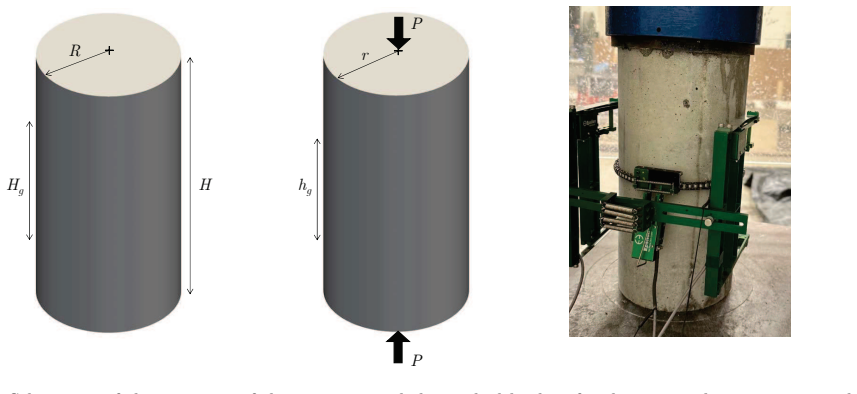
Guided by recent advances in the understanding of nucleation and propagation of fracture in elastic brittle materials, this paper proposes a suite of three simple experiments that permit the measurement of the three macroscopic material properties governing when and where cracks nucleate and propagate in structures made of cementitious materials that are subjected to arbitrary monotonic quasi-static loading conditions. The first experiment is that of the uniaxial compression of a cylindrical specimen, which enables the extraction of the elastic properties -- namely, the Young's modulus and Poisson's ratio -- as well as the uniaxial compressive strength. The second experiment is the Brazilian fracture test, performed with flat platens on a material disk to determine the uniaxial tensile strength. Having knowledge of the uniaxial compressive and uniaxial tensile strengths then allows for the estimation of the strength surface of the material via interpolation (e.g., a Drucker-Prager fit). Finally, the third experiment is the wedge split test on a notched cube, which yields the fracture toughness. We demonstrate by means of direct comparisons with four-point and three-point bending tests on both unnotched and notched beams made of a 3D-printable mortar mixture that the elasticity, strength, and toughness properties obtained from the proposed tests are sufficient to predict the nucleation and propagation of fracture for any structure (granted separation of length scales) made of cementitious materials under any monotonic quasi-static loading condition.
Editorial analysis
A structured set of objections, weighed in public.
Referee Report
Summary. The paper claims that three simple experiments suffice to extract the full set of macroscopic properties (Young's modulus E, Poisson's ratio ν, uniaxial compressive strength f_c, uniaxial tensile strength f_t, and mode-I fracture toughness K_Ic) needed to predict crack nucleation and propagation in any cementitious structure under monotonic quasi-static loading, provided length-scale separation holds. Uniaxial compression of a cylinder yields E, ν and f_c; the Brazilian disk test yields f_t; these two strengths are used to fit a Drucker-Prager (or similar) strength surface; and the wedge-split test on a notched cube yields K_Ic. Direct comparisons with three- and four-point bending tests (notched and unnotched) on a 3D-printable mortar are presented as validation that the extracted parameters are predictive.
Significance. If the central claim is substantiated, the work supplies a practical, low-complexity protocol for obtaining the minimal parameter set required for predictive fracture modeling of cementitious materials, which would be valuable for both research and engineering practice. The direct experimental comparisons to bending configurations provide concrete evidence that the proposed tests recover consistent elasticity, strength and toughness values. The approach also avoids circularity by deriving all quantities from independent measurements.
major comments (3)
- [strength-surface estimation section] § on strength-surface estimation (following the Brazilian-test description): the assertion that a Drucker-Prager surface fitted exclusively to the two uniaxial strengths f_c and f_t is adequate for arbitrary multiaxial stress states is load-bearing for the claim of applicability to 'any structure.' The validation experiments are confined to beam bending, in which the tensile zone remains essentially uniaxial and the compressive zone stays below f_c; no direct check is provided for biaxial compression, pure shear, or confined regimes where cementitious materials commonly deviate from Drucker-Prager. This leaves the generality of the interpolated surface untested.
- [Methods paragraph on Drucker-Prager fit] Methods paragraph describing the Drucker-Prager fit: the manuscript provides only limited detail on the precise fitting procedure, the choice of internal-friction parameter, and any post-processing or outlier rejection applied to the strength data. Without these specifics it is difficult to reproduce the surface or to quantify the interpolation error that would propagate into nucleation predictions for general geometries.
- [Validation section] Validation section (comparisons with four-point and three-point bending): while the reported load-displacement and crack-path agreement is encouraging, these tests do not exercise the full strength surface under the combined shear and confinement conditions that arise in many practical structures (shear walls, anchors, plates). Consequently the evidence does not yet fully support the claim that the three-test suite is sufficient for fracture prediction 'under any monotonic quasi-static loading condition.'
minor comments (3)
- [Notation] Notation for the fitted strength surface parameters should be introduced explicitly and used consistently when the surface is later invoked in the fracture simulations.
- [Figure of wedge-split test] Figure showing the wedge-split geometry would benefit from an additional panel or annotation clarifying the exact notch depth and loading platen contact conditions used in the experiments.
- [Discussion] A short discussion or reference to the known limitations of Drucker-Prager for concrete (e.g., under biaxial compression) would help readers assess the range of applicability.
Simulated Author's Rebuttal
We thank the referee for the constructive and insightful comments, which help clarify the scope and limitations of our proposed protocol. We address each major point below and will revise the manuscript accordingly to improve clarity and precision without overstating the generality of the results.
read point-by-point responses
-
Referee: [strength-surface estimation section] § on strength-surface estimation (following the Brazilian-test description): the assertion that a Drucker-Prager surface fitted exclusively to the two uniaxial strengths f_c and f_t is adequate for arbitrary multiaxial stress states is load-bearing for the claim of applicability to 'any structure.' The validation experiments are confined to beam bending, in which the tensile zone remains essentially uniaxial and the compressive zone stays below f_c; no direct check is provided for biaxial compression, pure shear, or confined regimes where cementitious materials commonly deviate from Drucker-Prager. This leaves the generality of the interpolated surface untested.
Authors: We agree that a Drucker-Prager surface fitted only to uniaxial strengths represents a standard engineering approximation rather than a complete multiaxial characterization, and that cementitious materials can exhibit deviations under confinement or shear. The manuscript presents this fit as one possible interpolation method when only the two uniaxial strengths are available. The bending validations confirm predictive capability for the stress states encountered there. In revision, we will add explicit discussion of the approximation's limitations and note that for regimes outside the validated range, additional multiaxial tests could be used to refine the surface. This preserves the practical value of the three-test suite while avoiding overgeneralization. revision: partial
-
Referee: Methods paragraph describing the Drucker-Prager fit: the manuscript provides only limited detail on the precise fitting procedure, the choice of internal-friction parameter, and any post-processing or outlier rejection applied to the strength data. Without these specifics it is difficult to reproduce the surface or to quantify the interpolation error that would propagate into nucleation predictions for general geometries.
Authors: We thank the referee for highlighting the need for greater reproducibility. The original description was intentionally concise, but we acknowledge that more detail is required. In the revised manuscript, we will expand the Methods section to include the exact Drucker-Prager parameter relations (friction angle and cohesion derived directly from the ratio f_c/f_t), confirmation that no outlier rejection was applied due to consistent specimen data, and the equations used for the fit. This will allow full reproduction and error assessment. revision: yes
-
Referee: Validation section (comparisons with four-point and three-point bending): while the reported load-displacement and crack-path agreement is encouraging, these tests do not exercise the full strength surface under the combined shear and confinement conditions that arise in many practical structures (shear walls, anchors, plates). Consequently the evidence does not yet fully support the claim that the three-test suite is sufficient for fracture prediction 'under any monotonic quasi-static loading condition.'
Authors: The referee is correct that the chosen validation configurations primarily involve near-uniaxial tension and compression. These tests were selected as they are standard for assessing fracture in cementitious materials and directly compare nucleation and propagation predictions. While they support the protocol for such cases, they do not cover all multiaxial conditions. We will revise the abstract, introduction, and conclusions to moderate the language, stating that the extracted parameters enable predictive modeling for monotonic quasi-static loading in geometries where the stress states align with the validated regime and the Drucker-Prager approximation holds. The core claim regarding the minimal parameter set from fracture mechanics principles remains intact. revision: partial
Circularity Check
No significant circularity; measurements and predictions remain independent
full rationale
The paper extracts Young's modulus, Poisson's ratio, and compressive strength directly from uniaxial cylinder compression, tensile strength from the Brazilian disk test, and fracture toughness from the wedge-split test. These measured values are then inserted into a standard Drucker-Prager interpolation (fitted only to the two uniaxial strengths) and a fracture-mechanics model to generate predictions for separate four-point and three-point bending specimens. Because the validation data are distinct experiments whose outcomes are not used in any fitting step, and because the central claim rests on externally established fracture-mechanics relations rather than self-referential definitions or load-bearing self-citations, no derivation step reduces to its own inputs by construction.
Axiom & Free-Parameter Ledger
free parameters (1)
- Drucker-Prager fit parameters
axioms (2)
- domain assumption The material behaves as an elastic brittle solid under monotonic quasi-static loading
- domain assumption Separation of length scales between material and structure
Lean theorems connected to this paper
-
IndisputableMonolith/Cost/FunctionalEquation.leanwashburn_uniqueness_aczel unclear?
unclearRelation between the paper passage and the cited Recognition theorem.
elastic energy density W(E) = E/(1+ν) tr E² + Eν/((1+ν)(1−2ν)) (tr E)²; Drucker-Prager F(σ)=√J₂ + σ_cs − σ_ts/√3(σ_cs+σ_ts) I₁ − 2σ_cs σ_ts/√3(σ_cs+σ_ts)=0 fitted to uniaxial strengths only
-
IndisputableMonolith/Foundation/RealityFromDistinction.leanreality_from_one_distinction unclear?
unclearRelation between the paper passage and the cited Recognition theorem.
phase-field equations (5)–(6) with v² ∂W/∂E and δε, cε_e derived from Drucker-Prager
What do these tags mean?
- matches
- The paper's claim is directly supported by a theorem in the formal canon.
- supports
- The theorem supports part of the paper's argument, but the paper may add assumptions or extra steps.
- extends
- The paper goes beyond the formal theorem; the theorem is a base layer rather than the whole result.
- uses
- The paper appears to rely on the theorem as machinery.
- contradicts
- The paper's claim conflicts with a theorem or certificate in the canon.
- unclear
- Pith found a possible connection, but the passage is too broad, indirect, or ambiguous to say the theorem truly supports the claim.
Reference graph
Works this paper leans on
- [1]
- [2]
-
[3]
A. Kumar and O. Lopez-Pamies. The phase-field approach to self-healable fracture of elastomers: A model accounting for fracture nucleation at large, with application to a clas s of conspicuous experiments. Theoretical and Applied Fracture Mechanics, 107:102550, 2020
work page 2020
- [4]
-
[5]
A. Kumar and O. Lopez-Pamies. The poker-chip experiment s of Gent and Lindley (1959) explained. Journal of the Mechanics and Physics of Solids , 150:104359, 2021
work page 1959
- [6]
- [7]
-
[8]
C. J. Larsen, J. E. Dolbow, and O. Lopez-Pamies. A variati onal formulation of Griffith phase-field fracture with materi al strength. International Journal of Fracture , 247:319–327, 2024
work page 2024
-
[9]
F. Kamarei, A. Kumar, and O. Lopez-Pamies. The poker-chi p experiments of synthetic elastomers explained. Journal of the Mechanics and Physics of Solids , 188:105683, 2024
work page 2024
-
[10]
S. Saha, J. E. Dolbow, and O. Lopez-Pamies. A Griffith desc ription of fracture for non-monotonic loading with applica tion to fatigue. Journal of the Mechanics and Physics of Solids , 191:105754, 2024
work page 2024
-
[11]
F. Kamarei, E. Breedlove, and O. Lopez-Pamies. Validat ing Griffith fracture propagation in the phase-field approach to fracture: The case of Mode III by means of the trousers test. International Journal of Fracture , 249:51, 2025
work page 2025
-
[12]
F. Kamarei, B. Zeng, J. E. Dolbow, and O. Lopez-Pamies. N ine circles of elastic brittle fracture: A series of challen ge problems to assess fracture models. Computer Methods in Applied Mechanics and Engineering , 448:118449, 2026
work page 2026
-
[13]
S. Saha, J. R. Roesler, and O. Lopez-Pamies. Breaking fo ur-point and three-point bending tests. International Journal of Solids and Structures , Submitted, 2026
work page 2026
-
[14]
O. Lopez-Pamies and F. Kamarei. When and where do large c racks grow? Griffith energy competition constrained by material strength. Extreme Mechanics Letters , 81:102417, 2025
work page 2025
-
[15]
G. Lam´ e and E. Clapeyron. M´ emoire sur l’´ equilibre in t´ erieur des corps solides homog` enes. Journal f¨ ur die reine und angewandte Mathematik , 7:381–413, 1831
-
[16]
W. J. M. Rankine. A Manual of Applied Mechanics . Richard Griffin and Company, 1858
-
[17]
O. Mohr. W elche umst¨ ande bedingen die elastizit¨ atsgrenze und den bruch eines materiales? [What circumstances d etermine the elastic limit and fracture of a material?]. Zeitschrift des Vereines deutscher Ingenieure , 44:1524–1530,1572–1574, 1900
work page 1900
-
[18]
E. Breedlove, C. Chen, D. Lindeman, and O. Lopez-Pamies . Cavitation in elastomers: A review of the evidence against elasticity. Journal of the Mechancis and Physics of Solids , 188:105678, 2024
work page 2024
-
[19]
W. J. Drugan and J. R. Willis. A micromechanics-based no nlocal constitutive equation and estimates of representat ive volume element size for elastic composites. Journal of the Mechanics and Physics of Solids , 44:497–524, 1996
work page 1996
-
[20]
R. F. Blanks and C. C. McNamara. Mass concrete tests in la rge cylinders. ACI Journal Proceedings, 31:280–303, 1935
work page 1935
-
[21]
H. F. Gonnerman. Effect of size and shape of test specimen on compressive strength of concrete. Proceedings, ASTM, 25: 237–250, 1925
work page 1925
-
[22]
T. Heister, M. F. Wheeler, and T. Wick. A primal-dual act ive set method and predictor-corrector mesh adaptivity for computing fracture propagation using a phase-field approac h. Computer Methods in Applied Mechanics and Engineering , 290:466–495, 2015
work page 2015
-
[23]
B. Manaugh. Aggregate gradation impacts on fresh prope rties of 3D concrete printing. Master’s thesis, University of Illinois Urbana-Champaign, 2025
work page 2025
-
[24]
F. L. L. B. Carneiro. A new method to determine the tensil e strength of concrete. In Proceedings of the 5th Meeting of the Brazilian Association for Technical Rules , pages 126–129, 1943
work page 1943
-
[25]
H. N. Linsbauer and E. K. Tschegg. Die bestimmung der bru chenergie an w¨ urfelproben [Determination of the fracture energy on cube specimens]. Zement und Beton , 31:38–40, 1986
work page 1986
-
[26]
E. Br¨ uhwiler and F. H. Wittmann. The wedge splitting te st, a new method of performing stable fracture mechanics tes ts. Engineering Fracture Mechanics, 35:117–125, 1990
work page 1990
-
[27]
P. Gillis and J. Gilman. Double-cantilever cleavage mo de of crack propagation. J. Appl. Phys. , 35:647–658, 1964
work page 1964
-
[28]
P. Rossi, E. Br¨ uhwiler, S. Chhuy, Y.-S. Jenq, and S. P. S hah. Fracture properties of concrete as determined by means of wedge splitting tests and tapered double cantilever beam tests. In S. P. Shah and A. Carpinteri, editors, Fracture Mechanics Test Methods for Concrete , pages 87–128. 1991
work page 1991
-
[29]
P. Chupanit and J. R. Roesler. Fracture energy approach to characterize concrete crack surface roughness and shear stiffness. Journal of Materials in Civil Engineering , 20:275–282, 2008
work page 2008
-
[30]
K. A. Rieder. Determination of crack resistance curves of cementitious materials from measurements of a wedge spli tting test. ACI Symposium Publication , 201:207–228, 2001
work page 2001
-
[31]
C. Gaedicke, S. Villalobos, J. Roesler, and D. Lange. Fr acture mechanics analysis for saw cutting requirements of c oncrete pavements. Transportation Research Record: Journal of the Transporta tion Research Board , 2020:20–29, 2007. 17
work page 2020
-
[32]
P. J. F. W right. The effect of the method of test on the flexu ral strength of concrete. Magazine of Concrete Research , 4: 67–76, 1952
work page 1952
-
[33]
C. P. Lindner and J. C. Sprague. Effect of depth of beam upo n the modulus of rupture of plain concrete. American Society for Testing Materials , 55:1062–1084, 1955
work page 1955
-
[34]
S. W alker and D. L. Bloem. Studies of flexural strength of concete – Part 3. American Society for Testing Materials , 57: 1122–1139, 1957. 18
work page 1957
discussion (0)
Sign in with ORCID, Apple, or X to comment. Anyone can read and Pith papers without signing in.