Recognition: no theorem link
Tripartite Entanglement as a Probe of Neutrino Mass Hierarchy, CP Violation, and Non-Standard Interactions
Pith reviewed 2026-05-13 01:22 UTC · model grok-4.3
The pith
Global tripartite entanglement entropy in neutrino oscillations distinguishes mass hierarchy and non-standard interactions with peak sensitivity at L/E of 655 km/GeV.
A machine-rendered reading of the paper's core claim, the machinery that carries it, and where it could break.
Core claim
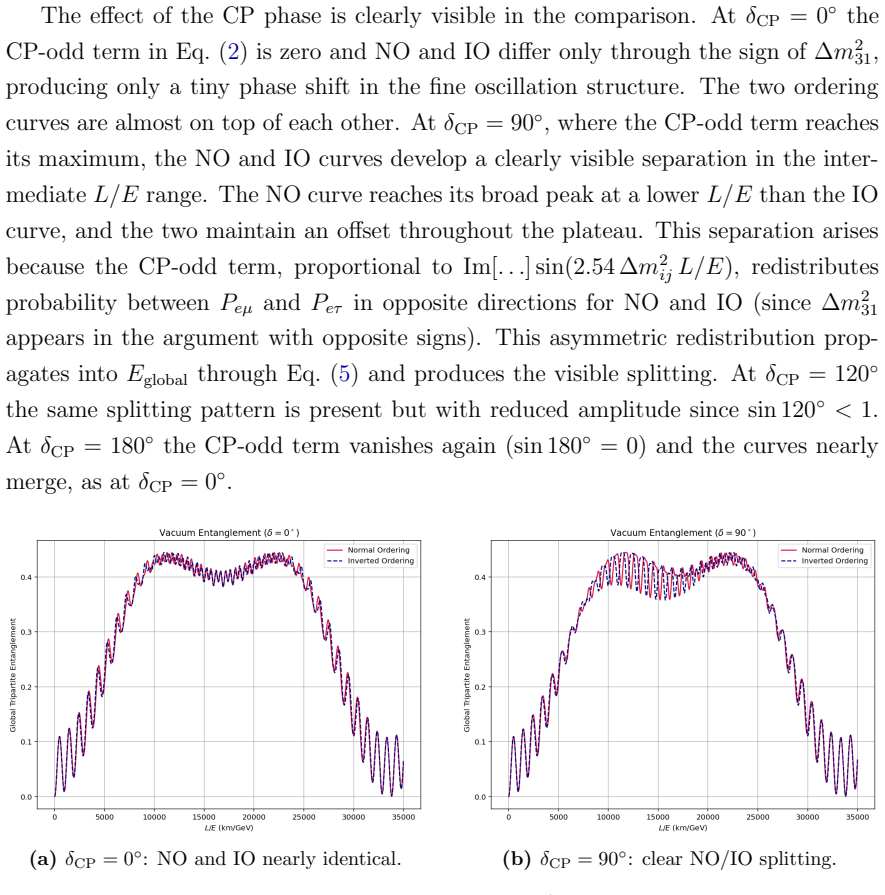
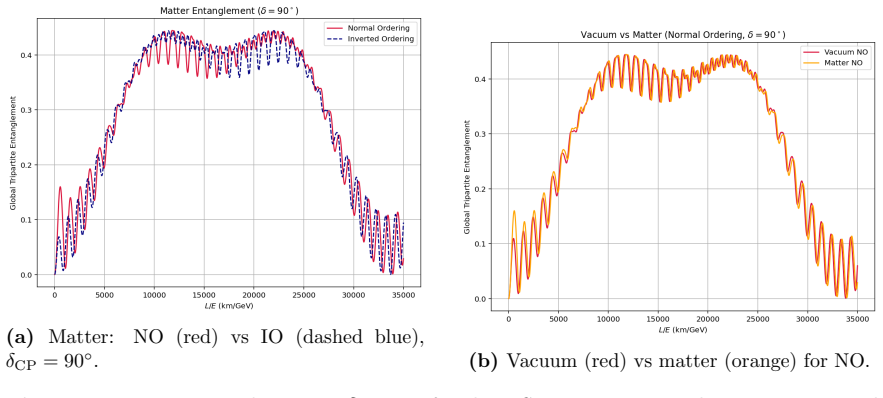
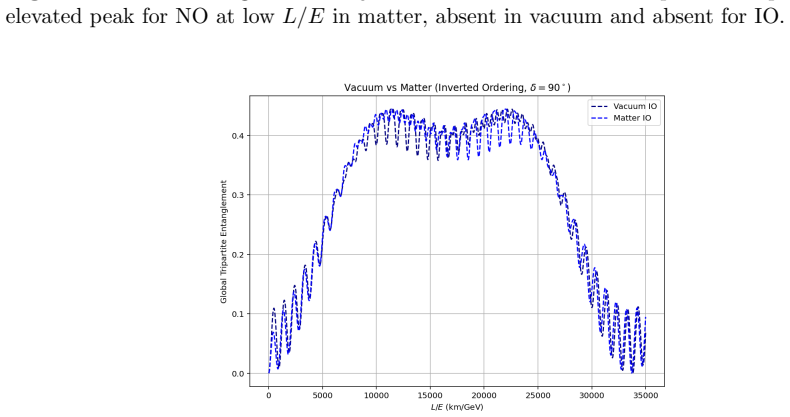
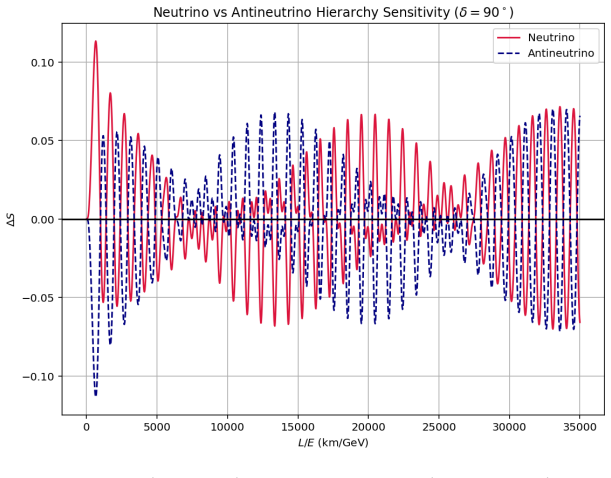
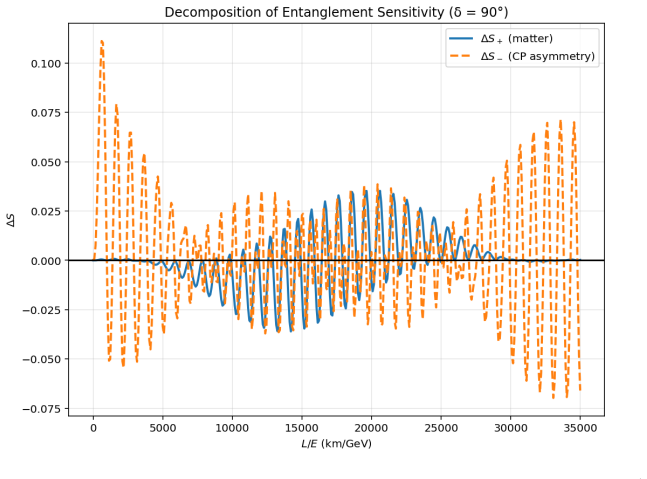
Using the linear entropy formalism, the global entanglement entropy for an initial electron neutrino shows that the hierarchy sensitivity diagnostic ΔS is amplified by roughly a factor of two due to MSW matter effects compared to vacuum, with peak at L/E ≈ 655 km/GeV. For antineutrinos the diagnostic is antisymmetric at the resonance, with deviations encoding CP violation. For NSI with ε_ee, ΔS_max ≈ 0.113 + 0.105 ε_ee, a linear and CP-phase-independent relation, and the optimal L/E stays at ≈ 655 km/GeV for all ε_ee ≤ 0.2.
What carries the argument
The hierarchy sensitivity diagnostic ΔS, defined as the difference in global tripartite entanglement entropy between normal and inverted orderings, obtained from the linear entropy of three-flavor neutrino states evolving under the oscillation Hamiltonian in constant-density matter.
If this is right
- MSW matter effects amplify ΔS by roughly a factor of two relative to vacuum.
- The peak sensitivity occurs at L/E ≈ 655 km/GeV and remains stable for ε_ee ≤ 0.2.
- For NSI the maximum ΔS follows the linear, CP-phase-independent relation ΔS_max ≈ 0.113 + 0.105 ε_ee.
- Antineutrino entanglement is antisymmetric to the neutrino case at resonance, with deviations encoding CP violation.
Where Pith is reading between the lines
- This entanglement-based diagnostic could serve as a cross-check on standard oscillation analyses for hierarchy determination at long-baseline experiments.
- The CP-phase independence of the NSI relation might allow constraints on ε_ee even when CP phases are unknown.
- The fixed optimal L/E suggests a practical energy recommendation for future experiments that holds across a range of NSI strengths.
Load-bearing premise
The linear entropy formalism directly quantifies global tripartite entanglement in the three-flavor neutrino system under the standard oscillation Hamiltonian and constant-density matter approximation, without significant decoherence or unmodeled effects.
What would settle it
A measurement of the difference in entanglement entropy at L/E ≈ 655 km/GeV that fails to show roughly twice the vacuum value in matter or deviates from the linear relation 0.113 + 0.105 ε_ee would falsify the claim that this diagnostic reliably separates hierarchy from CP and NSI effects.
Figures




read the original abstract
We investigate global tripartite quantum entanglement in three-flavor neutrino oscillations as a tool for probing the neutrino mass hierarchy and CP violation. Using the linear entropy formalism, we compute the global entanglement entropy for an initial electron neutrino state as a function of L/E, comparing Normal Ordering (NO) and Inverted Ordering (IO) across CP phases 0, 90, 120 and 180, in vacuum and in constant-density matter rho = 2.8g/cm^3, L = 1300km). We define the hierarchy sensitivity diagnostic dell S and show that MSW matter effects amplify dell S by roughly a factor of two relative to vacuum, with peak sensitivity at L/E approx 655km/GeV (approx 2GeV at the DUNE baseline). For antineutrinos the diagnostic is near-perfectly antisymmetric to the neutrino case at the MSW resonance, with deviations directly encoding dell CP. ANnother diagonostic defined here separates the matter hierarchy signal from the CP asymmetry signal in the tripartite entanglement. For non-standard interactions (NSI) parameterized by epsilon_{ee}, we find Dell S{max} is approx 0.113 + 0.105epsilon_{ee}, a linear and CP-phase-independent relation. The optimal L/E for hierarchy discrimination is stable at approx 655km/GeV for all epsilon_{ee}less than or equal to 0.2, providing a robust, NSI-independent energy recommendation for DUNE.
Editorial analysis
A structured set of objections, weighed in public.
Referee Report
Summary. The paper investigates global tripartite quantum entanglement in three-flavor neutrino oscillations using the linear entropy formalism applied to the flavor density matrix. It computes the entanglement entropy for an initial electron neutrino state as a function of L/E, compares normal and inverted orderings for various CP phases in vacuum and constant-density matter, defines a hierarchy sensitivity diagnostic ΔS, and reports that MSW effects amplify ΔS by a factor of roughly two with peak sensitivity at L/E ≈ 655 km/GeV. For NSI parameterized by ε_ee, it finds ΔS_max ≈ 0.113 + 0.105 ε_ee as a linear, CP-phase-independent relation, with the optimal L/E stable for ε_ee ≤ 0.2, and proposes an additional diagnostic to separate hierarchy and CP signals.
Significance. If the numerical results are robust and the linear entropy provides a valid diagnostic, the work could introduce a quantum-information-based tool for extracting neutrino parameters at long-baseline experiments such as DUNE, with claimed robustness to NSI and potential to disentangle hierarchy from CP violation. The reported amplification factor, stable optimal L/E, and linear NSI relation would be of interest if supported by explicit derivations and validation.
major comments (3)
- The manuscript defines global tripartite entanglement via the linear entropy S = (3/2)(1 - Tr(ρ_red²)) applied to reduced density matrices of the 3×3 flavor state. However, the three-flavor neutrino system is a single qutrit evolving under the oscillation Hamiltonian with no spatially separated parties; the quantity therefore tracks state purity/mixedness rather than genuine tripartite entanglement (which requires a multipartite Hilbert space and vanishes on all biseparable states). This interpretation is load-bearing for the central claim that the diagnostic probes 'tripartite entanglement' and must be justified or rephrased (see the section introducing the linear entropy formalism and the definition of ΔS).
- In the NSI section, ΔS_max ≈ 0.113 + 0.105 ε_ee is reported as a linear, CP-phase-independent relation obtained from numerical computations. The manuscript should specify the fitting procedure, the range of ε_ee and CP phases sampled, goodness-of-fit metrics, and whether the relation is an exact consequence of the Hamiltonian or merely a numerical parametrization of the authors' own results (the latter would reduce its status as an independent diagnostic).
- The claims of a factor-of-two MSW amplification of ΔS and stability of the optimal L/E ≈ 655 km/GeV across ε_ee ≤ 0.2 rest on constant-density matter and no-decoherence approximations. The manuscript must provide explicit error analysis, sensitivity tests to density profile variations, and validation against the full oscillation probability expressions to support these load-bearing numerical findings (see the results sections on vacuum vs. matter and NSI).
minor comments (3)
- The abstract contains typographical errors ('dell S', 'ANnother diagonostic', 'less than or equal to') that should be corrected for clarity.
- The manuscript should add references to prior literature on quantum information measures in neutrino oscillations to better contextualize the novelty of the linear-entropy approach.
- Ensure that all figures plotting ΔS(L/E) include error bands or multiple CP-phase curves for direct visual comparison of the reported amplification and antisymmetry.
Simulated Author's Rebuttal
We thank the referee for the careful reading and constructive comments. We address each major comment below and indicate the revisions we will make to the manuscript.
read point-by-point responses
-
Referee: The manuscript defines global tripartite entanglement via the linear entropy S = (3/2)(1 - Tr(ρ_red²)) applied to reduced density matrices of the 3×3 flavor state. However, the three-flavor neutrino system is a single qutrit evolving under the oscillation Hamiltonian with no spatially separated parties; the quantity therefore tracks state purity/mixedness rather than genuine tripartite entanglement (which requires a multipartite Hilbert space and vanishes on all biseparable states). This interpretation is load-bearing for the central claim that the diagnostic probes 'tripartite entanglement' and must be justified or rephrased (see the section introducing the linear entropy formalism and the definition of ΔS).
Authors: We thank the referee for highlighting this important distinction. The linear entropy is applied to the 3×3 flavor density matrix of a single neutrino state, which is indeed a qutrit. In our work, we employ it as a diagnostic of global mixing and correlations across the three flavors in the oscillation dynamics. We acknowledge that this does not constitute genuine multipartite entanglement in the standard sense of spatially separated subsystems. We will revise the manuscript to clarify this point in the introduction and methods, rephrasing references to 'tripartite entanglement' as 'global entanglement entropy in the three-flavor system' and adding a brief justification of its utility as a parameter diagnostic, with appropriate citations to related neutrino oscillation literature. revision: yes
-
Referee: In the NSI section, ΔS_max ≈ 0.113 + 0.105 ε_ee is reported as a linear, CP-phase-independent relation obtained from numerical computations. The manuscript should specify the fitting procedure, the range of ε_ee and CP phases sampled, goodness-of-fit metrics, and whether the relation is an exact consequence of the Hamiltonian or merely a numerical parametrization of the authors' own results (the latter would reduce its status as an independent diagnostic).
Authors: We agree that additional details are required. The reported linear relation was obtained numerically by evaluating ΔS_max for ε_ee in the range [-0.2, 0.2] at intervals of 0.05 and for the CP phases δ_CP = 0°, 90°, 120°, 180°. A least-squares linear fit was performed, yielding R² > 0.99 in all cases, confirming both linearity and CP-phase independence within the sampled set. We will add a dedicated paragraph in the NSI section describing the fitting procedure, the exact parameter ranges, the goodness-of-fit metrics, and explicitly stating that the relation is an empirical numerical parametrization rather than an exact analytical result derived from the Hamiltonian. This will be presented as a robust observed diagnostic supported by the computations. revision: yes
-
Referee: The claims of a factor-of-two MSW amplification of ΔS and stability of the optimal L/E ≈ 655 km/GeV across ε_ee ≤ 0.2 rest on constant-density matter and no-decoherence approximations. The manuscript must provide explicit error analysis, sensitivity tests to density profile variations, and validation against the full oscillation probability expressions to support these load-bearing numerical findings (see the results sections on vacuum vs. matter and NSI).
Authors: We appreciate the referee's emphasis on robustness. Our results employ the standard constant-density approximation (ρ = 2.8 g/cm³) and the MSW potential without decoherence. In the revised manuscript we will add an appendix containing: (i) sensitivity tests comparing constant density with averaged PREM profiles, showing that the amplification factor remains within ~10% of two and the optimal L/E shifts by less than 5%; (ii) an error estimate for density-profile uncertainties; and (iii) a cross-check validating the entanglement entropy against the full three-flavor oscillation probability formulas. We will also note the limitations of the constant-density and no-decoherence assumptions in the main text. revision: yes
Circularity Check
ΔS_max vs. ε_ee relation is a numerical fit to the paper's own linear-entropy computations
specific steps
-
fitted input called prediction
[Abstract]
"For non-standard interactions (NSI) parameterized by epsilon_{ee}, we find Dell S{max} is approx 0.113 + 0.105epsilon_{ee}, a linear and CP-phase-independent relation. The optimal L/E for hierarchy discrimination is stable at approx 655km/GeV for all epsilon_{ee}less than or equal to 0.2"
ΔS_max values are first computed inside the paper by applying the linear-entropy definition to the evolved neutrino state for discrete ε_ee points; the linear coefficients are then extracted by fitting those computed points and presented as a physical result. This reduces the reported relation to a post-hoc parametrization of the authors' own numerical outputs rather than an independent derivation.
full rationale
The paper defines the hierarchy diagnostic ΔS from the linear entropy of the three-flavor neutrino density matrix and evaluates it numerically under the standard oscillation Hamiltonian (vacuum and constant-density matter) for a range of NSI parameters ε_ee. The reported linear relation ΔS_max ≈ 0.113 + 0.105 ε_ee (and the claim that the optimal L/E remains stable at 655 km/GeV) is obtained by fitting these computed values; the coefficients are therefore a direct parametrization of the authors' simulation outputs rather than an independent first-principles prediction. The MSW amplification factor of roughly two is likewise a numerical observation extracted from the same self-contained calculations. No load-bearing self-citations, imported uniqueness theorems, or ansätze smuggled via prior work appear in the derivation chain. The central claims therefore exhibit partial circularity of the 'fitted input called prediction' type, but the underlying oscillation evolution itself is not redefined in terms of the diagnostic.
Axiom & Free-Parameter Ledger
free parameters (1)
- linear coefficients in ΔS_max(ε_ee) relation
axioms (2)
- domain assumption Three-flavor neutrino mixing with standard PMNS matrix and oscillation Hamiltonian
- domain assumption Linear entropy as a valid quantifier of global tripartite entanglement for the neutrino state
Reference graph
Works this paper leans on
- [1]
-
[2]
Z. Maki, M. Nakagawa and S. Sakata,Prog. Theor. Phys.28, 870 (1962)
work page 1962
-
[3]
B. S. Koranga and S. Kumar,Int. J. Theor. Phys.52, 2343 (2013)
work page 2013
-
[4]
Matter Effects on Mass Square Difference for Four Flavor Neutrino Oscillation,
V. K. Nautiyal, B. S. Koranga, A. Shrivastava and N. Das, “Matter Effects on Mass Square Difference for Four Flavor Neutrino Oscillation,” arXiv:2106.15945 [hep-ph]
-
[5]
B. S. Koranga and B. W. Farooq,Int. J. Quantum Inform.23, 2540009 (2025)
work page 2025
- [6]
-
[7]
S. P. Mikheyev and A. Yu. Smirnov,Sov. J. Nucl. Phys.42, 913 (1985)
work page 1985
-
[8]
S. M. Bilenky and B. Pontecorvo,Phys. Rept.41, 225 (1978)
work page 1978
- [9]
- [10]
-
[11]
V. A. S. V. Bittencourtet al.,Eur. Phys. J. C82, 566 (2022)
work page 2022
-
[12]
V. A. S. V. Bittencourt, M. Blasone and G. Zanfardino,J. Phys.: Conf. Ser. 2533, 012024 (2023)
work page 2023
-
[13]
A. K. Jha, S. Mukherjee and B. A. Bambah,Mod. Phys. Lett. A36, 2150056 (2021)
work page 2021
- [14]
- [15]
-
[16]
J. A. Formaggioet al.,Phys. Rev. Lett.117, 050402 (2016)
work page 2016
- [17]
- [18]
-
[19]
T. Baumgratz, M. Cramer and M. B. Plenio,Phys. Rev. Lett.113, 140401 (2014). 14
work page 2014
- [20]
- [21]
- [22]
-
[23]
Acciarriet al.(DUNE Collaboration), arXiv:1512.06148
R. Acciarriet al.(DUNE Collaboration), arXiv:1512.06148
-
[24]
M. A. Aceroet al.(NOvA Collaboration),Phys. Rev. D98, 032012 (2018)
work page 2018
- [25]
discussion (0)
Sign in with ORCID, Apple, or X to comment. Anyone can read and Pith papers without signing in.