Recognition: 2 theorem links
· Lean TheoremUnique Gravitational-Wave Signals from Negative-Mass Binaries
Pith reviewed 2026-05-13 01:15 UTC · model grok-4.3
The pith
Negative-mass binary systems produce anomalous gravitational-wave signals like anti-chirps, dispersal, and runaway motion that are absent from observations.
A machine-rendered reading of the paper's core claim, the machinery that carries it, and where it could break.
Core claim
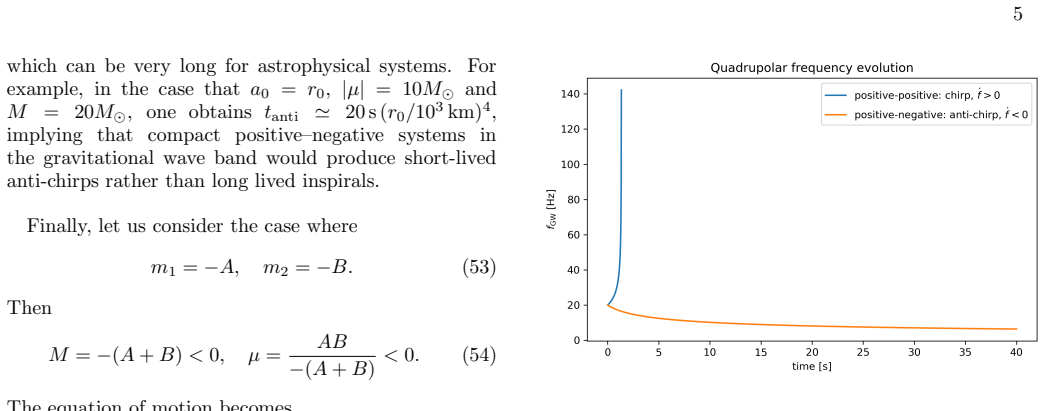
The intrinsic dynamics of negative mass binaries generically lead to anomalous behaviors such as anti-chirps, dispersal and runaway motion. These signatures are absent in current gravitational wave observations, providing a robust exclusion channel independent of modified gravity assumptions.
What carries the argument
The orbital dynamics of negative-mass binary systems and the gravitational wave patterns they emit.
If this is right
- Negative mass binaries would generate anti-chirp gravitational wave signals with decreasing frequency.
- Such binaries would exhibit dispersal or runaway motion rather than stable inspiral.
- The absence of these signals in data provides an exclusion bound on negative masses.
- This exclusion holds independently of any assumptions about modified gravity theories.
Where Pith is reading between the lines
- The same dynamical approach could be used to search existing gravitational wave catalogs for other hypothetical mass configurations.
- It suggests negative masses cannot form stable, detectable binary systems under standard gravitational dynamics.
- Future detectors might target specific anomalous patterns to place tighter limits if no signals appear.
Load-bearing premise
Negative-mass binaries would produce gravitational wave signals with anomalous features clearly distinguishable from standard sources, and current observations are complete enough to have detected them if present.
What would settle it
Detection of a gravitational wave signal with decreasing frequency over time, matching an anti-chirp from a binary system, would indicate negative masses exist.
Figures

read the original abstract
Negative masses have long been explored, but their observational viability remains unclear. In this work, we develop a unified, observationally testable framework to constrain negative masses using both coupling level and dynamical probes. We establish that while dipole radiation bounds require universality of gravitational charge, the intrinsic dynamics of negative mass binaries generically lead to anomalous behaviors such as anti-chirps, dispersal and runaway motion. These signatures are absent in current gravitational wave observations, providing a robust exclusion channel independent of modified gravity assumptions.
Editorial analysis
A structured set of objections, weighed in public.
Referee Report
Summary. The manuscript develops a unified framework to constrain negative masses via gravitational coupling (dipole radiation bounds requiring universality of gravitational charge) and dynamical probes. It derives that negative-mass binaries generically produce anomalous gravitational-wave behaviors including anti-chirps, dispersal, and runaway motion; these signatures are stated to be absent from current observations, yielding a robust exclusion independent of modified-gravity assumptions.
Significance. If the dynamical derivations hold and the non-observation is rigorously quantified, the work supplies a novel, model-independent bound on negative masses by repurposing existing LIGO/Virgo/KAGRA data. The focus on intrinsic binary dynamics rather than modified gravity is a clear strength and could open a new observational channel.
major comments (2)
- The central exclusion claim rests on the assertion that anti-chirp, dispersal, and runaway signals are absent in current gravitational-wave observations. The manuscript reports no injection-recovery studies, template-overlap calculations, or rate upper limits propagated through actual search pipelines, leaving the step from predicted dynamics to observational exclusion unsubstantiated.
- In the dynamical analysis of negative-mass binaries, the generic appearance of anomalous behaviors (anti-chirps, runaway motion) is asserted without quantitative distinguishability metrics such as mismatch with standard positive-mass templates or a scan over mass-ratio and eccentricity parameters.
minor comments (2)
- The abstract and conclusion should explicitly name the GW catalogs or search pipelines invoked for the non-observation statement.
- Define the sign convention and notation for negative mass (e.g., m < 0) at first use and ensure consistent usage throughout the equations.
Simulated Author's Rebuttal
We thank the referee for the constructive and detailed comments on our manuscript. We address each major comment point by point below, offering clarifications on the theoretical derivations while acknowledging where additional discussion or qualification is warranted. Revisions will be incorporated in the updated version to improve the presentation of the observational implications.
read point-by-point responses
-
Referee: The central exclusion claim rests on the assertion that anti-chirp, dispersal, and runaway signals are absent in current gravitational-wave observations. The manuscript reports no injection-recovery studies, template-overlap calculations, or rate upper limits propagated through actual search pipelines, leaving the step from predicted dynamics to observational exclusion unsubstantiated.
Authors: We acknowledge that the exclusion is presented at a qualitative level, relying on the non-observation of these distinctive signatures in existing LIGO/Virgo/KAGRA catalogs rather than dedicated injection studies or pipeline-specific limits. The manuscript's core contribution lies in deriving the anomalous dynamics from the negative-mass equations of motion, which predict behaviors (such as frequency evolution opposite to the standard chirp) that differ fundamentally from any positive-mass binary waveforms. No such events have been reported despite comprehensive searches sensitive to a wide range of signals. In the revised manuscript, we will expand the relevant discussion section to explicitly state this limitation, clarify that the exclusion is an initial model-independent constraint based on the absence of reported anomalies, and recommend that future work perform targeted searches to derive quantitative bounds. revision: partial
-
Referee: In the dynamical analysis of negative-mass binaries, the generic appearance of anomalous behaviors (anti-chirps, runaway motion) is asserted without quantitative distinguishability metrics such as mismatch with standard positive-mass templates or a scan over mass-ratio and eccentricity parameters.
Authors: The anomalous behaviors follow directly from the sign reversal in the gravitational mass terms within the orbital equations, causing repulsive interactions and inverted frequency-amplitude evolution for any negative-mass binary system. This leads to anti-chirps and potential dispersal or runaway trajectories as generic outcomes, independent of specific mass ratios or eccentricities, because the overall sign flip alters the effective potential and energy loss uniformly. While we agree that explicit mismatch calculations or parameter scans would provide additional quantitative support, the qualitative distinction arises at the level of the leading-order dynamics and cannot be reproduced by standard positive-mass templates. We will add a short clarifying paragraph in the dynamical analysis section of the revised manuscript to emphasize this generality across the parameter space. revision: partial
Circularity Check
No significant circularity; dynamics-derived signals checked against independent external observations
full rationale
The paper's core derivation starts from the equations of motion for negative-mass binaries and obtains anti-chirps, dispersal, and runaway trajectories as direct consequences of the sign flip in gravitational mass. This step is a standard (if exotic) application of Newtonian or post-Newtonian dynamics and does not reduce to a fitted parameter or self-referential definition. The subsequent claim that these signatures are absent in existing LIGO/Virgo/KAGRA catalogs is an external empirical statement, not a re-expression of the model's own inputs. No load-bearing self-citation, ansatz smuggling, or renaming of known results is required for the argument. The derivation chain therefore remains self-contained against external benchmarks.
Axiom & Free-Parameter Ledger
axioms (1)
- domain assumption Universality of gravitational charge
invented entities (1)
-
Negative mass
no independent evidence
Lean theorems connected to this paper
-
IndisputableMonolith/Foundation/RealityFromDistinction.leanreality_from_one_distinction unclear?
unclearRelation between the paper passage and the cited Recognition theorem.
the intrinsic dynamics of negative mass binaries generically lead to anomalous behaviors such as anti-chirps, dispersal and runaway motion... ˙fGW <0 ... M=0 correspond to runaway solutions
-
IndisputableMonolith/Cost/FunctionalEquation.leanwashburn_uniqueness_aczel unclear?
unclearRelation between the paper passage and the cited Recognition theorem.
˙EGW =−32/5 G⁴μ²M³/c⁵a⁵ ... sign of ˙fGW determined by sign of μ
What do these tags mean?
- matches
- The paper's claim is directly supported by a theorem in the formal canon.
- supports
- The theorem supports part of the paper's argument, but the paper may add assumptions or extra steps.
- extends
- The paper goes beyond the formal theorem; the theorem is a base layer rather than the whole result.
- uses
- The paper appears to rely on the theorem as machinery.
- contradicts
- The paper's claim conflicts with a theorem or certificate in the canon.
- unclear
- Pith found a possible connection, but the passage is too broad, indirect, or ambiguous to say the theorem truly supports the claim.
Reference graph
Works this paper leans on
-
[1]
Bondi, Negative mass in general relativity, Reviews of Modern Physics29, 423 (1957)
H. Bondi, Negative mass in general relativity, Reviews of Modern Physics29, 423 (1957)
work page 1957
-
[2]
The Bondi universe: Can negative mass drive the cosmological expansion?
G. Manfredi, J.-L. Rouet, and B. Miller, The bondi uni- verse: How negative mass drives the cosmological expan- sion, arXiv preprint arXiv:2601.22910 (2026)
work page internal anchor Pith review Pith/arXiv arXiv 2026
-
[3]
S. Nojiri and S. Odintsov, May negative mass objects ex- ist in the sky?, arXiv preprint arXiv:2602.15058 (2026)
-
[4]
J. S. Farnes, A unifying theory of dark energy and dark matter: Negative masses and matter creation within a modifiedλcdm framework, Astronomy & Astrophysics 620, A92 (2018)
work page 2018
-
[5]
J. Belletˆ ete and M. Paranjape, On negative mass, In- ternational Journal of Modern Physics D22, 1341017 (2013)
work page 2013
-
[6]
W. B. Bonnor, Negative mass in general relativity, Gen- eral relativity and gravitation21, 1143 (1989)
work page 1989
-
[7]
H. Cebeci, ¨O. Sarıo˘ glu, and B. Tekin, Negative mass solitons in gravity, Physical Review D—Particles, Fields, Gravitation, and Cosmology73, 064020 (2006)
work page 2006
-
[8]
Mann, Black holes of negative mass, Classical and Quantum Gravity14, 2927 (1997)
R. Mann, Black holes of negative mass, Classical and Quantum Gravity14, 2927 (1997)
work page 1997
-
[9]
R. L. Forward, Negative matter propulsion, Journal of Propulsion and Power6, 28 (1990)
work page 1990
-
[10]
C. B. Møller, R. A. Thomas, G. Vasilakis, E. Zeuthen, Y. Tsaturyan, M. Balabas, K. Jensen, A. Schliesser, K. Hammerer, and E. S. Polzik, Quantum back-action- evading measurement of motion in a negative mass ref- erence frame, Nature547, 191 (2017)
work page 2017
-
[11]
M. Khamehchi, K. Hossain, M. Mossman, Y. Zhang, T. Busch, M. M. Forbes, and P. Engels, Negative-mass hydrodynamics in a spin-orbit–coupled bose-einstein con- densate, Physical review letters118, 155301 (2017)
work page 2017
-
[12]
H. Socas-Navarro, Can a negative-mass cosmology ex- plain dark matter and dark energy?, Astronomy & As- trophysics626, A5 (2019)
work page 2019
-
[13]
J.-P. Petit and G. d’Agostini, Negative mass hypothesis in cosmology and the nature of dark energy, Astrophysics and Space Science354, 611 (2014)
work page 2014
-
[14]
S. N´ ajera, A. Gamboa, A. Aguilar-Nieto, and C. Escamilla-Rivera, On negative mass cosmology in general relativity, Astronomy & Astrophysics651, L13 (2021)
work page 2021
-
[15]
G. Manfredi, J.-L. Rouet, B. Miller, and G. Chardin, Cos- mological structure formation with negative mass, Phys- ical Review D98, 023514 (2018)
work page 2018
-
[16]
Z. Wang, J. Zhao, Z. An, L. Shao, and Z. Cao, Simulta- neous bounds on the gravitational dipole radiation and varying gravitational constant from compact binary in- spirals, Physics Letters B834, 137416 (2022)
work page 2022
-
[17]
K. Lazaridis, N. Wex, A. Jessner, M. Kramer, B. Stap- pers, G. Janssen, G. Desvignes, M. Purver, I. Cognard, G. Theureau,et al., Generic tests of the existence of the gravitational dipole radiation and the variation of the gravitational constant, Monthly Notices of the Royal As- tronomical Society400, 805 (2009)
work page 2009
-
[18]
C. M. Will, Gravitational radiation from binary systems in alternative metric theories of gravity-dipole radiation and the binary pulsar, Astrophysical Journal, Part 1, vol. 214, June 15, 1977, p. 826-839.214, 826 (1977)
work page 1977
-
[19]
T. P. Krisher, Dipole gravitational radiation in the non- symmetric gravitational theory of moffat, Physical Re- view D32, 329 (1985)
work page 1985
-
[20]
E. Barausse, N. Yunes, and K. Chamberlain, Theory- agnostic constraints on black-hole dipole radiation with multiband gravitational-wave astrophysics, Physical re- view letters116, 241104 (2016)
work page 2016
-
[21]
M. Vas´ uth, Z. Keresztes, A. Mih´ aly, and L.´A. Gergely, Gravitational radiation reaction in compact binary sys- tems: Contribution of the magnetic dipole–magnetic dipole interaction, Physical Review D68, 124006 (2003). 7
work page 2003
-
[22]
J. M. Weisberg and J. H. Taylor, Gravitational radiation from an orbiting pulsar, General Relativity and Gravita- tion13, 1 (1981)
work page 1981
-
[23]
K. Arun, Generic bounds on dipolar gravitational radi- ation from inspiralling compact binaries, Classical and Quantum Gravity29, 075011 (2012)
work page 2012
-
[24]
K. Yagi, L. C. Stein, and N. Yunes, Challenging the pres- ence of scalar charge and dipolar radiation in binary pul- sars, Physical Review D93, 024010 (2016)
work page 2016
-
[25]
E. Barausse and K. Yagi, Gravitation-wave emission in shift-symmetric horndeski theories, Physical Review Let- ters115, 211105 (2015)
work page 2015
-
[26]
E. Barausse, Testing the strong equivalence principle with gravitational-wave observations of binary black holes, arXiv preprint arXiv:1703.05699 (2017)
-
[27]
S. Das, M. Fridman, and G. Lambiase, Testing the quan- tum equivalence principle with gravitational waves, Jour- nal of High Energy Astrophysics48, 100413 (2025)
work page 2025
-
[28]
G. Lambiase, M. Sakellariadou, and A. Stabile, Con- straints on extended gravity models through gravita- tional wave emission, Journal of Cosmology and As- troparticle Physics2021(03), 014
- [29]
-
[30]
R. Abbott, T. Abbott, S. Abraham, F. Acernese, K. Ack- ley, A. Adams, C. Adams, R. X. Adhikari, V. Adya, C. Affeldt,et al., Tests of general relativity with binary black holes from the second ligo-virgo gravitational-wave transient catalog, Physical review D103, 122002 (2021)
work page 2021
-
[31]
A. Ghosh, N. K. Johnson-McDaniel, A. Ghosh, C. K. Mishra, P. Ajith, W. D. Pozzo, C. P. Berry, A. B. Nielsen, and L. London, Testing general relativity using gravita- tional wave signals from the inspiral, merger and ring- down of binary black holes, Classical and Quantum Grav- ity35, 014002 (2018)
work page 2018
- [32]
- [33]
-
[34]
Z. Carson and K. Yagi, Probing beyond-kerr space- times with inspiral-ringdown corrections to gravitational waves, Physical Review D101, 084050 (2020)
work page 2020
-
[35]
M. Isi, M. Pitkin, and A. J. Weinstein, Probing dynam- ical gravity with the polarization of continuous gravita- tional waves, Physical Review D96, 042001 (2017)
work page 2017
-
[36]
X.-L. Wang, S.-C. Yang, and W.-B. Han, Tests of gravi- tational wave propagation with ligo-virgo catalog, arXiv preprint arXiv:2404.14684 (2024)
-
[37]
N. Yunes and F. Pretorius, Fundamental theoretical bias in gravitational wave astrophysics¡? format?¿ and the parametrized post-einsteinian framework, Physical Re- view D—Particles, Fields, Gravitation, and Cosmology 80, 122003 (2009)
work page 2009
-
[38]
C. K. Mishra, K. Arun, B. R. Iyer, and B. S. Sathyaprakash, Parametrized tests of post-newtonian theory using advanced ligo and einstein telescope, Phys- ical Review D—Particles, Fields, Gravitation, and Cos- mology82, 064010 (2010)
work page 2010
discussion (0)
Sign in with ORCID, Apple, or X to comment. Anyone can read and Pith papers without signing in.