Recognition: no theorem link
Photon Sphere and Shadow of a Perturbative Black Hole in f(R,mathcal{G}) Gravity
Pith reviewed 2026-05-13 01:52 UTC · model grok-4.3
The pith
Higher-curvature corrections in f(R,G) gravity shift the photon-sphere radius and alter black-hole shadow sizes.
A machine-rendered reading of the paper's core claim, the machinery that carries it, and where it could break.
Core claim
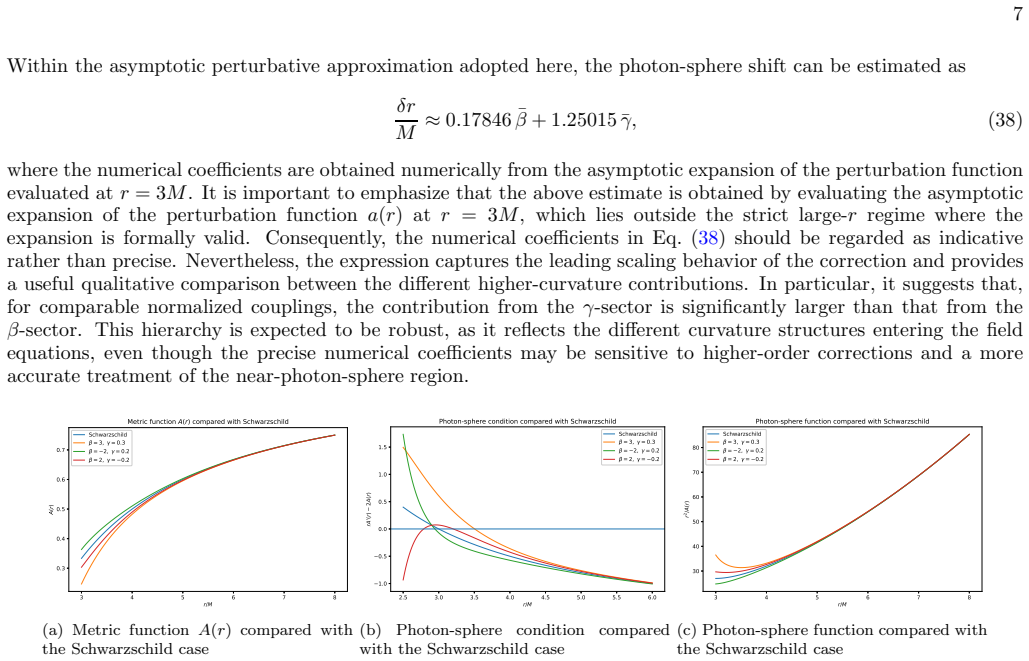
In the leading-order perturbed metric, the radius of the unstable circular photon orbit receives an analytic correction proportional to the f(R,G) coupling constants; the Gauss-Bonnet sector contributes more than the mixed curvature terms, and the resulting displacement together with direct metric perturbations fixes the corrected shadow radius.
What carries the argument
The effective potential for null geodesics in the perturbed spherically symmetric metric, whose critical point supplies the photon-sphere radius and from which the shadow size is obtained.
If this is right
- The black-hole shadow radius acquires leading-order corrections proportional to the coupling parameters.
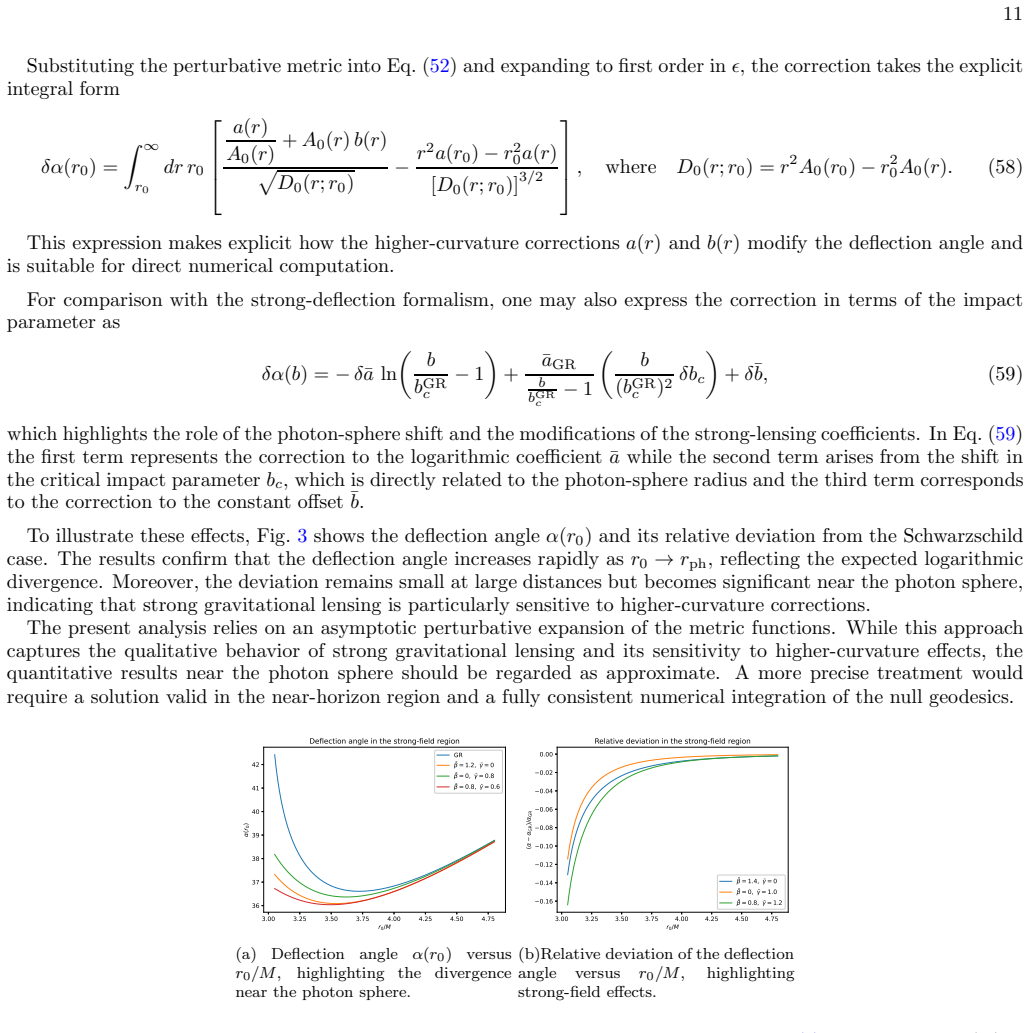
- Strong gravitational lensing observables receive corresponding modifications from the shifted photon sphere.
- Quasinormal mode spectra are expected to be altered by the same higher-curvature terms.
- Very-long-baseline interferometry and gravitational-wave observations can place constraints on the allowed size of the couplings.
Where Pith is reading between the lines
- Even tiny couplings permitted by the perturbative regime could produce measurable shifts in the shadow radius of supermassive black holes.
- Comparison of an observed shadow radius with the pure general-relativity prediction for a known mass could directly bound the f(R,G) coupling strengths.
- The same perturbative approach could be applied to other higher-curvature theories to predict their distinct signatures in strong-field observables.
Load-bearing premise
The higher-curvature coupling parameters are small enough that the asymptotic expansion around the Schwarzschild solution remains accurate all the way into the strong-field region near the black hole.
What would settle it
A high-precision measurement of the shadow radius for a black hole with independently known mass and distance that deviates from the general-relativity value by an amount inconsistent with the derived perturbative corrections or that would require couplings large enough to invalidate the expansion.
Figures


read the original abstract
We investigate the impact of higher-curvature corrections on black-hole observables within a perturbative $f(R, G)$ gravity framework. Working in a static, spherically symmetric spacetime, we construct leading-order deviations from the Schwarzschild solution by expanding the field equations in small coupling parameters associated with quadratic curvature invariants. The resulting metric corrections are obtained as asymptotic expansions and used to analyze null geodesics. We derive analytic expressions for the shift in the photon-sphere radius and show that higher-curvature terms modify the location of unstable photon orbits, with the Gauss--Bonnet sector producing a more significant contribution than mixed curvature terms. These modifications propagate to observable quantities, leading to corrections in the black-hole shadow radius. We identify the distinct roles of photon-sphere displacement and direct metric perturbations in determining the shadow size. We further discuss the implications of these corrections for strong gravitational lensing and quasinormal modes, highlighting the enhanced sensitivity of strong-field observables to higher-curvature effects. While the present analysis is based on an asymptotic perturbative treatment, our results provide a consistent framework for estimating leading-order deviations from general relativity and suggest that high-resolution observations, including very-long-baseline interferometry and gravitational-wave measurements, may offer constraints on modified gravity models.
Editorial analysis
A structured set of objections, weighed in public.
Referee Report
Summary. The paper constructs leading-order perturbative corrections to the Schwarzschild metric in f(R,𝒢) gravity by expanding the field equations in small coupling parameters for the quadratic curvature invariants. These metric corrections are inserted into the null geodesic equation to obtain analytic expressions for the shift in the photon-sphere radius; the Gauss-Bonnet sector is shown to dominate the displacement relative to mixed curvature terms. The shifts are propagated to the black-hole shadow radius, with separate identification of photon-sphere displacement versus direct metric effects, and the implications for strong lensing and quasinormal modes are discussed.
Significance. If the leading-order expansion remains controlled near the photon sphere, the work supplies explicit, analytic estimates of strong-field deviations from GR that can be directly compared with VLBI shadow measurements and GW ringdown data, thereby offering a practical route to constrain the coupling parameters of quadratic-curvature gravity.
major comments (1)
- [Sections deriving metric perturbations and null geodesics] The metric corrections are derived as asymptotic expansions in the small couplings (presumably large-r series). These are then substituted into the effective potential for null geodesics to locate the unstable photon orbit at r≈3M. At this radius the expansion parameter is O(1), so the truncation error is not demonstrably small; the reported analytic shifts in photon-sphere radius and shadow size therefore rest on an uncontrolled approximation precisely where the observables are evaluated. A consistency check (higher-order terms or numerical integration of the exact field equations) is required before the central claim can be considered robust.
minor comments (1)
- [Abstract] The abstract states that the analysis is 'based on an asymptotic perturbative treatment'; a short paragraph quantifying the expected range of validity of the expansion (e.g., in terms of the coupling parameters and radial coordinate) would improve clarity.
Simulated Author's Rebuttal
We thank the referee for the careful review and for identifying a substantive limitation in the perturbative treatment. We address the major comment below and indicate the changes we will implement.
read point-by-point responses
-
Referee: [Sections deriving metric perturbations and null geodesics] The metric corrections are derived as asymptotic expansions in the small couplings (presumably large-r series). These are then substituted into the effective potential for null geodesics to locate the unstable photon orbit at r≈3M. At this radius the expansion parameter is O(1), so the truncation error is not demonstrably small; the reported analytic shifts in photon-sphere radius and shadow size therefore rest on an uncontrolled approximation precisely where the observables are evaluated. A consistency check (higher-order terms or numerical integration of the exact field equations) is required before the central claim can be considered robust.
Authors: We agree that the metric perturbations are constructed via asymptotic (large-r) expansions of the linearized field equations in the small coupling parameters. Inserting the leading terms into the null-geodesic effective potential at r ≈ 3M therefore leaves the truncation error unquantified, since higher powers of M/r are not demonstrably small. While the overall expansion parameter remains the coupling constant (so that the reported shifts are formally first-order in that small quantity), we acknowledge that this does not automatically guarantee control at finite r. In the revised manuscript we will add a dedicated paragraph in the discussion section that (i) states the regime of validity explicitly, (ii) provides a qualitative estimate of the expected magnitude of the next-order terms based on the structure of the perturbative equations, and (iii) notes that a full consistency check would require either higher-order analytic terms or a numerical solution of the exact field equations—both of which lie outside the present scope. revision: partial
- A quantitative consistency check via explicit higher-order terms in the asymptotic expansion or numerical integration of the exact field equations in f(R,𝒢) gravity.
Circularity Check
No circularity; direct perturbative derivation from field equations
full rationale
The paper expands the f(R,G) field equations in small coupling parameters to obtain leading-order metric corrections as asymptotic series around Schwarzschild, then substitutes these corrections into the null geodesic equation to derive analytic shifts in the photon-sphere radius and shadow size. This is a standard forward calculation with no fitted parameters renamed as predictions, no self-definitional loops, and no load-bearing self-citations of uniqueness theorems or ansatze. The derivation chain remains independent of the final observables and does not reduce to its inputs by construction.
Axiom & Free-Parameter Ledger
free parameters (1)
- small coupling parameters for quadratic curvature invariants
axioms (2)
- domain assumption Static spherically symmetric spacetime
- ad hoc to paper Leading-order asymptotic expansion around Schwarzschild is sufficient
Reference graph
Works this paper leans on
-
[1]
we have the derivatives of fR and fG give by Eq. ( 12). On the Schwarzschild background one has R(0) µν = 0, R (0) = 0, A 0(r) = 1 − 2M r , (A9) so that f (0) R = 1 + β G(0), f (0) G = 2γG(0). (A10) Moreover, the Gauss–Bonnet invariant is G(0) = 48M 2 r6 . (A11) Therefore, at first order the higher-curvature sector enters through the effective source tensor...
-
[2]
Modified Gravity and Cosmology
T. Clifton, P. G. Ferreira, A. Padilla, and C. Skordis, Ph ys. Rept. 513, 1 (2012), 1106.2476
work page internal anchor Pith review arXiv 2012
-
[3]
Unified cosmic history in modified gravity: from F(R) theory to Lorentz non-invariant models,
S. Nojiri and S. D. Odintsov, Phys. Rept. 505, 59 (2011), 1011.0544
-
[4]
S. Capozziello and M. De Laurentis, Phys. Rept. 509, 167 (2011), 1108.6266
- [5]
-
[6]
A. De Felice and S. Tsujikawa, Living Rev. Rel. 13, 3 (2010), 1002.4928
work page Pith review arXiv 2010
-
[7]
C.-M. Claudel, K. S. Virbhadra, and G. F. R. Ellis, J. Math . Phys. 42, 818 (2001), gr-qc/0005050. 16
- [8]
-
[9]
First M87 Event Horizon Telescope Results. I. The Shadow of the Supermassive Black Hole
K. Akiyama et al. (Event Horizon Telescope), Astrophys. J. Lett. 875, L1 (2019), 1906.11238
work page internal anchor Pith review Pith/arXiv arXiv 2019
-
[10]
K. Akiyama et al. (Event Horizon Telescope), Astrophys. J. Lett. 930, L12 (2022), 2311.08680
work page internal anchor Pith review arXiv 2022
- [11]
-
[12]
D. Psaltis et al. (Event Horizon Telescope), Phys. Rev. Lett. 125, 141104 (2020), 2010.01055
-
[13]
S. Nojiri and S. D. Odintsov, Phys. Lett. B 631, 1 (2005), hep-th/0508049
-
[14]
J. L. Synge, Mon. Not. Roy. Astron. Soc. 131, 463 (1966)
work page 1966
- [15]
-
[16]
J. M. Bardeen, Proceedings, Ecole d’Et´ e de Physique Th ´ eorique: Les Astres Occlus : Les Houches, France, August, 1 972, 215-240 pp. 215–240 (1973)
work page 1973
- [17]
- [18]
-
[19]
S. Weinberg, Gravitation and Cosmology: Principles and Applications of the General Theory of Relativity (John Wiley and Sons, New York, 1972), ISBN 978-0-471-92567-5, 978-0-4 71-92567-5
work page 1972
-
[20]
K. D. Kokkotas and B. G. Schmidt, Living Rev. Rel. 2, 2 (1999), gr-qc/9909058
work page internal anchor Pith review arXiv 1999
-
[21]
Quasinormal modes of black holes and black branes
E. Berti, V. Cardoso, and A. O. Starinets, Class. Quant. Grav. 26, 163001 (2009), 0905.2975
work page internal anchor Pith review Pith/arXiv arXiv 2009
-
[22]
R. A. Konoplya and A. Zhidenko, Rev. Mod. Phys. 83, 793 (2011), 1102.4014
work page internal anchor Pith review arXiv 2011
-
[23]
Geodesic stability, Lyapunov exponents and quasinormal modes,
V. Cardoso, A. S. Miranda, E. Berti, H. Witek, and V. T. Za nchin, Phys. Rev. D 79, 064016 (2009), 0812.1806
- [24]
discussion (0)
Sign in with ORCID, Apple, or X to comment. Anyone can read and Pith papers without signing in.