Recognition: no theorem link
The ICESPICE demonstrator for particle/γ-e⁻ coincidence experiments at Florida State University
Pith reviewed 2026-05-13 01:25 UTC · model grok-4.3
The pith
The ICESPICE demonstrator uses a modular mini-orange spectrometer to enable particle-gamma-electron coincidence measurements for nuclear structure studies.
A machine-rendered reading of the paper's core claim, the machinery that carries it, and where it could break.
Core claim
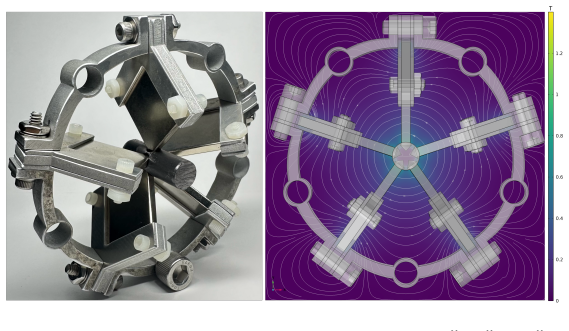
ICESPICE, built on the mini-orange spectrometer concept with commercially available permanent magnets in toroidal configurations, transports internal conversion electrons to room-temperature PIPS detectors while suppressing background; commissioning with a 207Bi source and first in-beam tests in the 208Pb(d,t)207Pb reaction produced observable gamma-electron correlations and prompt particle-electron coincidences, demonstrating its suitability for low-energy nuclear structure experiments at the FSU SE-SPS.
What carries the argument
Toroidal arrangements of permanent magnets that focus internal conversion electrons onto PIPS detectors while rejecting undesired particles and background.
If this is right
- The system supports coincidence measurements between tritons detected in the SE-SPS and electrons in the PIPS detectors.
- Gamma-electron correlations with the CeBrA array were recorded for the first time with this setup.
- The design is optimized via SolidWorks, COMSOL, and Geant4 modeling for electrons near 1 MeV.
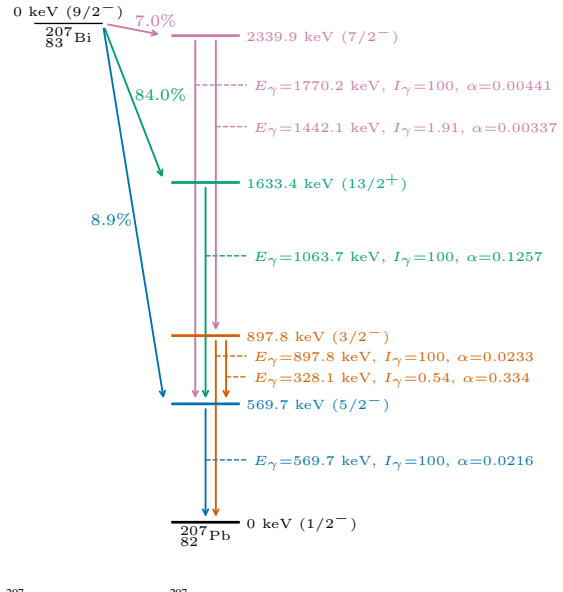
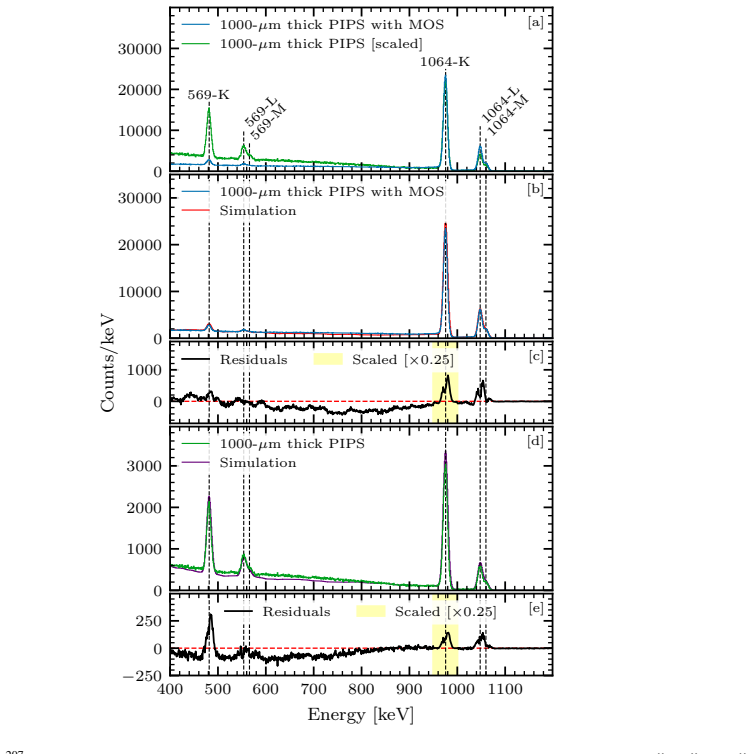
- Multiple spectrometer-detector configurations were validated with the 207Bi source.
Where Pith is reading between the lines
- This approach could allow conversion electron data to be collected in reactions where gamma-ray detection alone suffers from high background.
- Routine use at the SE-SPS may enable new measurements of internal conversion coefficients in nuclei populated by light-ion transfer reactions.
Load-bearing premise
The observed prompt coincidences arise from the spectrometer's magnetic transmission and background rejection rather than from detector artifacts or unquantified backgrounds.
What would settle it
A control measurement in the same reaction with the magnets removed or demagnetized that still shows the same prompt electron-triton coincidences would falsify the performance attribution.
Figures






read the original abstract
The Internal Conversion Electron SPectrometer In Coincidence Experiments (ICESPICE) demonstrator has been developed at Florida State University to enable particle/gamma-electron coincidence measurements in low-energy nuclear structure studies. ICESPICE is based on the mini-orange spectrometer concept and features a modular design using commercially available permanent magnets arranged in toroidal configurations to transport internal conversion electrons to room-temperature PIPS detectors while suppressing background from undesired particles. The system was optimized through SolidWorks modeling, COMSOL magnetic field simulations, and Geant4 particle tracking to maximize the magnetic transmission probability for electrons around 1 MeV. Commissioning tests using a calibrated 207Bi source demonstrated the performance of multiple spectrometer-detector configurations. Coincidence measurements between CeBr3 detectors from the CeBrA array and PIPS detectors revealed clear gamma-electron correlations. The first in-beam particle-electron measurements using ICESPICE were performed with the Super-Enge Split-Pole Spectrograph (SE-SPS) in the 208Pb(d,t)207Pb reaction. Prompt coincidences between tritons detected with the SE-SPS and electrons detected with ICESPICE were observed. The presented results show that ICESPICE is a promising ancillary detector system for in-beam internal conversion electron spectroscopy at the FSU SE-SPS.
Editorial analysis
A structured set of objections, weighed in public.
Referee Report
Summary. The manuscript describes the design, simulation-based optimization, and initial experimental commissioning of the ICESPICE mini-orange spectrometer demonstrator for internal conversion electron detection in particle/gamma-electron coincidence experiments. It details a modular toroidal magnet arrangement using commercial permanent magnets, Geant4 tracking for ~1 MeV electrons, commissioning with a 207Bi source, gamma-electron correlations with CeBr3 detectors, and first in-beam results showing prompt triton-electron coincidences in the 208Pb(d,t)207Pb reaction at the FSU SE-SPS. The central conclusion is that ICESPICE is a promising ancillary detector system for in-beam internal conversion electron spectroscopy.
Significance. If the reported coincidence signals are attributable to the spectrometer's transmission and background suppression, this work provides a practical, accessible modular system that could expand nuclear structure capabilities at facilities like the SE-SPS by enabling electron spectroscopy in coincidence with charged particles and gammas. The combination of SolidWorks/COMSOL/Geant4 optimization and use of room-temperature PIPS detectors is a strength for reproducibility. However, the absence of tabulated quantitative metrics (transmission probabilities, energy resolution, background rejection) limits direct comparison to existing mini-orange systems and weakens the ability to gauge the degree of promise.
major comments (1)
- Abstract and in-beam results section: The claim that prompt coincidences demonstrate the spectrometer's performance is load-bearing for the 'promising ancillary system' conclusion, yet no numerical values are provided for magnetic transmission probability, electron detection efficiency, energy resolution, or background suppression factors. Without these, it remains unclear whether the observed triton-electron and gamma-electron correlations arise from the optimized toroidal transport or from unquantified backgrounds/detector artifacts, as noted in the commissioning and reaction data descriptions.
minor comments (2)
- The manuscript would benefit from a dedicated table or figure panel summarizing key commissioning metrics (e.g., detected electron energies from 207Bi, coincidence rates, and any estimated efficiencies) to make the performance assessment more quantitative and self-contained.
- Notation for detector configurations (e.g., multiple spectrometer-detector setups) could be clarified with a short table or diagram legend for easier reference across the commissioning and in-beam sections.
Simulated Author's Rebuttal
We thank the referee for the constructive review and recommendation of minor revision. We address the major comment below and have prepared revisions to strengthen the quantitative support for our claims.
read point-by-point responses
-
Referee: Abstract and in-beam results section: The claim that prompt coincidences demonstrate the spectrometer's performance is load-bearing for the 'promising ancillary system' conclusion, yet no numerical values are provided for magnetic transmission probability, electron detection efficiency, energy resolution, or background suppression factors. Without these, it remains unclear whether the observed triton-electron and gamma-electron correlations arise from the optimized toroidal transport or from unquantified backgrounds/detector artifacts, as noted in the commissioning and reaction data descriptions.
Authors: We agree with the referee that the absence of explicit numerical values in the abstract and in-beam results section limits the ability to directly assess performance and compare with other systems. The manuscript describes the SolidWorks/COMSOL/Geant4 optimization process and reports the observation of prompt coincidences, but does not tabulate the requested metrics in those locations. In the revised version we will add the simulated magnetic transmission probability for ~1 MeV electrons, the energy resolution measured with the 207Bi source, and quantitative details on coincidence timing and rates from the commissioning and in-beam data. These additions will clarify that the observed prompt triton-electron and gamma-electron correlations are consistent with the expected internal-conversion electrons transported by the toroidal field rather than random or artifactual backgrounds. The prompt timing constraint inherent to the SE-SPS coincidence setup provides additional evidence against uncorrelated events. revision: yes
Circularity Check
No significant circularity; self-contained instrumentation report
full rationale
The manuscript is a hardware development and commissioning paper describing the ICESPICE mini-orange spectrometer. It reports SolidWorks/COMSOL/Geant4 optimization of a modular permanent-magnet design, 207Bi source tests, CeBr3-PIPS gamma-electron correlations, and first in-beam triton-electron coincidences in 208Pb(d,t)207Pb. No derivations, fitted parameters, or predictions appear; all claims rest on direct simulation outputs and raw coincidence observations. No self-citations are invoked as load-bearing uniqueness theorems or ansatzes. The central claim of 'promising ancillary system' follows immediately from the presented design and qualitative signals without reduction to prior inputs by construction.
Axiom & Free-Parameter Ledger
Reference graph
Works this paper leans on
-
[1]
K. S. Krane,Introductory Nuclear Physics(Wiley, New York, NY , 1988)
work page 1988
-
[2]
T. Kibédi and R. Spear, Atomic Data and Nuclear Data Tables89, 77 (2005)
work page 2005
-
[3]
L. Evitts, A. Garnsworthy, T. Kibédi, J. Smallcombe, M. Reed, B. Brown, A. Stuchbery, G. Lane, T. Eriksen, A. Akber, B. Alshahrani, M. de Vries, M. Gerathy, J. Holt, B. Lee, B. McCormick, A. Mitchell, M. Moukaddam, S. Mukhopadhyay, N. Palalani, T. Palazzo, E. Peters, A. Ramirez, S. Stroberg, T. Tornyi, and S. Yates, Physics Letters B779, 396 (2018)
work page 2018
- [4]
-
[5]
P. E. Garrett, M. Zieli ´nska, and E. Clément, Progress in Particle and Nuclear Physics124, 103931 (2022)
work page 2022
-
[6]
J. Smallcombe, A. B. Garnsworthy, W. Korten, P. Singh, D. Muir, L. Próchniak, F. A. Ali, C. Andreoiu, S. Ansari, G. C. Ball, C. J. Barton, S. S. Bhattacharjee, M. Bowry, A. D. Briscoe, R. Caballero-Folch, A. Chester, S. A. Gillespie, G. F. Grinyer, G. Hackman, J. Heery, C. Jones, B. Melon, M. Moukaddam, A. Nannini, P. Ruot- salainen, K. Starosta, C. E. Sv...
work page 2024
-
[7]
N. Marchini, A. Nannini, M. Rocchini, T. Rodríguez, M. Ottanelli, N. Gelli, A. Perego, G. Benzoni, N. Blasi, G. Bocchi, D. Brugnara, A. Buccola, G. Carozzi, A. Goasduff, E. Gregor, P. John, M. Komorowska, D. Mengoni, F. Recchia, S. Riccetto, D. Rosso, A. Saltarelli, M. Siciliano, J. Valiente-Dobón, and I. Zanon, Physics Letters B844, 138067 (2023). 13 □40...
work page 2023
-
[8]
J. Smallcombe, A. B. Garnsworthy, W. Korten, P. Singh, F. A. Ali, C. Andreoiu, S. Ansari, G. C. Ball, C. J. Bar- ton, S. S. Bhattacharjee, M. Bowry, R. Caballero-Folch, A. Chester, S. A. Gillespie, G. F. Grinyer, G. Hackman, C. Jones, B. Melon, M. Moukaddam, A. Nannini, P. Ruotsalainen, K. Starosta, C. E. Svensson, R. Wadsworth, and J. Williams, Phys. Rev...
work page 2022
-
[9]
C. M. Witcher, Phys. Rev.60, 32 (1941)
work page 1941
-
[10]
Mladjenovi ´c, Nuclear Instruments and Methods7, 11 (1960)
M. Mladjenovi ´c, Nuclear Instruments and Methods7, 11 (1960)
work page 1960
-
[11]
J. Van Klinken and K. Wisshak, Nuclear Instruments and Methods98, 1 (1972)
work page 1972
-
[12]
K. Lee, C. Dulal, W. Tan, A. Gyurjinyan, E. Sauer, S. Lesher, and A. Aprahamian, Nuclear Instruments and Methods in Physics Research Section A: Accelerators, Spectrometers, Detectors and Associated Equipment 1052, 168288
-
[13]
N. Marchini, A. Nannini, M. Ottanelli, A. Saltarelli, M. Rocchini, G. Benzoni, E. R. Gamba, A. Goasduff, A. Gottardo, T. Krings, and M. Perri, Nuclear Instruments and Methods in Physics Research Section A: Accel- erators, Spectrometers, Detectors and Associated Equipment1020, 165860
-
[14]
S. Ketelhut, L. J. Evitts, A. B. Garnsworthy, C. Bolton, G. C. Ball, R. Churchman, R. Dunlop, G. Hackman, R. Henderson, M. Moukaddam, E. T. Rand, C. E. Svensson, and J. Witmer, Nuclear Instruments and Methods in Physics Research Section A: Accelerators, Spectrometers, Detectors and Associated Equipment753, 154
-
[15]
M.-C. Spieker and S. Almaraz-Calderon, Frontiers in PhysicsV olume 12 - 2024(2024), 10.3389/fphy.2024.1511394
-
[16]
A. L. Conley, B. Kelly, M. Spieker, R. Aggarwal, S. Ajayi, L. T. Baby, S. Baker, C. Benetti, I. Conroy, P. D. Cottle, I. B. D’Amato, P. DeRosa, J. Esparza, S. Genty, K. Hanselman, I. Hay, M. Heinze, D. Houlihan, M. I. Khawaja, P. S. Kielb, A. N. Kuchera, G. W. McCann, A. B. Morelock, E. Lopez-Saavedra, R. Renom, L. A. Riley, G. Ryan, A. Sandrik, V . Sitar...
-
[17]
Dassault Systèmes, SolidWorkshttp://www.solidworks.com
-
[18]
COMSOL Multphysics ® v. 6.0http://www.comsol.com. COMSOL AB, Stockholm, Sweden. 14 0.0 0.5 1.0 1.5 2.0 TM (E) [%] (a) PIPS 1 mm 25 mm 2 50 mm 2 150 mm 2 300 mm 2 450 mm 2 600 mm 2 900 mm 2 1200 mm 2 Si(Li) 2 mm 200 mm 2 500 mm 2 Si(Li) 5 mm 200 mm 2 500 mm 2 500 1000 1500 Energy [keV] 0.0 0.2 0.4 0.6 0.8 1.0 TF ED(E) [%] (b) Figure 14: Geant4 simulations ...
-
[19]
J. Allison, K. Amako, J. Apostolakis, P. Arce, M. Asai, T. Aso, E. Bagli, A. Bagulya, S. Banerjee, G. Barrand, B. Beck, A. Bogdanov, D. Brandt, J. Brown, H. Burkhardt, P. Canal, D. Cano-Ott, S. Chauvie, K. Cho, G. Cir- rone, G. Cooperman, M. Cortés-Giraldo, G. Cosmo, G. Cuttone, G. Depaola, L. Desorgher, X. Dong, A. Dotti, V . Elvira, G. Folger, Z. Franci...
work page 2016
-
[20]
J. Allison, K. Amako, J. Apostolakis, H. Araujo, P. Arce Dubois, M. Asai, G. Barrand, R. Capra, S. Chauvie, R. Chytracek, G. Cirrone, G. Cooperman, G. Cosmo, G. Cuttone, G. Daquino, M. Donszelmann, M. Dres- 15 sel, G. Folger, F. Foppiano, J. Generowicz, V . Grichine, S. Guatelli, P. Gumplinger, A. Heikkinen, I. Hriv- nacova, A. Howard, S. Incerti, V . Iva...
work page 2006
-
[21]
S. Agostinelli, J. Allison, K. Amako, J. Apostolakis, H. Araujo, P. Arce, M. Asai, D. Axen, S. Banerjee, G. Bar- rand, F. Behner, L. Bellagamba, J. Boudreau, L. Broglia, A. Brunengo, H. Burkhardt, S. Chauvie, J. Chuma, R. Chytracek, G. Cooperman, G. Cosmo, P. Degtyarenko, A. Dell’Acqua, G. Depaola, D. Dietrich, R. Enami, A. Feliciello, C. Ferguson, H. Fes...
work page 2003
-
[22]
Mirion, PIPS Detectors Passivated Implanted Planar Silicon Detectors,https://www.mirion.com/ products/technologies/spectroscopy-scientific-analysis/research-education-and- industrial-solutions/passivated-implanted-planar-silicon-pips-detectors/standard- pips-detectors/pips-detectors-passivated-implanted-planar-silicon-detectors(2025)
work page 2025
- [23]
- [24]
-
[25]
M. P. Metlay, J. X. Saladin, I. Y . Lee, and O. Dietzsch, Nuclear Instruments and Methods in Physics Research Section A: Accelerators, Spectrometers, Detectors and Associated Equipment336, 162
-
[26]
Electron Energy Corporation,https://www.electronenergy.com/
-
[27]
Y . Zheng, X.-G. Wu, G.-S. Li, C.-B. Li, C.-Y . He, Q.-M. Chen, J. Zhong, W.-K. Zhou, L.-T. Deng, and B.-J. Zhu, Chinese Physics C40, 086002 (2016)
work page 2016
-
[28]
Applied Magnets, Rare Earth Magnets 1 in x 1 in x 1/8 in Neodymium Block N42,https: //appliedmagnets.com/rare-earth-magnets-1-in-x-1-in-x-1-8-in-neodymium-block- n42/?srsltid=AfmBOop4FQKskFNrFp2KxhCcXCQvVb3VFUZ0Al_FkDoUoOCEXnEIOy13QOs(2025)
work page 2025
-
[29]
C. M. Poole, I. Cornelius, J. V . Trapp, and C. M. Langton, Australasian Physical & Engineering Science in Medicine (2012), 10.1007/s13246-012-0159-8
- [30]
-
[31]
J. Hoogduin, E. Ditzel, A. Balanda, F. de Boer, H. Bokemeyer, J. Gerl, K. Heyde, J. van Klinken, A. Kraszna- horkay, P. Salabura, and H. Wollersheim, Physics Letters B384, 43 (1996). 16
work page 1996
-
[32]
M. Spieker, D. Bucurescu, J. Endres, T. Faestermann, R. Hertenberger, S. Pascu, S. Skalacki, S. Weber, H.-F. Wirth, N.-V . Zamfir, and A. Zilges, Phys. Rev. C88, 041303 (2013)
work page 2013
- [33]
-
[34]
Mirion, 2003BT™Silicon Detector Preamplifier,https://www.mirion.com/products/technologies/ spectroscopy-scientific-analysis/research-education-and-industrial-solutions/ passivated-implanted-planar-silicon-pips-detectors/standard-pips-detectors/2003bt- silicon-detector-preamplifier(2025)
work page 2025
-
[35]
mesytec, MPR-1,https://www.mesytec.com/products/nuclear-physics/MPR-1.html(2025)
work page 2025
-
[36]
CAEN S.p.A., V1725/V1725S 16/8 Channel 14-bit 250 MS/s Digitizer,https://www.caen.it(2023)
work page 2023
-
[37]
G. Muehllehner, A. S. Poltorak, W. C. Parkinson, and R. H. Bassel,159, 1039, publisher: American Physical Society
-
[38]
ENSDF, NNDC Online Data Service, ENSDF database,http://www.nndc.bnl.gov/ensdf/(2023)
work page 2023
-
[39]
Mirion, Silicon Lithium SiLi,https://www.mirion.com/products/technologies/spectroscopy- scientific-analysis/gamma-spectroscopy/detectors/sili-detectors-x-ray/silicon- lithium-sili-detectors-for-charged-particles(2025). 17
work page 2025
discussion (0)
Sign in with ORCID, Apple, or X to comment. Anyone can read and Pith papers without signing in.