Recognition: 1 theorem link
· Lean TheoremNano-Clay-Stabilized Water-in-Oil Colloidal Pickering Emulsions as Thixotropic Lubricant
Pith reviewed 2026-05-13 01:10 UTC · model grok-4.3
The pith
Nano-clay stabilized water-in-oil emulsions reduce friction by up to 84 percent and wear by up to 96 percent compared to oil and water.
A machine-rendered reading of the paper's core claim, the machinery that carries it, and where it could break.
Core claim
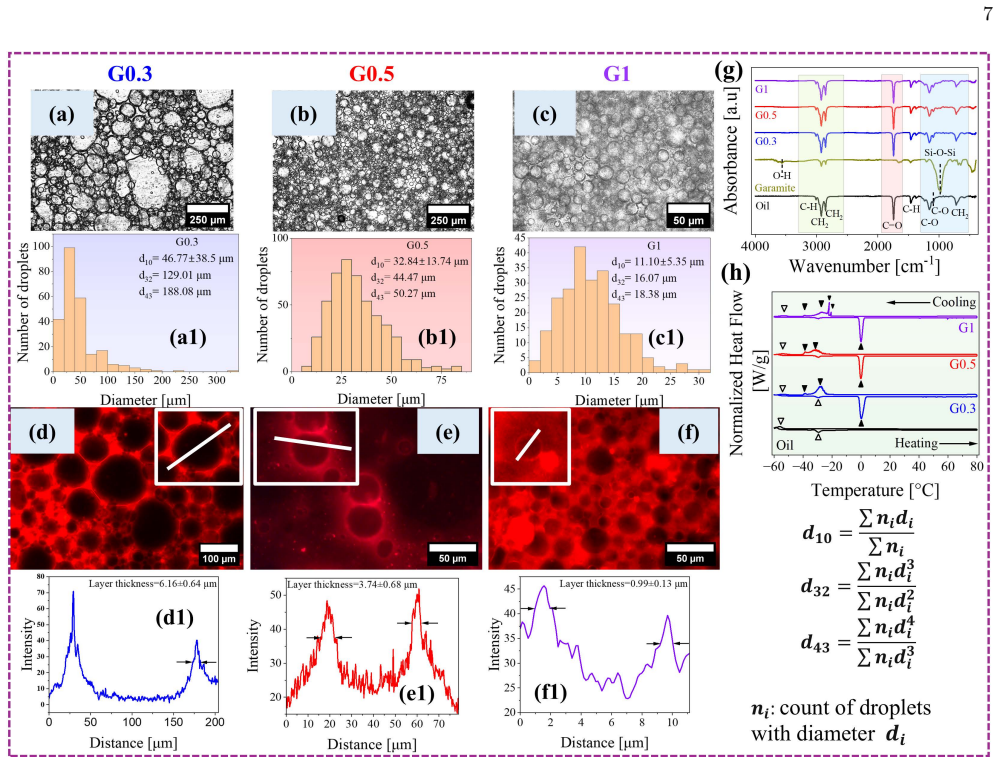
The emulsion with the optimal nano-clay concentration demonstrates approximately 41% and 84% lower friction and approximately 80% and 96% lower wear than oil and water, respectively. This superior performance is attributed to the combined effects of thixotropy, anisotropic nanoclay morphology, and stable droplet armoring, which form a robust and adaptive interfacial film.
What carries the argument
The reversible clay-droplet network in the thixotropic Pickering emulsion that creates a robust and adaptive interfacial film through droplet armoring and anisotropic particle effects.
If this is right
- The emulsions exhibit sensitivity to sliding direction, suggesting potential for anisotropic lubrication control.
- Friction shows load-responsive behavior with a memory effect arising from reversible network restructuring.
- Direct correlation of microstructure and rheology with tribological results guides the design of tailored lubricants.
- Plant-based Pickering emulsions provide an eco-conscious alternative to mineral-oil lubricants for metallic contacts.
Where Pith is reading between the lines
- The memory effect could be leveraged in machinery with cyclic or varying loads to maintain consistent film strength.
- Tuning clay concentration or droplet size might optimize performance for specific contact pressures or speeds.
- The armoring mechanism may offer secondary benefits such as improved surface protection beyond wear reduction.
Load-bearing premise
The observed friction and wear reductions arise primarily from the thixotropic microstructure and clay-droplet network rather than from unstated differences in test conditions, surface preparation, or secondary chemical effects.
What would settle it
Repeating the tribological tests after pre-shearing the emulsion to destroy its thixotropic structure and finding that the friction and wear advantages disappear would falsify the central role of the reversible network.
Figures




read the original abstract
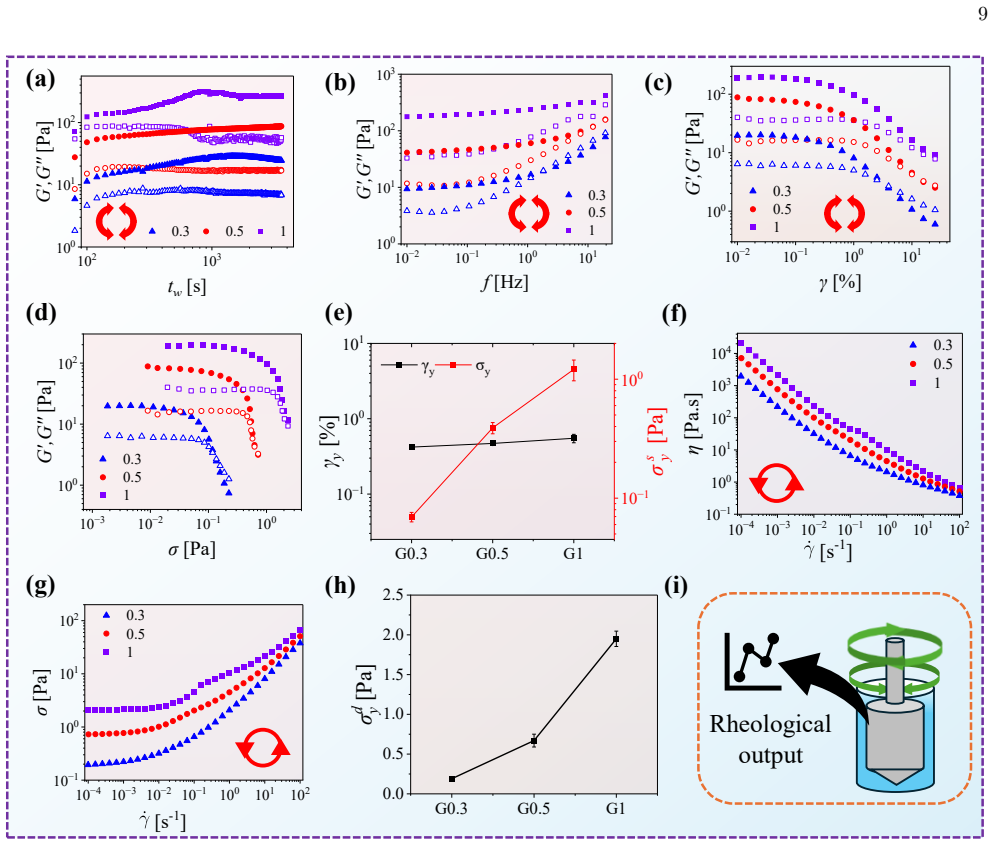
The limitations of conventional mineral oil-based lubricants motivate the development of environmentally benign emulsions capable of providing lubrication and heat dissipation in demanding applications. In this study, nano-organoclay (Garamite 1958)-stabilized thixotropic water-in-oil Pickering emulsions are developed using sunflower oil as the base. The rheological and tribological properties of the emulsion system are systematically examined. Rheological findings reveal a pronounced increase in yield stress, shear thinning and thixotropic behavior on increasing Garamite loading percentage in the emulsion. The tribological performance is assessed against dry, water, and oil-lubricated conditions for a steel-steel interface under high contact pressure. The findings indicate that the tribological performance is significantly influenced by the microstructure and thixotropic behavior of the emulsions. The emulsion with the optimal nano-clay concentration demonstrates approximately 41\% and 84\% lower friction and approximately 80\% and 96\% lower wear than oil and water, respectively. The emulsion exhibits sensitivity to the sliding direction and displays load-responsive friction behavior with a memory effect owing to the reversible structuring of the clay-droplet network. This superior performance is attributed to the combined effects of thixotropy, anisotropic nanoclay morphology, and stable droplet armoring, which form a robust and adaptive interfacial film. This study advances the understanding of Pickering emulsions in metallic tribosystems by correlating the microstructure and rheology with tribological performance, thereby facilitating the design of high-performance, smart, and eco-conscious lubricants for metallic systems.
Editorial analysis
A structured set of objections, weighed in public.
Referee Report
Summary. The paper develops nano-organoclay (Garamite 1958)-stabilized water-in-oil Pickering emulsions in sunflower oil and characterizes their rheological and tribological properties. Rheology shows increased yield stress, shear thinning, and thixotropy with higher clay loading. Tribological tests on steel-steel contacts under high pressure report that the optimal formulation yields ~41% and ~84% lower friction and ~80% and ~96% lower wear than oil and water, respectively, with direction sensitivity and load-responsive memory effect. These are attributed to thixotropy, anisotropic morphology, and droplet armoring forming an adaptive film.
Significance. If the results hold, this is a significant contribution to soft-matter lubrication. It demonstrates an environmentally benign emulsion lubricant that substantially outperforms oil and water in friction and wear reduction while exhibiting adaptive, thixotropic behavior. The experimental correlation of microstructure, rheology (including yield stress and thixotropic loops), and tribology (with repeat measurements, error bars, and control comparisons) provides a useful template for designing smart lubricants. The stress-test concern that performance gains may stem from unstated test differences rather than thixotropy and armoring does not land, as the manuscript includes direct comparisons and controls addressing viscosity and chemistry alternatives.
minor comments (3)
- Abstract: The central performance claims are given as approximate percentages without error bars, replicate counts, or statistical tests. Although the full text supplies these in the tribological results section, the abstract should briefly indicate variability to strengthen immediate credibility of the reported reductions.
- The manuscript would benefit from explicit statement of the optimal Garamite concentration (e.g., in the abstract or results summary) rather than referring to it only as 'optimal'.
- Figure captions and legends for rheological and tribological data could more clearly distinguish the different clay loadings and control conditions to improve readability.
Simulated Author's Rebuttal
We thank the referee for the positive and constructive review of our manuscript. The assessment correctly identifies the key contributions of the nano-organoclay-stabilized Pickering emulsions in achieving substantial friction and wear reductions through thixotropic and microstructural effects. We appreciate the recommendation for minor revision and are prepared to incorporate any editorial suggestions. No specific major comments were listed in the report.
Circularity Check
No circularity; purely experimental study with no derivations
full rationale
The manuscript reports synthesis of Pickering emulsions, rheological measurements (yield stress, shear thinning, thixotropy), and tribological tests (friction, wear under specified loads/speeds) with direct comparisons to controls. No equations, fitted parameters, predictions, or self-citations are invoked as load-bearing steps in any derivation chain. All performance claims rest on experimental data and microstructural observations, rendering the work self-contained.
Axiom & Free-Parameter Ledger
axioms (2)
- domain assumption Nano-organoclay particles adsorb at the oil-water interface and stabilize droplets against coalescence (Pickering mechanism).
- domain assumption Thixotropic restructuring of the clay-droplet network produces reversible yield stress and shear-thinning behavior.
Lean theorems connected to this paper
-
IndisputableMonolith/Cost/FunctionalEquationwashburn_uniqueness_aczel unclear?
unclearRelation between the paper passage and the cited Recognition theorem.
The rheological findings reveal a pronounced increase in yield stress, shear thinning and thixotropic behavior... attributed to the combined effects of thixotropy, anisotropic nanoclay morphology, and stable droplet armoring
What do these tags mean?
- matches
- The paper's claim is directly supported by a theorem in the formal canon.
- supports
- The theorem supports part of the paper's argument, but the paper may add assumptions or extra steps.
- extends
- The paper goes beyond the formal theorem; the theorem is a base layer rather than the whole result.
- uses
- The paper appears to rely on the theorem as machinery.
- contradicts
- The paper's claim conflicts with a theorem or certificate in the canon.
- unclear
- Pith found a possible connection, but the passage is too broad, indirect, or ambiguous to say the theorem truly supports the claim.
Reference graph
Works this paper leans on
-
[1]
Nanoclay characterization Figure 1aschematically illustrates the emulsion preparation process (details in section IVB). Water droplets in the emulsion were co-stabilized by the plateletandrod-likemorphologyofthenanoclay(chem- ical structure of nanoclay shown in Figure S1: support- ing information (SI)), consistent with similar systems [37]. The residual G...
-
[2]
The Garamite content in these emulsions was 0.5 wt.%
Emulsion stability Following nanoclay characterization, a set of five emulsions (W8O2, W7O3, W6O4, W5O5, and W4O6) with the corresponding water–oil weight ratios (4:1, 7:3, 3:2, 1:1, and 2:3), as detailed in section IVB, was sys- tematically designed to evaluate formulation-dependent stability for long-term storage. The Garamite content in these emulsions...
-
[3]
Emulsion characterization The optical micrographs and droplet size distribu- tions inFigure 3illustrate the structural evolution of W6O4 emulsions. A clear transition from a coarse, polydisperse system in G0.3 to a fine and uniform dis- persion in G1 is evident. In the G0.3 system (Figure 3a), large non-spherical droplets dominate the morphol- ogy, with s...
-
[4]
Droplet morphology after wear Figure 8presents optical micrographs of the Picker- ing emulsions following tribological testing. In the G0.3 system (Figure 8a), the morphology is dominated by severe coalescence, forming massive, irregular droplets exceeding 500µm (d43 = 373.85µm, Figure 8a1). This drastic increase from the fresh state confirms that the wea...
-
[5]
Under dry (Figure 9a) and water lubrication (Figure 9b), the surfaces exhibited severe damage
Worn Surface Analysis Figure 9shows SEM micrographs and energy- dispersive X-ray spectroscopy (EDS) elemental maps of the worn surfaces. Under dry (Figure 9a) and water lubrication (Figure 9b), the surfaces exhibited severe damage. Dry sliding resulted in severe adhesive wear with layered delamination and deep cracks. Water lu- brication produced massive ...
-
[6]
Lubrication Mechanism Based on the friction and wear analyses, a lubrica- tion mechanism for the nanoclay-stabilized Pickering emulsion is proposed (Figure 10). The superior tribo- logical performance arises from the combined effects of thixotropy, anisotropic nanoclay morphology, and the strong armoring of water droplets. These effects to- gether form a ...
-
[7]
Increasing Garamite content significantly en- hanced thixotropy, with higher dynamic moduli (G′,G ′′) and pronounced shear-thinning behav- ior, attributed to the formation of a strength- enedexcessparticlebridgednetworkaroundwater droplets in the continuous oil phase
-
[8]
The G0.5 emulsion showed the best tribological performance, with≈41% and≈84% reduction in CoF, and≈80% and≈96% reduction in SWR, compared to oil and water, respectively
-
[9]
The emulsion exhibited lubrication performance 15 Figure 8. Optical micrographs and corresponding droplet size distribution histograms of emulsions after tribological testing: (a–a2) G0.3 and (b–b2) G0.5, where a2 and b2 show higher-magnification views of representative droplets; (c, c1) G1. (d) Schematic illustration of rupture of coalesced droplet and s...
-
[10]
The superior performance originated from the synergistic interplay of thixotropy, anisotropic nanoclay morphology, and stable droplet armor- ing, which together formed a robust, adaptive multiphase interfacial film. Overall, the tribological behavior was governed by both the rheology and hierarchical microstructure of the nanoclay, arising from its platel...
work page 1958
-
[11]
M. K. Singh, inTribology and Sustainability, Vol. 1, edited by J. K. Katiyar, M. Irfan Ul Haq, A. Raina, S. Jayalakshmi, and R. A. Singh (CRC Press, Boca Raton and Oxon, 2022) 1st ed., Chap. 20, pp. 397–412
work page 2022
-
[12]
M. K. Singh, P. Ilg, R. M. Espinosa-Marzal, M. Kröger, and N. D. Spencer, Langmuir31, 4798 (2015)
work page 2015
-
[13]
S. Chen, J. Wang, H. Lu, and L. Xu, ACS Sustainable Chemistry and Engineering10, 10816 (2022)
work page 2022
-
[14]
Y. Bao, K. Liu, Q. Zheng, L. Yao, and Y. Xu, Journal of Tribology144(2022), 10.1115/1.4052480
-
[15]
H. Liu, X. Wang, T. Yang, S. Chen, S. Yang, and X. Zhang, Colloids and Surfaces A: Physicochemical and Engineering Aspects695, 134206 (2024)
work page 2024
-
[16]
L. Du, S. Zhou, Y. Huang, and Z. Meng, Food Chem- istry465, 142121 (2025)
work page 2025
-
[17]
T. Feng, Q. Ding, K. Zhu, Y. Wang, Q. Zhao, F. Yang, X. Wang, S. Xia, and Q. Huang, Journal of the Science of Food and Agriculture105, 8048 (2025)
work page 2025
- [18]
-
[19]
Z. Lu, S. Zhou, F. Ye, G. Zhou, R. Gao, D. Qin, and G. Zhao, Food Chemistry353, 129418 (2021)
work page 2021
-
[20]
Z. Guo, F. Wu, C. Guo, R. Hu, Y. Ou, Y. Zhu, S. Luo, Y. Song, P. He, C. He, Y. Xu, X. Tang, M. Qin, H. Wang, G. Du, and X. Sun, Advanced Materials37, 2412627 (2025)
work page 2025
-
[21]
X. Dai, J. Zhang, X. Bao, Y. Guo, Y. Jin, C. Yang, H. Zhang, L. Liu, Y. Gao, C. Ye, W. Wu, C. Liu, C. X. Zhao, J. Sheng, E. Ren, H. Li, W. Fang, B. Wu, J. Ruan, Z. Gu, D. Chen, and P. Zhao, Advanced Ma- terials35, 2303542 (2023)
work page 2023
-
[22]
X. Xia, Y. Li, R. Huang, Y. Wang, W. Xiong, H. Zhou, M. Li, X. Lin, Y. Tang, and B. Zhang, Advanced Sci- ence12, 2410873 (2025)
work page 2025
-
[23]
Y. Zhang, C. Li, R. Carland, Z. Ye, S. E. Bell, and Y. Xu, Advanced Science12(2025), 10.1002/advs.202505714. 20
-
[24]
X. Guan, Y. Ming, Y. Zhou, C. C. Chio, H. Jiang, L. Li, Y. L. S. Tse, Y. Xia, and T. Ngai, Journal of Colloid and Interface Science702, 138790 (2026)
work page 2026
-
[25]
Y. Yao, J. Feng, N. Ao, Y. Zhang, J. Zhang, Y. Wang, C. Liu, M. Wang, and C. Yu, Journal of Colloid and Interface Science678, 1158 (2025)
work page 2025
-
[26]
W. Yu, Z. Ji, Y. Lyu, X. Sui, J. Hao, and L. Xu, Materials Horizons11, 3298 (2024)
work page 2024
-
[27]
B. Wu, C. Yang, Q. Xin, L. Kong, M. Eggersdorfer, J. Ruan, P. Zhao, J. Shan, K. Liu, D. Chen, D. A. Weitz, and X. Gao, Advanced Materials33, 2102362 (2021)
work page 2021
- [28]
-
[29]
Q. Wu, Z. Yuan, Y. Fang, L. Wu, Z. Bo, C. Peng, and B. Wu, Colloids and Surfaces B: Biointerfaces240, 113993 (2024)
work page 2024
- [30]
-
[31]
Y. Wu, X. Zeng, T. Ren, E. de Vries, and E. van der Heide, Tribology International105, 304 (2017)
work page 2017
-
[32]
H. Yang, L. Zhao, S. Xue, Z. Deng, J. Li, and X. Zeng, Colloids and Surfaces A: Physicochemical and Engi- neering Aspects579, 123703 (2019)
work page 2019
-
[33]
Y. Y. Xu, C. Song, L. Fan, and Z. L. Cheng, New Journal of Chemistry49, 4320 (2025)
work page 2025
- [34]
- [35]
-
[36]
H. Li, X. Sui, P. Ayala, E. Marquis, H. Rabl, A. Ertl, P. Bilotto, Y. Shang, J. Li, L. Xu, M. C. Righi, D. Eder, and C. Gachot, Advanced Science12, 2415268 (2025)
work page 2025
- [37]
-
[38]
K. S. Silmore, C. Gupta, and N. R. Washburn, Journal of Colloid and Interface Science466, 91 (2016)
work page 2016
-
[39]
K. M. You, B. S. Murray, and A. Sarkar, Food Hydro- colloids134, 108009 (2023)
work page 2023
-
[40]
P. Bertsch, P. Frøslev, J. Currie, F. Carrière, A. Müllertz, and H. M. Nielsen, Journal of Colloid and Interface Science700, 138363 (2025)
work page 2025
- [41]
-
[42]
N. Zhao, C. Zhou, W. Liu, F. Hao, M. Han, Z. Pan, J. Yuan, and M. Pan, Journal of Colloid and Interface Science697, 138001 (2025)
work page 2025
- [43]
- [44]
-
[45]
I. C. Assunção Dorigon, M. E. Araújo Pessoa, J. C. Queiroz Neto, D. V. Andrade Silva, J. E. Soares Filho, and F. D. Silva Curbelo, Applied Clay Science270, 107780 (2025)
work page 2025
-
[46]
Y. Kang, Y. Zan, Y. Cong, X. Wang, Y. Luo, and L. Li, Colloids and Surfaces A: Physicochemical and Engineering Aspects686, 133337 (2024)
work page 2024
-
[47]
T. Lu, H. Gou, H. Rao, and G. Zhao, Journal of Envi- ronmental Chemical Engineering9, 105941 (2021)
work page 2021
-
[48]
L. Lisuzzo, G. Cavallaro, S. Milioto, and G. Lazzara, Advanced Materials Interfaces9, 2102346 (2022)
work page 2022
-
[49]
L. Liu, X. Pu, H. Tao, K. Chen, W. Guo, D. Luo, and Z. Ren, Colloids and Surfaces A: Physicochemical and Engineering Aspects610, 125694 (2021)
work page 2021
-
[50]
A. Luo, L. Yu, X. Wang, and P. Yu, Geoenergy Science and Engineering244, 213418 (2025)
work page 2025
- [51]
-
[52]
L. Yu, S. Li, L. P. Stubbs, and H. C. Lau, Applied Clay Science213, 106246 (2021)
work page 2021
- [53]
-
[54]
P. J. Schubel, M. S. Johnson, N. A. Warrior, and C. D. Rudd, Composites Part A: Applied Science and Manu- facturing37, 1757 (2006)
work page 2006
-
[55]
R. Sarathi, R. K. Sahu, and P. Rajeshkumar, Materials Science and Engineering: A445-446, 567 (2007)
work page 2007
-
[56]
A. S. Rana, M. K. Vamshi, K. Naresh, R. Velmurugan, and R. Sarathi, Advances in Materials and Processing Technologies7, 109 (2021)
work page 2021
-
[57]
M. W. Ho, C. K. Lam, K. t. Lau, D. H. Ng, and D. Hui, Composite Structures75, 415 (2006)
work page 2006
-
[58]
H. Y. Liu, Y. H. Huang, J. Y. Lai, and T. S. Chung, Journal of Membrane Science737, 124778 (2026)
work page 2026
- [59]
-
[60]
Maity, A.Dutta, andR.K.Das,Langmuir 41, 13301 (2025)
P.Panda, P. Maity, A.Dutta, andR.K.Das,Langmuir 41, 13301 (2025)
work page 2025
- [61]
-
[62]
S. Kong, X. Ma, S. Zhen, Y. Liu, F. Sun, and N. Yang, International Journal of Biological Macro- molecules296, 139650 (2025)
work page 2025
-
[63]
E. L. Thompson, T. W. Capehart, and T. J. Fuller, J. Phys.: Condens. Matter13, 95 (2001)
work page 2001
-
[64]
K. Morishige and K. Kawano, Journal of Chemical Physics110, 4867 (1999)
work page 1999
-
[65]
Y. M. Joshi, Annual Review of Chemical and Biomolec- ular Engineering5, 181 (2014)
work page 2014
-
[66]
Y. M. Joshi, Soft Matter11, 3198 (2015)
work page 2015
-
[67]
B.C.Munro, S.B.Hall, andC.P.Whitby,Colloidsand Surfaces A: Physicochemical and Engineering Aspects 637, 128237 (2022)
work page 2022
- [68]
-
[69]
D. P. Keane, E. Nikoumanesh, K. M. Kamani, S. A. Rogers, and R. Poling-Skutvik, Physical Review Let- ters134, 208202 (2025)
work page 2025
-
[70]
Y. M. Joshi and G. Petekidis, Rheologica Acta57, 521 (2018)
work page 2018
-
[71]
G. Ciccone, S. Skopalik, C. Smart, S. Gezgin, D. Rid- land, M. C. Paul, M. D. P. Noriega Escobar, and M. Tassieri, Physics of Fluids34, 097109 (2022)
work page 2022
-
[72]
S. Majumder, M. J. Dunlop, B. Acharya, and S. Ghosh, Foods15, 509 (2026). 21
work page 2026
- [73]
-
[74]
T. Bhattacharyya, A. R. Jacob, G. Petekidis, and Y. M. Joshi, Journal of Rheology67, 461 (2023)
work page 2023
-
[75]
Y. M. Joshi, Current Opinion in Colloid and Interface Science76, 101896 (2025)
work page 2025
-
[76]
C. Qin, H. Yang, Y. Lu, B. Li, S. Ma, Y. Ma, and F. Zhou, Advanced Materials37, 2420626 (2025)
work page 2025
-
[77]
B. J. Hamrock and D. Dowson, Journal of Tribology 99, 264 (1977)
work page 1977
-
[78]
C. Wang, B. S. Murray, M. Bryant, and A. Sarkar, Current Opinion in Colloid and Interface Science79, 101940 (2025)
work page 2025
-
[79]
Two component curable compositions,
M. Miller, “Two component curable compositions,” (2011)
work page 2011
-
[80]
Standard Guide for Elemental Anal- ysis by Wavelength Dispersive X-Ray Fluorescence Spectrometry,
ASTM E1621 22, “Standard Guide for Elemental Anal- ysis by Wavelength Dispersive X-Ray Fluorescence Spectrometry,” (2022)
work page 2022
discussion (0)
Sign in with ORCID, Apple, or X to comment. Anyone can read and Pith papers without signing in.