Recognition: 1 theorem link
· Lean TheoremQuantum gravitational deflection of parallel matter wave beams
Pith reviewed 2026-05-13 00:45 UTC · model grok-4.3
The pith
Parallel atom laser beams from condensates acquire an extra tidal deflection due to quantum gravity, producing irreducible noise in their geodesic separation.
A machine-rendered reading of the paper's core claim, the machinery that carries it, and where it could break.
Core claim
Two spatially separated Bose-Einstein condensates are outcoupled into parallel atom laser beams. In addition to classical deflection, a purely quantum-gravity-induced tidal deflection appears, producing an irreducible noise in the geodesic separation of the beams. The model isolates this quantum contribution and proposes measuring the resulting standard deviation as a direct experimental probe of quantum gravity.
What carries the argument
Quantum-gravity-induced tidal deflection acting on the geodesic separation of two parallel matter-wave beams, isolated from classical gravitational and other noise sources.
If this is right
- The beams acquire a quantum-induced spread in separation that grows with propagation distance.
- This spread remains even if all classical gravitational and electromagnetic effects are subtracted.
- The effect supplies a new, low-energy signature that could be searched for with existing atom-laser technology.
- Detection would demonstrate that quantum gravity influences the relative geodesics of macroscopic quantum matter.
Where Pith is reading between the lines
- Similar separation statistics might appear in other parallel quantum systems, such as atomic interferometers or trapped-ion chains, providing independent test channels.
- If the noise is confirmed, it could be used to bound parameters in effective quantum-gravity models without invoking high-energy collisions.
- The result raises the question whether an analogous irreducible spread exists for other bosonic fields when quantum gravity is included, even if classical parallel beams show none.
Load-bearing premise
The proposed model correctly isolates a purely quantum gravitational tidal effect on the matter waves that is distinguishable from classical gravity and other noise sources.
What would settle it
An experiment that measures the separation statistics of the two parallel atom beams and finds no excess standard deviation beyond what classical gravity plus known quantum and technical noises predict would falsify the claim of an observable quantum-gravity tidal noise.
Figures

read the original abstract
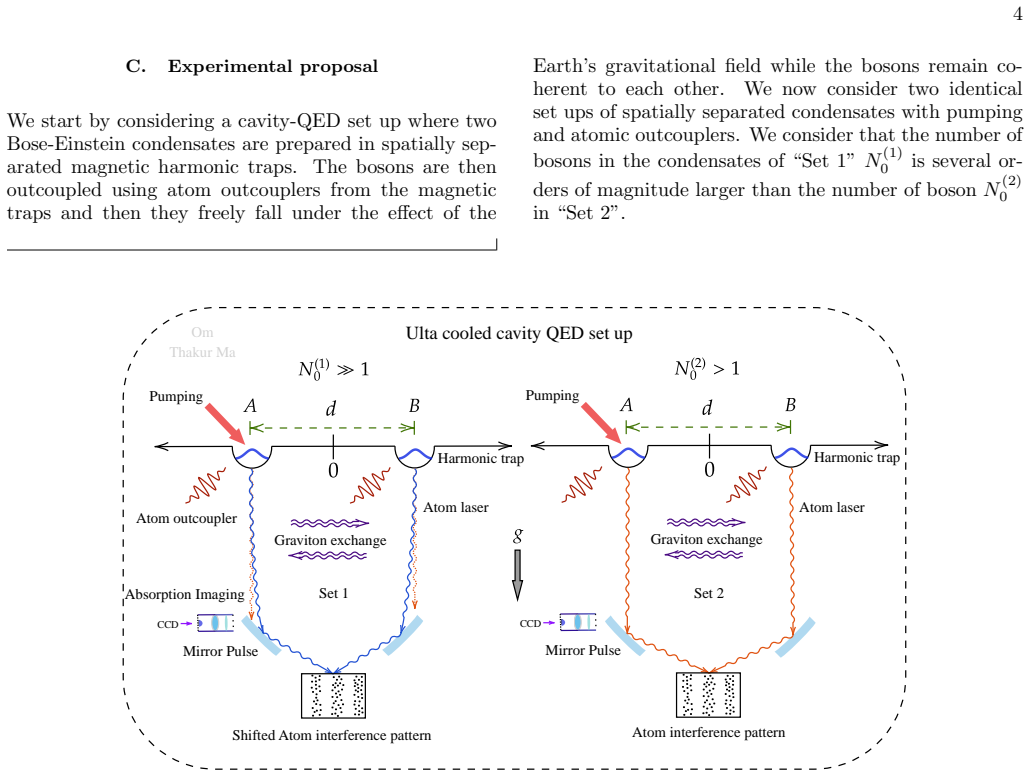
It is well known that two parallel photon beams do not deflect under the effect of their energy-momentum tensor. In this work, we propose a novel model where two spatially separated Bose-Einstein condensates are outcoupled to create two parallel atom laser beams. We find out that apart from the classical deflection, a purely quantum gravity induced tidal deflection is observed which results in an irreducible noise in the geodesic separation of the two beams. Based on this simple but novel theoretical outcome, we propose an experimental model for detecting this quantum gravity induced standard deviation in the geodesic separation of the two parallel matter-wave beams.
Editorial analysis
A structured set of objections, weighed in public.
Referee Report
Summary. The manuscript proposes a model in which two spatially separated Bose-Einstein condensates are outcoupled to form parallel atom-laser beams. It reports that, in addition to the expected classical gravitational deflection, a purely quantum-gravitational tidal effect produces an irreducible noise (standard deviation) in the geodesic separation of the beams, and it outlines an experimental scheme to detect this noise as a signature of quantum gravity.
Significance. If the claimed separation between classical gravity plus quantum matter dynamics and a genuine quantum-gravitational contribution can be demonstrated rigorously, the proposal would constitute a novel tabletop route to quantum-gravity phenomenology. The use of parallel matter-wave beams to convert tidal fluctuations into measurable separation noise is conceptually interesting and could, in principle, be falsifiable with existing atom-optics technology.
major comments (2)
- [Abstract and derivation sections] Abstract and the central derivation (presumably §3–4): the claim that the observed noise is 'purely quantum gravity induced' and 'irreducible' is not secured by any explicit limit calculation. The manuscript must demonstrate that the variance in geodesic separation vanishes (or reduces to zero within the model) when the gravitational field is treated classically while the matter waves remain fully quantum-mechanical; without this comparison the isolation of a quantum-gravity effect fails.
- [Model and results sections] The model introduces an 'invented entity' (quantum-gravity-induced tidal deflection) whose functional dependence on ħ, G, or Planck-scale parameters is never displayed. Equation(s) for the separation variance should be written explicitly and the term that survives only when gravity is quantized must be identified.
minor comments (2)
- [Abstract] The abstract states the central finding but supplies no equations; a short derivation outline or key result equation should be added to the abstract or a dedicated results paragraph.
- [Model description] Notation for the two beams, their initial separation, and the measured geodesic deviation should be defined once and used consistently; a schematic figure would help.
Simulated Author's Rebuttal
We thank the referee for the careful reading and constructive suggestions. We agree that the isolation of a genuine quantum-gravitational contribution requires explicit demonstration and that the model equations must be presented more transparently. We address each major comment below and will revise the manuscript accordingly.
read point-by-point responses
-
Referee: [Abstract and derivation sections] Abstract and the central derivation (presumably §3–4): the claim that the observed noise is 'purely quantum gravity induced' and 'irreducible' is not secured by any explicit limit calculation. The manuscript must demonstrate that the variance in geodesic separation vanishes (or reduces to zero within the model) when the gravitational field is treated classically while the matter waves remain fully quantum-mechanical; without this comparison the isolation of a quantum-gravity effect fails.
Authors: We agree that an explicit classical-gravity limit is required to substantiate the claim. In the revised manuscript we will add a dedicated subsection (in §3 or §4) that treats the gravitational field classically while retaining the full quantum dynamics of the matter waves. We will show that the variance in geodesic separation vanishes in this limit, thereby confirming that the residual noise is due to the quantized gravitational field. The added calculation will include the relevant steps and assumptions. revision: yes
-
Referee: [Model and results sections] The model introduces an 'invented entity' (quantum-gravity-induced tidal deflection) whose functional dependence on ħ, G, or Planck-scale parameters is never displayed. Equation(s) for the separation variance should be written explicitly and the term that survives only when gravity is quantized must be identified.
Authors: We acknowledge that the explicit functional dependence on fundamental constants and the identification of the surviving quantum-gravitational term were not displayed clearly enough. In the revision we will write the equation for the separation variance in full, display its dependence on ħ, G and the relevant Planck-scale quantities, and explicitly mark the term that is absent when gravity is treated classically. This will make the structure of the model transparent and remove any ambiguity about the origin of the effect. revision: yes
Circularity Check
No circularity identified; derivation chain not visible
full rationale
The provided abstract states a theoretical outcome ('purely quantum gravity induced tidal deflection' leading to 'irreducible noise') but contains no equations, no derivation steps, no parameter fitting, and no citations. Without any load-bearing steps that could be quoted and shown to reduce to inputs by construction, no instances of self-definitional, fitted-input, self-citation, or ansatz-smuggling circularity exist. The paper's central claim therefore cannot be assessed as circular from the given text; it remains an independent theoretical proposal pending the full derivation.
Axiom & Free-Parameter Ledger
invented entities (1)
-
quantum gravity induced tidal deflection
no independent evidence
Lean theorems connected to this paper
-
IndisputableMonolith/Foundation/RealityFromDistinction.leanreality_from_one_distinction unclearoperator-valued metric perturbation ˆhμν = 4G/c⁴ ∫ ˆTμν … leading to Δˆx(τ) ≃ … non-vanishing standard deviation
Reference graph
Works this paper leans on
-
[1]
Quantization of Einstein’s Gravitational Field: Linear Approximation
S. N. Gupta, “Quantization of Einstein’s Gravitational Field: Linear Approximation”, Proc. Phys. Soc. A 65 (1952) 161
work page 1952
-
[2]
Gravitation and Electromagnetism
S. N. Gupta, “Gravitation and Electromagnetism”, Phys. Rev. 96 (1954) 1683
work page 1954
-
[3]
R. P. Feynman, “Quantum theory of gravitation”, Acta. Phys. Pol. 24 (1963) 697
work page 1963
-
[4]
Quantum Theory of Gravity. I. The Canonical Theory
B. S. DeWitt, “Quantum Theory of Gravity. I. The Canonical Theory”, Phys. Rev. 160 (1967) 1113
work page 1967
-
[5]
Quantum Theory if Gravity. II. The Man- ifestly Covariant Theory
B. S. DeWitt, “Quantum Theory if Gravity. II. The Man- ifestly Covariant Theory”, Phys. Rev. 162 (1967) 1195
work page 1967
-
[6]
R. P. Feynman in The Role of Gravitation in Physics: Report from the 1957 Chapel Hill Conference (eds D. Rickles, C. M. DeWitt) (Edition Open Sources, 2011)
work page 1957
-
[7]
Witness gravity’s quantum side in the lab
C. Marletto and V. Vedral, “Witness gravity’s quantum side in the lab”, Nature 547 (2017) 156
work page 2017
-
[8]
General relativity as an effective field theory: The leading quantum corrections
J. F. Donoghue, “General relativity as an effective field theory: The leading quantum corrections”, Phys. Rev. D 50 (1994) 3874
work page 1994
-
[9]
Spin Entanglement Witness for Quan- tum Gravity
S. Bose, A. Mazumdar, G. W. Morley, H. Ulbricht, M. Toroˇ s, M. Paternostro, A. Geraci, P. Barker, M. S. Kim, and G. Milburn, “Spin Entanglement Witness for Quan- tum Gravity”, Phys. Rev. Lett. 119 (2017) 240401
work page 2017
-
[10]
Local- ity and entanglement in table-top testing of the quantum nature of linearized gravity
R. J. Marshman, A. Mazumdar, and S. Bose, “Local- ity and entanglement in table-top testing of the quantum nature of linearized gravity”, Phys. Rev. A 101 (2020) 052110
work page 2020
-
[11]
C. Marletto and V. Vedral, “Gravitationally Induced En- tanglement between Two Massive Particles is Sufficient Evidence of Quantum Effects in Gravity”, Phys. Rev. Lett. 119 (2017) 240402
work page 2017
-
[12]
Gravitationally mediated entanglement: Newtonian field vs gravitons
D. L. Danielson, G. Satischandran, and R. M. Wald, “Gravitationally mediated entanglement: Newtonian field vs gravitons”, Phys. Rev. D 105 (2022) 086001
work page 2022
-
[13]
Mo- tional Dynamical Decoupling for Matter-Wave Interfer- ometry
J. S. Pedernales, G. W. Morley, and M. B. Plenio, “Mo- tional Dynamical Decoupling for Matter-Wave Interfer- ometry”, Phys. Rev. Lett. 125 (2020) 023602
work page 2020
-
[14]
Large splitting massive Schr¨ odinger kittens
R. J. Marshman, A. Mazumdar, R. Folman, and S. Bose, “Large splitting massive Schr¨ odinger kittens”, Phys. Rev. Research 4 (2022) 023087
work page 2022
-
[15]
On the possibility of laboratory evidence for quantum superposition of geome- tries
M. Christodoulou and C. Rovelli, “On the possibility of laboratory evidence for quantum superposition of geome- tries”, Phys. Lett. B 792 (2019) 64
work page 2019
-
[16]
Entangle- ment and decoherence of massive particles due to grav- ity
D. Mikki, A. Matsumura, and K. Yamamoto, “Entangle- ment and decoherence of massive particles due to grav- ity”, Phys. Rev. D 103 (2021) 026017
work page 2021
-
[17]
Gravity-induced en- tanglement in optomechanical systems
A. Matsumara and K. Yamamoto, “Gravity-induced en- tanglement in optomechanical systems”, Phys. Rev. D 102 (2020) 106021
work page 2020
-
[18]
Non-Gaussianity as a Signature of a Quantum Theory of Gravity
R. Howl, V. Vedral, D. Naik, M. Christodoulou, C. Rov- elli, and A. Iyer, “Non-Gaussianity as a Signature of a Quantum Theory of Gravity”, PRX Quantum 2 (2021) 010325
work page 2021
-
[19]
Gravity mediated entanglement of phonons in Bose-Einstein condensates
S. Sen, S. Gangopadhyay, and V. Vedral, “Gravity medi- ated entanglement of phonons in Bose-Einstein conden- sates”, arXiv:2604.20767 [hep-th]
work page internal anchor Pith review Pith/arXiv arXiv
-
[20]
Bose-Einstein Consensa- tion and Superfluidity
L. Pitaevski and S. Stingari, “Bose-Einstein Consensa- tion and Superfluidity” (Oxford University Press, Ox- ford, 2016)
work page 2016
discussion (0)
Sign in with ORCID, Apple, or X to comment. Anyone can read and Pith papers without signing in.