Recognition: no theorem link
Adamantane plasma polymers: fluorine-free vacuum-processable triboelectric thin films for all-triboelectric nanogenerator configurations
Pith reviewed 2026-05-13 00:57 UTC · model grok-4.3
The pith
Adamantane plasma polymers can act as either tribopositive or tribonegative surfaces by changing whether the substrate faces or backs the plasma during deposition.
A machine-rendered reading of the paper's core claim, the machinery that carries it, and where it could break.
Core claim
Fabrication facing or backfacing the plasma yields adamantane polymer films with different dielectric constants, Young's moduli, and secondary electron emission. These property shifts allow the same base material to serve as either tribopositive or tribonegative layers. The resulting conformable, stable films operate across solid-solid, solid-liquid, and piezo-triboelectric configurations. Textured 2.8 micrometer tribonegative and 400 nanometer tribopositive pairs reach 90 V per square centimeter and 0.6 microamperes, while a 500 nanometer tribopositive layer produces 2.1 microwatts per square centimeter from salty droplets. Durability exceeds 10^5 solid-solid cycles and 10^4 droplet impacts
What carries the argument
Bivalent triboelectric character controlled by plasma-facing versus backfacing deposition orientation that alters dielectric constant, Young's modulus, and secondary electron emission.
If this is right
- One base polymer family supplies both polarities for all-triboelectric nanogenerator designs.
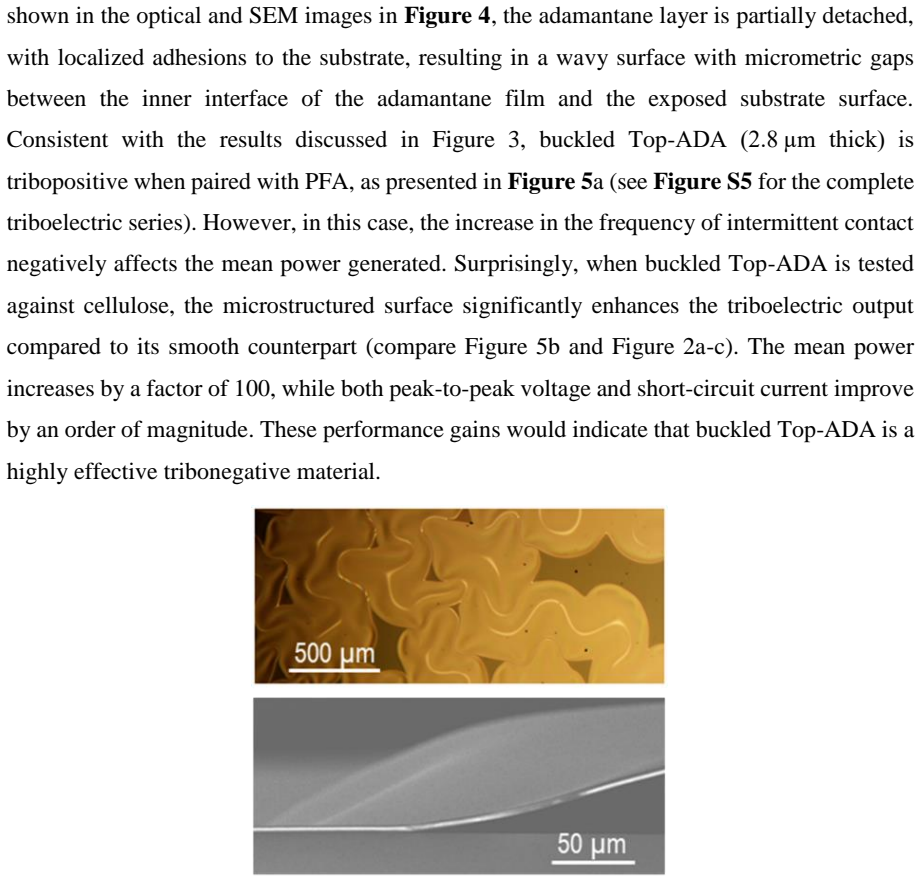
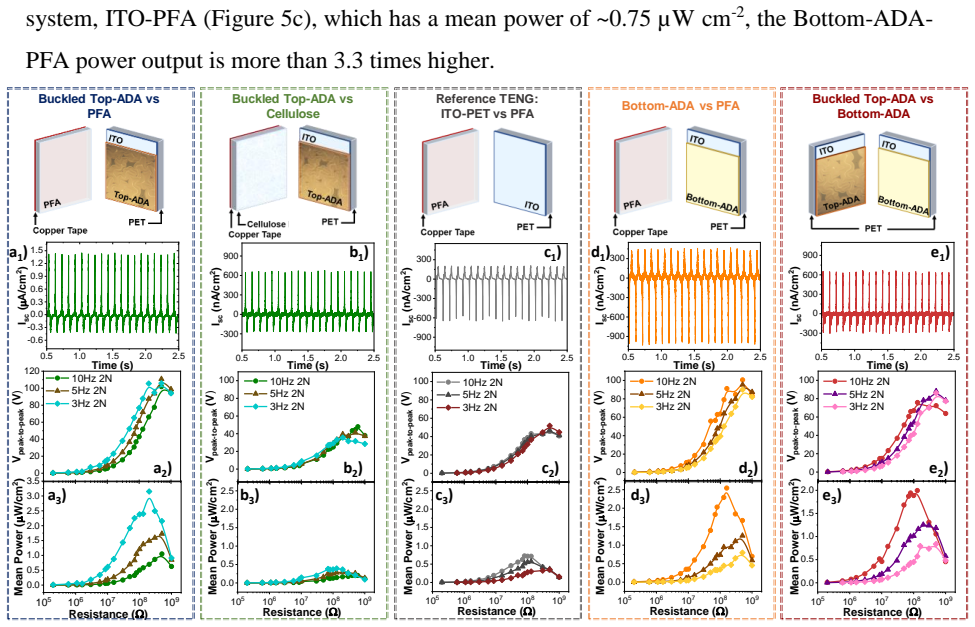
- Buckling texturization of 2.8 micrometer and 400 nanometer layers produces 90 V per square centimeter and 0.6 microamperes.
- A 500 nanometer tribopositive film generates 2.1 microwatts per square centimeter from salty droplets in a switch-electrode drop configuration.
- The layers maintain performance after more than 100,000 solid-solid contacts and 10,000 liquid impacts.
Where Pith is reading between the lines
- Device layouts could use sequential deposition steps of the same material to create opposing surfaces without material switches.
- The observed dependence on deposition geometry may extend to other hydrocarbon precursors processed by plasma.
- Stability in droplet impacts points toward possible use in self-powered sensors exposed to liquid environments.
Load-bearing premise
That the facing or backfacing position during plasma deposition alone produces reliable, consistent differences in dielectric constant, Young's modulus, and secondary electron emission that determine the final triboelectric polarity.
What would settle it
Side-by-side triboelectric charging tests on films deposited facing versus backfacing the plasma, performed under identical gas flow, power, and substrate temperature, to check whether polarity consistently reverses.
Figures




read the original abstract
Triboelectric nanogenerators (TENGs) are major drivers in on-site power generation for smart devices, enable self-powered sensors, and introduce novel catalytic processes. Here, we present the advantages of adamantane plasma layers as bivalently triboelectric surfaces capable of exhibiting both tribopositive and tribonegative character through simple modification of the synthesis conditions without the need for additives or functionalization. Fabrication facing or backfacing the plasma yields thin film polymers with different dielectric constants, Young's moduli, and secondary electron emission. The conformality, stability, and processability of the polymers enable direct implementation across solid-solid, solid-liquid, and hybrid piezo-triboelectric configurations. Additional texturization by buckling is shown to provide voltage and current outputs as high as 90 V cm2 and 0.6 uA for a 2.8 um (tribonegative) vs. 400 nm (tribopositive) combination. A maximum power density of 2.1 uW cm-2 is generated from salty droplets in a switch-electrode drop-TENG configuration employing a 500 nm-thick tribopositive adamantane polymer as the triboelectric surface. These layers have demonstrated outstanding durability, enabling more than 10^5 cycles in solid-solid nanogenerators and 10^4 droplet impacts in solid-liquid configurations. The synthetic method is environmentally friendly and industrially scalable, making the adamantane plasma polymer a reliable and competitive solution for thin film triboelectric materials.
Editorial analysis
A structured set of objections, weighed in public.
Referee Report
Summary. The manuscript claims that adamantane plasma polymers can function as bivalently triboelectric thin films, exhibiting either tribopositive or tribonegative character solely by placing the substrate facing or backfacing the plasma during deposition, without additives or functionalization. The films are reported to enable direct use in solid-solid, solid-liquid, and hybrid piezo-triboelectric TENG configurations due to their conformality and stability, with performance metrics including outputs up to 90 V cm^{-2} and 0.6 µA for a 2.8 µm tribonegative / 400 nm tribopositive pair, a power density of 2.1 µW cm^{-2} in a salty-droplet switch-electrode drop-TENG, and durability exceeding 10^5 cycles in solid-solid devices and 10^4 droplet impacts.
Significance. If the central experimental claims are substantiated with adequate controls, this work offers a meaningful advance in triboelectric materials by demonstrating a simple, fluorine-free, vacuum-processable route to polarity-tunable thin films. The reported versatility across TENG types, combined with high durability and scalability, could reduce reliance on fluorinated polymers and simplify all-TENG device fabrication for self-powered sensors and energy harvesters.
major comments (2)
- [Abstract] Abstract: The claim that facing versus backfacing geometry alone produces the polarity reversal via differences in dielectric constant, Young's modulus, and secondary electron emission is not isolated from confounds. The abstract reports substantially different thicknesses (2.8 µm tribonegative vs. 400 nm tribopositive), which can independently alter effective capacitance, contact area, and charge-transfer dynamics. The manuscript must demonstrate that thickness, roughness, deposition rate, and chemical composition were matched while varying only substrate position; absent such controls, the bivalent-triboelectric attribution rests on an under-constrained causal link.
- [Results and Methods] Results and Methods: The performance numbers (90 V cm^{-2}, 0.6 µA, 2.1 µW cm^{-2}, >10^5 cycles) and the attribution to specific material properties lack supporting characterization data, error bars, replicate statistics, or full methods. Without these, it is impossible to evaluate whether the observed outputs and durability are reproducible or whether the claimed property differences (dielectric constant, modulus, secondary-electron emission) were directly measured and correlated with polarity.
minor comments (2)
- [Abstract] Abstract: Unit notation is inconsistent and non-standard (e.g., '90 V cm2', '0.6 uA', '2.1 uW cm-2'); these should be rendered with proper superscripts as V cm^{-2}, µA, and µW cm^{-2}.
- [Abstract] Abstract: The mention of 'additional texturization by buckling' is introduced without any description of the buckling process, its parameters, or quantitative comparison of performance with and without texturization.
Simulated Author's Rebuttal
We thank the referee for the constructive and detailed comments. We have carefully reviewed the concerns about isolating the effect of substrate position from thickness and other variables, as well as the need for more complete data reporting. Our responses below address each point directly, and we indicate the revisions that will be made to the manuscript.
read point-by-point responses
-
Referee: [Abstract] Abstract: The claim that facing versus backfacing geometry alone produces the polarity reversal via differences in dielectric constant, Young's modulus, and secondary electron emission is not isolated from confounds. The abstract reports substantially different thicknesses (2.8 µm tribonegative vs. 400 nm tribopositive), which can independently alter effective capacitance, contact area, and charge-transfer dynamics. The manuscript must demonstrate that thickness, roughness, deposition rate, and chemical composition were matched while varying only substrate position; absent such controls, the bivalent-triboelectric attribution rests on an under-constrained causal link.
Authors: We agree that the reported thickness difference constitutes a potential confound that must be addressed to strengthen the causal attribution. The facing and backfacing positions inherently influence plasma sheath effects and deposition kinetics, which in turn affect thickness along with the other film properties. To isolate the positional variable, we have performed additional depositions in which total deposition time was adjusted to produce films of comparable thickness (~500 nm) for both orientations. In these thickness-matched samples, the polarity reversal persists (facing: tribonegative; backfacing: tribopositive), accompanied by measurable differences in dielectric constant, Young's modulus, and secondary-electron emission yield. Roughness (AFM), deposition rate, and XPS-derived chemical composition data for the matched films are now included. These results have been added as a new supplementary figure and the abstract has been revised to note that thickness is one resulting property rather than the sole driver. revision: yes
-
Referee: [Results and Methods] Results and Methods: The performance numbers (90 V cm^{-2}, 0.6 µA, 2.1 µW cm^{-2}, >10^5 cycles) and the attribution to specific material properties lack supporting characterization data, error bars, replicate statistics, or full methods. Without these, it is impossible to evaluate whether the observed outputs and durability are reproducible or whether the claimed property differences (dielectric constant, modulus, secondary-electron emission) were directly measured and correlated with polarity.
Authors: We acknowledge that the original presentation of performance metrics and property correlations was insufficiently detailed. In the revised manuscript we have added error bars (standard deviation from n ≥ 3 independent devices) to all reported voltage, current, power-density, and durability values. Replicate statistics and the exact number of cycles/impacts tested are now stated explicitly. Expanded methods in the supplementary information describe the protocols for dielectric-constant measurements (impedance spectroscopy), Young's modulus (nanoindentation), and secondary-electron emission (electron-beam setup), together with the raw data correlating these quantities to triboelectric polarity for both film orientations. Full device-fabrication and testing procedures have also been provided. revision: yes
Circularity Check
No circularity: purely experimental claims with no derivations or self-referential reductions
full rationale
The manuscript reports direct experimental results from plasma deposition of adamantane films under facing versus backfacing geometries, followed by measurements of dielectric constant, Young's modulus, secondary electron emission, and TENG device outputs. No equations, fitted models, predictions derived from parameters, or load-bearing self-citations appear in the provided text or abstract. Thickness differences are noted but treated as observed outcomes rather than inputs to a tautological derivation. The bivalency claim rests on empirical variation of synthesis conditions and subsequent characterization, with no step reducing by construction to its own inputs.
Axiom & Free-Parameter Ledger
axioms (1)
- domain assumption Plasma polymerization of adamantane yields stable, conformal thin films whose surface properties can be modulated by substrate orientation relative to the plasma.
Reference graph
Works this paper leans on
- [1]
-
[2]
Z. L. Wang, A. C. Wang, Materials Today 2019, 30, 34
work page 2019
-
[3]
G. Khandelwal, N. P. Maria Joseph Raj, S.-J. Kim, Advanced Energy Materials 2021, 11, 2101170
work page 2021
- [4]
-
[5]
H. Zou, Y. Zhang, L. Guo, P. Wang, X. He, G. Dai, H. Zheng, C. Chen, A. C. Wang, C. Xu, Z. L. Wang, Nat Commun 2019, 10, 1427
work page 2019
- [6]
-
[7]
L. Zhou, D. Liu, J. Wang, Z. L. Wang, Friction 2020, 8, 481
work page 2020
-
[8]
J. Hu, M. Iwamoto, X. Chen, Nano-Micro Lett. 2023, 16, 7
work page 2023
- [9]
-
[10]
C. Lee, Y. Qin, Y.-C. Wang, MRS Bulletin 2025, 50, 428
work page 2025
-
[11]
Y. Zhou, M. Shen, X. Cui, Y. Shao, L. Li, Y. Zhang, Nano Energy 2021, 84, 105887
work page 2021
-
[12]
X. Li, Y. Cao, X. Yu, Y. Xu, Y. Yang, S. Liu, T. Cheng, Z. L. Wang, Applied Energy 2022, 306, 117977
work page 2022
-
[13]
H. Guo, J. Chen, L. Wang, A. C. Wang, Y. Li, C. An, J.-H. He, C. Hu, V. K. S. Hsiao, Z. L. Wang, Nat Sustain 2021, 4, 147
work page 2021
- [14]
-
[15]
P. K. Szewczyk, D. P. Ura, J. Knapczyk-Korczak, L. Halagačka, K. Postava, J. Nizioł, U. Stachewicz, Advanced Materials Interfaces 2025, 12, e00352
work page 2025
-
[16]
M. Hua, R. Jiang, Y. Lu, Y. Su, Y. Zhao, Nano Energy 2025, 135, 110676
work page 2025
-
[17]
Z. Wang, X. Dong, X.-F. Li, Y. Feng, S. Li, W. Tang, Z. L. Wang, Nat Commun 2024, 15, 757
work page 2024
-
[18]
J. C. Lee, S. Smaoui, J. Duffill, B. Marandi, T. Varzakas, 2025, DOI 10.20944/preprints202501.1698.v1
-
[19]
P. C. Sherrell, A. Šutka, M. Timusk, A. Šutka, Small 2024, 20, 2311570
work page 2024
-
[20]
M. Alcaire, J. R. Sanchez-Valencia, F. J. Aparicio, Z. Saghi, J. C. Gonzalez-Gonzalez, A. Barranco, Y. O. Zian, A. R. Gonzalez-Elipe, P. Midgley, J. P. Espinos, P. Groening, A. Borras, Nanoscale 2011, 3, 4554
work page 2011
-
[21]
F. J. Aparicio, M. Holgado, A. Borras, I. Blaszczyk-Lezak, A. Griol, C. A. Barrios, R. Casquel, F. J. Sanza, H. Sohlström, M. Antelius, A. R. González-Elipe, A. Barranco, Advanced Materials 2011, 23, 684
work page 2011
-
[22]
J. Idígoras, F. J. Aparicio, L. Contreras-Bernal, S. Ramos-Terrón, M. Alcaire, J. R. Sánchez-Valencia, A. Borras, Á. Barranco, J. A. Anta, ACS Appl. Mater. Interfaces 2018, 10, 11587
work page 2018
-
[23]
A. Barranco, M. Bielmann, R. Widmer, P. A. Groening, Advanced Engineering Materials 2005, 7, 396
work page 2005
-
[24]
F. J. Aparicio, M. Alcaire, A. Borras, J. C. Gonzalez, F. López-Arbeloa, I. Blaszczyk- Lezak, A. R. González-Elipe, A. Barranco, J. Mater. Chem. C 2014, 2, 6561
work page 2014
-
[25]
M. Alcaire, L. Cerdán, F. L. Zamarro, F. J. Aparicio, J. C. González, F. J. Ferrer, A. Borras, J. P. Espinós, A. Barranco, ACS Appl. Mater. Interfaces 2017, 9, 8948
work page 2017
-
[26]
I. Blaszczyk-Lezak, F. J. Aparicio, A. Borrás, A. Barranco, A. Álvarez-Herrero, M. Fernández-Rodríguez, A. R. González-Elipe, J. Phys. Chem. C 2009, 113, 431
work page 2009
-
[27]
F. J. Aparicio, I. Blaszczyk-Lezak, J. R. Sánchez-Valencia, M. Alcaire, J. C. González, C. Serra, A. R. González-Elipe, A. Barranco, J. Phys. Chem. C 2012, 116, 8731. 36
work page 2012
-
[28]
M. Alcaire, A. N. Filippin, M. Macias-Montero, J. R. Sanchez-Valencia, T. C. Rojas, A. Mora-Boza, C. Lopez-Santos, J. P. Espinos, A. Barranco, A. Borras, Plasma Processes and Polymers 2016, 13, 287
work page 2016
-
[29]
A. N. Filippin, J. R. Sanchez-Valencia, J. Idígoras, M. Macias-Montero, M. Alcaire, F. J. Aparicio, J. P. Espinos, C. Lopez-Santos, F. Frutos, A. Barranco, J. A. Anta, A. Borras, Advanced Materials Interfaces 2017, 4, 1601233
work page 2017
-
[30]
J. M. Obrero, A. N. Filippin, M. Alcaire, J. R. Sanchez-Valencia, M. Jacob, C. Matei, F. J. Aparicio, M. Macias-Montero, T. C. Rojas, J. P. Espinos, Z. Saghi, A. Barranco, A. Borras, Front. Chem. 2020, 8, 520
work page 2020
-
[31]
Ali Mansoori, in Advances in Chemical Physics, John Wiley & Sons, Ltd, 2007, pp
G. Ali Mansoori, in Advances in Chemical Physics, John Wiley & Sons, Ltd, 2007, pp. 207–258
work page 2007
-
[32]
M. Alcaire, C. Lopez-Santos, F. J. Aparicio, J. R. Sanchez-Valencia, J. M. Obrero, Z. Saghi, V. J. Rico, G. de la Fuente, A. R. Gonzalez-Elipe, A. Barranco, A. Borras, Langmuir 2019, 35, 16876
work page 2019
- [33]
-
[34]
W. Xu, H. Zheng, Y. Liu, X. Zhou, C. Zhang, Y. Song, X. Deng, M. Leung, Z. Yang, R. X. Xu, Z. L. Wang, X. C. Zeng, Z. Wang, Nature 2020, 578, 392
work page 2020
-
[35]
M. Alcaire, F. J. Aparicio, J. Obrero, C. López-Santos, F. J. Garcia-Garcia, J. R. Sánchez-Valencia, F. Frutos, K. (Ken) Ostrikov, A. Borrás, A. Barranco, Advanced Functional Materials 2019, 29, 1903535
work page 2019
-
[36]
A. Barranco, F. Aparicio, A. Yanguas-Gil, P. Groening, J. Cotrino, A. R. González- Elipe, Chemical Vapor Deposition 2007, 13, 319
work page 2007
-
[37]
D. Lin-Vien, The Handbook of Infrared and Raman Characteristic Frequencies of Organic Molecules, Academic Press, Boston, 1991
work page 1991
-
[38]
A. C. Ferrari, J. Robertson, Phys. Rev. B 2000, 61, 14095
work page 2000
-
[39]
C. Casiraghi, F. Piazza, A. C. Ferrari, D. Grambole, J. Robertson, Diamond and Related Materials 2005, 14, 1098
work page 2005
-
[40]
P. C. Sherrell, A. Sutka, N. A. Shepelin, L. Lapcinskis, O. Verners, L. Germane, M. Timusk, R. A. Fenati, K. Malnieks, A. V. Ellis, ACS Appl. Mater. Interfaces 2021, 13, 44935
work page 2021
- [41]
- [42]
-
[43]
M. R. VanLandingham, J. S. Villarrubia, W. F. Guthrie, G. F. Meyers, Macromolecular Symposia 2001, 167, 15
work page 2001
-
[44]
F. Núñez-Gálvez, X. García-Casas, L. Contreras-Bernal, A. Descalzo, J. M. Obrero- Pérez, J. Castillo-Seoane, A. Ginés, G. Leger, J. C. Sánchez-Lopez, J. P. Espinós, Á. Barranco, A. Borrás, J. R. Sánchez-Valencia, C. López-Santos, Nano Energy 2026, 148, 111678
work page 2026
-
[45]
J. Carneiro De Oliveira, A. Airoudj, P. Kunemann, F. Bally-Le Gall, V. Roucoules, SN Appl. Sci. 2021, 3, 656
work page 2021
- [46]
-
[47]
A.-Y. Jee, M. Lee, Polymer Testing 2010, 29, 95
work page 2010
-
[48]
A. M. Díez-Pascual, M. A. Gómez-Fatou, F. Ania, A. Flores, Progress in Materials Science 2015, 67, 1
work page 2015
-
[49]
S. Ji, J. Yang, J. Zhao, Y. Hu, H. Gao, Polymers 2018, 10, 173. 37
work page 2018
- [50]
- [51]
-
[52]
T. Hu, I. Montero, P. Perez-Villacastin, W. Cui, M. Cao, Q. Wang, in 2017 Sixth Asia- Pacific Conference on Antennas and Propagation (APCAP), IEEE, Xi’an, 2017, pp. 1–3
work page 2017
-
[53]
Galli, in Computer-Based Modeling of Novel Carbon Systems and Their Properties (Eds.: L
G. Galli, in Computer-Based Modeling of Novel Carbon Systems and Their Properties (Eds.: L. Colombo, A. Fasolino), Springer Netherlands, Dordrecht, 2010, pp. 37–56
work page 2010
-
[54]
T. Xu, L. Donà, J.-C. Tan, ACS Appl. Mater. Interfaces 2026, 18, 18221
work page 2026
-
[55]
S. Li, Y. Zhou, Y. Zi, G. Zhang, Z. L. Wang, ACS Nano 2016, 10, 2528
work page 2016
-
[56]
S. Acharya, S. Liyanage, P. Parajuli, S. Rumi, J. Shamshina, N. Abidi, Polymers 2021, 13, DOI 10.3390/polym13244344
-
[57]
C. Coupeau, J. Durinck and G. Parry, MPS 2024, DOI 10.47485/2832-9384.1046
-
[58]
K. C. Pradel, N. Fukata, Nano Energy 2021, 83, 105856
work page 2021
-
[59]
I.-W. Tcho, W.-G. Kim, S.-B. Jeon, S.-J. Park, B. J. Lee, H.-K. Bae, D. Kim, Y.-K. Choi, Nano Energy 2017, 42, 34
work page 2017
-
[60]
C. K. Chung, K. H. Ke, Applied Surface Science 2020, 508, 145310
work page 2020
-
[61]
Y.-J. Huang, C.-H. Tsai, C.-W. Hung, C.-K. Chung, Polymers 2024, 16, DOI 10.3390/polym16233397
- [62]
-
[63]
C. A. Mizzi, L. D. Marks, Nano Lett. 2022, 22, 3939
work page 2022
-
[64]
J. Delgado-Alvarez, H. K. Mishra, F. J. Aparicio, X. García-Casas, A. Barranco, J. R. Sanchez-Valencia, V. Lopez-Flores, A. Borras, APL Electronic Devices 2025, 1, 036122
work page 2025
- [65]
-
[66]
S. Z. Hussain, V. P. Singh, M. S. B. Sadeque, S. Yavari, G. Kalimuldina, M. Ordu, Small 2025, 21, 2504626
work page 2025
- [67]
-
[68]
L. Xie, N. Zhai, Y. Liu, Z. Wen, X. Sun, Research 2021, 2021, DOI 10.34133/2021/9143762
-
[69]
S. M. A. Z. Shawon, A. X. Sun, V. S. Vega, B. D. Chowdhury, P. Tran, Z. D. Carballo, J. A. Tolentino, J. Li, M. S. Rafaqut, S. Danti, M. J. Uddin, Nano Energy 2021, 82, 105691
work page 2021
-
[70]
T. Abu Ali, J. Pilz, P. Schäffner, M. Kratzer, C. Teichert, B. Stadlober, A. M. Coclite, physica status solidi (a) 2020, 217, 2000319
work page 2020
- [71]
-
[72]
E.-Y. Jung, H. O. Suleiman, H.-S. Tae, C.-S. Park, Polymers 2024, 16, DOI 10.3390/polym16111548
-
[73]
X. García-Casas, A. Ghaffarinejad, F. J. Aparicio, J. Castillo-Seoane, C. López-Santos, J. P. Espinós, J. Cotrino, J. R. Sánchez-Valencia, Á. Barranco, A. Borrás, Nano Energy 2022, 91, 106673
work page 2022
-
[74]
R. T. Leon, P. C. Sherrell, A. Šutka, A. V. Ellis, Nano Energy 2023, 110, 108445
work page 2023
-
[75]
J. M. Obrero-Perez, L. Contreras-Bernal, F. Nuñez-Galvez, J. Castillo-Seoane, K. Valadez-Villalobos, F. J. Aparicio, J. A. Anta, A. Borras, J. R. Sanchez-Valencia, A. Barranco, Advanced Energy Materials 2022, 12, 2200812
work page 2022
- [76]
-
[77]
A. Ghaffarinejad, X. García-Casas, F. Núñez-Gálvez, J. Budagosky, V. Godinho, C. López-Santos, J. R. Sánchez-Valencia, Á. Barranco, A. Borrás, Device 2025, 3, 100566
work page 2025
-
[78]
C. Ye, D. Liu, P. Chen, L. N. Y. Cao, X. Li, T. Jiang, Z. L. Wang, Advanced Materials 2023, 35, 2209713
work page 2023
-
[79]
H. Ma, B. Xi, Y. Chen, H. Liu, W. Li, Z. Tang, Journal of Environmental Sciences 2025, S1001074225002943
work page 2025
-
[80]
Y. (关寅) Guan, J. (傅经纬) Fu, S. (吴双) Wu, X. (陈喜阳) Chen, C. (周程) Zhou, Physics of Fluids 2021, 33, 072108
work page 2021
discussion (0)
Sign in with ORCID, Apple, or X to comment. Anyone can read and Pith papers without signing in.