Recognition: no theorem link
Electronic Direct Detection of Light Dark Matter with Intermediate-Mass Mediators
Pith reviewed 2026-05-13 00:44 UTC · model grok-4.3
The pith
Electron direct detection experiments can probe dark matter with intermediate-mass mediators spanning up to three orders of magnitude for sub-GeV particles.
A machine-rendered reading of the paper's core claim, the machinery that carries it, and where it could break.
Core claim
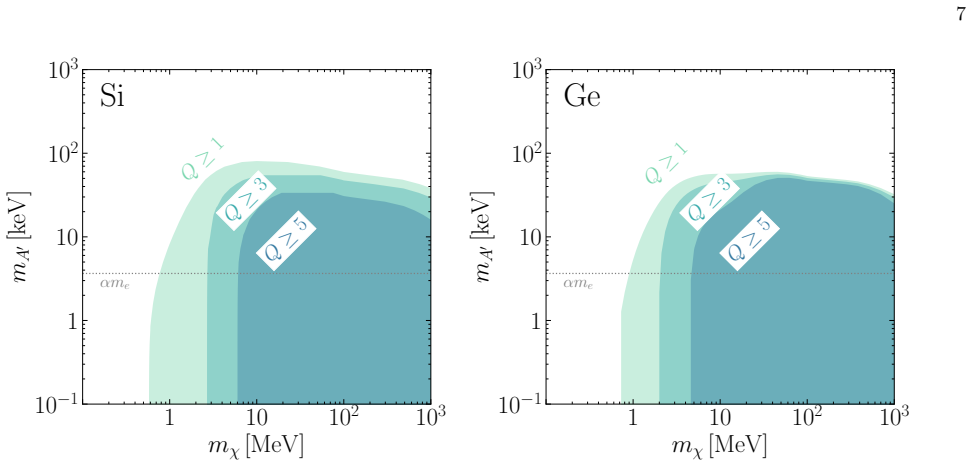
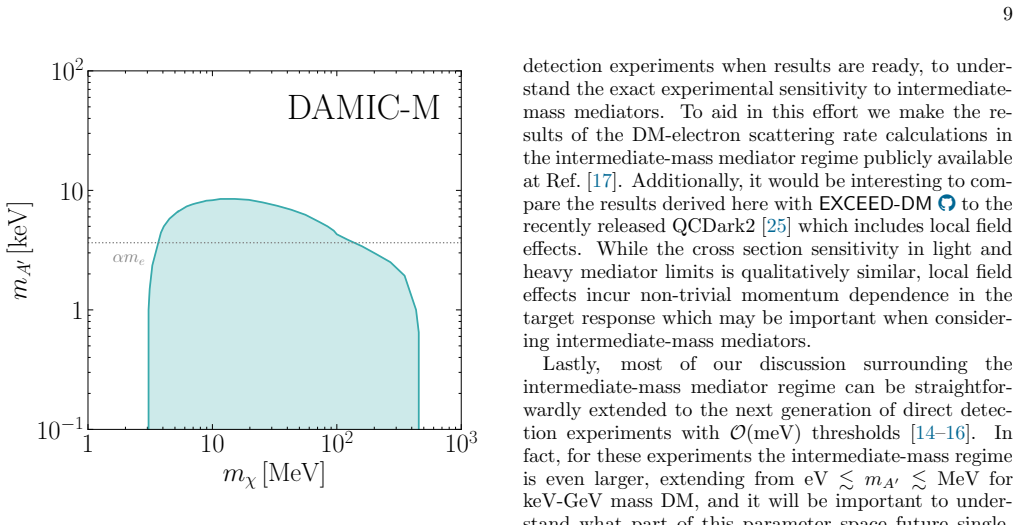
The light and heavy mediator mass limits are not separated by a single scale; for sub-GeV dark matter they can be separated by up to three orders of magnitude in mediator mass. The background-free reach of silicon, germanium, and projected DAMIC-M detectors is calculated for the intermediate-mass regime when the relic density is generated exclusively via freeze-in, and the results are released in an updated version of the EXCEED-DM code.
What carries the argument
The differential rate for dark matter-electron scattering with finite mediator mass, which smoothly interpolates between the light-mediator and heavy-mediator limits and is evaluated for semiconductor targets.
If this is right
- Sensitivity curves for silicon and germanium cover a continuous range of mediator masses between the light and heavy limits.
- Projected DAMIC-M reach includes the intermediate-mass window for freeze-in dark matter.
- The separation between limits can reach three orders of magnitude, so experiments test mediator masses that would otherwise be missed.
- Public release of the calculation code allows direct use for other targets or production mechanisms.
Where Pith is reading between the lines
- Model builders should scan mediator masses continuously rather than jumping between the two asymptotic regimes.
- Null results from electron direct detection now translate into broader exclusions on freeze-in scenarios than previously mapped.
- The same intermediate-mass treatment could be applied to other detection channels such as nuclear recoils or accelerator searches to check consistency.
Load-bearing premise
The projected sensitivities assume zero backgrounds and that dark matter is produced solely through freeze-in.
What would settle it
A background-free search in a silicon or germanium detector that records no events at the predicted rate for a chosen dark-matter mass and an intermediate mediator mass would rule out the claimed sensitivity in that slice of parameter space.
Figures




read the original abstract
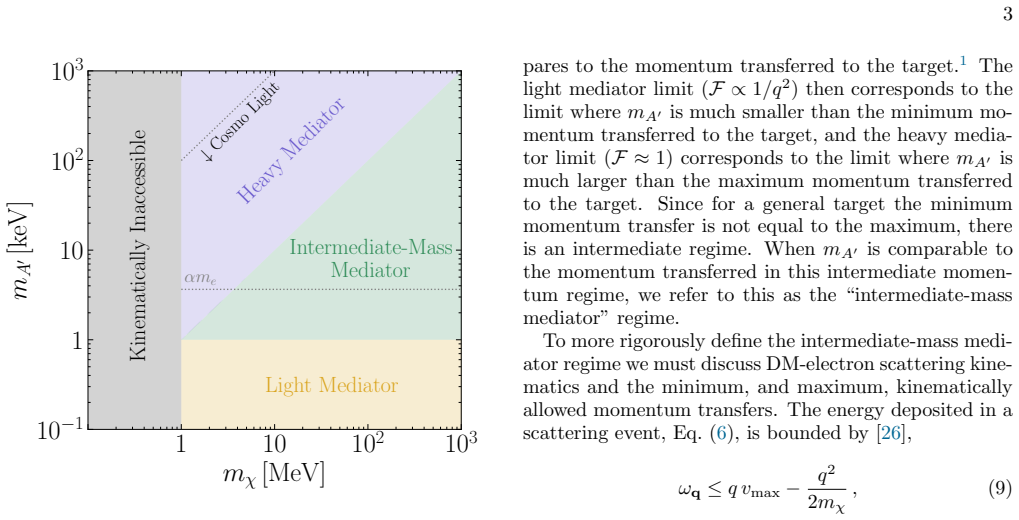
Recent years have seen dramatic improvements in the sensitivity of electron-based direct detection experiments. Typically, the sensitivity to dark matter scattering is determined in the light and heavy mediator mass limits. In this paper we show that the light and heavy mediator mass limits are not separated by a single scale, but instead can be separated by up to three orders of magnitude in mediator mass for sub-GeV mass dark matter. We calculate the background-free sensitivity in Si and Ge targets, and a projected DAMIC-M sensitivity, to sub-GeV mass dark matter models with ``intermediate-mass" mediators between the light and heavy mediator limits. This allows us to determine the precise range of mediator masses that electron-based direct detection experiments are sensitive to when the dark matter relic abundance is generated via freeze-in. We make the calculations presented here publicly available in an updated release of EXCEED-DM (https://github.com/tanner-trickle/EXCEED-DM).
Editorial analysis
A structured set of objections, weighed in public.
Referee Report
Summary. The manuscript calculates background-free sensitivities of electron-recoil direct detection in Si and Ge targets, plus a projected DAMIC-M reach, to sub-GeV dark matter scattering via intermediate-mass mediators. It shows that the light-mediator and heavy-mediator regimes are not separated by a single characteristic scale but can be separated by up to three orders of magnitude in mediator mass when the DM relic density is fixed by freeze-in production, and releases updated public code in EXCEED-DM.
Significance. If the numerical results hold, the work is significant because it demonstrates that a broad window of mediator masses (far wider than the naive light/heavy split) is accessible to existing and near-future electron-based experiments under standard freeze-in cosmology. The public code release is a clear strength, enabling direct verification and reuse of the scattering-rate and yield calculations.
major comments (1)
- The central quantitative claim (up to three orders of magnitude separation in reachable m_med) rests on an accurate mapping g(m_med) obtained from the freeze-in yield. The manuscript must explicitly state whether the thermally averaged production cross section in the intermediate window (roughly 1 keV–100 MeV) is computed with the full propagator |M|^2 ∝ 1/(s + m_med²)² or by stitching the m_med → 0 and m_med → ∞ analytic limits; any use of the latter would systematically misestimate the required coupling precisely where the transition occurs and would shrink or shift the quoted interval.
minor comments (2)
- Abstract and §1: the background-free assumption is stated without a short justification or reference to how sub-keV backgrounds are controlled in Si/Ge/DAMIC-M; a one-sentence caveat would improve clarity.
- Figure captions and text: ensure that the plotted mediator-mass ranges are labeled with the precise numerical boundaries used for “light,” “intermediate,” and “heavy” so readers can reproduce the three-order separation without ambiguity.
Simulated Author's Rebuttal
We thank the referee for their careful review and constructive feedback on our manuscript. We are pleased that the referee recognizes the significance of our results on the broad mediator mass window accessible to electron-based direct detection experiments under freeze-in cosmology, as well as the value of the public code release. Below, we provide a point-by-point response to the major comment.
read point-by-point responses
-
Referee: The central quantitative claim (up to three orders of magnitude separation in reachable m_med) rests on an accurate mapping g(m_med) obtained from the freeze-in yield. The manuscript must explicitly state whether the thermally averaged production cross section in the intermediate window (roughly 1 keV–100 MeV) is computed with the full propagator |M|^2 ∝ 1/(s + m_med²)² or by stitching the m_med → 0 and m_med → ∞ analytic limits; any use of the latter would systematically misestimate the required coupling precisely where the transition occurs and would shrink or shift the quoted interval.
Authors: We appreciate the referee pointing out the need for explicit clarification on this technical detail. In the calculations presented in the manuscript, the freeze-in yield is computed using the full propagator in the squared matrix element, |M|^2 ∝ 1/(s + m_med²)², across the entire mediator mass range, including the intermediate window from approximately 1 keV to 100 MeV. This is done numerically in the updated version of the EXCEED-DM code without relying on stitched analytic limits for the light and heavy mediator regimes. We will revise the manuscript to include a clear statement of this methodology, for example in the section describing the relic density calculation, to ensure readers understand that the mapping g(m_med) is accurately determined without systematic bias in the transition region. This does not alter our quantitative results but enhances the transparency of the work. revision: yes
Circularity Check
No circularity: direct numerical computation of rates and yields
full rationale
The paper performs explicit numerical integration of electron scattering rates and freeze-in production cross sections using the full mediator propagator for intermediate masses, without fitting any parameters to the final sensitivity curves or re-deriving target quantities from prior self-citations. The central result (separation of light/heavy regimes by up to three orders of magnitude in m_med) follows from these calculations and the background-free assumption, both of which are independent of the claimed reach. Public code release further ensures the derivation is externally verifiable and not self-referential.
Axiom & Free-Parameter Ledger
axioms (2)
- domain assumption Background-free sensitivity for Si, Ge, and DAMIC-M targets
- domain assumption Dark matter relic abundance generated exclusively via freeze-in
Reference graph
Works this paper leans on
-
[1]
Freeze-In Production of FIMP Dark Matter
L. J. Hall, K. Jedamzik, J. March-Russell, and S. M. West, “Freeze-In Production of FIMP Dark Matter,” JHEP03(2010) 080,arXiv:0911.1120 [hep-ph]
work page Pith review arXiv 2010
-
[2]
The Four Basic Ways of Creating Dark Matter Through a Portal
X. Chu, T. Hambye, and M. H. G. Tytgat, “The Four Basic Ways of Creating Dark Matter Through a Portal,” JCAP05(2012) 034,arXiv:1112.0493 [hep-ph]
work page Pith review arXiv 2012
-
[3]
Dark matter from dark photons: a taxonomy of dark matter production,
T. Hambye, M. H. G. Tytgat, J. Vandecasteele, and L. Vanderheyden, “Dark matter from dark photons: a taxonomy of dark matter production,”Phys. Rev. D 100no. 9, (2019) 095018,arXiv:1908.09864 [hep-ph]
-
[4]
Making dark matter out of light: freeze-in from plasma effects,
C. Dvorkin, T. Lin, and K. Schutz, “Making dark matter out of light: freeze-in from plasma effects,”Phys. Rev. D99no. 11, (2019) 115009,arXiv:1902.08623 [hep-ph]. [Erratum: Phys.Rev.D 105, 119901 (2022)]
-
[5]
Dark matter models and direct detection,
T. Lin, “Dark matter models and direct detection,”PoS 333(2019) 009,arXiv:1904.07915 [hep-ph]
-
[6]
Y. Kahn and T. Lin, “Searches for light dark matter using condensed matter systems,”Rept. Prog. Phys.85 no. 6, (2022) 066901,arXiv:2108.03239 [hep-ph]
-
[7]
Dark Matter Candidates of a Very Low Mass,
K. M. Zurek, “Dark Matter Candidates of a Very Low Mass,”Ann. Rev. Nucl. Part. Sci.74(2024) 287–319, arXiv:2401.03025 [hep-ph]
-
[8]
Results for Electronic Direct Detection of Light Dark Matter with Intermediate-Mass Mediators
C. Stratman and T. Trickle, “Results for Electronic Direct Detection of Light Dark Matter with Intermediate-Mass Mediators .” May, 2026. https://doi.org/10.5281/zenodo.19805613
-
[9]
M. E. Peskin and D. V. Schroeder,An Introduction to quantum field theory. Addison-Wesley, Reading, USA, 1995
work page 1995
-
[10]
Multichannel direct detection of light dark matter: Target comparison,
S. M. Griffin, K. Inzani, T. Trickle, Z. Zhang, and K. M. Zurek, “Multichannel direct detection of light dark matter: Target comparison,”Phys. Rev. D101 no. 5, (2020) 055004,arXiv:1910.10716 [hep-ph]
-
[11]
S. M. Griffin, K. Inzani, T. Trickle, Z. Zhang, and K. M. Zurek, “Extended calculation of dark matter-electron scattering in crystal targets,”Phys. Rev. D104no. 9, (2021) 095015,arXiv:2105.05253 [hep-ph]
-
[12]
Extended calculation of electronic excitations for direct detection of dark matter,
T. Trickle, “Extended calculation of electronic excitations for direct detection of dark matter,”Phys. Rev. D107no. 3, (2023) 035035,arXiv:2210.14917 [hep-ph]
-
[13]
C. E. Dreyer, R. Essig, M. Fernandez-Serra, A. Singal, and C. Zhen, “Fully ab-initio all-electron calculation of dark matter-electron scattering in crystals with evaluation of systematic uncertainties,”Phys. Rev. D 109no. 11, (2024) 115008,arXiv:2306.14944 [hep-ph]
-
[14]
Dark matter-electron scattering in dielectrics,
S. Knapen, J. Kozaczuk, and T. Lin, “Dark matter-electron scattering in dielectrics,”Phys. Rev. D 104no. 1, (2021) 015031,arXiv:2101.08275 [hep-ph]
-
[15]
Determining Dark-Matter–Electron Scattering Rates from the Dielectric Function,
Y. Hochberg, Y. Kahn, N. Kurinsky, B. V. Lehmann, T. C. Yu, and K. K. Berggren, “Determining Dark-Matter–Electron Scattering Rates from the Dielectric Function,”Phys. Rev. Lett.127no. 15, (2021) 151802,arXiv:2101.08263 [hep-ph]
-
[16]
C. Dreyer, R. Essig, M. Fernandez-Serra, M. Hott, and A. Singal, “All-electron dark matter-electron scattering with random-phase approximation dielectric screening and local field effects,”arXiv:2603.12326 [hep-ph]
-
[17]
Multi-Channel Direct Detection of Light Dark Matter: Theoretical Framework,
T. Trickle, Z. Zhang, K. M. Zurek, K. Inzani, and S. M. Griffin, “Multi-Channel Direct Detection of Light Dark Matter: Theoretical Framework,”JHEP03(2020) 036, arXiv:1910.08092 [hep-ph]
-
[18]
D. Baxteret al., “Recommended conventions for reporting results from direct dark matter searches,” Eur. Phys. J. C81no. 10, (2021) 907, arXiv:2105.00599 [hep-ex]
-
[19]
Direct Detection of Sub-GeV Dark Matter,
R. Essig, J. Mardon, and T. Volansky, “Direct Detection of Sub-GeV Dark Matter,”Phys. Rev. D85 (2012) 076007,arXiv:1108.5383 [hep-ph]
-
[20]
Direct Detection of sub-GeV Dark Matter with Semiconductor Targets
R. Essig, M. Fernandez-Serra, J. Mardon, A. Soto, T. Volansky, and T.-T. Yu, “Direct Detection of sub-GeV Dark Matter with Semiconductor Targets,” 12 JHEP05(2016) 046,arXiv:1509.01598 [hep-ph]
work page Pith review arXiv 2016
-
[21]
Dark sink enhances the direct detection of freeze-in dark matter,
P. N. Bhattiprolu, R. McGehee, and A. Pierce, “Dark sink enhances the direct detection of freeze-in dark matter,”Phys. Rev. D110no. 3, (2024) L031702, arXiv:2312.14152 [hep-ph]
-
[22]
EXCEED-DMv1.0.0: User Manual Results for Si and Ge
T. Trickle, “EXCEED-DMv1.0.0: User Manual Results for Si and Ge.” Oct., 2022. https://doi.org/10.5281/zenodo.7250090
-
[23]
Bandgap dependence and related features of radiation ionization energies in semiconductors,
C. A. Klein, “Bandgap dependence and related features of radiation ionization energies in semiconductors,” Journal of Applied Physics39no. 4, (03, 1968) 2029–2038.https://doi.org/10.1063/1.1656484
-
[24]
B. Streetman and S. Banerjee,Solid State Electronic Devices. Pearson, 2015
work page 2015
-
[25]
Direct Detection of sub-GeV Dark Matter with Scintillating Targets,
S. Derenzo, R. Essig, A. Massari, A. Soto, and T.-T. Yu, “Direct Detection of sub-GeV Dark Matter with Scintillating Targets,”Phys. Rev. D96no. 1, (2017) 016026,arXiv:1607.01009 [hep-ph]
-
[26]
Clarification of the Use of Chi Square and Likelihood Functions in Fits to Histograms,
S. Baker and R. D. Cousins, “Clarification of the Use of Chi Square and Likelihood Functions in Fits to Histograms,”Nucl. Instrum. Meth.221(1984) 437–442
work page 1984
-
[27]
Asymptotic formulae for likelihood-based tests of new physics
G. Cowan, K. Cranmer, E. Gross, and O. Vitells, “Asymptotic formulae for likelihood-based tests of new physics,”Eur. Phys. J. C71(2011) 1554, arXiv:1007.1727 [physics.data-an]. [Erratum: Eur.Phys.J.C 73, 2501 (2013)]
work page internal anchor Pith review Pith/arXiv arXiv 2011
-
[28]
Tools for model-independent bounds in direct dark matter searches,
M. Cirelli, E. Del Nobile, and P. Panci, “Tools for model-independent bounds in direct dark matter searches,”JCAP10(2013) 019,arXiv:1307.5955 [hep-ph]. [38]Particle Data GroupCollaboration, S. Navaset al., “Review of particle physics,”Phys. Rev. D110no. 3, (2024) 030001
-
[29]
The Likelihood Test of Independence in Contingency Tables,
S. S. Wilks, “The Likelihood Test of Independence in Contingency Tables,”The Annals of Mathematical Statistics6no. 4, (1935) 190 – 196. https://doi.org/10.1214/aoms/1177732564
-
[30]
The Large-Sample Distribution of the Likelihood Ratio for Testing Composite Hypotheses,
S. S. Wilks, “The Large-Sample Distribution of the Likelihood Ratio for Testing Composite Hypotheses,” Annals Math. Statist.9no. 1, (1938) 60–62
work page 1938
-
[31]
M. Fabbrichesi, E. Gabrielli, and G. Lanfranchi, “The Dark Photon,”arXiv:2005.01515 [hep-ph]
-
[32]
Heavy dark photon handbook: Cosmological and astrophysical bounds,
A. Caputo, J. Park, and S. Yun, “Heavy dark photon handbook: Cosmological and astrophysical bounds,” Phys. Rev. D113no. 7, (2026) 075001, arXiv:2511.15785 [hep-ph]
-
[33]
The Dark Photon: a 2026 Perspective,
A. Caputo and R. Essig, “The Dark Photon: a 2026 Perspective,” 3, 2026.arXiv:2603.08430 [hep-ph]
-
[34]
Light Dark Matter: Models and Constraints,
S. Knapen, T. Lin, and K. M. Zurek, “Light Dark Matter: Models and Constraints,”Phys. Rev. D96 no. 11, (2017) 115021,arXiv:1709.07882 [hep-ph]
-
[35]
Exploring the robustness of stellar cooling constraints on light particles,
W. DeRocco, P. W. Graham, and S. Rajendran, “Exploring the robustness of stellar cooling constraints on light particles,”Phys. Rev. D102no. 7, (2020) 075015,arXiv:2006.15112 [hep-ph]
-
[36]
Solar origin of the XENON1T excess without stellar cooling problems,
S. Chakraborty, T. H. Jung, V. Loladze, T. Okui, and K. Tobioka, “Solar origin of the XENON1T excess without stellar cooling problems,”Phys. Rev. D102 no. 9, (2020) 095029,arXiv:2008.10610 [hep-ph]
-
[37]
Constraints on Large-Scale Dark Acoustic Oscillations from Cosmology,
F.-Y. Cyr-Racine, R. de Putter, A. Raccanelli, and K. Sigurdson, “Constraints on Large-Scale Dark Acoustic Oscillations from Cosmology,”Phys. Rev. D 89no. 6, (2014) 063517,arXiv:1310.3278 [astro-ph.CO]
-
[38]
Detectability of Light Dark Matter with Superfluid Helium,
K. Schutz and K. M. Zurek, “Detectability of Light Dark Matter with Superfluid Helium,”Phys. Rev. Lett. 117no. 12, (2016) 121302,arXiv:1604.08206 [hep-ph]
-
[39]
Detection of Light Dark Matter With Optical Phonons in Polar Materials,
S. Knapen, T. Lin, M. Pyle, and K. M. Zurek, “Detection of Light Dark Matter With Optical Phonons in Polar Materials,”Phys. Lett. B785(2018) 386–390, arXiv:1712.06598 [hep-ph]. [50]TESSERACTCollaboration, T. K. Buiet al., “First Limits on Light Dark Matter Interactions in a Low Threshold Two-Channel Athermal Phonon Detector from the TESSERACT Collaboratio...
-
[40]
T. Trickle, Z. Zhang, and K. M. Zurek, “Detecting Light Dark Matter with Magnons,”Phys. Rev. Lett.124 no. 20, (2020) 201801,arXiv:1905.13744 [hep-ph]
-
[41]
SPLENDOR: a novel detector platform to search for light dark matter with narrow-gap semiconductors,
P. Abbamonteet al., “SPLENDOR: a novel detector platform to search for light dark matter with narrow-gap semiconductors,”arXiv:2507.17782 [physics.ins-det]
-
[42]
Testing Thermal-Relic Dark Matter with a Dark Photon Mediator,
G. Krnjaic, “Testing Thermal-Relic Dark Matter with a Dark Photon Mediator,”arXiv:2505.04626 [hep-ph]
-
[43]
Sub-MeV dark sink dark matter,
P. N. Bhattiprolu, R. McGehee, E. Petrosky, and A. Pierce, “Sub-MeV dark sink dark matter,”Phys. Rev. D111no. 3, (2025) 035027,arXiv:2408.07744 [hep-ph]
discussion (0)
Sign in with ORCID, Apple, or X to comment. Anyone can read and Pith papers without signing in.