Recognition: 2 theorem links
· Lean TheoremStrain-controlled crossover between Majorana and Andreev bound states in disordered superconductor-semiconductor heterostructures
Pith reviewed 2026-05-13 00:51 UTC · model grok-4.3
The pith
Spatially nonuniform strain controls the crossover from trivial Andreev bound states to topological Majorana bound states in disordered hybrid systems.
A machine-rendered reading of the paper's core claim, the machinery that carries it, and where it could break.
Core claim
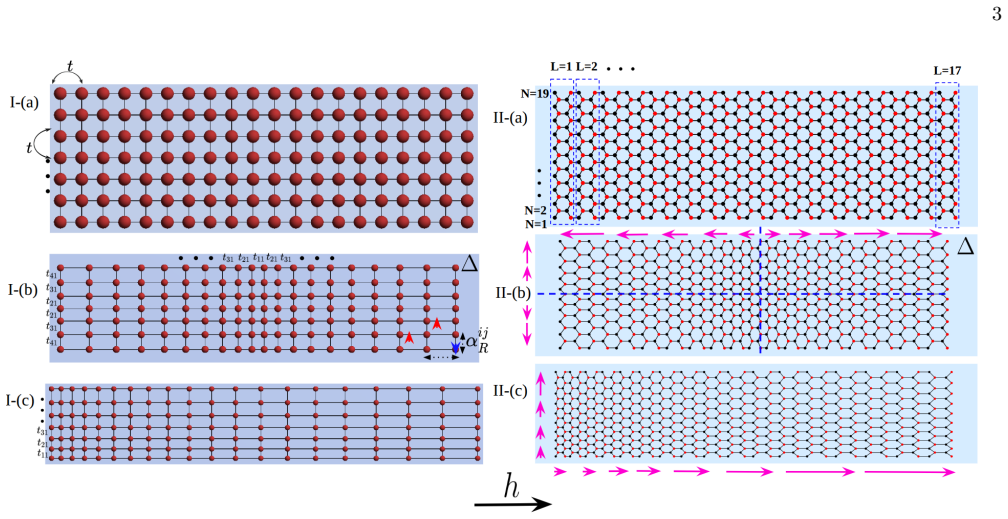
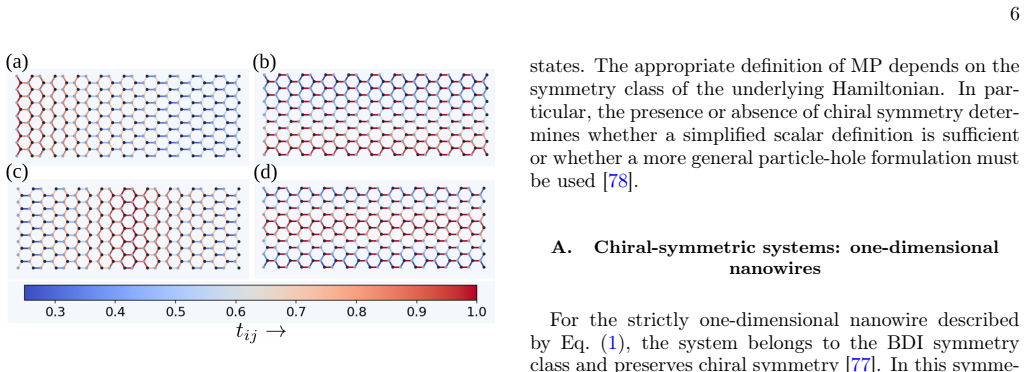
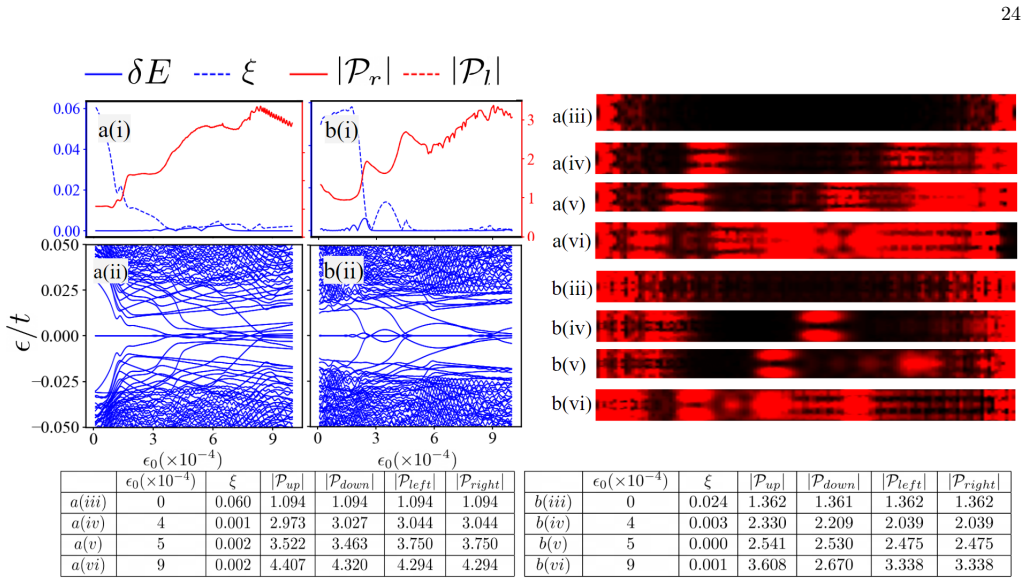
In one-dimensional semiconductor nanowires and graphene nanoribbons with superconductivity, Rashba spin-orbit coupling, Zeeman fields, and disorder, spatially nonuniform strain modifies the low-energy spectrum, reduces spatial overlap of Majorana components, suppresses subband mixing, lifts degeneracies, and converts partially separated Andreev bound states into robust, well-separated Majorana bound states via strain-enhanced nonlocality.
What carries the argument
Position-dependent topological mass together with strain-driven domain-wall motion, which supplies a real-space criterion for the emergence and stability of Majorana modes.
Load-bearing premise
The tight-binding Bogoliubov-de Gennes model with added strain terms accurately captures the physics of real disordered superconductor-semiconductor heterostructures without missing lattice relaxation or other effects.
What would settle it
An experiment on a strained nanowire or nanoribbon that shows no increase in spatial separation of low-energy modes or no conversion from overlapping Andreev-like to separated Majorana-like signatures under applied strain would contradict the predicted crossover mechanism.
Figures






read the original abstract
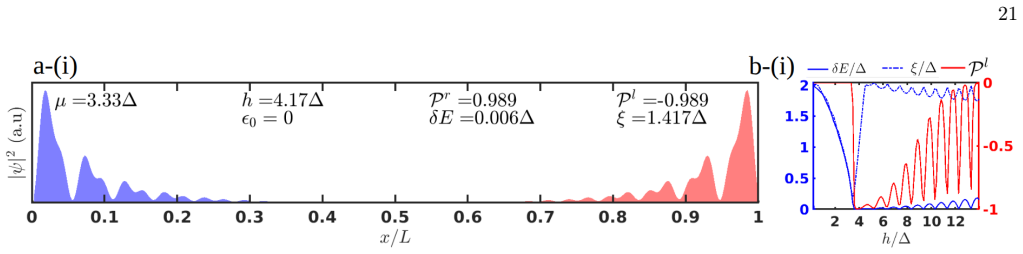
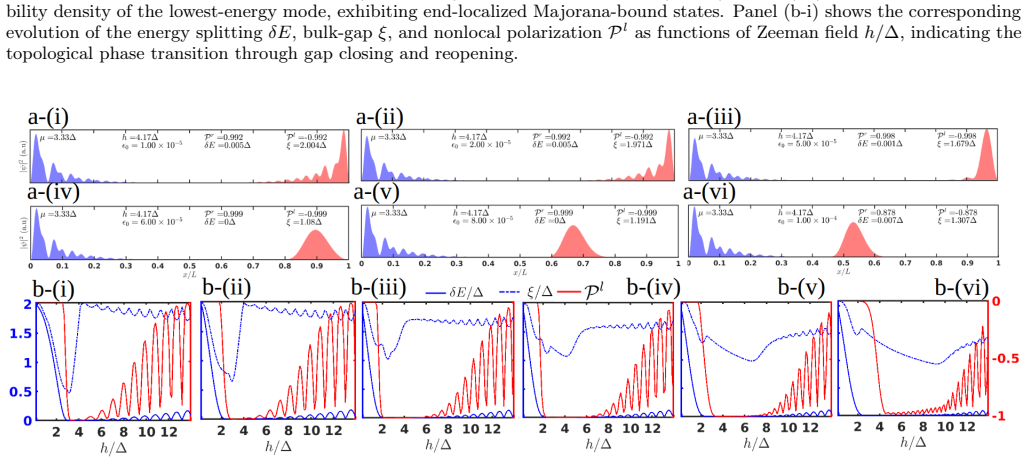
The unambiguous identification of topological Majorana-bound states (MBSs) in superconducting hybrid systems is hindered by trivial low-energy excitations, especially partially separated Andreev bound states (psABSs), which can mimic Majorana signatures. Here we show that spatially nonuniform strain offers a systematic route to control and interconvert these low-energy states. Using tight-binding Bogoliubov--de Gennes simulations, we study one-dimensional semiconductor nanowires and graphene nanoribbons with superconductivity, Rashba spin-orbit coupling, Zeeman fields, and disorder. We find that even weak strain can qualitatively reshape the low-energy spectrum by modifying effective band parameters and redistributing wavefunction weight. In nanowires, strain tunes the spatial overlap of Majorana components and shifts the topological phase boundary, enabling controlled crossovers between trivial states, psABSs, and topological MBSs. In graphene nanoribbons, where multiband effects and edge states produce a dense, hybridized low-energy spectrum, strain suppresses subband mixing, lifts degeneracies, and stabilizes boundary-localized modes. In both platforms, we identify regimes where disorder-induced psABSs are converted into well-separated and robust MBSs through strain-enhanced nonlocality. We further develop an analytical framework based on a position-dependent topological mass and strain-driven domain-wall motion, which captures the physical mechanism of these crossovers and yields a real-space criterion for the emergence and stability of Majorana modes. Our results establish strain as an effective tuning parameter for distinguishing and stabilizing topological MBSs in realistic disordered systems, and suggest an experimentally relevant pathway toward improved control and identification of Majorana modes in complex hybrid structures relevant to topological quantum computation.
Editorial analysis
A structured set of objections, weighed in public.
Referee Report
Summary. The paper claims that spatially nonuniform strain provides a systematic way to control and interconvert trivial partially separated Andreev bound states (psABSs) and topological Majorana bound states (MBSs) in disordered superconductor-semiconductor nanowires and graphene nanoribbons. Using tight-binding Bogoliubov-de Gennes simulations that incorporate superconductivity, Rashba spin-orbit coupling, Zeeman fields, and disorder, the authors show that even weak strain reshapes the low-energy spectrum, tunes spatial overlap of Majorana components, shifts topological phase boundaries, suppresses subband mixing, and converts disorder-induced psABSs into well-separated robust MBSs via enhanced nonlocality. An analytical framework based on a position-dependent topological mass and strain-driven domain-wall motion is developed to explain the mechanism and provide a real-space stability criterion.
Significance. If the numerical results and analytical picture hold under realistic conditions, the work identifies strain as a practical experimental tuning knob for stabilizing and distinguishing MBSs in disordered hybrid systems, which is directly relevant to topological quantum computation. The combination of platform-specific simulations (nanowires and graphene) with a domain-wall interpretation strengthens the mechanistic insight and suggests falsifiable predictions for spectral reshaping and phase-boundary shifts.
major comments (3)
- [Model and Methods (tight-binding BdG Hamiltonian with strain)] The central claim that strain converts psABSs to separated MBSs via enhanced nonlocality rests on the tight-binding BdG model with an added position-dependent strain term. However, the implementation details—specifically how strain modifies hopping amplitudes, whether lattice relaxation is included, and whether strain-induced potential fluctuations at the interface are modeled—are not visible. This is load-bearing because the skeptic concern (missing atomic displacements and new disorder channels) directly affects whether the reported spectral reshaping and crossover survive in real heterostructures.
- [Analytical framework (position-dependent topological mass)] The analytical framework of a position-dependent topological mass and domain-wall motion is used to derive a real-space criterion for MBS emergence. It is unclear how this effective description is derived from the microscopic strained Hamiltonian and whether it remains valid when disorder is strong enough to produce the initial psABSs; a direct comparison between the analytical phase boundary and the numerical spectra (e.g., for specific strain amplitudes) would be needed to confirm it captures the crossover without additional assumptions.
- [Graphene nanoribbon results] In the graphene nanoribbon results, strain is reported to suppress subband mixing and stabilize boundary-localized modes despite the dense hybridized spectrum. The claim would be strengthened by showing that the observed stabilization persists across multiple disorder realizations and is not sensitive to the particular choice of strain profile amplitude or spatial variation, which are free parameters in the model.
minor comments (2)
- [Abstract] The abstract states that 'even weak strain' qualitatively reshapes the spectrum, but no quantitative strain values or units are provided; including a brief statement of the strain amplitude range used in the simulations would improve clarity.
- [Figures] Figure captions and axis labels should explicitly state the disorder strength, Zeeman field, and strain profile parameters for each panel to allow readers to reproduce the crossover behavior.
Simulated Author's Rebuttal
We thank the referee for the careful reading, positive assessment of significance, and constructive major comments. We have revised the manuscript to improve clarity on the model implementation, provide explicit derivation and validation of the analytical framework, and demonstrate robustness of the graphene results. Our point-by-point responses follow.
read point-by-point responses
-
Referee: [Model and Methods (tight-binding BdG Hamiltonian with strain)] The central claim that strain converts psABSs to separated MBSs via enhanced nonlocality rests on the tight-binding BdG model with an added position-dependent strain term. However, the implementation details—specifically how strain modifies hopping amplitudes, whether lattice relaxation is included, and whether strain-induced potential fluctuations at the interface are modeled—are not visible. This is load-bearing because the skeptic concern (missing atomic displacements and new disorder channels) directly affects whether the reported spectral reshaping and crossover survive in real heterostructures.
Authors: We agree that additional implementation details are needed for full transparency. In the revised Methods section we now explicitly state that strain enters the tight-binding Hamiltonian by rescaling nearest-neighbor hopping amplitudes with a position-dependent factor obtained from the deformation-potential approximation (t(r) = t0 [1 − β ε(r)]), where ε(r) is the local strain tensor; lattice relaxation is omitted because the model employs a fixed-lattice approximation standard for mesoscopic BdG simulations of nanowires and nanoribbons. Interface potential fluctuations are not included, as they constitute a secondary disorder channel beyond the scope of the present study; we have added a short paragraph discussing this limitation and arguing that the dominant effect remains the strain-induced tuning of band parameters and nonlocality. These clarifications do not alter the reported spectra but address the referee’s concern about realism. revision: partial
-
Referee: [Analytical framework (position-dependent topological mass)] The analytical framework of a position-dependent topological mass and domain-wall motion is used to derive a real-space criterion for MBS emergence. It is unclear how this effective description is derived from the microscopic strained Hamiltonian and whether it remains valid when disorder is strong enough to produce the initial psABSs; a direct comparison between the analytical phase boundary and the numerical spectra (e.g., for specific strain amplitudes) would be needed to confirm it captures the crossover without additional assumptions.
Authors: The position-dependent topological mass is obtained by projecting the strained microscopic BdG Hamiltonian onto the low-energy subspace near the Fermi level, where nonuniform strain appears as a spatially varying shift in the effective chemical potential and Rashba term, producing a domain-wall profile when the local topological invariant changes sign. We have added a new appendix that walks through this projection step by step. To validate the framework under disorder, we now include direct comparisons (new panels in Figs. 3 and 5) between the analytically predicted phase boundary and the numerically computed low-energy spectra for several strain amplitudes; agreement is quantitative for moderate disorder and remains qualitatively correct even when disorder is strong enough to generate psABSs, because strain-enhanced nonlocality still dominates local scattering. These additions confirm that the real-space criterion captures the crossover without extra assumptions. revision: yes
-
Referee: [Graphene nanoribbon results] In the graphene nanoribbon results, strain is reported to suppress subband mixing and stabilize boundary-localized modes despite the dense hybridized spectrum. The claim would be strengthened by showing that the observed stabilization persists across multiple disorder realizations and is not sensitive to the particular choice of strain profile amplitude or spatial variation, which are free parameters in the model.
Authors: We have performed additional simulations averaging over 20 independent disorder realizations for the graphene nanoribbons. The suppression of subband mixing and the stabilization of boundary-localized modes remain statistically robust, with the average localization length and spectral gap showing only small fluctuations. We have also varied the strain amplitude by ±20 % around the reported values and replaced the linear strain profile with a Gaussian profile; the qualitative conversion of hybridized states into well-separated boundary modes persists in all cases. These results are now documented in the revised supplementary material and strengthen the claim that the effect is not an artifact of a single disorder sample or a specific strain profile. revision: yes
Circularity Check
No circularity; results from direct numerical BdG simulations plus independent analytical model
full rationale
The derivation chain consists of (1) constructing a standard tight-binding BdG Hamiltonian with an added position-dependent strain term, (2) performing numerical diagonalization to obtain spectra and wavefunctions, and (3) introducing an analytical position-dependent topological-mass / domain-wall description to interpret the numerics. None of these steps reduces to a self-definition, a fitted parameter renamed as prediction, or a load-bearing self-citation. The central claims (strain-induced crossover from psABSs to MBSs, shift of topological boundary, strain-enhanced nonlocality) are outputs of the model rather than inputs; the analytical framework is presented as a post-hoc explanatory tool, not as the source of the numerical results. The work is therefore self-contained against external benchmarks.
Axiom & Free-Parameter Ledger
free parameters (1)
- strain profile amplitude and spatial variation
axioms (2)
- domain assumption Tight-binding approximation remains valid under applied strain
- domain assumption Rashba spin-orbit coupling and Zeeman field are uniform and independent of strain
Lean theorems connected to this paper
-
IndisputableMonolith/Cost/FunctionalEquation.leanwashburn_uniqueness_aczel unclear?
unclearRelation between the paper passage and the cited Recognition theorem.
We develop an analytical framework based on a position-dependent topological mass and strain-driven domain-wall motion... M(x) = h² − Δ² − μ_eff(x)²... domain wall condition V_eff(x) = V_c
-
IndisputableMonolith/Foundation/AlexanderDuality.leanalexander_duality_circle_linking unclear?
unclearRelation between the paper passage and the cited Recognition theorem.
The local eigenvalues... gap-closing condition when h² = Δ² + μ_eff(x)²... real-space topological mass M(x)
What do these tags mean?
- matches
- The paper's claim is directly supported by a theorem in the formal canon.
- supports
- The theorem supports part of the paper's argument, but the paper may add assumptions or extra steps.
- extends
- The paper goes beyond the formal theorem; the theorem is a base layer rather than the whole result.
- uses
- The paper appears to rely on the theorem as machinery.
- contradicts
- The paper's claim conflicts with a theorem or certificate in the canon.
- unclear
- Pith found a possible connection, but the passage is too broad, indirect, or ambiguous to say the theorem truly supports the claim.
Reference graph
Works this paper leans on
- [1]
-
[2]
G. Moore and N. Read, Nonabelions in the fractional quantum hall effect, Nuclear Physics B360, 362 (1991)
work page 1991
-
[3]
N. Read and D. Green, Paired states of fermions in two dimensions with breaking of parity and time-reversal symmetries and the fractional quantum hall effect, Phys- ical Review B61, 10267 (2000)
work page 2000
-
[4]
C. Nayak and F. Wilczek, 2n-quasihole states realize 2n- 1-dimensional spinor braiding statistics in paired quan- tum hall states, Nuclear Physics B479, 529 (1996)
work page 1996
-
[5]
A. Y. Kitaev, Annals. Phys.303, 2 (2003)
work page 2003
- [6]
-
[7]
J. D. Sau, R. M. Lutchyn, S. Tewari, and S. D. Sarma, Generic new platform for topological quantum computa- tion using semiconductor heterostructures, Physical re- view letters104, 040502 (2010)
work page 2010
-
[8]
J. D. Sau, S. Tewari, R. M. Lutchyn, T. D. Stanescu, and S. D. Sarma, Non-abelian quantum order in spin-orbit- coupled semiconductors: Search for topological majorana particles in solid-state systems, Physical Review B82, 214509 (2010)
work page 2010
-
[9]
Y. Oreg, G. Refael, and F. von Oppen, Helical liquids and majorana bound states in quantum wires, Physical review letters105, 177002 (2010)
work page 2010
-
[10]
R. M. Lutchyn, J. D. Sau, and S. D. Sarma, Ma- jorana fermions and a topological phase transition in semiconductor-superconductor heterostructures, Physi- cal review letters105, 077001 (2010)
work page 2010
-
[11]
K. Sengupta, I. Žutić, H.-J. Kwon, V. M. Yakovenko, and S.D.Sarma,Midgapedgestatesandpairingsymmetryof quasi-one-dimensional organic superconductors, Physical Review B63, 144531 (2001)
work page 2001
-
[12]
K. Law, P. A. Lee, and T. Ng, Majorana fermion induced resonant andreev reflection, Physical review letters103, 237001 (2009)
work page 2009
-
[13]
K. Flensberg, Tunneling characteristics of a chain of 18 majorana bound states, Physical Review B82, 180516 (2010)
work page 2010
- [14]
-
[15]
M. Deng, C. Yu, G. Huang, M. Larsson, P. Caroff, and H. Xu, Anomalous zero-bias conductance peak in a nb– insb nanowire–nb hybrid device, Nano letters12, 6414 (2012)
work page 2012
-
[16]
A. Das, Y. Ronen, Y. Most, Y. Oreg, M. Heiblum, and H. Shtrikman, Zero-bias peaks and splitting in an al– inas nanowire topological superconductor as a signature of majorana fermions, Nature Physics8, 887 (2012)
work page 2012
-
[17]
L. P. Rokhinson, X. Liu, and J. K. Furdyna, The fractional ac josephson effect in a semiconductor– superconductor nanowire as a signature of majorana par- ticles, Nature Physics8, 795 (2012)
work page 2012
-
[18]
H. Churchill, V. Fatemi, K. Grove-Rasmussen, M. Deng, P. Caroff, H. Xu, and C. M. Marcus, Superconductor- nanowire devices from tunneling to the multichannel regime: Zero-bias oscillations and magnetoconductance crossover, Physical Review B87, 241401 (2013)
work page 2013
- [19]
-
[20]
M. Deng, S. Vaitiek˙ enas, E. B. Hansen, J. Danon, M. Lei- jnse, K. Flensberg, J. Nygård, P. Krogstrup, and C. M. Marcus, Majorana bound state in a coupled quantum-dot hybrid-nanowire system, Science354, 1557 (2016)
work page 2016
- [21]
-
[22]
J.Chen, P.Yu, J.Stenger, M.Hocevar, D.Car, S.R.Plis- sard, E.P.Bakkers, T.D.Stanescu,andS.M.Frolov,Ex- perimental phase diagram of zero-bias conductance peaks in superconductor/semiconductor nanowire devices, Sci- ence advances3, e1701476 (2017)
work page 2017
-
[23]
F. Nichele, A. C. Drachmann, A. M. Whiticar, E. C. O’Farrell, H. J. Suominen, A. Fornieri, T. Wang, G. C. Gardner, C.Thomas, A.T.Hatke,et al.,Scalingofmajo- rana zero-bias conductance peaks, Physical review letters 119, 136803 (2017)
work page 2017
-
[24]
S. Albrecht, E. Hansen, A. P. Higginbotham, F. Kuem- meth, T. Jespersen, J. Nygård, P. Krogstrup, J. Danon, K. Flensberg, and C. Marcus, Transport signatures of quasiparticle poisoning in a majorana island, Physical review letters118, 137701 (2017)
work page 2017
-
[25]
E. O Farrell, A. Drachmann, M. Hell, A. Fornieri, A. Whiticar, E. Hansen, S. Gronin, G. Gardner, C. Thomas, M. Manfra,et al., Hybridization of subgap states in one-dimensional superconductor-semiconductor coulomb islands, Physical review letters121, 256803 (2018)
work page 2018
-
[26]
J. Shen, S. Heedt, F. Borsoi, B. Van Heck, S. Gaz- ibegovic, R.L.O.hetVeld, D.Car, J.A.Logan, M.Pend- harkar, S. J. Ramakers,et al., Parity transitions in the superconducting ground state of hybrid insb–al coulomb islands, Nature communications9, 4801 (2018)
work page 2018
-
[27]
D. Sherman, J. Yodh, S. M. Albrecht, J. Nygård, P. Krogstrup, and C. M. Marcus, Normal, superconduct- ing and topological regimes of hybrid double quantum dots, Nature nanotechnology12, 212 (2017)
work page 2017
-
[28]
S. Vaitiek˙ enas, A. Whiticar, M.-T. Deng, F. Krizek, J. Sestoft, C. Palmstrøm, S. Marti-Sanchez, J. Arbiol, P. Krogstrup, L. Casparis,et al., Selective-area-grown semiconductor-superconductor hybrids: A basis for topo- logical networks, Physical review letters121, 147701 (2018)
work page 2018
-
[29]
S. M. Albrecht, A. P. Higginbotham, M. Madsen, F. Kuemmeth, T. S. Jespersen, J. Nygård, P. Krogstrup, and C. Marcus, Exponential protection of zero modes in majorana islands, Nature531, 206 (2016)
work page 2016
-
[30]
P. Yu, J. Chen, M. Gomanko, G. Badawy, E. P. A. M. Bakkers, K. Zuo, V. Mourik, and S. M. Frolov, Non- majorana states yield nearly quantized conductance in proximatized nanowires, Nature Physics17, 482–488 (2021)
work page 2021
-
[31]
M. A. Quantum, M. Aghaee, A. Alcaraz Ramirez, Z. Alam, R. Ali, M. Andrzejczuk, A. Antipov, M. Astafev, A. Barzegar, B. Bauer,et al., Interferometric single-shot parity measurement in inas–al hybrid devices, Nature638, 651 (2025)
work page 2025
- [32]
-
[33]
S. Głodzik, N. Sedlmayr, and T. Domański, How to measure the majorana polarization of a topological pla- nar josephson junction, Physical Review B102, 085411 (2020)
work page 2020
-
[34]
L.Rossi, F.Dolcini,andF.Rossi,Majorana-likelocalized spin density without bound states in topologically trivial spin-orbit coupled nanowires, Physical Review B101, 195421 (2020)
work page 2020
- [35]
- [36]
-
[37]
G. Sharma and S. Tewari, Tunneling conductance for majorana fermions in spin-orbit coupled semiconductor- superconductor heterostructures using superconducting leads, Physical Review B93, 195161 (2016)
work page 2016
- [38]
- [39]
-
[40]
S. Mi, D. I. Pikulin, M. Marciani, and C. W. J. Beenakker, X-shaped and y-shaped andreev resonance profiles in a superconducting quantum dot, Journal of Experimental and Theoretical Physics119, 1018 (2014)
work page 2014
-
[41]
D. Bagrets and A. Altland, Classdspectral peak in majorana quantum wires, Phys. Rev. Lett.109, 227005 (2012)
work page 2012
-
[42]
D. I. Pikulin, J. Dahlhaus, M. Wimmer, H. Schomerus, and C. Beenakker, A zero-voltage conductance peak from weak antilocalization in a majorana nanowire, New Jour- 19 nal of Physics14, 125011 (2012)
work page 2012
- [43]
- [44]
- [45]
- [46]
- [47]
-
[48]
T. D. Stanescu and S. Tewari, Robust low-energy an- dreev bound states in semiconductor-superconductor structures: Importance of partial separation of compo- nent majorana bound states, Phys. Rev. B100, 155429 (2019)
work page 2019
-
[49]
P. San-Jose, J. Cayao, E. Prada, and R. Aguado, Ma- jorana bound states from exceptional points in non- topological superconductors, Scientific Reports6, 21427 (2016)
work page 2016
- [50]
-
[51]
O. A. Awoga, J. Cayao, and A. M. Black-Schaffer, Su- percurrent detection of topologically trivial zero-energy states in nanowire junctions, Phys. Rev. Lett.123, 117001 (2019)
work page 2019
- [52]
-
[53]
C. Zeng, G. Sharma, T. D. Stanescu, and S. Tewari, Feasibility of measurement-based braiding in the quasi- majorana regime of semiconductor-superconductor het- erostructures, Physical Review B102, 205101 (2020)
work page 2020
-
[54]
C. Zeng, G. Sharma, S. Tewari, and T. Stanescu, Par- tially separated majorana modes in a disordered medium, Physical Review B105, 205122 (2022)
work page 2022
- [55]
-
[56]
J. Cayao and A. M. Black-Schaffer, Distinguishing triv- ial and topological zero-energy states in long nanowire junctions, Physical Review B104(2021)
work page 2021
-
[57]
H. Zhang, M. W. A. de Moor, J. D. S. Bommer, D. Xu, G. Wang, N. van Loo, C.-X. Liu, S. Gazibegovic, J. A. Logan, D. Car, R. L. M. O. het Veld, P. J. van Veldhoven, S. Koelling, M. A. Verheijen, M. Pendharkar, D. J. Pen- nachio, B. Shojaei, J. S. Lee, C. J. Palmstrøm, E. P. A. M. Bakkers, S. D. Sarma, and L. P. Kouwenhoven, Large zero-bias peaks in insb-al...
work page 2021
-
[58]
S. D. Sarma and H. Pan, Disorder-induced zero-bias peaks in majorana nanowires (2021)
work page 2021
-
[59]
Frolov, Quantum computing’s reproducibility crisis: Majorana fermions, Nature592, 350 (2021)
S. Frolov, Quantum computing’s reproducibility crisis: Majorana fermions, Nature592, 350 (2021)
work page 2021
- [60]
-
[61]
A. H. Castro Neto, F. Guinea, N. M. Peres, K. S. Novoselov, and A. K. Geim, The electronic properties of graphene, Reviews of modern physics81, 109 (2009)
work page 2009
- [62]
-
[63]
V. Kaladzhyan and C. Bena, Formation of majorana fermions in finite-size graphene strips, SciPost Physics 3, 002 (2017)
work page 2017
-
[64]
V. Kaladzhyan, J. Despres, I. Mandal, and C. Bena, Ma- jorana fermions in finite-size strips with in-plane mag- netic fields, The European Physical Journal B90, 1 (2017)
work page 2017
-
[65]
P. San-Jose, J. L. Lado, R. Aguado, F. Guinea, and J. Fernández-Rossier, Majorana zero modes in graphene, Phys. Rev. X5, 041042 (2015)
work page 2015
-
[66]
K. Laubscher, D. Loss, and J. Klinovaja, Majorana and parafermion corner states from two coupled sheets of bilayer graphene, Physical Review Research2, 013330 (2020)
work page 2020
-
[67]
Z.-H. Wang, E. V. Castro, and H.-Q. Lin, Strain ma- nipulation of majorana fermions in graphene armchair nanoribbons, Physical Review B97, 041414 (2018)
work page 2018
-
[68]
A. L. Manesco, G. Weber, and D. Rodrigues Jr, Effective model for majorana modes in graphene, Physical Review B100, 125411 (2019)
work page 2019
-
[69]
G. Signorello, S. Sant, N. Bologna, M. Schraff, U. Drech- sler, H. Schmid, S. Wirths, M. D. Rossell, A. Schenk, and H. Riel, Manipulating surface states of iii–v nanowires with uniaxial stress, Nano letters17, 2816 (2017)
work page 2017
-
[70]
L. Zeng, C. Gammer, B. Ozdol, T. Nordqvist, J. Nygard, P. Krogstrup, A. M. Minor, W. Jaager, and E. Olsson, Correlation between electrical transport and nanoscale strain in inas/in0. 6ga0. 4as core–shell nanowires, Nano Letters18, 4949 (2018)
work page 2018
-
[71]
C. Chen, P. Das, E. Aytan, W. Zhou, J. Horowitz, B. Sat- pati, A. A. Balandin, R. K. Lake, and P. Wei, Strain- controlled superconductivity in few-layer nbse2, ACS ap- plied materials & interfaces12, 38744 (2020)
work page 2020
- [72]
-
[73]
M.A.Vozmediano, M.Katsnelson,andF.Guinea,Gauge fields in graphene, Physics Reports496, 109 (2010)
work page 2010
-
[74]
V. M. Pereira and A. Castro Neto, Strain engineering of graphene’s electronic structure, Physical review letters 103, 046801 (2009)
work page 2009
-
[75]
N. Levy, S. A. Burke, K. Meaker, M. Panlasigui, A. Zettl, F. Guinea, A. C. Neto, and M. F. Crommie, Strain- induced pseudo–magnetic fields greater than 300 tesla in graphene nanobubbles, science329, 544 (2010)
work page 2010
-
[76]
D.-H. Kang, H. Sun, M. Luo, K. Lu, M. Chen, Y. Kim, Y. Jung, X. Gao, S. J. Parluhutan, J. Ge,et al., Pseudo- magnetic field-induced slow carrier dynamics in period- ically strained graphene, Nature Communications12, 5087 (2021)
work page 2021
-
[77]
S. Tewari and J. D. Sau, Topological invariants for spin- 20 orbit coupled superconductor nanowires, Physical review letters109, 150408 (2012)
work page 2012
-
[78]
S. Karoliya, S. Tewari, and G. Sharma, Majorana po- larization in disordered quasi-one-dimensional hybrid nanowires, Physical Review B112, 165410 (2025)
work page 2025
-
[79]
S. Das Sarma, S. Adam, E. Hwang, and E. Rossi, Elec- tronic transport in two-dimensional graphene, Reviews of modern physics83, 407 (2011)
work page 2011
-
[80]
D. Sticlet, C. Bena, and P. Simon, Spin and majorana po- larization in topological superconducting wires, Physical Review Letters108, 096802 (2012)
work page 2012
discussion (0)
Sign in with ORCID, Apple, or X to comment. Anyone can read and Pith papers without signing in.