Recognition: 1 theorem link
· Lean TheoremValley-Controlled Viscosity of Two-Dimensional Dirac Fluids
Pith reviewed 2026-05-13 00:54 UTC · model grok-4.3
The pith
Shifting the two low-energy Dirac cones relative to one another directly controls the viscosity of the electron fluid in twisted bilayer graphene.
A machine-rendered reading of the paper's core claim, the machinery that carries it, and where it could break.
Core claim
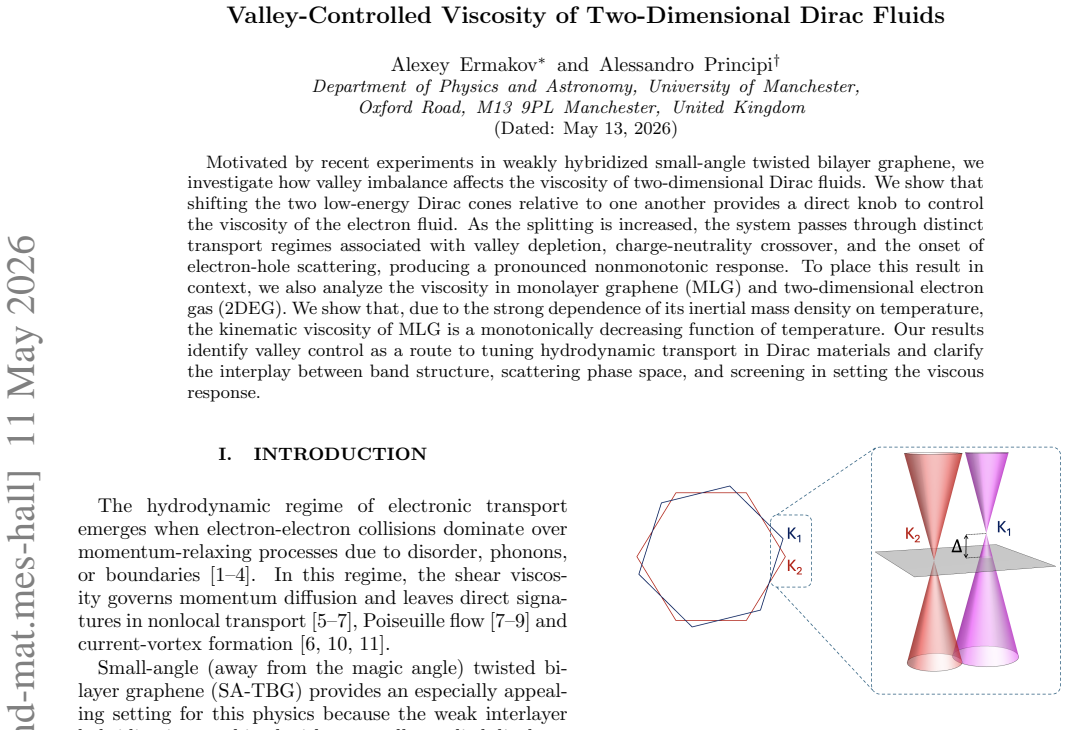
Shifting the two low-energy Dirac cones relative to one another provides a direct knob to control the viscosity of the electron fluid. As the splitting is increased, the system passes through distinct transport regimes associated with valley depletion, charge-neutrality crossover, and the onset of electron-hole scattering, producing a pronounced nonmonotonic response. In monolayer graphene the kinematic viscosity is a monotonically decreasing function of temperature owing to the strong temperature dependence of its inertial mass density.
What carries the argument
The relative shift of the two Dirac cones that generates valley imbalance and thereby selects among depletion, neutrality, and electron-hole scattering regimes.
If this is right
- Viscosity responds nonmonotonically to increasing valley splitting.
- Monolayer graphene kinematic viscosity decreases steadily with temperature.
- Valley imbalance supplies a practical route to tune hydrodynamic transport in Dirac materials.
- Band structure, scattering phase space, and screening together fix the viscous response.
Where Pith is reading between the lines
- Gate or twist-angle control of the cone shift could let experiments dial viscosity up or down in real devices.
- The same valley-tuning idea may extend to other multi-valley Dirac systems such as transition-metal dichalcogenides.
- Hydrodynamic signatures at the charge-neutrality point could become sharper or weaker depending on the chosen splitting.
Load-bearing premise
The scattering mechanisms and screening model assumed for weakly hybridized small-angle twisted bilayer graphene remain valid across the three transport regimes.
What would settle it
A measurement of viscosity versus valley splitting in small-angle twisted bilayer graphene that shows only monotonic behavior without the predicted depletion, crossover, and scattering features.
Figures





read the original abstract
Motivated by recent experiments in weakly hybridized small-angle twisted bilayer graphene, we investigate how valley imbalance affects the viscosity of two-dimensional Dirac fluids. We show that shifting the two low-energy Dirac cones relative to one another provides a direct knob to control the viscosity of the electron fluid. As the splitting is increased, the system passes through distinct transport regimes associated with valley depletion, charge-neutrality crossover, and the onset of electron-hole scattering, producing a pronounced nonmonotonic response. To place this result in context, we also analyze the viscosity in monolayer graphene (MLG) and two-dimensional electron gas (2DEG). We show that, due to the strong dependence of its inertial mass density on temperature, the kinematic viscosity of MLG is a monotonically decreasing function of temperature. Our results identify valley control as a route to tuning hydrodynamic transport in Dirac materials and clarify the interplay between band structure, scattering phase space, and screening in setting the viscous response.
Editorial analysis
A structured set of objections, weighed in public.
Referee Report
Summary. The paper claims that shifting the relative positions of the two low-energy Dirac cones in 2D Dirac fluids (motivated by weakly hybridized small-angle twisted bilayer graphene) provides a direct control parameter for the fluid viscosity. As the valley splitting increases, the system traverses three regimes—valley depletion, charge-neutrality crossover, and onset of electron-hole scattering—producing a pronounced nonmonotonic viscosity. The authors contrast this with monolayer graphene, where kinematic viscosity decreases monotonically with temperature due to the T-dependent inertial mass density, and with a conventional 2DEG.
Significance. If the central derivation holds, the work identifies valley splitting as a tunable knob for hydrodynamic transport in Dirac materials and clarifies how band-structure details, scattering phase space, and screening together set the viscous response. It extends standard kinetic-theory treatments of Dirac hydrodynamics with a concrete, experimentally relevant prediction.
minor comments (3)
- §3 (or equivalent derivation section): the transition points between the three regimes are stated qualitatively; an explicit expression or plot of viscosity versus valley splitting (with the relevant scattering rates and screening lengths) would make the nonmonotonic claim easier to verify.
- The MLG comparison paragraph: the statement that inertial mass density depends strongly on temperature is central to the monotonicity claim; a short derivation or reference to the explicit T-dependence of the density of states would strengthen the contrast with the valley-split case.
- Figure captions and axis labels: ensure all curves are labeled with the specific values of valley splitting, temperature, and screening length used, and that error bars or uncertainty estimates (if any) are indicated.
Simulated Author's Rebuttal
We thank the referee for their careful reading of the manuscript, positive assessment of its significance, and recommendation for minor revision. No specific major comments were raised in the report.
Circularity Check
No significant circularity; derivation is model-based and self-contained
full rationale
The paper derives the nonmonotonic viscosity response from a standard kinetic-theory treatment of the stress tensor in a two-valley Dirac fluid, analyzing regimes (valley depletion, charge-neutrality crossover, electron-hole scattering) as cone splitting increases. No parameters are fitted to the target viscosity and then relabeled as predictions; no self-citations are invoked as load-bearing uniqueness theorems; the MLG/2DEG limits are standard comparisons with known T-dependence from linear dispersion. The central claim follows from the model's equations without reducing to its inputs by construction.
Axiom & Free-Parameter Ledger
Reference graph
Works this paper leans on
-
[1]
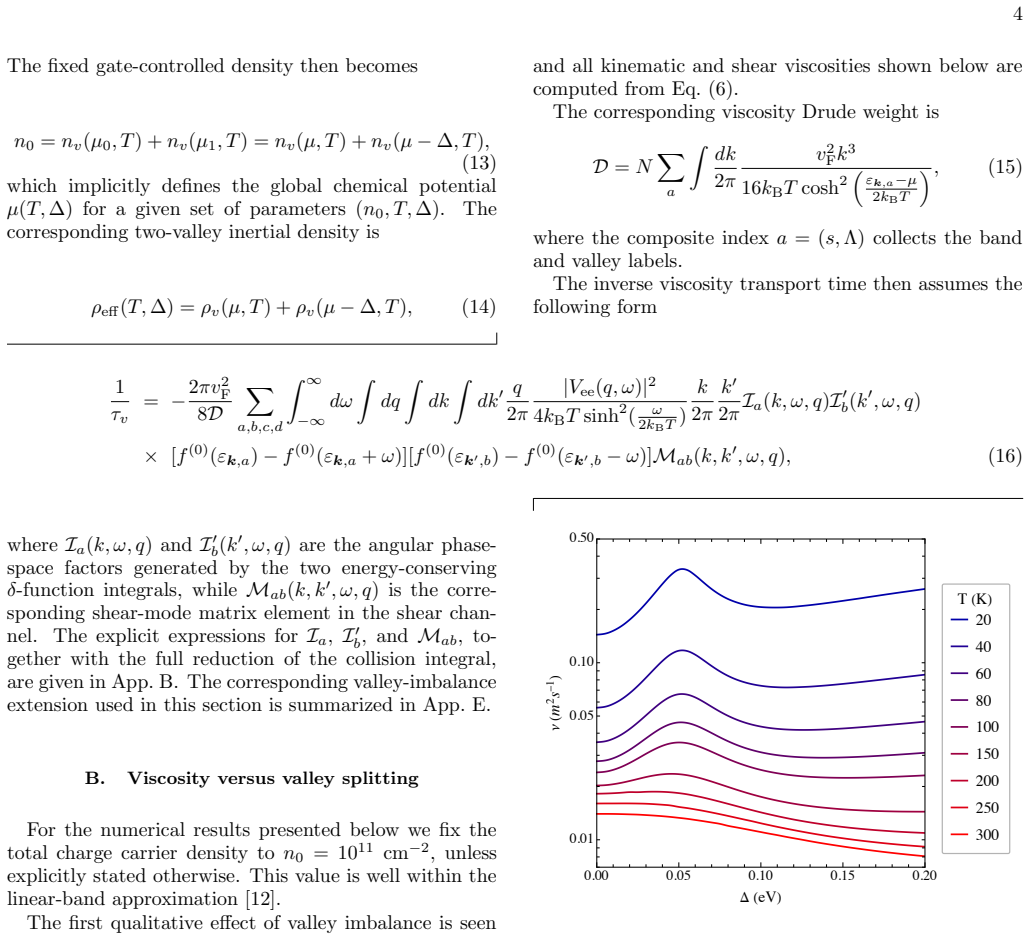
Numerically we find a pronounced maximum of ν(∆, T) at ∆ = ∆ max(T)
Evolution of the maximum∆ max(T). Numerically we find a pronounced maximum of ν(∆, T) at ∆ = ∆ max(T). Physically, this occurs when the shifted valley Λ = 1 is tuned close to charge neutral- ity, µ1 =µ−∆≃0 =⇒∆ max(T)≃µ(T,∆ max).(19) Under the conditionµ 1 = 0, the Λ = 1 valley carries no net charge,n v(0, T) = 0, and the density constraint (13) reduces to...
-
[2]
Evolution of the local minimum∆ min(T). At larger valley splitting the shifted valley becomes hole doped,µ 1 <0, and strong electron-hole scattering channels become available. We empirically find a sec- ond minimum ofν(∆, T) at ∆ = ∆ min(T). To obtain a simple analytic estimate, we assume that the minimum is reached once a moderately developed hole pocket...
-
[3]
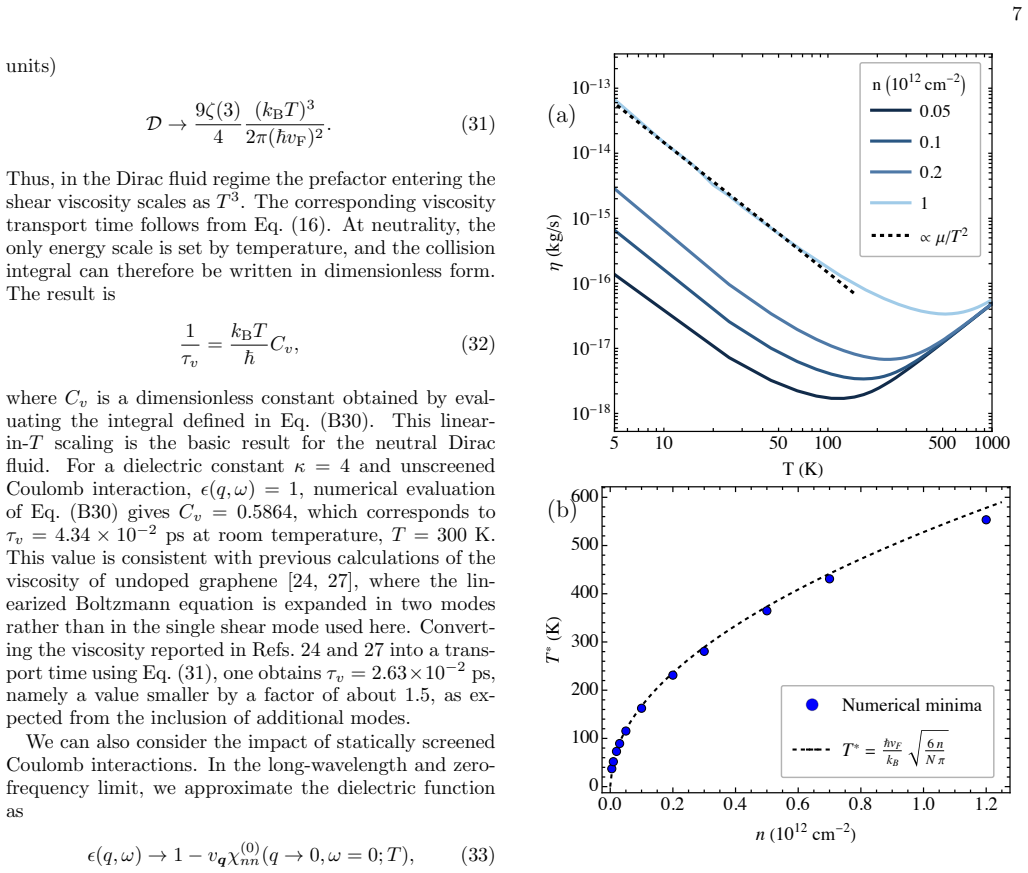
Neutrality-point Dirac fluid At charge neutrality,µ= 0, the viscosity Drude weight of Eq. (15) can be evaluated analytically (restoring all the 7 units) D → 9ζ(3) 4 (kBT) 3 2π(ℏvF)2 .(31) Thus, in the Dirac fluid regime the prefactor entering the shear viscosity scales asT 3. The corresponding viscosity transport time follows from Eq. (16). At neutrality,...
-
[4]
Finite density and the minimal-viscosity regime We now turn to doped monolayer graphene. At fixed carrier density, the chemical potential is temperature de- pendent,µ=µ(n 0, T) and can be determined by invert- 8 n 1012 cm-2 0.05 0.1 0.2 1 ∝ T-1 5 10 50 100 500 100010-14 10-13 10-12 10-11 T (K) τv (s) (a) Bare interaction n 1012 cm-2 0.05 0.1 0.2 1 ∝ T...
-
[5]
Screening and low-Tasymptotics in the shear channel The role of screening in the shear channel deserves to be stated separately. First, we introduce the Thomas- 9 ● ● ● ● ● ● ●●●●●●●●●●●●●●●●●●●●●●●●●●●●●●●●●●●●● ● ● ● ● ● ● ●●●●●●●●●●●●●●●●●●●●●●●●●●●●●●●●●●●●● ● ● ● ●● ● ● ●●●●●●●●●●●●●●●●●●●●●●●●●●●●●●●●●●●● ● Bare ● qTF/100 ● Fullq TF ∝T-2 ∝(T2ln(T))-...
work page 2023
-
[6]
(4) byA µν k,λ and sum overkandλ
Solving the linearized Boltzmann equation To findτ v we multiply Eq. (4) byA µν k,λ and sum overkandλ. Eq. 4 becomes Duµν = 2πτ 4kBT X q,k,k′ X λ,λ′,λ′′,λ′′′ |Vee(q, εk,λ −ε k+q,λ′′)|2F(k, λ;k+q, λ ′′)F(k ′, λ′;k ′ −q, λ ′′′) ×δ(ε k,λ +ε k′,λ′ −ε k+q,λ′′ −ε k′−q,λ′′′)f(0) k,λf(0) k′,λ′(1−f (0) k+q,λ′′)(1−f (0) k′−q,λ′′′) ×(A µν k,λ +A µν k′,λ′ −A µν k+q,λ...
-
[7]
The integration boundaries We shiftφ k, φk′ →φ k +φ q, φk′ +φ q. The delta functionδ(ω+ε k,λ −ε k+q,λ′′) is solved by λ′′(ω+λv Fk)−v F p k2 +q 2 + 2kqcos(φ k) = 0.(B8) The solution of the delta functionδ(ε k′,λ′ −ε k′−q,λ′′′ −ω) can be found from the previous one by settingk→k ′, λ→ λ′, λ′′ →λ ′′′ andq, ω→ −q,−ω. Thus, we will not discuss it in detail, bu...
-
[8]
The matrix element of the viscosity The matrix element on the last line of Eq. B8 reads Mλλ′(k, k′, ω, q)≡ λkcos(2φ k) +λ ′k′ cos(2φk′)−λ ′′|k+q|cos(2φ k+q)−λ ′′′|k′ −q|cos(2φ k′−q) 2 = 4 λkcos 2(φk) +λ ′k′ cos2(φk′)−λ ′′|k+q|cos 2(φk+q)−λ ′′′|k′ −q|cos 2(φk′−q) 2 = 4 " λkcos 2(φk)− kcos(φ k) +qcos(φ q) 2 ω/vF +λk +λ ′k′ cos2(φk′)− k′ cos(φk′)−qcos(φ q) 2...
-
[9]
The integral of the delta function We now evaluate Iλ(k, ω, q) = Z 2π 0 dφk 2π δ(ω+ε k,λ −ε k+q,λ′′)F(k, λ;k+q, λ ′′) = Z π 0 dφk 2π δ(ω+ε k,λ −ε k+q,λ′′) 1 +λ k+qcos(φ k −φ q) λk+ω/v F .(B19) 15 We shiftφ k →φ k +φ q, and using Eq. B9 we get Iλ(k, ω, q) = 2λ (ω+ 2λv Fk)2 −v 2 Fq2 2vFk(λvFk+ω) 1 2π |ω+λv Fk| v2 Fkq q 1−cos 2(φ(0) k ) .(B20) Finally, using...
-
[10]
Final integral for the viscosity transport time The final integral takes the form of Eq. 16. To find the temperature dependence of Eq. 16, we scale the various quantities as follows ω=k BT¯ω, q=k BT¯q/vF, k=k BT ¯k/vF, k ′ =k BT ¯k′/vF, µ=k BT¯µ.(B23) The delta-function integrals are then Iλ(k, ω, q) = 1 2π 2λ(kBT) 2 (¯ω+ 2λ¯k)2 −¯q2 (kBT) 22¯k(λ¯k+ ¯ω) 2...
-
[11]
M. J. M. de Jong and L. W. Molenkamp, Phys. Rev. B 51, 13389 (1995)
work page 1995
-
[12]
A. V. Andreev, S. A. Kivelson, and B. Spivak, Phys. Rev. Lett.106, 256804 (2011)
work page 2011
- [13]
- [14]
- [15]
-
[16]
D. A. Bandurin, I. Torre, R. Krishna Kumar, M. Ben Shalom, A. Tomadin, A. Principi, G. H. Auton, E. Khestanova, K. S. Novoselov, I. V. Grigorieva, L. A. Ponomarenko, A. K. Geim, and M. Polini, Science351, 1055 (2016)
work page 2016
-
[17]
J. A. Sulpizio, L. Ella, A. Rozen, J. Birkbeck, D. J. Perello, D. Dutta, M. Ben-Shalom, T. Taniguchi, K. Watanabe, T. Holder, R. Queiroz, A. Principi, A. Stern, T. Scaffidi, A. K. Geim, and S. Ilani, Nature 576, 75 (2019)
work page 2019
-
[18]
R. Krishna Kumar, D. A. Bandurin, F. M. D. Pel- legrino, Y. Cao, A. Principi, H. Guo, G. H. Auton, M. Ben Shalom, L. A. Ponomarenko, G. Falkovich, K. Watanabe, T. Taniguchi, I. V. Grigorieva, L. S. Lev- itov, M. Polini, and A. K. Geim, Nat. Phys.13, 1182 (2017)
work page 2017
-
[19]
M. J. H. Ku, T. X. Zhou, Q. Li, Y. J. Shin, J. K. Shi, C. Burch, L. E. Anderson, A. T. Pierce, Y. Xie, A. Hamo, U. Vool, H. Zhang, F. Casola, T. Taniguchi, K. Watanabe, M. M. Fogler, P. Kim, A. Yacoby, and R. L. Walsworth, Nature583, 537 (2020)
work page 2020
- [20]
-
[21]
K. A. Guerrero-Becerra, F. M. D. Pellegrino, and M. Polini, Phys. Rev. B99, 041407(R) (2019)
work page 2019
-
[22]
D. A. Bandurin, A. Principi, I. Y. Phinney, T. Taniguchi, K. Watanabe, and P. Jarillo-Herrero, Phys. Rev. Lett. 129, 206802 (2022)
work page 2022
-
[23]
J. M. B. Lopes dos Santos, N. M. R. Peres, and A. H. Castro Neto, Phys. Rev. Lett.99, 256802 (2007)
work page 2007
-
[24]
R. Bistritzer and A. H. MacDonald, Proc. Natl. Acad. Sci. U.S.A.108, 12233 (2011)
work page 2011
-
[25]
Y. Cao, V. Fatemi, A. Demir, S. Fang, S. L. Tomarken, J. Y. Luo, J. D. Sanchez-Yamagishi, K. Watanabe, T. Taniguchi, E. Kaxiras, R. C. Ashoori, and P. Jarillo- Herrero, Nature556, 80 (2018)
work page 2018
-
[26]
R. V. Gorbachev, J. C. W. Song, G. L. Yu, A. V. Kre- tinin, F. Withers, Y. Cao, A. Mishchenko, I. V. Grig- orieva, K. S. Novoselov, L. S. Levitov, and A. K. Geim, Science346, 448 (2014). 20
work page 2014
-
[27]
M. Sui, G. Chen, L. Ma, W.-Y. Shan, D. Tian, K. Watan- abe, T. Taniguchi, X. Jin, W. Yao, D. Xiao, and Y. Zhang, Nat. Phys.11, 1027 (2015)
work page 2015
-
[28]
H. Chen, P. Zhou, J. Liu, J. Qiao, B. Oezyilmaz, and J. Martin, Nat. Commun.11, 1202 (2020)
work page 2020
-
[29]
L. Liu, S. Zhang, Y. Chu, C. Shen, Y. Huang, Y. Yuan, J. Tian, J. Tang, Y. Ji, R. Yang, K. Watanabe, T. Taniguchi, D. Shi, J. Liu, W. Yang, and G. Zhang, Nat. Commun.13, 3292 (2022)
work page 2022
-
[30]
A. Aharon-Steinberg, T. V¨ olkl, A. Kaplan,et al., Nature 607, 74 (2022)
work page 2022
-
[31]
E. H. Hwang and S. Das Sarma, Phys. Rev. B77, 115449 (2008)
work page 2008
-
[32]
D. K. Efetov and P. Kim, Phys. Rev. Lett.105, 256805 (2010)
work page 2010
-
[33]
S. M. Davis, F. Wu, and S. Das Sarma, Phys. Rev. B 107, 235155 (2023)
work page 2023
-
[34]
M. M¨ uller, J. Schmalian, and L. Fritz, Phys. Rev. Lett. 103, 025301 (2009)
work page 2009
- [35]
- [36]
-
[37]
B. N. Narozhny, Ann. Phys. (N.Y.)411, 167979 (2019)
work page 2019
-
[38]
P. K. Kovtun, D. T. Son, and A. O. Starinets, Phys. Rev. Lett.94, 111601 (2005)
work page 2005
-
[39]
A. Principi, G. Vignale, M. Carrega, and M. Polini, Phys. Rev. B93, 125410 (2016)
work page 2016
-
[40]
K. Pongsangangan, P. Cosme, E. Di Salvo, and L. Fritz, Phys. Rev. B110, 045443 (2024)
work page 2024
- [41]
-
[42]
L. D. Landau and E. M. Lifshitz,Fluid Mechanics, 2nd ed. (Pergamon Press, Oxford, 1987)
work page 1987
-
[43]
Shankar, Reviews of Modern Physics66, 129 (1994)
R. Shankar, Reviews of Modern Physics66, 129 (1994)
work page 1994
discussion (0)
Sign in with ORCID, Apple, or X to comment. Anyone can read and Pith papers without signing in.