Recognition: no theorem link
Quantum Fanout Gates in Constant Depth via Resonance Engineering
Pith reviewed 2026-05-13 03:30 UTC · model grok-4.3
The pith
Resonance engineering with a shared oscillator implements n-qubit fanout gates in constant depth.
A machine-rendered reading of the paper's core claim, the machinery that carries it, and where it could break.
Core claim
By tuning the qubit-oscillator couplings to selected resonance conditions, the state of one control qubit is copied to all target qubits simultaneously through collective dynamics of the shared bosonic mode. The full operation completes in time independent of n, with an upper bound on total error that grows linearly rather than quadratically with system size.
What carries the argument
Jaynes-Cummings coupling of several qubits to a single harmonic oscillator, with resonance frequencies engineered so that the control qubit's excitation spreads to all targets in one collective step.
If this is right
- Stabilizer readouts in surface codes or other error-correcting schemes can be completed in fixed time rather than scaling with code distance.
- Quantum algorithms whose depth is dominated by fanout or parity-check layers receive a direct constant-factor speedup.
- Large-scale simulations become tractable because permutation symmetry collapses the Hilbert space to a polynomial-sized effective model.
- The linear error scaling remains favorable even when the oscillator is treated as a finite-dimensional mode rather than an ideal harmonic oscillator.
Where Pith is reading between the lines
- The same resonance-engineering pattern could be adapted to implement other collective gates such as multi-controlled operations without increasing depth.
- Because the method relies on a single ancillary mode, it may lower the hardware overhead compared with schemes that require many auxiliary qubits.
- The polynomial simulation technique suggests that symmetric multi-qubit systems in general could be modeled efficiently even when full exponential simulation is intractable.
Load-bearing premise
The qubits and oscillator can be coupled and detuned precisely enough that the desired resonances dominate without significant unwanted interactions or decoherence.
What would settle it
A measurement showing the observed gate infidelity grows quadratically or faster with qubit number, or that the operation time must increase with n to keep error below a fixed threshold.
Figures




read the original abstract
We present a novel implementation of an n-qubit fanout gate using resonance engineering. Our proposed mechanism uses Jaynes-Cummings interactions between multiple qubits and a common harmonic oscillator to realize a fanout gate at the system-level. Our theoretical analysis establishes upper bounds on the gate error, demonstrating linear infidelity scaling in constant time -- a favorable trade-off compared to a conventional CNOT decomposition. To validate the performance of our scheme at large system sizes, we exploit permutation symmetry to reduce the simulation complexity from exponential to polynomial in the number of qubits, enabling simulation up to 100 qubits. The results of this numerical analysis are consistent with our theoretical findings and allow us to characterize the performance well. Our gate will enable faster stabilizer readouts and could provide polynomial speedups in many quantum algorithms.
Editorial analysis
A structured set of objections, weighed in public.
Referee Report
Summary. The manuscript proposes realizing an n-qubit fanout gate in constant depth by engineering resonances in Jaynes-Cummings interactions between the qubits and a shared harmonic oscillator. Theoretical upper bounds are derived showing linear scaling of infidelity with n at fixed interaction time, and these are validated by permutation-symmetric numerical simulations whose complexity is reduced from exponential to polynomial, allowing runs up to 100 qubits whose results are stated to be consistent with the bounds.
Significance. If the bounds and scaling hold under realistic noise, the scheme would replace the O(log n) depth of CNOT decompositions with constant-depth fanout, directly benefiting stabilizer readout circuits and algorithms that rely on collective operations. The explicit use of permutation symmetry to enable large-scale numerics is a concrete methodological strength that supports the large-n claims.
major comments (2)
- [Theoretical analysis] Theoretical analysis (section containing the upper-bound derivation): the claim of linear infidelity scaling independent of n rests on the effective unitary obtained after resonance engineering, yet the manuscript does not exhibit the explicit Trotter or Magnus expansion steps that convert the multi-qubit Jaynes-Cummings Hamiltonian into the target fanout operator while bounding the error term; without these steps the linear scaling cannot be verified as load-bearing.
- [Numerical simulations] Numerical simulations (section reporting the 100-qubit runs): although permutation symmetry reduces the Hilbert-space dimension, the reported consistency with theory is stated only qualitatively; the manuscript must include the explicit infidelity values versus n, the precise error model (e.g., oscillator damping, qubit dephasing rates), and the fitting procedure used to confirm linear scaling, as these data are required to assess whether the numerics actually corroborate the analytic bound.
minor comments (2)
- [Abstract] The abstract states 'linear infidelity scaling in constant time' but does not define the precise figure of merit (e.g., diamond-norm distance or average gate fidelity) nor the reference time unit; this notation should be fixed for clarity.
- [Discussion] The manuscript should add a short discussion of how the required resonance tuning avoids unwanted cross-talk or higher-order dispersive shifts that are generic in multi-qubit cavity QED systems.
Simulated Author's Rebuttal
We thank the referee for their careful reading and constructive comments on our manuscript. We address each major point below and will incorporate the requested clarifications in a revised version.
read point-by-point responses
-
Referee: [Theoretical analysis] Theoretical analysis (section containing the upper-bound derivation): the claim of linear infidelity scaling independent of n rests on the effective unitary obtained after resonance engineering, yet the manuscript does not exhibit the explicit Trotter or Magnus expansion steps that convert the multi-qubit Jaynes-Cummings Hamiltonian into the target fanout operator while bounding the error term; without these steps the linear scaling cannot be verified as load-bearing.
Authors: We agree that the explicit intermediate steps were not presented in sufficient detail. In the revised manuscript we will add the Trotter or Magnus expansion that derives the effective fanout unitary from the multi-qubit Jaynes-Cummings Hamiltonian and show the explicit error-term bound that establishes the linear infidelity scaling with n at fixed interaction time. revision: yes
-
Referee: [Numerical simulations] Numerical simulations (section reporting the 100-qubit runs): although permutation symmetry reduces the Hilbert-space dimension, the reported consistency with theory is stated only qualitatively; the manuscript must include the explicit infidelity values versus n, the precise error model (e.g., oscillator damping, qubit dephasing rates), and the fitting procedure used to confirm linear scaling, as these data are required to assess whether the numerics actually corroborate the analytic bound.
Authors: We will include in the revision the explicit infidelity values versus n (tabulated or plotted up to 100 qubits), a precise statement of the error model employed (including oscillator damping and qubit dephasing rates), and a description of the fitting procedure used to verify linear scaling. These quantitative details will allow direct comparison with the analytic bound. revision: yes
Circularity Check
No significant circularity; derivation remains self-contained
full rationale
The paper presents a theoretical derivation of upper bounds on gate infidelity from Jaynes-Cummings resonance engineering on a shared oscillator, followed by independent numerical validation via permutation symmetry reduction. No load-bearing step reduces by construction to a fitted parameter, self-citation chain, or ansatz smuggled from prior work; the linear scaling claim is stated as an output of the interaction Hamiltonian analysis rather than an input. The scheme is benchmarked against conventional CNOT decompositions without circular redefinition of the target unitary.
Axiom & Free-Parameter Ledger
axioms (1)
- domain assumption Jaynes-Cummings interactions accurately model the qubit-oscillator coupling in the relevant regime
Reference graph
Works this paper leans on
-
[1]
Excite the harmonic oscillator conditioned on the control qubit using a Jaynes-Cummings π-pulse: H1 = Ωca†|e⟩⟨0|1 + H.c. (11)
-
[2]
Apply conditional phase to target qubits using a 2π pulse carrier drive Ωt, while applying a strong anti- Jaynes-Cummings drive Ω c to block the transition 4 on the one phonon manifold: H2 = nX i=2 Ωca|f ⟩⟨e|i + Ωt|e⟩⟨1| + H.c. (12)
-
[3]
(13) The steps of the control sequence are shown on an en- ergy level diagram in Fig
Restore the control qubit state and de-excite the harmonic oscillator using a Jaynes-Cummings π- pulse: H3 = Ωca†|e⟩⟨0|1 + H.c. (13) The steps of the control sequence are shown on an en- ergy level diagram in Fig. 3. Here it is easier to see how the drives operate on the different subspaces. In the first step (depicted in panel (a)), the harmonic oscillat...
-
[4]
3, and therefore the harmonic os- cillator remains in the ground state
Transition Subspace |1⟩c The transition subspace is not excited by the π pulse in the first step of Fig. 3, and therefore the harmonic os- cillator remains in the ground state. In the second step, we apply a carrier drive |1⟩ to |e⟩ and an anti-Jaynes- Cummings drive |e⟩ to |f ⟩ to the target qubits. Since the anti-Jaynes-Cummings drive needs to annihilat...
-
[5]
Idle Subspace |0⟩c If the control qubit is in the |0⟩c state, the first step will excite the harmonic oscillator to the first fock state. On the excited manifold, a state with m target qubits in the |1⟩ state couples to m excited states, the states with one target qubit in the |e⟩ state. Each of these states is coupled further via the red sideband to a st...
-
[6]
Fidelity Using the evolutions on the two subspaces, we can eval- uate the fidelity using the approximate formula given in Eq. (15). We then find a infidelity of 1 − F = 1 2n X b 1 − | ⟨b| U †e−iHt |b⟩ |2 (20) ≤ 1 2n X m n − 1 m 4mΩ2 t Ω2c + mΩ2 t (21) ≤ 1 2n Ω2 t Ω2c X m 4m n − 1 m . (22) This sum can be evaluated to 1 2n nX m=0 n m m = n 2 , (23) for all...
-
[7]
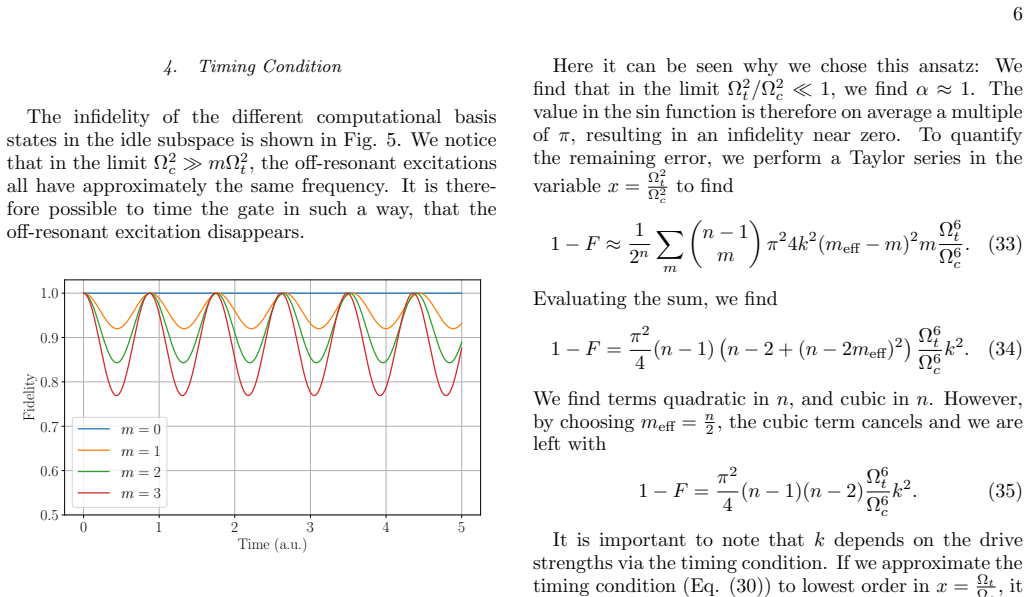
Timing Condition The infidelity of the different computational basis states in the idle subspace is shown in Fig. 5. We notice that in the limit Ω 2 c ≫ mΩ2 t , the off-resonant excitations all have approximately the same frequency. It is there- fore possible to time the gate in such a way, that the off-resonant excitation disappears. 0 1 2 3 4 5 Time (a....
-
[8]
Experimental Comparison To estimate the feasibility of our scheme, we inter- pret our results here with realistic parameters from the Penning trap at the Trapped Ion Quantum Information group at ETH Zurich [34]. Their system has a sideband strength of Ωs = ηΩ ≈ 20 kHz · 2π, (45) where η = 0.4 and Ω = 50 kHz · 2π are the Lamb-Dicke parameter and Rabi rate ...
-
[9]
Preskill, Quantum Computing in the NISQ era and beyond, Quantum 2, 79 (2018)
J. Preskill, Quantum Computing in the NISQ era and beyond, Quantum 2, 79 (2018)
work page 2018
-
[10]
A. Barenco, C. H. Bennett, R. Cleve, D. P. DiVincenzo, N. Margolus, P. Shor, T. Sleator, J. A. Smolin, and H. Weinfurter, Elementary gates for quantum computa- tion, Physical Review A 52, 3457 (1995)
work page 1995
-
[11]
M. A. Nielsen and I. L. Chuang, Quantum Computation and Quantum Information: 10th Anniversary Edition , 1st ed. (Cambridge University Press, 2012)
work page 2012
-
[12]
Moore, Quantum Circuits: Fanout, Parity, and Count- ing (1999), arXiv:quant-ph/9903046
C. Moore, Quantum Circuits: Fanout, Parity, and Count- ing (1999), arXiv:quant-ph/9903046
-
[13]
P. Hoyer and R. Spalek, Quantum Circuits with Un- bounded Fan-out, Theory of Computing 1, 81 (2005), arXiv:quant-ph/0208043
-
[14]
Coppersmith, An approximate Fourier transform use- ful in quantum factoring (2002)
D. Coppersmith, An approximate Fourier transform use- ful in quantum factoring (2002)
work page 2002
-
[15]
P. W. Shor, Scheme for reducing decoherence in quantum computer memory, Physical Review A 52, R2493 (1995)
work page 1995
-
[16]
A. M. Steane, Error Correcting Codes in Quantum The- ory, Physical Review Letters 77, 793 (1996)
work page 1996
-
[17]
A. G. Fowler, M. Mariantoni, J. M. Martinis, and A. N. Cleland, Surface codes: Towards practical large-scale quantum computation, Physical Review A 86, 032324 (2012)
work page 2012
-
[18]
D. Bacon, Operator quantum error-correcting subsys- tems for self-correcting quantum memories, Physical Re- view A 73, 012340 (2006)
work page 2006
-
[19]
A. R. Calderbank and P. W. Shor, Good quantum error-correcting codes exist, Physical Review A 54, 1098 (1996)
work page 1996
-
[20]
L. K. Grover, Quantum Mechanics Helps in Searching for a Needle in a Haystack, Physical Review Letters 79, 325 (1997)
work page 1997
- [21]
-
[22]
Gottesman, An Introduction to Quantum Error Correction and Fault-Tolerant Quantum Computation (2009)
D. Gottesman, An Introduction to Quantum Error Correction and Fault-Tolerant Quantum Computation (2009)
work page 2009
-
[23]
S. Fenner and R. Wosti, Implementing the quan- tum fanout operation with simple pairwise interactions (2023), arXiv:2203.01141 [quant-ph]
- [24]
-
[25]
A. Y. Guo, A. Deshpande, S.-K. Chu, Z. Eldredge, P. Bienias, D. Devulapalli, Y. Su, A. M. Childs, and A. V. Gorshkov, Implementing a fast unbounded quan- tum fanout gate using power-law interactions, Physical Review Research 4, L042016 (2022)
work page 2022
-
[26]
Y. Song, L. Beltr´ an, I. Besedin, M. Kerschbaum, M. Pechal, F. Swiadek, C. Hellings, D. Colao Zanuz, A. Flasby, J.-C. Besse, and A. Wallraff, Constant-depth fan-out with real-time feedforward on a superconducting quantum processor, Physical Review Applied 24, 024068 (2025)
work page 2025
-
[27]
E. B¨ aumer and S. Woerner, Measurement-based long- range entangling gates in constant depth, Physical Re- view Research 7, 023120 (2025)
work page 2025
-
[28]
E. Jaynes and F. Cummings, Comparison of quantum and semiclassical radiation theories with application to the beam maser, Proceedings of the IEEE 51, 89 (1963)
work page 1963
-
[29]
J. I. Cirac and P. Zoller, Quantum Computations with Cold Trapped Ions, Physical Review Letters 74, 4091 (1995)
work page 1995
-
[30]
A. Blais, R.-S. Huang, A. Wallraff, S. M. Girvin, and R. J. Schoelkopf, Cavity quantum electrodynamics for superconducting electrical circuits: An architecture for quantum computation, Physical Review A 69, 062320 (2004)
work page 2004
- [31]
-
[32]
J. P. Marangos, Electromagnetically induced trans- parency, Journal of Modern Optics 45, 471 (1998)
work page 1998
-
[33]
M. Fleischhauer, A. Imamoglu, and J. P. Marangos, Elec- tromagnetically induced transparency: Optics in coher- ent media, Reviews of Modern Physics 77, 633 (2005)
work page 2005
-
[34]
Y. Lin, J. P. Gaebler, F. Reiter, T. R. Tan, R. Bowler, Y. Wan, A. Keith, E. Knill, S. Glancy, K. Coakley, A. S. Sørensen, D. Leibfried, and D. J. Wineland, Preparation of Entangled States through Hilbert Space Engineering, Physical Review Letters 117, 140502 (2016)
work page 2016
-
[35]
M. W. Van Mourik, E. Zapusek, P. Hrmo, L. Gerster, R. Blatt, T. Monz, P. Schindler, and F. Reiter, Experi- mental Realization of Nonunitary Multiqubit Operations, Physical Review Letters 132, 040602 (2024)
work page 2024
-
[36]
D. Leibfried, R. Blatt, C. Monroe, and D. Wineland, Quantum dynamics of single trapped ions, Reviews of Modern Physics 75, 281 (2003)
work page 2003
- [37]
-
[38]
J. R. Johansson, P. D. Nation, and F. Nori, Qutip 2: A python framework for the dynamics of open quantum systems (2012)
work page 2012
-
[39]
J. I. Cirac and P. Zoller, A scalable quantum computer with ions in an array of microtraps, Nature 404, 579 (2000)
work page 2000
-
[40]
R. H. Dicke, Coherence in Spontaneous Radiation Pro- cesses, Physical Review 93, 99 (1954)
work page 1954
-
[41]
J. Dalibard, Y. Castin, and K. Mølmer, Wave-function approach to dissipative processes in quantum optics, Physical Review Letters 68, 580 (1992)
work page 1992
-
[42]
S. Jain, T. S¨ agesser, P. Hrmo, C. Torkzaban, M. Stadler, R. Oswald, C. Axline, A. Bautista-Salvador, C. Os- pelkaus, D. Kienzler, and J. Home, Penning micro-trap for quantum computing, Nature 627, 510 (2024)
work page 2024
- [43]
- [44]
- [45]
-
[46]
Google Quantum AI and Collaborators, R. Acharya, D. A. Abanin, L. Aghababaie-Beni, I. Aleiner, T. I. Andersen, M. Ansmann, F. Arute, K. Arya, A. Asfaw, N. Astrakhantsev, et al. , Quantum error correction be- low the surface code threshold, Nature 638, 920 (2025)
work page 2025
-
[47]
A. Steane, Multiple-particle interference and quantum er- ror correction, Proceedings of the Royal Society of Lon- don. Series A: Mathematical, Physical and Engineering Sciences 452, 2551 (1996)
work page 1996
-
[48]
cancelling off-resonant drives
D. Gottesman, An introduction to quantum error correc- tion and fault-tolerant quantum computation, inProceed- ings of Symposia in Applied Mathematics , Vol. 68, edited by S. Lomonaco (American Mathematical Society, Prov- idence, Rhode Island, 2010) pp. 13–58. 14 Appendix A: Canceling Off-Resonant Drives Generally, an off-resonant drive causes an AC Stark...
work page 2010
discussion (0)
Sign in with ORCID, Apple, or X to comment. Anyone can read and Pith papers without signing in.