Recognition: no theorem link
Permutation-symmetric quantum trajectories
Pith reviewed 2026-05-13 02:47 UTC · model grok-4.3
The pith
A stochastic unraveling that respects weak permutation symmetry exactly reproduces the master equation for N emitters coupled to a shared mode while reducing simulation cost from O(N^5) to O(N^2) for two-level systems.
A machine-rendered reading of the paper's core claim, the machinery that carries it, and where it could break.
Core claim
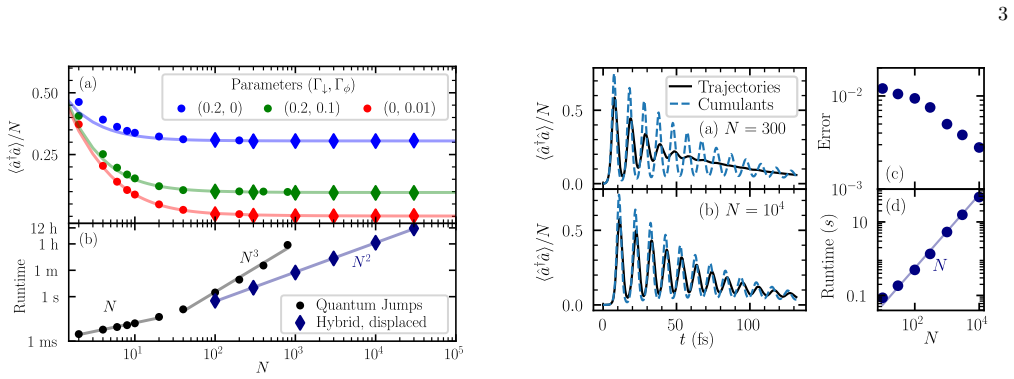
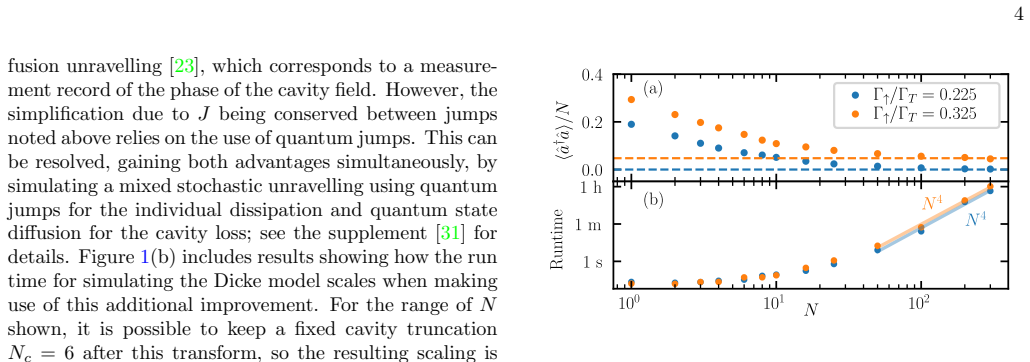
A stochastic unraveling can be defined for permutation-symmetric open quantum systems of N emitters coupled to a common cavity mode such that the unraveling respects weak permutation symmetry, exactly reproduces the dynamics of the underlying master equation, and reduces computational cost from O(N^5) to O(N^2) for two-level emitters and to O(N) with further refinements; the same approach scales as O(N^{d(d-1)/2}) for d-level emitters and permits large-N simulations when d=3.
What carries the argument
The symmetry-respecting stochastic unraveling, which generates quantum trajectories that are invariant under permutations of identical emitters and thereby avoids sampling redundant symmetric states.
If this is right
- Exact quantum-trajectory simulations of cavity QED with hundreds of two-level emitters become computationally feasible.
- The same symmetry reduction extends without modification to three-level emitters, allowing large-N studies of more complex level structures.
- Refinements that reach linear scaling further widen the range of accessible system sizes and simulation durations.
- Expectation values and correlation functions obtained from the reduced trajectories match those of the original master equation by construction.
Where Pith is reading between the lines
- The approach may generalize to other discrete symmetries, such as translational invariance in lattice models, once the corresponding symmetry-adapted jump operators are identified.
- Hybrid schemes that combine the symmetric unraveling with tensor-network representations of the shared mode could push accessible N even higher.
- The method supplies a concrete testbed for studying how symmetry-protected subspaces affect the convergence rate of stochastic averages in open quantum systems.
Load-bearing premise
A stochastic unraveling can be built that respects weak permutation symmetry while exactly reproducing the master-equation dynamics of the symmetric system.
What would settle it
Running both the full master-equation solver and the proposed symmetric unraveling on a small-N test case and finding statistically different expectation values or photon-counting statistics would disprove the claim.
Figures
read the original abstract
We show how one may perform a stochastic unraveling which respects weak permutation symmetry for models of $N$ emitters coupled to a common system (e.g. a cavity mode). For problems involving 2-level emitters, such an unravelling reduces the computational cost from $\mathcal{O}(N^5)$ to $\mathcal{O}(N^2)$, and with additional refinements, allows reduction to $\mathcal{O}(N)$. This significantly increases the range of system sizes for which one can model exact quantum dynamics of such systems. We further show how the method can also be applied to d-level systems, with computational effort scaling as $\mathcal{O}(N^{d(d-1)/2})$, and we show it allows large-N simulations for d=3.
Editorial analysis
A structured set of objections, weighed in public.
Referee Report
Summary. The manuscript introduces a stochastic unraveling of the Lindblad master equation for N emitters coupled to a common system (e.g., cavity mode) that respects weak permutation symmetry. For two-level emitters the method reduces the cost from O(N^5) to O(N^2) (or O(N) with further refinements); the construction is generalized to d-level emitters with scaling O(N^{d(d-1)/2}), enabling large-N simulations at d=3 while exactly recovering the original dynamics upon ensemble averaging.
Significance. If the claimed exactness holds, the work substantially enlarges the system sizes for which exact quantum-trajectory simulations of collective emitters are feasible. The symmetry-adapted construction and its extension beyond qubits are the primary contributions; they directly address a practical bottleneck in modeling superradiance and related phenomena.
major comments (1)
- [§3] §3 (construction of symmetry-adapted jump operators and noise): an explicit step-by-step verification is required that the stochastic average of the proposed trajectories reproduces the original Lindblad equation term-by-term with no residual or approximate contributions.
minor comments (3)
- [Abstract] Abstract: the phrase 'with additional refinements, allows reduction to O(N)' should be accompanied by a parenthetical reference to the specific section or algorithm that implements those refinements.
- [§2] Notation: the definition of 'weak permutation symmetry' should be stated once in a dedicated paragraph or equation block rather than introduced piecemeal across sections.
- [Figures 2-4] Figure captions: numerical scaling plots should include the fitted exponents and the range of N over which the scaling is measured.
Simulated Author's Rebuttal
We thank the referee for their positive assessment of the manuscript and for recommending minor revision. The single major comment is addressed below; we agree that an explicit verification will improve clarity and will incorporate it in the revised version.
read point-by-point responses
-
Referee: [§3] §3 (construction of symmetry-adapted jump operators and noise): an explicit step-by-step verification is required that the stochastic average of the proposed trajectories reproduces the original Lindblad equation term-by-term with no residual or approximate contributions.
Authors: We agree that an explicit term-by-term verification strengthens the presentation. The manuscript derives the symmetry-adapted jump operators and noise terms under weak permutation symmetry and states that ensemble averaging recovers the original Lindblad dynamics exactly, but we acknowledge that the intermediate algebra is not written out in full detail. In the revised manuscript we will add a dedicated subsection (or appendix) in §3 that performs the calculation explicitly: we expand the infinitesimal stochastic increments generated by the proposed operators, compute the first and second moments of the noise, take the ensemble average, and show that every term in the resulting master equation matches the original Lindblad form (collective decay, dephasing, and coherent driving) with no residual or approximate contributions. This verification uses only the algebraic properties of the permutation-symmetric operators and the Itô calculus rules already employed in the text. revision: yes
Circularity Check
No significant circularity; algorithmic construction is self-contained
full rationale
The paper introduces a symmetry-adapted stochastic unraveling for permutation-symmetric systems of emitters. The central claim is an explicit construction of jump operators and noise terms whose ensemble average recovers the original Lindblad master equation exactly, with no fitted parameters or self-referential definitions. Computational scaling reductions follow directly from the reduced Hilbert-space dimension under weak permutation symmetry. No load-bearing steps reduce to self-citation chains, ansatzes smuggled via prior work, or renaming of known results. The derivation is algorithmic and verifiable against the master equation without circularity.
Axiom & Free-Parameter Ledger
axioms (1)
- standard math The system obeys a standard Lindblad master equation for Markovian open quantum dynamics
Reference graph
Works this paper leans on
-
[1]
Haken, The semiclassical and quantum theory of the laser, inQuantum Opt., edited by Kay and Maitland (1970) p. 201
work page 1970
-
[2]
M. Scully and M. Zubairy,Quantum Optics, Quantum Optics (Cambridge University Press, 1997)
work page 1997
-
[3]
R. Bonifacio and G. Preparata, Coherent spontaneous emission, Phys. Rev. A2, 336 (1970)
work page 1970
-
[4]
K. Hepp and E. Lieb, Equilibrium statistical mechanics of matter interacting with the quantized radiation field, Phys. Rev. A8, 2517 (1973)
work page 1973
-
[5]
Y. K. Wang and F. T. Hioe, Phase Transition in the Dicke Model of Superradiance, Phys. Rev. A7, 831 (1973)
work page 1973
-
[6]
A. Abouelela, M. Turaev, R. Kramer, M. Janning, M. Kajan, S. Ray, and J. Kroha, Stabilizing open pho- ton condensates by ghost-attractor dynamics, Phys. Rev. Lett.135, 053402 (2025)
work page 2025
-
[7]
J. A. ´Cwik, S. Reja, P. B. Littlewood, and J. Keeling, Polariton condensation with saturable molecules dressed by vibrational modes, Eur. Lett.105, 47009 (2014)
work page 2014
- [8]
-
[9]
F. Herrera and F. C. Spano, Cavity-Controlled Chem- istry in Molecular Ensembles, Phys. Rev. Lett.116, 238301 (2016)
work page 2016
-
[10]
B. Buˇ ca and T. Prosen, A note on symmetry reductions of the Lindblad equation: transport in constrained open spin chains, New J. Phys.14, 73007 (2012)
work page 2012
-
[11]
V. V. Albert and L. Jiang, Symmetries and conserved quantities in lindblad master equations, Phys. Rev. A 89, 022118 (2014)
work page 2014
-
[12]
B. A. Chase and J. M. Geremia, Collective processes of an ensemble of spin-1/2 particles, Phys. Rev. A78, 052101 (2008)
work page 2008
-
[13]
M. Xu, D. A. Tieri, and M. J. Holland, Simulating open quantum systems by applying su(4) to quantum master equations, Phys. Rev. A87, 062101 (2013)
work page 2013
-
[14]
M. Richter, M. Gegg, T. S. Theuerholz, and A. Knorr, Numerically exact solution of the many emitter–cavity laser problem: Application to the fully quantized spaser emission, Phys. Rev. B91, 035306 (2015)
work page 2015
-
[15]
P. Kirton and J. Keeling, Superradiant and lasing states in driven-dissipative Dicke models, New J. Phys.20, 15009 (2018)
work page 2018
-
[16]
N. Shammah, S. Ahmed, N. Lambert, S. De Liberato, and F. Nori, Open quantum systems with local and col- lective incoherent processes: Efficient numerical simula- tions using permutational invariance, Phys. Rev. A98, 063815 (2018)
work page 2018
- [17]
-
[18]
X. Cao, A. Tilloy, and A. D. Luca, Entanglement in a fermion chain under continuous monitoring, SciPost Phys.7, 24 (2019)
work page 2019
-
[19]
Y. Li, X. Chen, and M. P. A. Fisher, Quantum Zeno effect and the many-body entanglement transition, Phys. Rev. B98, 205136 (2018)
work page 2018
-
[20]
B. Skinner, J. Ruhman, and A. Nahum, Measurement- Induced Phase Transitions in the Dynamics of Entangle- ment, Phys. Rev. X9, 31009 (2019)
work page 2019
-
[21]
S. Choi, Y. Bao, X.-L. Qi, and E. Altman, Quan- tum Error Correction in Scrambling Dynamics and Measurement-Induced Phase Transition, Phys. Rev. Lett.125, 30505 (2020)
work page 2020
-
[22]
M. J. Gullans and D. A. Huse, Dynamical Purification Phase Transition Induced by Quantum Measurements, Phys. Rev. X10, 41020 (2020)
work page 2020
-
[23]
N. Gisin and I. C. Percival, The quantum-state diffu- sion model applied to open systems, J. Phys. A25, 5677 (1992)
work page 1992
-
[24]
J. Dalibard, Y. Castin, and K. Mølmer, Wave-function approach to dissipative processes in quantum optics, Phys. Rev. Lett.68, 580 (1992)
work page 1992
-
[25]
R. Dum, P. Zoller, and H. Ritsch, Monte Carlo simulation of the atomic master equation for spontaneous emission, Phys. Rev. A45, 4879 (1992)
work page 1992
-
[26]
H. J. Carmichael, Quantum trajectory theory for cas- caded open systems, Phys. Rev. Lett.70, 2273 (1993)
work page 1993
-
[27]
M. B. Plenio and P. L. Knight, The quantum-jump ap- proach to dissipative dynamics in quantum optics, Rev. Mod. Phys.70, 101 (1998)
work page 1998
-
[28]
A. J. Daley, Quantum trajectories and open many-body quantum systems, Advances in Physics63, 77 (2014)
work page 2014
-
[29]
T. Vovk and H. Pichler, Entanglement-optimal trajec- tories of many-body quantum markov processes, Phys. Rev. Lett.128, 243601 (2022)
work page 2022
-
[30]
D. Barberena, Generalized holstein-primakoff mapping and 1/nexpansion of collective spin systems undergo- ing single particle dissipation (2025), arXiv:2508.05751 [quant-ph]
-
[31]
Supplementary Material for Permutation symmetric quantum trajectories
-
[32]
P. Kirton and J. Keeling, Suppressing and restoring the dicke superradiance transition by dephasing and decay, Phys. Rev. Lett.118, 123602 (2017)
work page 2017
-
[33]
A. J. Daley, J. M. Taylor, S. Diehl, M. Baranov, and P. Zoller, Atomic three-body loss as a dynamical three- body interaction, Phys. Rev. Lett.102, 040402 (2009)
work page 2009
-
[34]
In the notation of Eq. (1) these are ˆx i,1 =σ x i /2, ˆXc,1 = (g/ √ N)(ˆa+ˆa†) and ˆxi,2 =σ y i /2, ˆXc,2 =i(g/ √ N)(ˆa−ˆa†)
- [35]
-
[36]
K. M¨ uller and W. T. Strunz, Quantum trajectory method for highly excited environments in non-markovian open quantum dynamics, Phys. Rev. A112, 033719 (2025)
work page 2025
-
[37]
T. Bastin and J. Martin, Permutationally invariant pro- cesses in open multiqudit systems, J. Phys. A:Math. Gen. 58, 275301 (2025)
work page 2025
-
[38]
T. Ceccherini-Silberstein, F. Scarabotti, and F. Tolli, Representation Theory of the Symmetric Groups: The Okounkov-Vershik Approach, Character Formulas, and Partition Algebras, Cambridge Studies in Advanced Mathematics (Cambridge University Press, 2010)
work page 2010
-
[39]
I. M. Gelfand and M. L. Tsetlin, Finite-dimensional rep- resentations of the group of unimodular matrices, Dokl. Akad. Nauk SSSR71, 825 (1950)
work page 1950
- [40]
- [41]
-
[42]
PERMUTATION-SYMMETRIC QUANTUM TRAJECTORIES
K. M¨ uller, K. Luoma, and C. Sch¨ afer, A hierarchical ap- proach to quantum many-body systems in structured en- vironments (2025), arXiv:2405.05093 [quant-ph]. 1 SUPPLEMENTAL MATERIAL FOR: “PERMUTATION-SYMMETRIC QUANTUM TRAJECTORIES” EXPRESSIONS FOR COEFFICIENTSf ˆX In the main text, we noted that the results of Refs. [12, 30] can be written in terms of...
discussion (0)
Sign in with ORCID, Apple, or X to comment. Anyone can read and Pith papers without signing in.