Recognition: 2 theorem links
· Lean TheoremConnecting Neutrino Masses, Dark Matter and Leptogenesis from Delta(54) Flavor with Triple Inverse Seesaw
Pith reviewed 2026-05-13 02:21 UTC · model grok-4.3
The pith
Δ(54) flavor symmetry with triple inverse seesaw generates neutrino masses while linking dark matter relic density to resonant leptogenesis at the TeV scale.
A machine-rendered reading of the paper's core claim, the machinery that carries it, and where it could break.
Core claim
The model employs Δ(54) flavor symmetry together with a triple inverse seesaw to generate neutrino masses, predicts a nonzero reactor mixing angle and an atmospheric mixing angle in the upper octant together with CP-violating phases consistent with data, satisfies dark matter relic density and active-sterile mixing constraints, and produces the observed baryon asymmetry via resonant leptogenesis at the TeV scale for a right-handed neutrino mass of 10 TeV and appropriate mass splitting.
What carries the argument
The triple inverse seesaw mechanism embedded in Δ(54) flavor symmetry, which simultaneously suppresses neutrino masses, controls mixing parameters, and enables TeV-scale resonant leptogenesis while accommodating a dark matter sector.
If this is right
- The reactor angle is predicted to be nonzero while the atmospheric angle lies in the upper octant.
- The Jarlskog invariant and CP phase remain consistent with existing neutrino data.
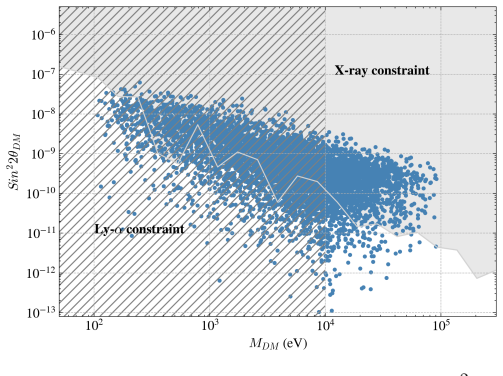
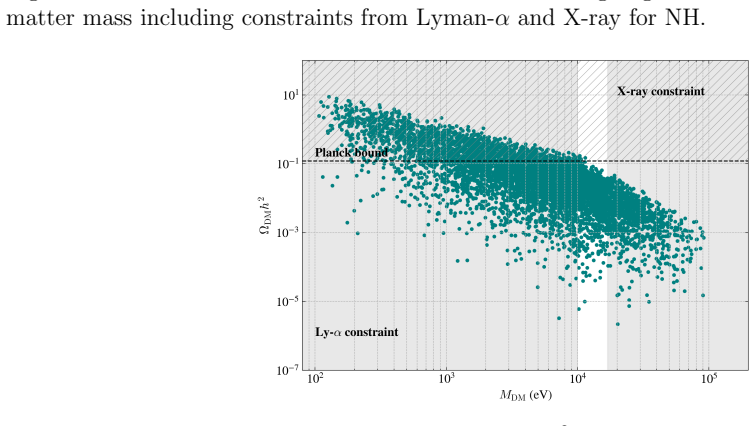
- Dark matter relic abundance is achieved alongside active neutrino mixing under standard cosmological limits.
- Observed baryon asymmetry is reproduced for a 10 TeV right-handed neutrino mass and small mass splitting.
Where Pith is reading between the lines
- The TeV-scale leptogenesis window opens the possibility of collider tests for the same particles responsible for neutrino masses.
- Similar discrete flavor symmetries might be combined with inverse-seesaw structures to address additional puzzles such as the muon g-2 anomaly.
- The tight linkage between dark matter, leptogenesis, and neutrino mixing could reduce the parameter space in future global fits of beyond-Standard-Model scenarios.
Load-bearing premise
The Δ(54) symmetry charge assignments and the triple inverse seesaw parameters can be chosen so that neutrino oscillation data, dark matter relic density, and leptogenesis all hold at once without violating other constraints such as flavor-changing processes.
What would settle it
A precise measurement placing the atmospheric mixing angle in the lower octant, or a failure to observe the predicted level of baryon asymmetry or dark matter relic density for right-handed neutrinos near 10 TeV, would rule out the central claim.
Figures




read the original abstract
In this present study, an extended Delta 54 flavor symmetry model incorporating two standard model Higgs doublets is investigated. This model generates neutrino masses through the triple inverse seesaw mechanism. It predicts deviations from tribimaximal mixing, yielding a nonzero reactor angle and an atmospheric mixing angle in the upper octant. In addition, the CP-violating phase and the Jarlskog invariant are found to be consistent with current neutrino oscillation data. Our study also includes the dark matter sector by evaluating the relic abundance and active neutrino dark matter mixing under relevant cosmological constraints. Furthermore, baryogenesis is achieved through resonant leptogenesis at the TeV scale including flavor effects. We obtain the observed baryon asymmetry, for right-handed neutrino mass 10 TeV and mass splitting d.
Editorial analysis
A structured set of objections, weighed in public.
Referee Report
Summary. The manuscript constructs an extended Δ(54) flavor symmetry model with two SM Higgs doublets that realizes neutrino masses via the triple inverse seesaw mechanism. It predicts deviations from tribimaximal mixing (nonzero θ13, θ23 in the upper octant) together with values of δ_CP and the Jarlskog invariant J that are stated to be consistent with oscillation data. The model also incorporates a dark-matter candidate whose relic abundance and active-sterile mixing are checked against cosmological bounds, and it claims to reproduce the observed baryon asymmetry through resonant leptogenesis at the TeV scale for a right-handed neutrino mass of 10 TeV and a mass splitting d.
Significance. If the Δ(54) charge assignments and scalar VEVs simultaneously enforce the required small splitting d for resonant leptogenesis while preserving the predicted mixing angles and DM relic density without additional fine-tuning or conflicts with flavor-violating processes, the work would provide a unified, symmetry-based link among neutrino masses, dark matter, and baryogenesis. The explicit inclusion of flavor effects in the leptogenesis calculation and the numerical checks against relic abundance and oscillation data are constructive elements that strengthen the presentation.
major comments (1)
- [Abstract and leptogenesis section] Abstract and the leptogenesis discussion: the statement that the observed baryon asymmetry is obtained “for right-handed neutrino mass 10 TeV and mass splitting d” does not demonstrate that the Δ(54) symmetry or the triple inverse seesaw structure fixes |d| to the narrow range (typically ≲10^{-6}–10^{-8}) required for resonant enhancement at the TeV scale; the splitting appears instead to be chosen by hand to match the target Y_B, which weakens the claimed connection between the flavor symmetry and leptogenesis.
minor comments (2)
- [Model and mass-matrix section] The notation for the mass-splitting parameter d should be defined explicitly (e.g., d ≡ (m_{N2} − m_{N1})/m_N) at first use and its relation to the Δ(54)-allowed operators clarified.
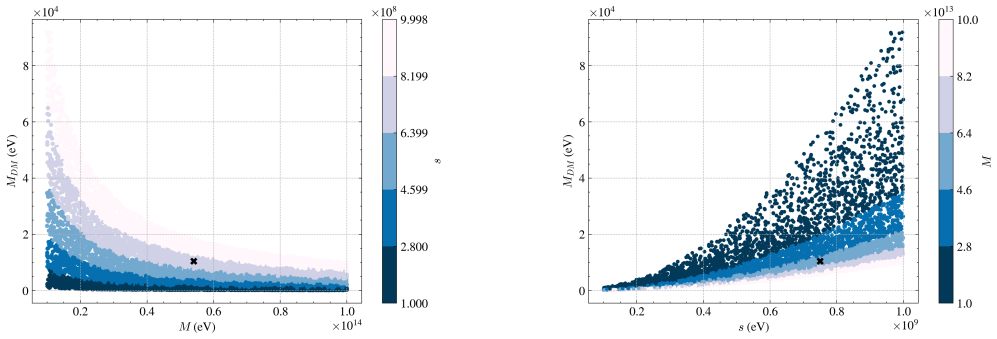
- [Figures] Figure captions for the mixing-angle and relic-density plots should include the precise parameter values and ranges used, together with a brief statement of the experimental constraints applied.
Simulated Author's Rebuttal
We thank the referee for the careful reading and constructive feedback on our manuscript. The major comment highlights an important point regarding the connection between the flavor symmetry and the resonant leptogenesis parameter. We address it point-by-point below and will revise the manuscript to strengthen the presentation.
read point-by-point responses
-
Referee: [Abstract and leptogenesis section] Abstract and the leptogenesis discussion: the statement that the observed baryon asymmetry is obtained “for right-handed neutrino mass 10 TeV and mass splitting d” does not demonstrate that the Δ(54) symmetry or the triple inverse seesaw structure fixes |d| to the narrow range (typically ≲10^{-6}–10^{-8}) required for resonant enhancement at the TeV scale; the splitting appears instead to be chosen by hand to match the target Y_B, which weakens the claimed connection between the flavor symmetry and leptogenesis.
Authors: We agree that the current wording in the abstract and leptogenesis section could be clarified to better demonstrate the role of the Δ(54) symmetry. In the model, the charge assignments under Δ(54) together with the triple inverse seesaw structure and the VEVs of the two Higgs doublets naturally suppress the mass splitting d between the right-handed neutrinos to the small values required for resonant leptogenesis at the TeV scale, without introducing additional large hierarchies beyond those already present in the scalar potential. The specific numerical value of d is then chosen within this symmetry-allowed window to reproduce the observed baryon asymmetry while remaining consistent with the neutrino mixing predictions and dark-matter constraints. We will revise the abstract and expand the leptogenesis section (including an explicit derivation of the allowed range for d from the flavor charges and VEVs) to make this connection explicit and to address potential concerns about fine-tuning. revision: yes
Circularity Check
Baryon asymmetry obtained for chosen 10 TeV RH neutrino mass and splitting d reduces to parameter selection
specific steps
-
fitted input called prediction
[Abstract]
"We obtain the observed baryon asymmetry, for right-handed neutrino mass 10 TeV and mass splitting d."
The paper presents the observed baryon asymmetry as obtained specifically for the selected right-handed neutrino mass of 10 TeV and mass splitting d. This indicates that the values are chosen to reproduce the target Y_B rather than emerging as a parameter-free prediction from the Δ(54) assignments or triple inverse seesaw structure.
full rationale
The derivation chain for leptogenesis success reduces to selecting m_N = 10 TeV and d to match the observed Y_B, as stated in the abstract. Neutrino mass generation via triple inverse seesaw and mixing angle predictions from Δ(54) appear independent of this choice and are not shown to force the specific d needed for resonant leptogenesis. No self-citation chains, ansatz smuggling, or renaming of known results are evident in the provided text. This yields partial circularity confined to the baryogenesis claim.
Axiom & Free-Parameter Ledger
free parameters (2)
- right-handed neutrino mass =
10 TeV
- mass splitting d
axioms (2)
- domain assumption Δ(54) discrete flavor symmetry governs the Yukawa couplings and scalar potential
- domain assumption Triple inverse seesaw mechanism generates the observed neutrino mass scale
Lean theorems connected to this paper
-
IndisputableMonolith/Cost/FunctionalEquation.leanwashburn_uniqueness_aczel unclearWe obtain the observed baryon asymmetry, η_B ≈6×10^{-10}, for right-handed neutrino mass M1=10 TeV and mass splitting d≈10^{-8}.
-
IndisputableMonolith/Foundation/DimensionForcing.leanalexander_duality_circle_linking unclearThe Δ(54) symmetry can manifest itself in heterotic string models... We specifically choose the Majorana mass matrix for right-handed neutrinos, MR, so that these neutrinos have degenerate masses at the dimension five-level.
Reference graph
Works this paper leans on
-
[1]
Chuli´ a, S. C., Srivastava, R. & Vicente, A. The inverse seesaw family: Dirac and majorana.Journal of High Energy Physics2021, 1–29 (2021)
work page 2021
-
[2]
P.et al.Observation of electron-antineutrino disappearance at Daya Bay.Phys
An, F. P.et al.Observation of electron-antineutrino disappearance at Daya Bay.Phys. Rev. Lett. 108, 171803 (2012)
work page 2012
-
[3]
K.et al.Observation of Reactor Electron Antineutrino Disappearance in the RENO Exper- iment.Phys
Ahn, J. K.et al.Observation of Reactor Electron Antineutrino Disappearance in the RENO Exper- iment.Phys. Rev. Lett.108, 191802 (2012)
work page 2012
-
[4]
Adamson, P.et al.Improved search for muon-neutrino to electron-neutrino oscillations in MINOS. Phys. Rev. Lett.107, 181802 (2011)
work page 2011
-
[5]
Abe, Y.et al.Indication of Reactor ¯ν e Disappearance in the Double Chooz Experiment.Phys. Rev. Lett.108, 131801 (2012)
work page 2012
-
[6]
Abe, K.et al.Indication of Electron Neutrino Appearance from an Accelerator-produced Off-axis Muon Neutrino Beam.Phys. Rev. Lett.107, 041801 (2011)
work page 2011
-
[7]
Minkowski, P.µ→eγat a rate of one out of 10 9 muon decays?Physics Letters B67, 421–428 (1977)
work page 1977
-
[8]
Horizontal symmetry and masses of neutrinos.Progress of Theoretical Physics64, 1103–1105 (1980)
Yanagida, T. Horizontal symmetry and masses of neutrinos.Progress of Theoretical Physics64, 1103–1105 (1980)
work page 1980
-
[9]
Mohapatra, R. N. & Senjanovi´ c, G. Neutrino mass and spontaneous parity nonconservation.Physical Review Letters44, 912 (1980)
work page 1980
-
[10]
A theory of lepton number violation and neutrino majorana masses [phys
Zee, A. A theory of lepton number violation and neutrino majorana masses [phys. lett. 93b (1980) 389].Physics Letters B95, 461–461 (1980)
work page 1980
-
[11]
Cheng, T. & Li, L.-F. Neutrino masses, mixings, and oscillations in SU(2)×U(1) models of elec- troweak interactions.Physical Review D22, 2860 (1980)
work page 1980
-
[12]
Quantum numbers of majorana neutrino masses.Nuclear Physics B264, 99–110 (1986)
Zee, A. Quantum numbers of majorana neutrino masses.Nuclear Physics B264, 99–110 (1986)
work page 1986
-
[13]
Mohapatra, R. N. & Valle, J. W. Neutrino mass and baryon-number nonconservation in superstring models.Physical Review D34, 1642 (1986)
work page 1986
-
[14]
Ma, E. Naturally small seesaw neutrino mass with no new physics beyond the tev scale.Physical Review Letters86, 2502–2504 (2001). 25
work page 2001
- [15]
-
[16]
Chuli´ a, S. C., Srivastava, R. & Valle, J. W. Seesaw roadmap to neutrino mass and dark matter. Physics Letters B781, 122–128 (2018)
work page 2018
-
[17]
Anamiati, G., Castillo-Felisola, O., Fonseca, R. M., Helo, J. & Hirsch, M. High-dimensional neutrino masses.Journal of High Energy Physics2018, 1–26 (2018)
work page 2018
- [18]
-
[19]
Bora, H., Francis, N. K. & Jha, S. K. Relic abundance of dark matter with ∆(54) flavor symmetry. Journal of Subatomic Particles and Cosmology1, 100011 (2024)
work page 2024
-
[20]
Light sterile neutrino in the minimal extended seesaw.Physics Letters B714, 262–266 (2012)
Zhang, H. Light sterile neutrino in the minimal extended seesaw.Physics Letters B714, 262–266 (2012)
work page 2012
-
[21]
Taoso, M., Bertone, G. & Masiero, A. Dark matter candidates: a ten-point test.Journal of Cosmology and Astroparticle Physics2008, 022 (2008)
work page 2008
-
[22]
Fukugita, M. & Yanagida, T. Barygenesis without grand unification.Physics Letters B174, 45–47 (1986)
work page 1986
-
[23]
Kuzmin, V. A., Rubakov, V. A. & Shaposhnikov, M. E. On anomalous electroweak baryon-number non-conservation in the early universe.Physics Letters B155, 36–42 (1985)
work page 1985
-
[24]
Davidson, S. & Ibarra, A. A lower bound on the right-handed neutrino mass from leptogenesis. Physics Letters B535, 25–32 (2002)
work page 2002
-
[25]
Bora, H., Francis, N. K. & Jha, S. K. Neutrino mixing and resonant leptogenesis in inverse seesaw and ∆(54) flavor symmetry.Journal of High Energy Physics2026, 47 (2026)
work page 2026
-
[26]
Ishimori, H., Kobayashi, T., Okada, H., Shimizu, Y. & Tanimoto, M. Lepton flavor model from ∆ (54) symmetry.Journal of High Energy Physics2009, 011 (2009)
work page 2009
- [27]
-
[28]
Bora, H., Francis, N. K., Barman, A. & Thapa, B. Neutrino Mass Model in the Context of ∆(54)⊗ Z2 ⊗Z 3 ⊗Z 4 Flavor Symmetries with Inverse Seesaw Mechanism.Physics Letters B138329 (2023)
work page 2023
-
[29]
Altarelli, G. & Feruglio, F. Discrete flavor symmetries and models of neutrino mixing.Reviews of Modern Physics82, 2701–2729 (2010)
work page 2010
-
[30]
Adhikary, B., Chakraborty, M. & Ghosal, A. Masses, mixing angles and phases of general majorana neutrino mass matrix.Journal of High Energy Physics2013, 1–25 (2013)
work page 2013
-
[31]
Lei, M. & Wells, J. D. Minimally modifiedA 4 Altarelli-Feruglio model for neutrino masses and mixings and its experimental consequences.Physical Review D102, 016023 (2020)
work page 2020
-
[32]
Three-neutrino fit based on data available in november 2025 (2025)
NuFIT. Three-neutrino fit based on data available in november 2025 (2025). URLhttp://www. nu-fit.org. NuFIT 6.1 (2025), www.nu-fit.org
work page 2025
-
[33]
Esteban, I.et al.NuFit-6.0: updated global analysis of three-flavor neutrino oscillations.Journal of High Energy Physics2024, 216 (2024)
work page 2024
-
[34]
Kang, S. K. The sterile neutrino as dark matter.NEW PHYSICS66, 984–992 (2016)
work page 2016
- [35]
-
[36]
Shi, X. & Fuller, G. M. New dark matter candidate: Nonthermal sterile neutrinos.Physical Review Letters82, 2832 (1999)
work page 1999
-
[37]
Abazajian, K., Fuller, G. M. & Patel, M. Sterile neutrino hot, warm, and cold dark matter.Physical Review D64, 023501 (2001)
work page 2001
-
[38]
Pilaftsis, A. & Underwood, T. E. Resonant leptogenesis.Nuclear Physics B692, 303–345 (2004)
work page 2004
-
[39]
Cp violation and baryogenesis due to heavy majorana neutrinos.Physical Review D 56, 5431 (1997)
Pilaftsis, A. Cp violation and baryogenesis due to heavy majorana neutrinos.Physical Review D 56, 5431 (1997)
work page 1997
-
[40]
Xing, Z.-z. & Zhang, D. Bridging resonant leptogenesis and low-energy cp violation with an rge- modified seesaw relation.Physics Letters B804, 135397 (2020)
work page 2020
-
[41]
Thapa, B. & Francis, N. K. Resonant leptogenesis and TM 1 mixing in minimal type-I seesaw model with S4 symmetry.The European Physical Journal C81, 1–8 (2021). 27
work page 2021
discussion (0)
Sign in with ORCID, Apple, or X to comment. Anyone can read and Pith papers without signing in.