Recognition: 2 theorem links
· Lean TheoremSecondary Electron-Only Reconnection Driven by Large Scale Ion-Coupled Reconnection and Electron Kelvin-Helmholtz Instabilities in Hybrid Simulations of Solar Wind Turbulence
Pith reviewed 2026-05-13 00:49 UTC · model grok-4.3
The pith
Electron-only reconnection develops spontaneously in solar wind turbulence simulations via two distinct mechanisms.
A machine-rendered reading of the paper's core claim, the machinery that carries it, and where it could break.
Core claim
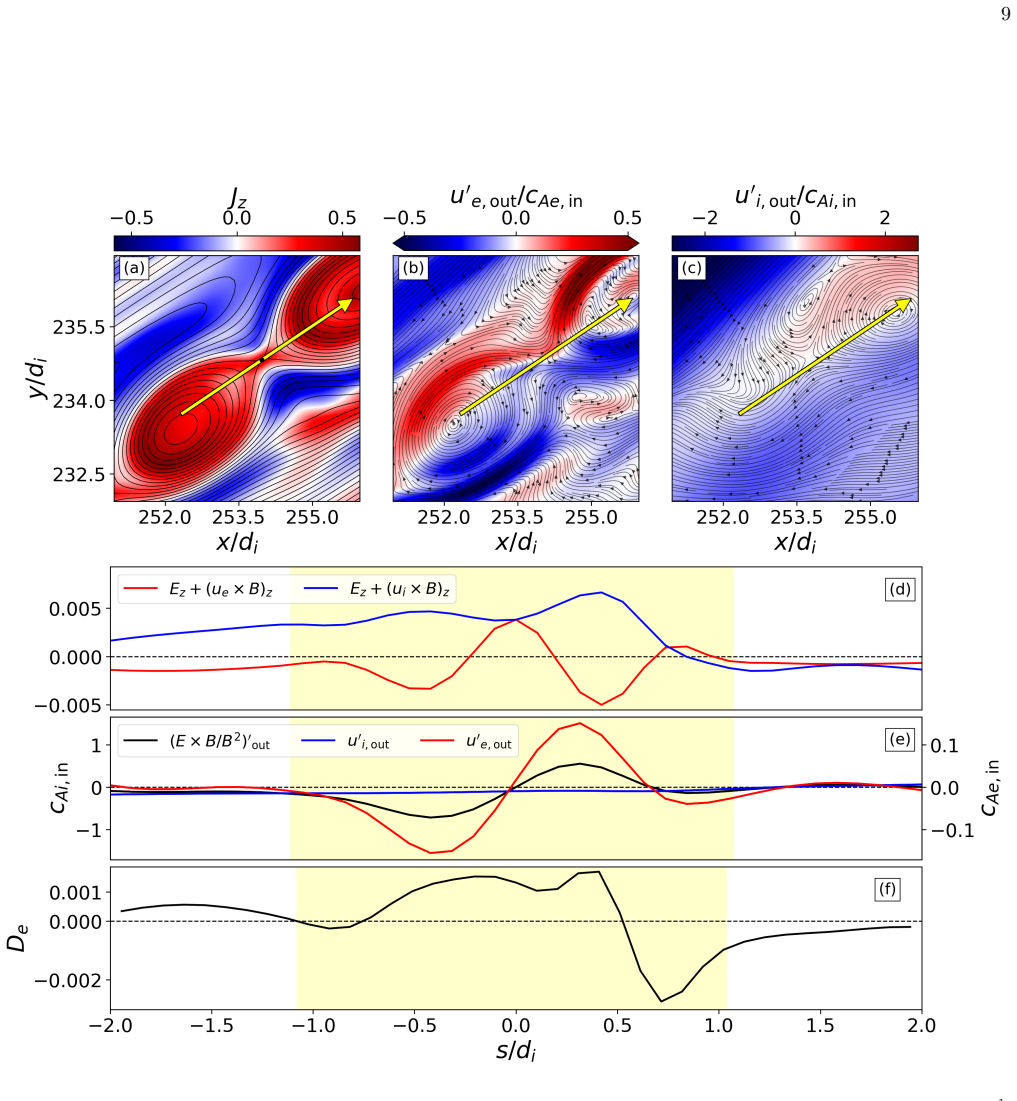
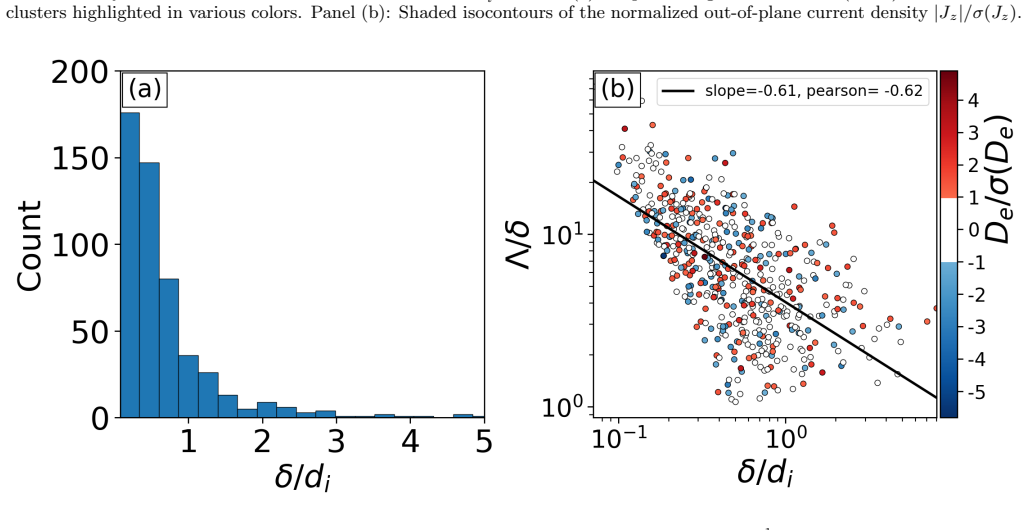
In a large-scale 2D hybrid simulation of solar wind turbulence with energy injection at the largest scales and finite electron inertia, electron-only reconnection develops spontaneously through two turbulence-driven mechanisms without external small-scale forcing. Secondary EREC is induced by the interaction of plasmoids in the outflows of large-scale ion-coupled reconnection, while direct EREC is driven at subion scales by the electron Kelvin-Helmholtz instability in small-scale velocity shears. Statistical analysis of current sheets using the HDBSCAN clustering algorithm shows that subion-scale current sheets capable of hosting EREC are dominant in the simulation.
What carries the argument
Two turbulence-driven mechanisms: secondary electron-only reconnection induced by plasmoid interactions in large-scale ion-coupled reconnection outflows, and direct driving by the electron Kelvin-Helmholtz instability in small-scale velocity shears.
If this is right
- EREC can occur in large-scale open systems like the solar wind through secondary turbulent processes even with long magnetic correlation lengths.
- Subion-scale current sheets dominate the population and serve as the primary sites for EREC.
- Energy dissipation at kinetic scales in the solar wind involves electron-only reconnection in addition to ion-coupled processes.
- Turbulence naturally cascades to produce conditions for EREC without needing imposed small-scale forcing.
Where Pith is reading between the lines
- Spacecraft measurements in the solar wind may detect EREC signatures more frequently than expected from shorter correlation length environments.
- The dominance of subion-scale current sheets indicates the turbulent cascade inherently favors electron-dominated reconnection at small scales.
- These mechanisms may apply to other large-scale astrophysical plasmas with extended correlation lengths, such as the interstellar medium.
- Three-dimensional simulations could reveal whether out-of-plane effects modify the relative importance of the two driving mechanisms.
Load-bearing premise
The 2D hybrid model with finite electron inertia and energy injection only at the largest scales faithfully reproduces the spontaneous development of electron-only reconnection in real three-dimensional solar wind turbulence without external small-scale forcing.
What would settle it
In-situ spacecraft observations of current sheet scale distributions and the presence of electron jets without ion outflows in solar wind turbulence would confirm or refute the simulated dominance of subion-scale EREC events.
Figures






read the original abstract
Electron-only reconnection (EREC) is a magnetic reconnection regime occurring within subion-scale current sheets (CSs), exhibiting only electron jets, without any ion outflows. EREC has been first observed in the Earth's magnetosheath, where its occurrence is linked to the small correlation length of magnetic fluctuations, limiting the growth of CSs to very large scales. On the other hand, the development of EREC in open systems with large magnetic correlation lengths, such as the solar wind (SW), remains an open question. To address this problem, we employ a large-scale 2D hybrid simulation with finite electron inertia, investigating the development of EREC driven by turbulence. By injecting energy at very large scales, we allow EREC to develop spontaneously due to the turbulent cascade, without any external small-scale forcing or imposed constraints on the turbulence correlation length. We find that EREC develops in our simulation via two distinct turbulence-driven mechanisms: (1) secondary EREC induced by the interaction of plasmoids in the outflows of large-scale ion-coupled reconnection; (2) EREC directly driven at subion scales by the electron Kelvin-Helmholtz instability in small-scale velocity shears. Furthermore, we perform a statistical analysis of CSs using the machine-learning clustering algorithm HDBSCAN, showing that subion-scale CSs capable of hosting EREC are dominant in our simulation. Our results suggest that EREC could occur even in large-scale space and astrophysical systems, like the SW, driven by secondary turbulent processes, potentially playing a key role in dissipating energy at kinetic scales.
Editorial analysis
A structured set of objections, weighed in public.
Referee Report
Summary. The paper claims that in a large-scale 2D hybrid simulation of solar wind turbulence with energy injection only at the largest scales and finite electron inertia, electron-only reconnection (EREC) develops spontaneously via two turbulence-driven mechanisms: (1) secondary EREC induced by plasmoid interactions in the outflows of large-scale ion-coupled reconnection, and (2) EREC directly driven at subion scales by the electron Kelvin-Helmholtz instability in small-scale velocity shears. A statistical analysis using the HDBSCAN machine-learning clustering algorithm on current sheets (CSs) shows that subion-scale CSs capable of hosting EREC are dominant, suggesting that EREC can occur in large-scale systems like the solar wind driven by secondary turbulent processes.
Significance. If the results hold, this would be significant for understanding kinetic-scale energy dissipation in the solar wind and similar astrophysical plasmas, as it addresses the open question of EREC development in systems with large magnetic correlation lengths without external small-scale forcing. The identification of specific driving mechanisms from the turbulent cascade and the application of HDBSCAN for objective, reproducible classification of CSs are methodological strengths. The standard hybrid approach with large-scale forcing only provides a clean setup for studying spontaneous development.
major comments (1)
- [Simulation Setup] Simulation Setup section: The simulation is performed strictly in 2D. No discussion, scaling arguments, or control runs are provided on how the suppression of out-of-plane modes affects electron Kelvin-Helmholtz instability growth rates, allowed wave vectors, or plasmoid coalescence topologies relative to 3D. This dimensionality choice is load-bearing for the central claim that the observed EREC mechanisms and dominance of subion-scale CSs arise spontaneously and apply to real three-dimensional solar wind turbulence.
minor comments (2)
- [Abstract] Abstract: The description of the simulation parameters (e.g., exact grid resolution, box size, and ion-to-electron scale separation) could be expanded to allow readers to immediately assess the achieved scale separation and Reynolds number.
- [Results] Figure captions and Results: Several panels showing velocity shears or current sheets would benefit from explicit annotations of the local scale relative to the ion inertial length to clarify the subion regime.
Simulated Author's Rebuttal
We thank the referee for their constructive and positive assessment of our work. We address the major comment below and have prepared revisions to strengthen the manuscript's discussion of its limitations.
read point-by-point responses
-
Referee: Simulation Setup section: The simulation is performed strictly in 2D. No discussion, scaling arguments, or control runs are provided on how the suppression of out-of-plane modes affects electron Kelvin-Helmholtz instability growth rates, allowed wave vectors, or plasmoid coalescence topologies relative to 3D. This dimensionality choice is load-bearing for the central claim that the observed EREC mechanisms and dominance of subion-scale CSs arise spontaneously and apply to real three-dimensional solar wind turbulence.
Authors: We agree that the strictly two-dimensional setup is an important limitation when relating the results to three-dimensional solar wind turbulence. The choice of 2D was dictated by the need to reach the required scale separation and resolution to follow the turbulent cascade from large injection scales to electron scales without small-scale forcing; equivalent 3D runs remain computationally prohibitive. In the revised manuscript we will add a dedicated paragraph in the Discussion section that (i) summarizes how out-of-plane modes can modify electron Kelvin-Helmholtz growth rates and allowed wave vectors, drawing on existing 3D hybrid and PIC literature, and (ii) provides scaling arguments indicating that the two identified mechanisms—secondary electron-only reconnection driven by plasmoid interactions and direct electron-scale shear driving—remain viable in 3D, even if quantitative statistics of current-sheet populations may differ. While we cannot supply 3D control runs, this expanded discussion will make the dimensionality caveats explicit and will better support the applicability claim. revision: partial
Circularity Check
No circularity: results are direct outputs of simulation runs and post-processing
full rationale
The paper reports findings from a 2D hybrid plasma simulation with energy injection at large scales. The two claimed EREC mechanisms (secondary from plasmoid interactions in ion-coupled reconnection outflows, and direct drive by electron KH in subion shears) and the HDBSCAN statistical result on dominance of subion-scale CSs are identified by inspecting and clustering the simulation data. No parameters are fitted to a subset and then relabeled as predictions; no equations reduce to their own inputs by construction; no load-bearing self-citations or uniqueness theorems are invoked. The derivation chain is simply “run the simulation under stated initial conditions and analyze the output fields,” which is self-contained against external benchmarks and contains no circular steps.
Axiom & Free-Parameter Ledger
free parameters (2)
- energy injection scale
- simulation box size and resolution
axioms (2)
- domain assumption Hybrid approximation with finite electron inertia suffices to capture electron-only reconnection at sub-ion scales
- domain assumption 2D geometry does not qualitatively alter the secondary reconnection mechanisms
Lean theorems connected to this paper
-
IndisputableMonolith/Foundation/RealityFromDistinction.leanreality_from_one_distinction unclearWe employ a large-scale 2D hybrid simulation with finite electron inertia... EREC develops... via two distinct turbulence-driven mechanisms: (1) secondary EREC induced by the interaction of plasmoids in the outflows of large-scale ion-coupled reconnection; (2) EREC directly driven at subion scales by the electron Kelvin-Helmholtz instability...
Reference graph
Works this paper leans on
-
[1]
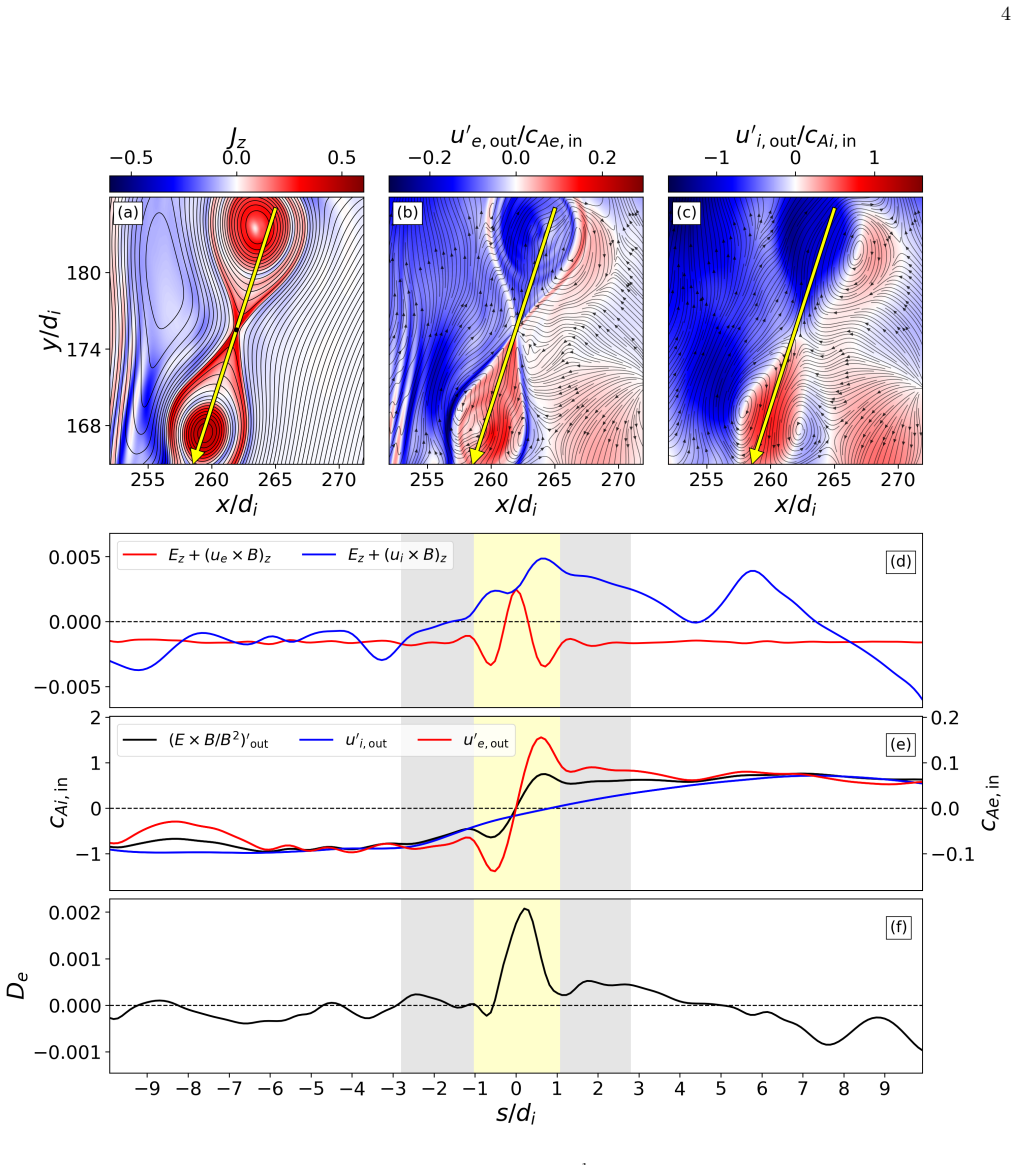
Ion coupled reconnection site We first analyze the large-scale reconnection region (Fig. 2). Panel (b) shows the outflow-directed compo- nents of the electron (u ′ e,out) and ion (u ′ i,out) fluid ve- locities, respectively, in the frame of the X-point. The yellow arrow indicates the direction of the cut. These velocities are normalized to the inflow Alfv...
-
[2]
Figure 3 presents this analysis using the same format as Fig
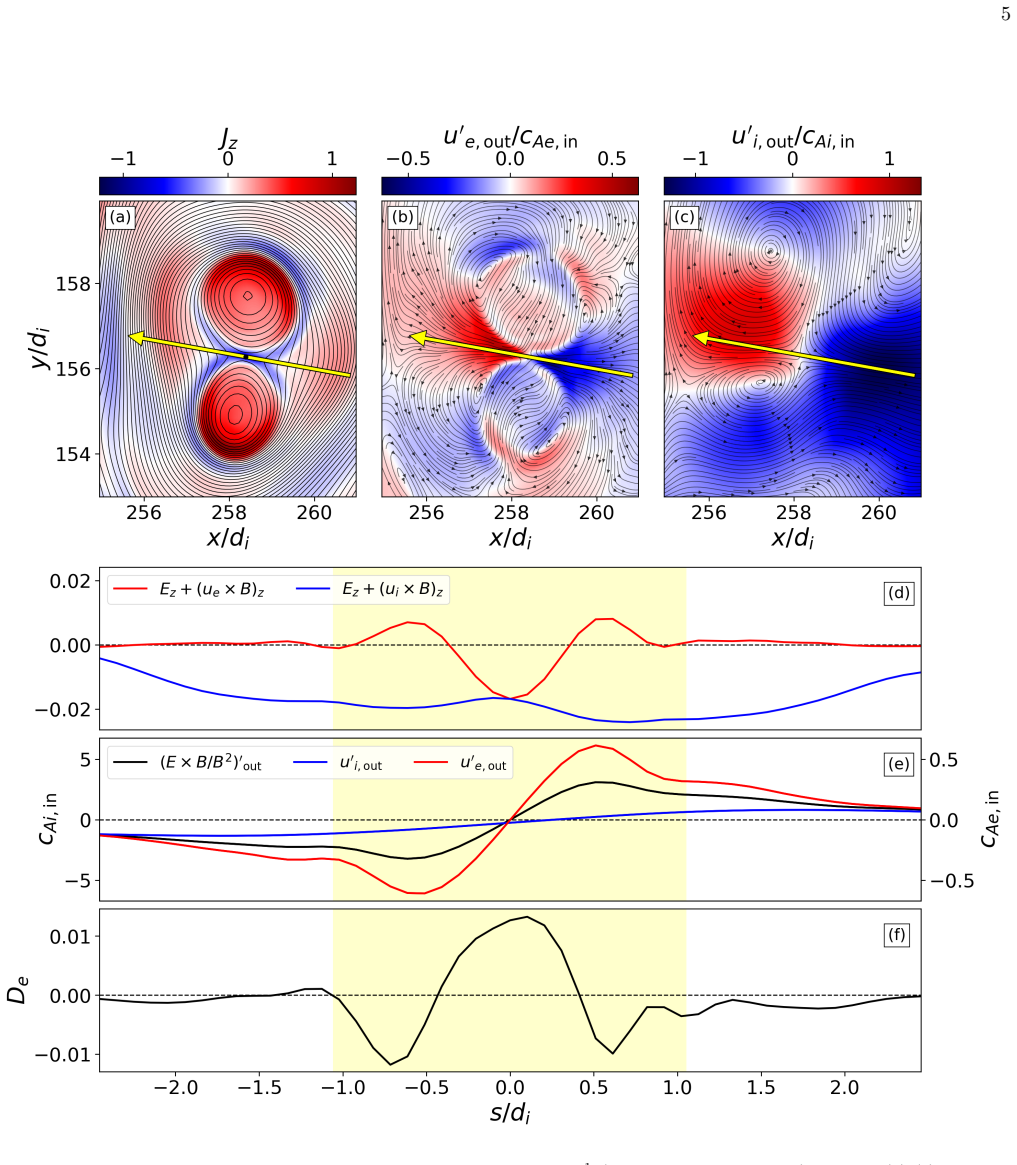
Electron-only reconnection site We now proceed to analyze the small-scale reconnec- tion region in comparison with the standard IREC case. Figure 3 presents this analysis using the same format as Fig. 2. Similarly to the large-scale reconnection case, the small-scale site exhibits a super-Alfv´ enic electron jet flowing out of the X-point (Fig. 3b). Howev...
-
[3]
D. Biskamp,Magnetic Reconnection in Plasmas, Cam- bridge Monographs on Plasma Physics (Cambridge Uni- versity Press, 2000)
work page 2000
-
[4]
E. G. Zweibel and M. Yamada, Magnetic reconnection in astrophysical and laboratory plasmas, Annual review of astronomy and astrophysics47, 291 (2009)
work page 2009
- [5]
-
[6]
S. Servidio, W. Matthaeus, M. Shay, P. Cassak, and P. Dmitruk, Magnetic reconnection in two-dimensional magnetohydrodynamic turbulence, Physical review let- ters102, 115003 (2009)
work page 2009
-
[7]
V. Zhdankin, D. A. Uzdensky, J. C. Perez, and S. Boldyrev, Statistical analysis of current sheets in three-dimensional magnetohydrodynamic turbulence, The Astrophysical Journal771, 124 (2013)
work page 2013
- [8]
-
[9]
S. S. Cerri and F. Califano, Reconnection and small-scale fields in 2d-3v hybrid-kinetic driven turbulence simula- tions, New Journal of Physics19, 025007 (2017)
work page 2017
-
[10]
D. Sundkvist, A. Retin` o, A. Vaivads, and S. D. Bale, Dissipation in turbulent plasma due to reconnection in thin current sheets, Physical review letters99, 025004 (2007)
work page 2007
-
[11]
S. Servidio, F. Valentini, F. Califano, and P. Veltri, Lo- cal kinetic effects in two-dimensional plasma turbulence, Physical review letters108, 045001 (2012)
work page 2012
- [12]
-
[13]
E. G. Zweibel and M. Yamada, Perspectives on mag- netic reconnection, Proceedings of the Royal Society A: Mathematical, Physical and Engineering Sciences472, 20160479 (2016)
work page 2016
-
[14]
J. Gosling, R. M. Skoug, D. McComas, and C. Smith, Direct evidence for magnetic reconnection in the solar wind near 1 au, Journal of Geophysical Research: Space Physics110(2005)
work page 2005
-
[15]
S. Eriksson, M. Swisdak, J. M. Weygand, A. Mallet, D. L. Newman, G. Lapenta, L. B. Wilson III, D. L. Turner, and B. Larsen, Characteristics of multi-scale current sheets in the solar wind at 1 au associated with magnetic re- connection and the case for a heliospheric current sheet avalanche, The Astrophysical Journal933, 181 (2022)
work page 2022
- [16]
-
[17]
T. Phan, J. P. Eastwood, M. Shay, J. Drake, B. ¨O. Son- nerup, M. Fujimoto, P. Cassak, M. Øieroset, J. Burch, R. Torbert,et al., Electron magnetic reconnection with- out ion coupling in earth’s turbulent magnetosheath, Na- ture557, 202 (2018)
work page 2018
-
[18]
P. Sharma Pyakurel, M. A. Shay, T. D. Phan, W. H. Matthaeus, J. F. Drake, J. M. TenBarge, C. C. Haggerty, K. G. Klein, P. A. Cassak, T. N. Parashar, M. Swis- dak, and A. Chasapis, Transition from ion-coupled to electron-only reconnection: Basic physics and implica- tions for plasma turbulence, Physics of Plasmas26, 082307 (2019)
work page 2019
-
[19]
F. Califano, S. S. Cerri, M. Faganello, D. Laveder, M. Sisti, and M. W. Kunz, Electron-only reconnection in plasma turbulence, Frontiers in Physics8, 317 (2020)
work page 2020
- [20]
-
[21]
C. Granier, S. S. Cerri, and F. Jenko, Electron-only re- connection and ion heating in 3d3v hybrid-vlasov plasma turbulence, The Astrophysical Journal974, 11 (2024)
work page 2024
-
[22]
J. Stawarz, J. Eastwood, T. Phan, I. Gingell, P. Pyakurel, M. Shay, S. Robertson, C. Russell, and O. Le Contel, Turbulence-driven magnetic reconnection and the mag- netic correlation length: Observations from magneto- spheric multiscale in earth’s magnetosheath, Physics of Plasmas29(2022)
work page 2022
-
[23]
G. Lapenta, J. Berchem, M. El-Alaoui, R. Walker, H. Ar- avindakshan, N. Reisinger, F. Pucci, G. Arr` o, and F. Bac- chini, A lagrangian-frame technique for investigating plasma turbulence in complex underlying system-scale structures, Fundamental Plasma Physics , 100099 (2025)
work page 2025
-
[24]
J. E. Stawarz, J. P. Eastwood, T. Phan, I. Gingell, M. Shay, J. Burch, R. Ergun, B. Giles, D. Gershman, O. Le Contel,et al., Properties of the turbulence associ- ated with electron-only magnetic reconnection in earth’s magnetosheath, The Astrophysical journal letters877, L37 (2019)
work page 2019
-
[25]
R. Bandyopadhyay, L. Sorriso-Valvo, A. Chasapis, P. Hellinger, W. H. Matthaeus, A. Verdini, S. Landi, L. Franci, L. Matteini, B. L. Giles,et al., In situ ob- servation of hall magnetohydrodynamic cascade in space plasma, Physical review letters124, 225101 (2020)
work page 2020
-
[26]
G. Lapenta, S. Markidis, M. V. Goldman, and D. L. Newman, Secondary reconnection sites in reconnection- generated flux ropes and reconnection fronts, Nature Physics11, 690 (2015)
work page 2015
-
[27]
M. Zhou, H. Man, X. Deng, Y. Pang, Y. Khotyaint- sev, G. Lapenta, Y. Yi, Z. Zhong, and W. Ma, Obser- vations of secondary magnetic reconnection in the turbu- lent reconnection outflow, Geophysical Research Letters 48, e2020GL091215 (2021)
work page 2021
- [28]
-
[30]
H. Karimabadi, V. Roytershteyn, M. Wan, W. Matthaeus, W. Daughton, P. Wu, M. Shay, B. Loring, J. Borovsky, E. Leonardis,et al., Coherent structures, intermittent turbulence, and dissipation in high-temperature plasmas, Physics of Plasmas20 (2013). 16
work page 2013
- [31]
-
[32]
J. Espinoza-Troni, G. Arr` o, F. A. Asenjo, and P. S. Moya, Electron-scale magnetic holes generation driven by whistler-to-bernstein mode conversion in fully kinetic plasma turbulence, The Astrophysical Journal986, 228 (2025)
work page 2025
-
[33]
J. E. Stawarz, P. A. Mu˜ noz, N. Bessho, R. Bandyopad- hyay, T. K. M. Nakamura, S. Eriksson, D. B. Graham, J. B¨ uchner, A. Chasapis, J. F. Drake, M. A. Shay, R. E. Ergun, H. Hasegawa, Y. V. Khotyaintsev, M. Swisdak, and F. D. Wilder, The interplay between collisionless magnetic reconnection and turbulence, Space Science Re- views220, 90 (2024)
work page 2024
-
[34]
F. Valentini, P. Tr´ avn´ ıˇ cek, F. Califano, P. Hellinger, and A. Mangeney, A hybrid-vlasov model based on the cur- rent advance method for the simulation of collisionless magnetized plasma, Journal of Computational Physics 225, 753 (2007)
work page 2007
-
[35]
M. V. Goldman, D. L. Newman, and G. Lapenta, What can we learn about magnetotail reconnection from 2d pic harris-sheet simulations?, Space Science Reviews199, 651 (2016)
work page 2016
- [36]
-
[37]
H. P. Furth, J. Killeen, and M. N. Rosenbluth, Finite- resistivity instabilities of a sheet pinch, The Physics of Fluids6, 459 (1963)
work page 1963
-
[38]
S. V. Bulanov, F. Pegoraro, and A. S. Sakharov, Mag- netic reconnection in electron magnetohydrodynamics, Physics of Fluids B: Plasma Physics4, 2499 (1992)
work page 1992
-
[39]
Q. Chen, A. Otto, and L. C. Lee, Tearing instability, kelvin-helmholtz instability, and magnetic reconnection, Journal of Geophysical Research: Space Physics102, 151 (1997)
work page 1997
-
[40]
D. A. Uzdensky and N. F. Loureiro, Magnetic reconnec- tion onset via disruption of a forming current sheet by the tearing instability, Phys. Rev. Lett.116, 105003 (2016)
work page 2016
-
[41]
N. Loureiro, A. A. Schekochihin, and S. C. Cowley, Insta- bility of current sheets and formation of plasmoid chains, Physics of Plasmas14(2007)
work page 2007
-
[42]
D. Uzdensky, N. Loureiro, and A. Schekochihin, Fast magnetic reconnection in the plasmoid-dominated regime, Physical review letters105, 235002 (2010)
work page 2010
- [43]
-
[44]
S. Boldyrev and N. F. Loureiro, Calculations in the the- ory of tearing instability, Journal of Physics: Conference Series1100, 012003 (2018)
work page 2018
-
[45]
F. Califano, S. S. Cerri, M. Faganello, D. Laveder, M. Sisti, and M. W. Kunz, Electron-only reconnection in plasma turbulence, Frontiers in PhysicsVolume 8 - 2020, 10.3389/fphy.2020.00317 (2020)
-
[46]
L. C. Lee and K. H. Lee, Fluid and kinetic aspects of mag- netic reconnection and some related magnetospheric phe- nomena, Reviews of Modern Plasma Physics4, 9 (2020)
work page 2020
-
[47]
K. Schindler, M. Hesse, and J. Birn, Magnetic field- aligned electric potentials in nonideal plasma flows, As- trophysical Journal, Part 1 (ISSN 0004-637X), vol. 380, Oct. 10, 1991, p. 293-301. Research supported by DFG, DOE, and NASA.380, 293 (1991)
work page 1991
-
[48]
Y. Guan, Q. Lu, S. Lu, Y. Shu, and R. Wang, Role of ion dynamics in electron-only magnetic reconnection, Geo- physical Research Letters51, e2024GL110787 (2024), e2024GL110787 2024GL110787
work page 2024
-
[49]
Y.-H. Liu, P. Pyakurel, X. Li, M. Hesse, N. Bessho, K. Genestreti, and S. B. Thapa, An analytical model of “electron-only” magnetic reconnection rates, Communi- cations Physics8, 128 (2025)
work page 2025
-
[50]
S. Zenitani, M. Hesse, A. Klimas, and M. Kuznetsova, New measure of the dissipation region in collision- less magnetic reconnection, Physical review letters106, 195003 (2011)
work page 2011
-
[51]
Y. Yang, S. Adhikari, and W. H. Matthaeus, Electron dissipation and electromagnetic work, Journal of Geo- physical Research: Space Physics129, e2024JA033105 (2024), e2024JA033105 2024JA033105
work page 2024
-
[52]
A. Das, N. Jain, P. Kaw, and S. Sengupta, Sausage in- stabilities in the electron current layer and its role in the concept of fast ignition, Nuclear Fusion44, 98 (2003)
work page 2003
-
[53]
N. Jain, A. Das, P. Kaw, and S. Sengupta, Nonlinear electron magnetohydrodynamic simulations of sausage- like instability of current channels, Physics of Plasmas 10, 29 (2003)
work page 2003
-
[54]
N. Jain, A. Das, and P. Kaw, Kink instability in electron magnetohydrodynamics, Physics of Plasmas11, 4390 (2004)
work page 2004
-
[55]
G. Gaur, S. Sundar, S. K. Yadav, A. Das, P. Kaw, and S. Sharma, Role of natural length and time scales on shear driven two-dimensional electron magnetohydrody- namic instability, Physics of Plasmas16, 072310 (2009)
work page 2009
-
[56]
G. Gaur and A. Das, Linear and nonlinear studies of velocity shear driven three dimensional electron- magnetohydrodynamics instability, Physics of Plasmas 19, 072103 (2012)
work page 2012
-
[57]
P. L. Pritchett and F. S. Mozer, Asymmetric magnetic reconnection in the presence of a guide field, Journal of Geophysical Research: Space Physics114(2009)
work page 2009
-
[58]
R. L. Fermo, J. F. Drake, and M. Swisdak, Secondary magnetic islands generated by the kelvin-helmholtz in- stability in a reconnecting current sheet, Phys. Rev. Lett. 108, 255005 (2012)
work page 2012
- [59]
-
[60]
Z. H. Zhong, R. X. Tang, M. Zhou, X. H. Deng, Y. Pang, W. R. Paterson, B. L. Giles, J. L. Burch, R. B. Tobert, R. E. Ergun, Y. V. Khotyaintsev, and P.-A. Lindquist, Evidence for secondary flux rope generated by the elec- tron kelvin-helmholtz instability in a magnetic recon- nection diffusion region, Phys. Rev. Lett.120, 075101 (2018)
work page 2018
-
[61]
Z. H. Zhong, M. Zhou, Y.-H. Liu, X. H. Deng, R. X. Tang, D. B. Graham, L. J. Song, H. Y. Man, Y. Pang, and Y. V. Khotyaintsev, Stacked electron diffusion re- gions and electron kelvin–helmholtz vortices within the ion diffusion region of collisionless magnetic reconnection, The Astrophysical Journal Letters926, L27 (2022)
work page 2022
-
[62]
J. Ren, G. Arr` o, M. E. Innocenti, and G. Lapenta, Anisotropic heating and parallel heat flux in electron- only magnetic reconnection with intense guide fields, 17 Journal of Plasma Physics91, E105 (2025)
work page 2025
-
[63]
R. J. G. B. Campello, D. Moulavi, and J. Sander, Density-based clustering based on hierarchical density es- timates, inAdvances in Knowledge Discovery and Data Mining, edited by J. Pei, V. S. Tseng, L. Cao, H. Motoda, and G. Xu (Springer Berlin Heidelberg, Berlin, Heidel- berg, 2013) pp. 160–172
work page 2013
- [64]
-
[65]
G. Lapenta, M. Goldman, D. L. Newman, and S. Eriks- son, Formation and reconnection of electron scale current layers in the turbulent outflows of a primary reconnection site, The Astrophysical Journal940, 187 (2022)
work page 2022
-
[66]
M. Ester, H.-P. Kriegel, J. Sander, and X. Xu, A Density-Based Algorithm for Discovering Clusters in Large Spatial Databases with Noise, inSecond Inter- national Conference on Knowledge Discovery and Data Mining (KDD’96). Proceedings of a conference held Au- gust 2-4, edited by D. W. Pfitzner and J. K. Salmon (1996) pp. 226–331
work page 1996
-
[67]
E. Schubert, J. Sander, M. Ester, H. P. Kriegel, and X. Xu, Dbscan revisited, revisited: Why and how you should (still) use dbscan, ACM Trans. Database Syst. 42, 10.1145/3068335 (2017)
-
[68]
W. H. Matthaeus, Y. Yang, M. Wan, T. N. Parashar, R. Bandyopadhyay, A. Chasapis, O. Pezzi, and F. Valen- tini, Pathways to dissipation in weakly collisional plas- mas, The Astrophysical Journal891, 101 (2020)
work page 2020
- [69]
discussion (0)
Sign in with ORCID, Apple, or X to comment. Anyone can read and Pith papers without signing in.