Recognition: unknown
An approximate formula for the entropy of the negative binomial distribution
Pith reviewed 2026-05-14 20:51 UTC · model grok-4.3
The pith
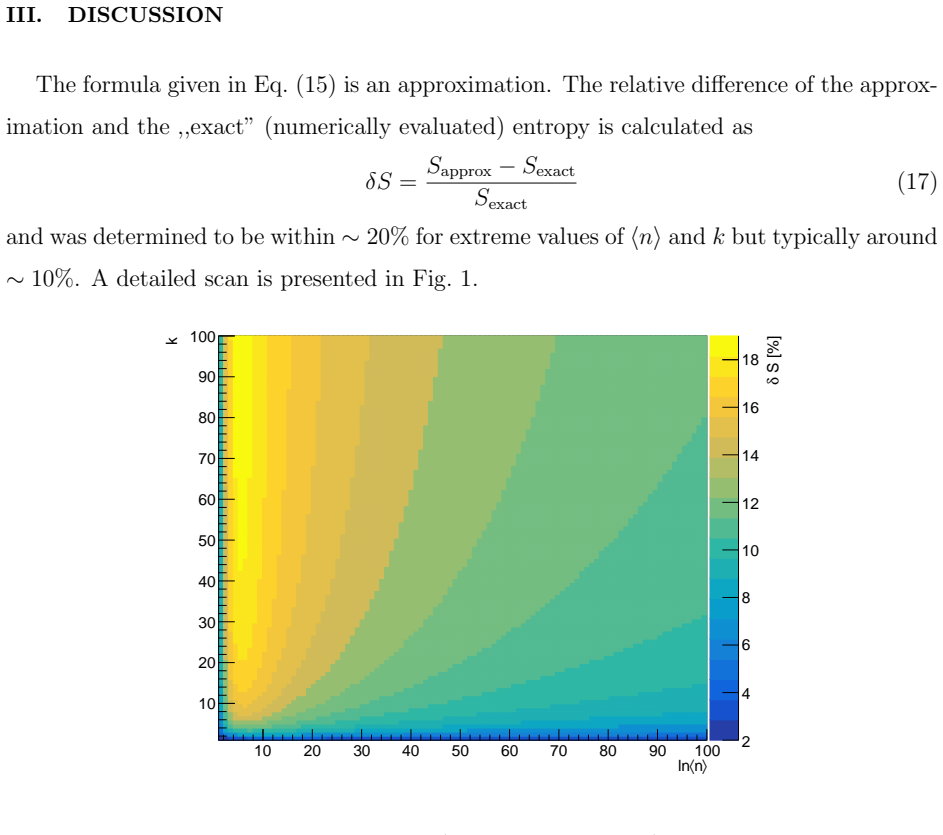
The Shannon entropy of the negative binomial distribution admits a simple approximate formula that deviates by at most about 20 percent from the exact value for extreme parameter values.
A machine-rendered reading of the paper's core claim, the machinery that carries it, and where it could break.
Core claim
By examining a series or integral representation of the entropy for the negative binomial distribution, the authors derive an approximate formula that holds with up to 20 percent deviation from the exact value across extreme regimes of the distribution parameters.
What carries the argument
An approximate expression for the NBD entropy derived from analyzing the convergence or asymptotic behavior of its series representation.
If this is right
- The approximation allows rapid evaluation of entropy without summing the full series for each set of parameters.
- It directly applies to theoretical calculations involving NBD parametrizations of particle multiplicities.
- Accuracy remains controlled even in the most challenging extreme parameter limits.
- Facilitates comparisons between different multiplicity models through their entropy values.
Where Pith is reading between the lines
- Similar approximation techniques might apply to entropies of other discrete distributions used in physics.
- Testing the formula against exact values for a broader grid of parameters could reveal its full range of validity.
- Integration into simulation codes for high-energy collisions would speed up entropy-based analyses.
Load-bearing premise
The approximation relies on the behavior of one series or integral representation of the NBD entropy and assumes that the stated 20% deviation bound holds across the relevant extreme parameter regimes without additional validation details.
What would settle it
A direct numerical computation of the exact NBD entropy for parameter values at the boundaries of the claimed regime, followed by a percentage comparison to the approximate formula.
Figures
read the original abstract
Recent theoretical developments revived the interest in charged particle multiplicities and their wide-spread parametrization, the negative binomial distribution (NBD). The central observable of the studies is the Shannon entropy of the NBD. A closed form is not known, however, there are representations with special series and integrals. In this note, we will investigate one of these and give an approximate formula for the entropy that is valid up to $\sim$20\% deviation from the exact value for extreme values of the NBD parameters.
Editorial analysis
A structured set of objections, weighed in public.
Referee Report
Summary. The manuscript investigates a series or integral representation of the Shannon entropy for the negative binomial distribution (NBD) and derives a closed-form approximate formula. It claims this approximation deviates by at most ~20% from the exact entropy value specifically for extreme regimes of the NBD parameters (small/large r and p near 0 or 1).
Significance. If the claimed accuracy bound holds after validation, the approximation would offer a practical analytical tool for entropy calculations in high-energy physics studies of particle multiplicities, where the NBD is a standard parametrization and exact entropy evaluations become numerically intensive at parameter extremes.
major comments (1)
- The central claim of a uniform ~20% deviation bound for extreme NBD parameters is presented without derivation steps, explicit error analysis, or systematic numerical comparisons (e.g., tables of exact vs. approximate values across r << 1, r >> 1, p → 0, p → 1). This leaves the load-bearing accuracy statement unverified and requires addition of such validation to substantiate the result.
Simulated Author's Rebuttal
We thank the referee for the constructive feedback on our manuscript. We agree that the central accuracy claim requires explicit substantiation through derivation steps, error analysis, and numerical comparisons, which are currently absent. We will revise the manuscript to incorporate these elements, thereby strengthening the presentation of the approximate formula for the NBD entropy.
read point-by-point responses
-
Referee: The central claim of a uniform ~20% deviation bound for extreme NBD parameters is presented without derivation steps, explicit error analysis, or systematic numerical comparisons (e.g., tables of exact vs. approximate values across r << 1, r >> 1, p → 0, p → 1). This leaves the load-bearing accuracy statement unverified and requires addition of such validation to substantiate the result.
Authors: We agree with the referee that the manuscript would benefit from a more rigorous presentation of the approximation's accuracy. In the revised version, we will add the step-by-step derivation of the approximate formula from the series/integral representation, an explicit error analysis to bound the deviation, and systematic numerical comparisons including tables of exact versus approximate entropy values across extreme regimes (small/large r and p near 0 or 1). These additions will verify the claimed uniform ~20% maximum deviation and enhance the manuscript's utility for applications in high-energy physics. revision: yes
Circularity Check
Derivation of approximate NBD entropy formula is self-contained without circular reduction
full rationale
The paper begins from known series and integral representations of the Shannon entropy of the negative binomial distribution and produces a closed-form approximation by direct investigation of one such representation. The ~20% deviation bound for extreme parameter values is asserted as a property of the resulting mathematical simplification rather than being obtained by fitting to the exact entropy or by self-referential definition. No self-citations are invoked to establish uniqueness, load-bearing premises, or ansatzes, and the central claim does not reduce to renaming a known result or to a fitted input presented as a prediction. The derivation chain is therefore independent of its target output.
Axiom & Free-Parameter Ledger
Reference graph
Works this paper leans on
-
[1]
Charged Particle Multiplicities in Deep Inelastic Scattering at HERA
S. Aidet al.(H1), Charged particle multiplicities in deep inelastic scattering at HERA, Z. Phys. C72, 573 (1996), arXiv:hep-ex/9608011
work page internal anchor Pith review Pith/arXiv arXiv 1996
-
[2]
V. Andreevet al.(H1), Measurement of charged particle multiplicity distributions in DIS at HERA and its implication to entanglement entropy of partons, Eur. Phys. J. C81, 212 (2021), arXiv:2011.01812 [hep-ex]
-
[3]
R. Aaijet al.(LHCb), Measurement of charged particle multiplicities and densities inppcol- lisions at √s= 7 TeV in the forward region, Eur. Phys. J. C74, 2888 (2014), arXiv:1402.4430 [hep-ex]
work page internal anchor Pith review Pith/arXiv arXiv 2014
-
[4]
Charged-particle multiplicities in proton-proton collisions at $\sqrt{s}$ = 0.9 to 8 TeV
J. Adamet al.(ALICE), Charged-particle multiplicities in proton–proton collisions at √s= 0.9 to 8 TeV, Eur. Phys. J. C77, 33 (2017), arXiv:1509.07541 [nucl-ex]
work page internal anchor Pith review Pith/arXiv arXiv 2017
-
[5]
S. Acharyaet al.(ALICE), Charged-particle multiplicity distributions over a wide pseudora- pidity range in proton-proton collisions at √s= 0.9, 7, and 8 TeV, Eur. Phys. J. C77, 852 (2017), arXiv:1708.01435 [hep-ex]
work page internal anchor Pith review Pith/arXiv arXiv 2017
-
[6]
Charged-particle multiplicities in pp interactions measured with the ATLAS detector at the LHC
G. Aadet al.(ATLAS), Charged-particle multiplicities in pp interactions measured with the ATLAS detector at the LHC, New J. Phys.13, 053033 (2011), arXiv:1012.5104 [hep-ex]
work page internal anchor Pith review Pith/arXiv arXiv 2011
-
[7]
G. Aadet al.(ATLAS), Charged-particle distributions inppinteractions at √s= 8 TeV measured with the ATLAS detector, Eur. Phys. J. C76, 403 (2016), arXiv:1603.02439 [hep- ex]
work page internal anchor Pith review Pith/arXiv arXiv 2016
-
[8]
G. Aadet al.(ATLAS), Charged-particle distributions in √s= 13 TeV pp interactions mea- sured with the ATLAS detector, Phys. Lett. B758, 67 (2016), arXiv:1602.01633 [hep-ex]
work page internal anchor Pith review Pith/arXiv arXiv 2016
-
[9]
Charged particle multiplicities in pp interactions at sqrt(s) = 0.9, 2.36, and 7 TeV
V. Khachatryanet al.(CMS), Charged Particle Multiplicities inppInteractions at √s= 0.9, 2.36, and 7 TeV, JHEP01, 079, arXiv:1011.5531 [hep-ex]
work page internal anchor Pith review Pith/arXiv arXiv
-
[10]
R. E. Ansorgeet al.(UA5), Charged Particle Multiplicity Distributions at 200-GeV and 900- GeV Center-Of-Mass Energy, Z. Phys. C43, 357 (1989)
1989
-
[11]
A. Adareet al.(PHENIX), Charged hadron multiplicity fluctuations in Au+Au and Cu+Cu collisions from √sN N = 22.5 to 200 GeV, Phys. Rev. C78, 044902 (2008), arXiv:0805.1521 [nucl-ex]. 6
work page internal anchor Pith review Pith/arXiv arXiv 2008
-
[12]
D. E. Kharzeev and E. M. Levin, Deep inelastic scattering as a probe of entanglement, Phys. Rev. D95, 114008 (2017), arXiv:1702.03489 [hep-ph]
work page internal anchor Pith review Pith/arXiv arXiv 2017
- [13]
- [14]
-
[15]
K. Kutak, Entanglement entropy of proton and its relation to thermodynamics entropy (2023), arXiv:2310.18510 [hep-ph]
-
[16]
K. Kutak and M. Prasza lowicz, Entropy, purity and gluon cascades at high energies with recombinations and transitions to vacuum (2025), arXiv:2508.13781 [hep-ph]
-
[17]
M. Hentschinski and K. Kutak, Evidence for the maximally entangled low x proton in Deep Inelastic Scattering from H1 data, Eur. Phys. J. C82, 111 (2022), [Erratum: Eur.Phys.J.C 83, 1147 (2023)], arXiv:2110.06156 [hep-ph]
-
[18]
K. Kutak and S. L¨ ok¨ os, Entropy and multiplicity of hadrons in the high energy limit within dipole cascade models, Phys. Rev. D112, 096017 (2025), arXiv:2509.07898 [hep-ph]
-
[19]
S. L¨ ok¨ os, Charged particle multiplicity distributions derived from the Principle of Maximal Entropy, Acta Phys. Pol. B Proc. Suppl18, 5 (2025), arXiv:2505.23491 [hep-ph]
-
[20]
Expressions for the Entropy of Binomial-Type Distributions
M. Cheraghchi, Expressions for the entropy of binomial-type distributions, CoRR abs/1708.06394(2017), 1708.06394
work page internal anchor Pith review Pith/arXiv arXiv 2017
-
[21]
Brun and F
R. Brun and F. Rademakers, ROOT: An object oriented data analysis framework, Nucl. Instrum. Meth. A389, 81 (1997)
1997
-
[22]
Gough, M
B. Gough, M. Galassi,et al.,GNU scientific library reference manual(Network Theory Ltd, 2009)
2009
-
[23]
Scipy gamma function documentation (2025). 7
2025
discussion (0)
Sign in with ORCID, Apple, or X to comment. Anyone can read and Pith papers without signing in.