Recognition: 2 theorem links
· Lean TheoremLecture Notes on Replica Tensor Networks for Random Quantum Circuits
Pith reviewed 2026-05-13 02:41 UTC · model grok-4.3
The pith
Circuit-averaged observables in random quantum circuits equal contractions of a classical tensor network whose spins live in the gate commutant.
A machine-rendered reading of the paper's core claim, the machinery that carries it, and where it could break.
Core claim
Circuit-averaged observables acting on multiple copies of the system can be recast as the contraction of a classical tensor network, equivalently the partition function of a statistical-mechanics model whose effective spins live in the commutant of the gate ensemble. Changing the observable or initial state modifies only the replica boundary conditions, while changing the ensemble modifies the bulk tensors. The same framework applies to clean and noisy random unitary circuits and extends to other ensembles such as orthogonal or Clifford circuits.
What carries the argument
Replica tensor network mapping, which converts multi-copy circuit averages into a classical tensor network contraction whose tensors are fixed by the gate ensemble and whose boundary conditions encode the chosen observable.
If this is right
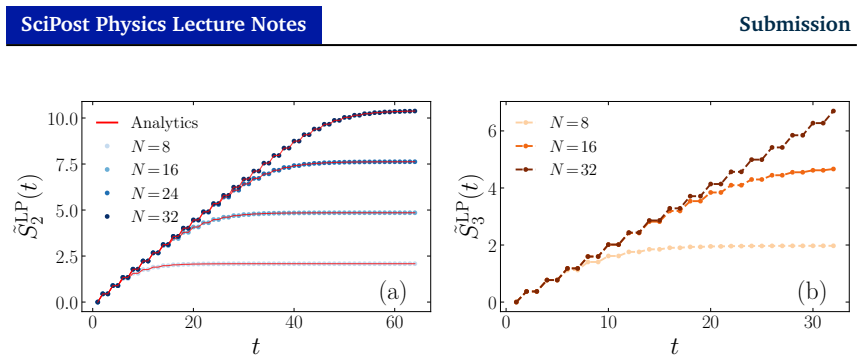
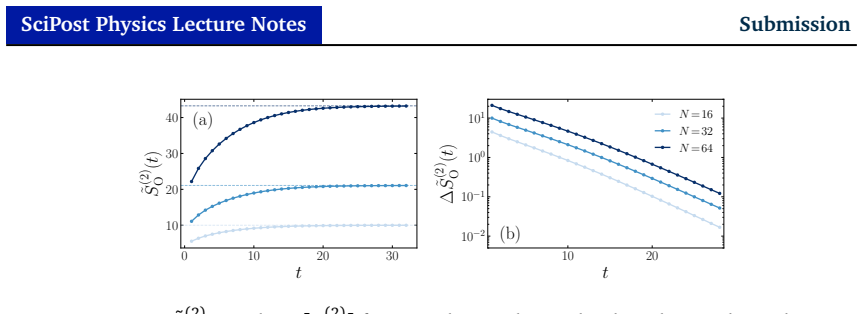
- Entanglement quantifiers and wavefunction spreading metrics become computable by contracting the same network after setting appropriate boundary conditions.
- Noisy circuits are handled by inserting additional tensors that represent the noise channel in the bulk.
- The method applies unchanged to other gate ensembles once the corresponding bulk tensors are computed from the new commutant.
- Only boundary conditions need to be updated when the initial state or measured observable changes.
Where Pith is reading between the lines
- The mapping may permit large-system limits to be analyzed with known techniques from statistical mechanics.
- Numerical checks on small circuits could directly test whether the commutant reduction holds for a chosen ensemble.
- The approach could be extended to circuits with intermediate measurements by adding appropriate boundary or bulk modifications.
Load-bearing premise
The effective description reduces exactly to spins in the commutant of the gate ensemble and boundary conditions alone capture all changes from observables or initial states without further approximations.
What would settle it
A mismatch between the tensor-network contraction and the exact circuit-averaged value of a simple observable such as the average fidelity, computed by direct enumeration on a small number of qubits.
Figures




read the original abstract
We present a pedagogical, hands-on tutorial on \emph{replica tensor-network} techniques for random quantum circuits. At its core, the method recasts circuit-averaged observables acting on multiple copies of the system as the contraction of a classical tensor network, equivalently the partition function of a statistical-mechanics model whose effective spins live in the commutant of the gate ensemble. The framework is general: changing the observable or the initial state modifies only the replica boundary conditions, while changing the ensemble modifies the bulk tensors. Focusing on quantum-information diagnostics, from metrics of wavefunction spreadings to entanglement quantifiers, we illustrate the approach in both clean and noisy random unitary circuits. We then briefly explain how the methodology extends to other ensembles, such as orthogonal or Clifford circuits. The lecture notes are accompanied by \texttt{ReplicaTN}, a self-contained C++/Python library and pedagogical notebooks.
Editorial analysis
A structured set of objections, weighed in public.
Referee Report
Summary. The manuscript is a set of pedagogical lecture notes on replica tensor-network methods applied to random quantum circuits. It shows how circuit-averaged observables on multiple replicas are recast as contractions of a classical tensor network (equivalently, the partition function of a statistical-mechanics model whose spins live in the commutant of the gate ensemble). The framework is illustrated for quantum-information diagnostics such as wave-function spreading and entanglement measures in both clean and noisy random unitary circuits; extensions to orthogonal and Clifford ensembles are sketched. The notes are accompanied by the self-contained ReplicaTN C++/Python library and pedagogical notebooks.
Significance. As lecture notes the work provides a clear, hands-on exposition of an established replica-mapping technique that connects random-circuit averages to tensor-network contractions and statistical-mechanics models. The accompanying open-source library and notebooks constitute a concrete strength, supplying reproducible code and practical examples that lower the barrier for researchers new to the method. The general structure—bulk tensors fixed by the ensemble, boundary conditions encoding observables and initial states—is correctly presented as exact for Haar (or orthogonal) unitary ensembles.
minor comments (3)
- [Abstract] The abstract and introduction would benefit from an explicit statement of the intended readership (e.g., graduate students familiar with basic quantum information but new to replica techniques).
- Figure captions should include a brief reminder of the replica boundary conditions used in each panel so that readers can connect the diagrams directly to the text without searching.
- A short table summarizing the mapping between common observables (purity, entanglement entropy, etc.) and the corresponding replica boundary tensors would improve quick reference.
Simulated Author's Rebuttal
We thank the referee for their positive and encouraging report. We are pleased that the pedagogical structure, the replica-mapping framework, the illustrative examples for quantum-information diagnostics, and the accompanying ReplicaTN library with notebooks were viewed as clear and useful contributions.
Circularity Check
No significant circularity identified
full rationale
The manuscript is a pedagogical tutorial recasting known replica averaging of random circuit observables into classical tensor-network contractions whose local tensors are fixed by the gate ensemble commutant. This mapping is presented as an exact equivalence for Haar or orthogonal ensembles, with observables and initial states encoded solely via boundary conditions. No derivation step reduces to a fitted parameter renamed as prediction, a self-referential definition, or a load-bearing self-citation whose validity depends on the present work. The notes explicitly frame the technique as established and illustrate its application without advancing a novel theorem that would require internal verification. The construction remains self-contained against external benchmarks of replica tensor networks.
Axiom & Free-Parameter Ledger
axioms (1)
- domain assumption Circuit-averaged observables on replicated systems map to contractions of a tensor network equivalent to a statistical mechanics partition function with spins in the gate commutant.
Lean theorems connected to this paper
-
IndisputableMonolith/Cost/FunctionalEquation.leanwashburn_uniqueness_aczel (J uniqueness) unclear?
unclearRelation between the paper passage and the cited Recognition theorem.
At its core, the method recasts circuit-averaged observables acting on multiple copies of the system as the contraction of a classical tensor network, equivalently the partition function of a statistical-mechanics model whose effective spins live in the commutant of the gate ensemble.
-
IndisputableMonolith/Foundation/RealityFromDistinction.leanreality_from_one_distinction unclear?
unclearRelation between the paper passage and the cited Recognition theorem.
For Haar-random unitaries on k-replicas, these gates describe interactions on k!-dimensional spins associated to permutations in Sk.
What do these tags mean?
- matches
- The paper's claim is directly supported by a theorem in the formal canon.
- supports
- The theorem supports part of the paper's argument, but the paper may add assumptions or extra steps.
- extends
- The paper goes beyond the formal theorem; the theorem is a base layer rather than the whole result.
- uses
- The paper appears to rely on the theorem as machinery.
- contradicts
- The paper's claim conflicts with a theorem or certificate in the canon.
- unclear
- Pith found a possible connection, but the passage is too broad, indirect, or ambiguous to say the theorem truly supports the claim.
Reference graph
Works this paper leans on
-
[1]
S. Boixo, S. V. Isakov, V. N. Smelyanskiy, R. Babbush, N. Ding, Z. Jiang, M. J. Bremner, J. M. Martinis and H. Neven, Characterizing quantum supremacy in near-term devices, Nat. Phys. 14, 595 (2018), doi:10.1038/s41567-018-0124-x
-
[2]
F. Arute et al., Quantum supremacy using a programmable superconducting processor, Nature 574, 505 (2019), doi:10.1038/s41586-019-1666-5
-
[3]
Quantum Computing in the NISQ era and beyond.Quantum, 2:79, August 2018
J. Preskill, Quantum C omputing in the NISQ era and beyond , Quantum 2, 79 (2018), doi:10.22331/q-2018-08-06-79
work page internal anchor Pith review doi:10.22331/q-2018-08-06-79 2018
-
[4]
M. P. A. Fisher, V. Khemani, A. Nahum and S. Vijay, Random quantum circuits, Annu. Rev. Condens. Matter Phys. 14, 335 (2023), doi:10.1146/annurev-conmatphys-031720-030658
-
[5]
A. Nahum, J. Ruhman, S. Vijay and J. Haah, Quantum entanglement growth under random unitary dynamics, Phys. Rev. X 7, 031016 (2017), doi:10.1103/PhysRevX.7.031016
-
[7]
C. W. von Keyserlingk, T. Rakovszky, F. Pollmann and S. L. Sondhi, Operator hydrodynamics, otocs, and entanglement growth in systems without conservation laws, Phys. Rev. X 8, 021013 (2018), doi:10.1103/PhysRevX.8.021013
-
[8]
A. C. Potter and R. Vasseur, Entanglement dynamics in hybrid quantum circuits, In Entanglement in Spin Chains. Springer (2022)
work page 2022
-
[9]
Y. Li, R. Vasseur, M. P. A. Fisher and A. W. W. Ludwig, Statistical mechanics model for clifford random tensor networks and monitored quantum circuits, Phys. Rev. B 109, 174307 (2024), doi:10.1103/PhysRevB.109.174307
-
[10]
C.-M. Jian, Y.-Z. You, R. Vasseur and A. W. W. Ludwig, Measurement-induced criticality in random quantum circuits, Phys. Rev. B 101, 104302 (2020), doi:10.1103/PhysRevB.101.104302
-
[11]
Y. Bao, S. Choi and E. Altman, Theory of the phase transition in random unitary circuits with measurements, Phys. Rev. B 101, 104301 (2020), doi:10.1103/PhysRevB.101.104301
-
[12]
P. Hayden and J. Preskill, Black holes as mirrors: quantum information in random subsystems, J. High Energy Phys. 09, 120 (2007), doi:10.1088/1126-6708/2007/09/120
-
[13]
D. A. Roberts and B. Yoshida, Chaos and complexity by design, J. High Energy Phys. 04, 121 (2017), doi:10.1007/JHEP04(2017)121
-
[14]
Holographic duality from random tensor networks
P. Hayden, S. Nezami, X.-L. Qi, N. Thomas, M. Walter and Z. Yang, Holographic duality from random tensor networks, Journal of High Energy Physics 2016(11) (2016), doi:10.1007/jhep11(2016)009
-
[15]
J. Lopez-Piqueres, B. Ware and R. Vasseur, Mean-field entanglement transitions in random tree tensor networks, Phys. Rev. B 102, 064202 (2020), doi:10.1103/PhysRevB.102.064202
-
[16]
R. Vasseur, A. C. Potter, Y.-Z. You and A. W. W. Ludwig, Entanglement transitions from holographic random tensor networks, Phys. Rev. B 100, 134203 (2019), doi:10.1103/PhysRevB.100.134203
-
[17]
Weingarten, Asymptotic behavior of group integrals in the limit of infinite rank, J
D. Weingarten, Asymptotic behavior of group integrals in the limit of infinite rank, J. Math. Phys. 19, 999 (1978), doi:10.1063/1.523807
-
[18]
B. Collins, Moments and cumulants of polynomial random variables on unitary groups, the itzykson-zuber integral and free probability (2002), math-ph/0205010
-
[19]
B. Collins and P. \'S niady, Integration with respect to the haar measure on unitary, orthogonal and symplectic group, Commun. Math. Phys. 264, 773 (2006), doi:10.1007/s00220-006-1554-3
-
[20]
B. Collins, S. Matsumoto and J. Novak, The W eingarten calculus , Notices of the AMS 69, 734 (2022), doi:10.1090/noti2474
-
[21]
A. A. Mele, Introduction to haar measure tools in quantum information: a beginner's tutorial, Quantum 8, 1340 (2024), doi:10.22331/q-2024-05-08-1340
-
[22]
Brauer, On algebras which are connected with the semisimple continuous groups, Ann
R. Brauer, On algebras which are connected with the semisimple continuous groups, Ann. Math. 38, 857 (1937), doi:10.2307/1968843
-
[23]
B. Collins and S. Matsumoto, On some properties of orthogonal weingarten functions, J. Math. Phys. 50, 113516 (2009), doi:10.1063/1.3251304
-
[24]
D. Gross, S. Nezami and M. Walter, Schur--weyl duality for the clifford group with applications, Commun. Math. Phys. 385, 1325 (2021), doi:10.1007/s00220-021-04118-7
-
[25]
Webb, The clifford group forms a unitary 3-design, Quantum Inf
Z. Webb, The clifford group forms a unitary 3-design, Quantum Inf. Comput. 16, 1379 (2016)
work page 2016
-
[26]
Zhu, Multiqubit clifford groups are unitary 3-designs, Phys
H. Zhu, Multiqubit clifford groups are unitary 3-designs, Phys. Rev. A 96, 062336 (2017), doi:10.1103/PhysRevA.96.062336
-
[27]
S. Nezami and M. Walter, Multipartite entanglement in stabilizer tensor networks, Phys. Rev. Lett. 125, 241602 (2020), doi:10.1103/PhysRevLett.125.241602
-
[28]
B. Magni, A. Christopoulos, A. De Luca and X. Turkeshi, Anticoncentration in clifford circuits and beyond: From random tensor networks to pseudomagic states, Phys. Rev. X 15, 031071 (2025), doi:10.1103/p8dn-glcw
- [29]
-
[30]
T. Zhou and A. Nahum, Emergent statistical mechanics of entanglement in random unitary circuits, Phys. Rev. B 99, 174205 (2019), doi:10.1103/PhysRevB.99.174205
-
[31]
T. Zhou and A. Nahum, Entanglement membrane in chaotic many-body systems, Phys. Rev. X 10, 031066 (2020), doi:10.1103/PhysRevX.10.031066
-
[32]
T. Rakovszky, F. Pollmann and C. W. von Keyserlingk, Sub-ballistic growth of R \'enyi entropies due to diffusion , Phys. Rev. Lett. 122, 250602 (2019), doi:10.1103/PhysRevLett.122.250602
-
[33]
C. W. von Keyserlingk, T. Rakovszky, F. Pollmann and S. L. Sondhi, Operator spreading in random unitary circuits, Phys. Rev. X 8(2), 021014 (2018), doi:10.1103/PhysRevX.8.021014
-
[34]
S. Sahu and S.-K. Jian, Phase transitions in sampling and error correction in local brownian circuits, Phys. Rev. A 109, 042414 (2024), doi:10.1103/PhysRevA.109.042414
-
[35]
I. Lovas, U. Agrawal and S. Vijay, Quantum coding transitions in the presence of boundary dissipation, PRX Quantum 5, 030327 (2024), doi:10.1103/PRXQuantum.5.030327
-
[36]
X. Turkeshi and P. Sierant, Error-resilience phase transitions in encoding-decoding quantum circuits, Phys. Rev. Lett. 132, 140401 (2024), doi:10.1103/PhysRevLett.132.140401
-
[37]
E. Dallas and P. Zanardi, Nonlocal magic generation and information scrambling in noisy clifford circuits (2025), 2509.20566
-
[38]
E. Dallas and P. Zanardi, Nonlocal nonstabilizerness generation and information scrambling in noisy clifford circuits, Phys. Rev. A 113, 042429 (2026), doi:10.1103/xkhn-d7yv
-
[39]
E. Dallas, F. Andreadakis and P. Zanardi, Butterfly effect in encoding-decoding quantum circuits, Phys. Rev. A 113, 042428 (2026), doi:10.1103/lcsc-sj5q
-
[40]
F. B. Trigueros and J. A. M. Guzmán, Nonstabilizerness and error resilience in noisy quantum circuits (2026), 2506.18976
work page internal anchor Pith review Pith/arXiv arXiv 2026
-
[41]
P. Sierant and X. Turkeshi, Theory of magic phase transitions in encoding-decoding circuits (2026), 2603.00235
-
[42]
P. Braccia, P. Bermejo, L. Cincio and M. Cerezo, Computing exact moments of local random quantum circuits via tensor networks, Quantum Mach. Intell. 6(2), 54 (2024), doi:10.1007/s42484-024-00187-8
-
[43]
X. Turkeshi and P. Sierant, Hilbert space delocalization under random unitary circuits, Entropy 26(6), 471 (2024), doi:10.3390/e26060471
-
[44]
G. Lami, J. De Nardis and X. Turkeshi, Anticoncentration and state design of random tensor networks, Phys. Rev. Lett. 134, 010401 (2025), doi:10.1103/PhysRevLett.134.010401
-
[45]
A. Sauliere, B. Magni, G. Lami, X. Turkeshi and J. De Nardis, Universality in the anticoncentration of chaotic quantum circuits, Phys. Rev. B 112, 134312 (2025), doi:10.1103/lkwg-4dbt
- [46]
-
[47]
E. Tirrito, P. S. Tarabunga, D. S. Bhakuni, M. Dalmonte, P. Sierant and X. Turkeshi, Universal spreading of nonstabilizerness and quantum transport (2025), 2506.12133
-
[48]
Coherence dynamics in quantum many-body systems with conservation laws
S. Aditya, E. Tirrito, P. Sierant and X. Turkeshi, Coherence dynamics in quantum many-body systems with conservation laws (2026), 2604.23192
work page internal anchor Pith review Pith/arXiv arXiv 2026
-
[49]
A. Sauliere, G. Lami, C. Boyer, J. D. Nardis and A. D. Luca, Universality in the anticoncentration of noisy quantum circuits at finite depths, PRX Quantum pp. -- (2026), doi:10.1103/xl16-cdy9
-
[51]
X. Turkeshi, E. Tirrito and P. Sierant, Magic spreading in random quantum circuits, Nat. Commun. 16(1), 2575 (2025), doi:10.1038/s41467-025-57704-x
-
[52]
B. Magni and X. Turkeshi, Quantum C omplexity and C haos in M any- Q udit D oped C lifford C ircuits , Quantum 9, 1956 (2025), doi:10.22331/q-2025-12-24-1956
-
[53]
P. Sierant, P. Stornati and X. Turkeshi, Fermionic magic resources of quantum many-body systems, PRX Quantum 7, 010302 (2026), doi:10.1103/3yx4-1j27
-
[54]
E. H. Lieb and D. W. Robinson, The finite group velocity of quantum spin systems, Commun. Math. Phys. 28, 251 (1972), doi:10.1007/BF01645779
-
[55]
A. M. Dalzell, N. Hunter-Jones and F. G. S. L. Brand \ a o, Random quantum circuits anticoncentrate in log depth, PRX Quantum 3, 010333 (2022), doi:10.1103/PRXQuantum.3.010333
-
[56]
A. Christopoulos, A. Chan and A. De Luca, Universal distributions of overlaps from generic dynamics in quantum many-body systems, Phys. Rev. Res. 7, 043035 (2025), doi:10.1103/kl64-xnsz
-
[57]
D. Hangleiter and J. Eisert, Computational advantage of quantum random sampling, Rev. Mod. Phys. 95, 035001 (2023), doi:10.1103/RevModPhys.95.035001
-
[58]
D. N. Page, Average entropy of a subsystem, Phys. Rev. Lett. 71, 1291 (1993), doi:10.1103/PhysRevLett.71.1291
-
[59]
K. Zyczkowski and H.-J. Sommers, Induced measures in the space of mixed quantum states, Journal of Physics A: Mathematical and General 34(35), 7111–7125 (2001), doi:10.1088/0305-4470/34/35/335
-
[60]
U. Schollw \"o ck, The density-matrix renormalization group in the age of matrix product states, Ann. Phys. 326, 96 (2011), doi:10.1016/j.aop.2010.09.012
-
[61]
J. Hauschild and F. Pollmann, Efficient numerical simulations with Tensor Networks: Tensor Network Python (TeNPy) , SciPost Phys. Lect. Notes p. 5 (2018), doi:10.21468/SciPostPhysLectNotes.5
-
[62]
P. W. Claeys and G. De Tomasi, Fock-space delocalization and the emergence of the porter-thomas distribution from dual-unitary dynamics, Phys. Rev. Lett. 134(5), 050405 (2025), doi:10.1103/physrevlett.134.050405
-
[63]
T. Schuster, J. Haferkamp and H.-Y. Huang, Random unitaries in extremely low depth, Science 389, 092 (2025), doi:10.1126/science.adv8590
-
[64]
H.-Y. Huang, R. Kueng and J. Preskill, Predicting many properties of a quantum system from very few measurements, Nature Phys. 16(10), 1050 (2020), doi:10.1038/s41567-020-0932-7
-
[65]
R. Cioli, E. Ercolessi, M. Ippoliti, X. Turkeshi and L. Piroli, Approximate inverse measurement channel for shallow shadows, Quantum 9, 1698 (2025), doi:10.22331/q-2025-04-08-1698
-
[66]
C. Bertoni, J. Haferkamp, M. Hinsche, M. Ioannou, J. Eisert and H. Pashayan, Shallow shadows: Expectation estimation using low-depth random clifford circuits, Phys. Rev. Lett. 133(2), 020602 (2024), doi:10.1103/physrevlett.133.020602
-
[67]
J. Bensa and M. Z nidari c , Fastest local entanglement scrambler, multistage thermalization, and a non-hermitian phantom, Phys. Rev. X 11, 031019 (2021), doi:10.1103/PhysRevX.11.031019
- [68]
-
[69]
T. Baumgratz, M. Cramer and M. B. Plenio, Quantifying coherence, Phys. Rev. Lett. 113, 140401 (2014), doi:https://doi.org/10.1103/PhysRevLett.113.140401
-
[70]
A. Streltsov, G. Adesso and M. B. Plenio, Colloquium: Quantum coherence as a resource, Rev. Mod. Phys. 89, 041003 (2017), doi:10.1103/RevModPhys.89.041003
-
[71]
S. P. Kelly, U. Poschinger, F. Schmidt-Kaler, M. P. A. Fisher and J. Marino, Coherence requirements for quantum communication from hybrid circuit dynamics , SciPost Phys. 15, 250 (2023), doi:10.21468/SciPostPhys.15.6.250
- [72]
- [73]
-
[74]
M. J. Gullans and D. A. Huse, Dynamical purification phase transition induced by quantum measurements, Phys. Rev. X 10(4), 041020 (2020), doi:10.1103/physrevx.10.041020
-
[75]
L. Colmenarez, Z.-M. Huang, S. Diehl and M. M\" u ller, Accurate optimal quantum error correction thresholds from coherent information, Phys. Rev. Res. 6(4), L042014 (2024), doi:10.1103/physrevresearch.6.l042014
-
[76]
D. Qian and J. Wang, Coherent information phase transition in a noisy quantum circuit, Phys. Rev. B 112(18), L180301 (2025), doi:10.1103/b8tq-z48t
-
[77]
A. Morvan et al., Phase transitions in random circuit sampling, Nature 634, 328 (2024), doi:10.1038/s41586-024-07998-6
-
[78]
A. Sauli \`e re, G. Lami, P. Ribeiro, A. De Luca and J. De Nardis, Error-correction transitions in finite-depth quantum channels, ArXiv:2603.20369 (2026)
-
[79]
S. Pappalardi, L. Foini and J. Kurchan, Eigenstate thermalization hypothesis and free probability, Phys. Rev. Lett. 129, 170603 (2022), doi:10.1103/PhysRevLett.129.170603
-
[80]
M. Fava, J. Kurchan and S. Pappalardi, Designs via free probability, Phys. Rev. X 15, 011031 (2025), doi:10.1103/PhysRevX.15.011031
-
[81]
S. Pappalardi, F. Fritzsch and T. c. v. Prosen, Full eigenstate thermalization via free cumulants in quantum lattice systems, Phys. Rev. Lett. 134, 140404 (2025), doi:10.1103/PhysRevLett.134.140404
-
[82]
N. Dowling, J. D. Nardis, M. Heinrich, X. Turkeshi and S. Pappalardi, Free independence and unitary design from random matrix product unitaries (2025), 2508.00051
discussion (0)
Sign in with ORCID, Apple, or X to comment. Anyone can read and Pith papers without signing in.