Recognition: 2 theorem links
· Lean TheoremSymmetry Guided Band-Gap Opening via Periodic Topological Defects in Graphene
Pith reviewed 2026-05-13 01:43 UTC · model grok-4.3
The pith
Periodic arrays of topological defects open a band gap in graphene only when the supercell size is a multiple of three.
A machine-rendered reading of the paper's core claim, the machinery that carries it, and where it could break.
Core claim
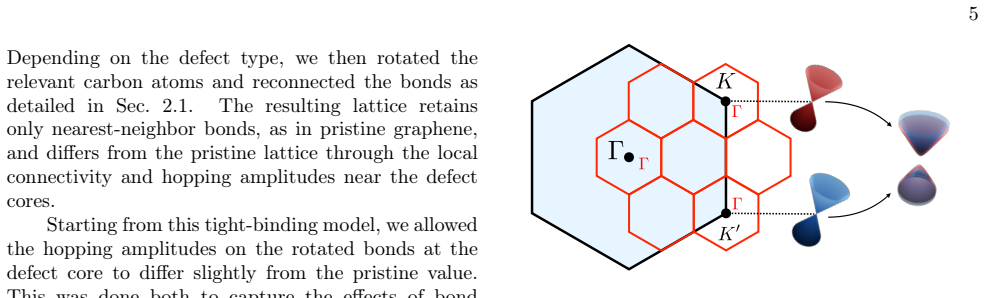
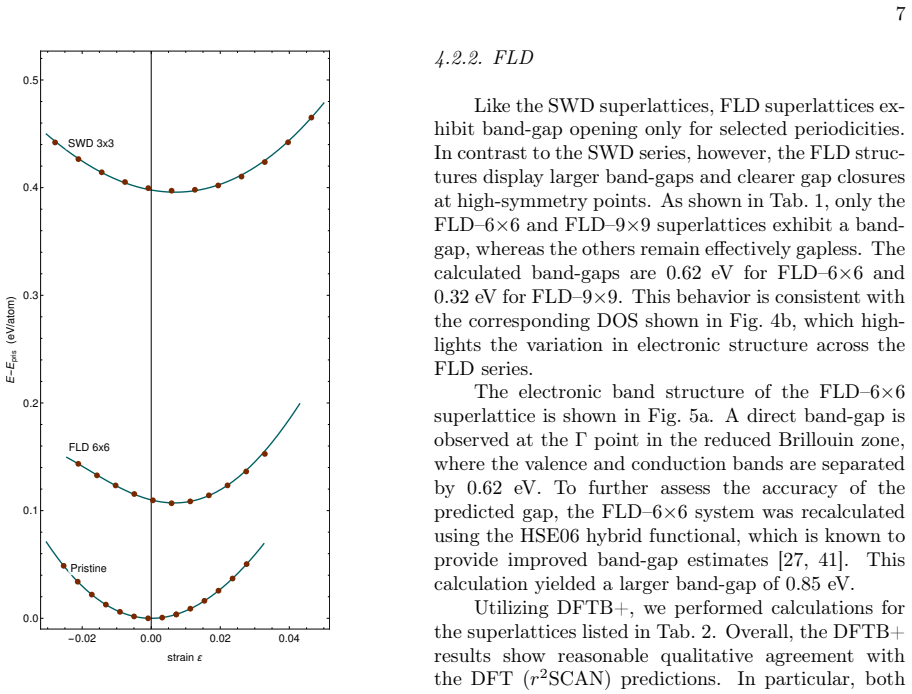
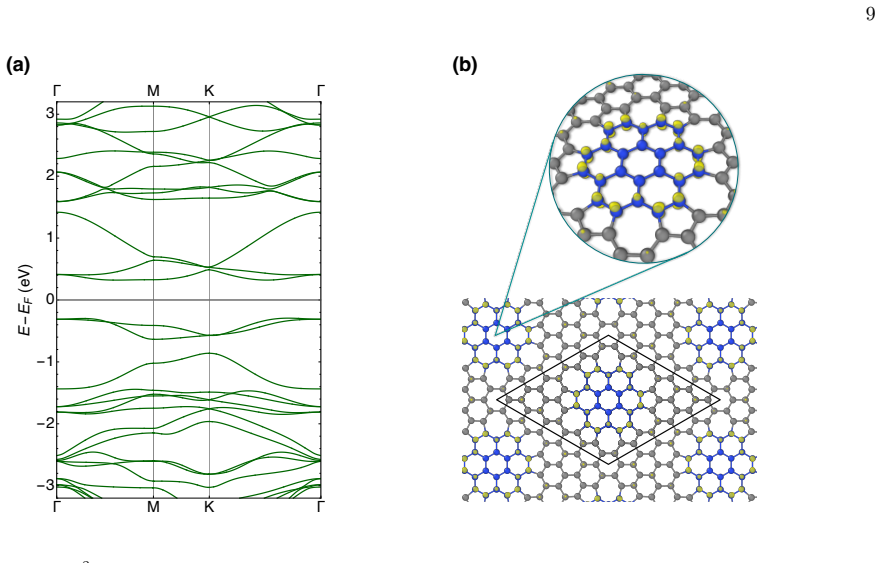
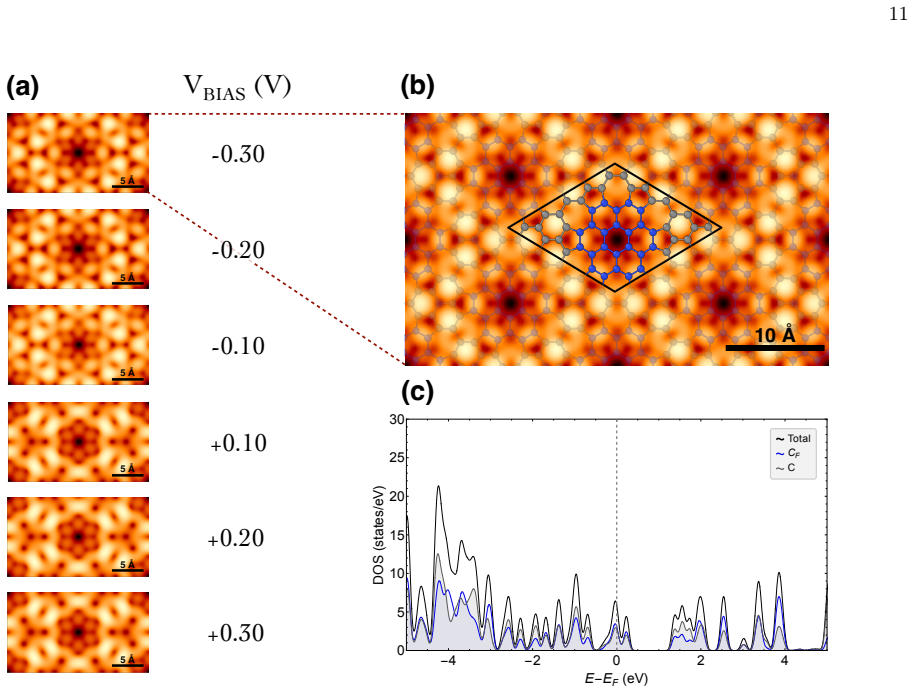
Band-gap opening occurs only when translation symmetry is reduced in a specific way: for supercells with N a multiple of three, Brillouin-zone folding brings the Dirac cones at K and K' to the same momentum in the reduced Brillouin zone. In particular, flower-like defect superlattices produce larger and tunable band-gaps, whose magnitude decreases systematically with increasing defect separation and approaches zero in the dilute-defect limit.
What carries the argument
Brillouin-zone folding caused by supercells whose linear size N is a multiple of three, which merges the K and K' Dirac cones so the periodic defects can split their degeneracy.
If this is right
- Band gaps can be tuned continuously by changing the defect separation while keeping the same defect type.
- Flower-like defects consistently produce larger gaps than Stone-Wales defects at the same spacing.
- The gap vanishes as defect density approaches zero, confirming the role of periodic interaction.
- The same symmetry rule applies across both defect types examined, giving a general design principle.
Where Pith is reading between the lines
- The same zone-folding requirement may apply to other two-dimensional Dirac materials when similar periodic defects are introduced.
- Device fabrication would need precise control of defect placement at the scale of a few nanometers to achieve useful gap sizes.
- In the dilute limit the results imply that isolated defects do not open a gap, only their periodic arrangement does.
- The approach could be extended to non-square supercells or mixed defect types to explore additional gap values.
Load-bearing premise
The first-principles calculations and tight-binding models accurately capture the electronic structure of the defect superlattices without large errors from exchange-correlation approximations or insufficient sampling.
What would settle it
Fabricating a graphene sample with flower-like defects on a 3x3 supercell and measuring either no gap or a gap size that does not follow the predicted decrease with larger N would disprove the zone-folding mechanism.
Figures


read the original abstract
Graphene lacks an intrinsic band-gap, which limits its use in electronic applications. Here we demonstrate that periodic arrays of topological defects can open and control a band-gap in a predictable manner governed by defect spacing and lattice symmetry. Using first-principles density functional theory calculations supported by tight-binding models, we investigate graphene superlattices containing Stone-Wales and flower-like defects over a range of $N \times N$ periodicities, where $N$ determines the defect separation. We show that band-gap opening occurs only when translation symmetry is reduced in a specific way: for supercells with $N$ a multiple of three, Brillouin-zone folding brings the Dirac cones at $K$ and $K'$ to the same momentum in the reduced Brillouin zone. In particular, flower-like defect superlattices produce larger and tunable band-gaps, whose magnitude decreases systematically with increasing defect separation and approaches zero in the dilute-defect limit. These results establish a predictive framework for band-gap engineering in defect-patterned graphene and clarify the microscopic mechanism underlying gap formation in periodically reconstructed lattices.
Editorial analysis
A structured set of objections, weighed in public.
Referee Report
Summary. The manuscript claims that periodic arrays of topological defects (Stone-Wales and flower-like) in graphene open a band gap only for N×N supercells where N is a multiple of 3. This occurs because Brillouin-zone folding maps the K and K' Dirac points to the same reduced-zone momentum, enabling intervalley scattering by the periodic defect potential. Flower-like defects produce larger, tunable gaps whose magnitude decreases systematically with increasing defect separation (approaching zero in the dilute limit). The claims are supported by first-principles DFT calculations and tight-binding models over a range of periodicities.
Significance. If the numerical results hold, the work supplies a symmetry-based, predictive route to band-gap engineering in graphene that relies on standard Brillouin-zone folding rather than external perturbations or ad-hoc parameters. The dual use of DFT and tight-binding provides cross-validation and mechanistic insight. This framework could be useful for designing 2D electronic materials, particularly if the gap tunability with defect spacing is quantitatively confirmed.
major comments (2)
- Abstract and main results: The manuscript states that DFT and tight-binding calculations support the claims over a range of periodicities but reports no numerical gap values, convergence tests, error bars, or details on exchange-correlation functional, k-point sampling, or supercell convergence. This directly limits verification of the central claim that flower-like defects produce larger and systematically tunable gaps.
- Methods/Computational details: No information is given on the specific tight-binding parameters (hopping terms, on-site energies) or DFT settings (plane-wave cutoff, vacuum spacing, relaxation criteria) used for the defected superlattices. These choices are load-bearing for assessing whether the reported gap magnitudes and their N-dependence are robust, especially in the dilute-defect limit.
minor comments (1)
- Figure captions and text should explicitly state the defect type (Stone-Wales vs. flower) and exact N values for each plotted band structure to facilitate direct comparison with the symmetry argument.
Simulated Author's Rebuttal
We thank the referee for the careful reading of our manuscript and the constructive comments. We agree that additional details on the computational methods and explicit numerical results will improve reproducibility and allow better verification of the reported trends. We will incorporate these changes in the revised version.
read point-by-point responses
-
Referee: Abstract and main results: The manuscript states that DFT and tight-binding calculations support the claims over a range of periodicities but reports no numerical gap values, convergence tests, error bars, or details on exchange-correlation functional, k-point sampling, or supercell convergence. This directly limits verification of the central claim that flower-like defects produce larger and systematically tunable gaps.
Authors: We acknowledge that while the manuscript describes the systematic decrease of the gap with increasing N and the larger gaps for flower-like defects relative to Stone-Wales, explicit tabulated numerical values, convergence tests, and error estimates are not provided in the current version. In the revised manuscript we will add a table summarizing the computed band gaps for each N (including both defect types), together with a brief description of the k-point convergence tests and supercell-size checks that were performed. The exchange-correlation functional used in the DFT calculations will also be stated explicitly. revision: yes
-
Referee: Methods/Computational details: No information is given on the specific tight-binding parameters (hopping terms, on-site energies) or DFT settings (plane-wave cutoff, vacuum spacing, relaxation criteria) used for the defected superlattices. These choices are load-bearing for assessing whether the reported gap magnitudes and their N-dependence are robust, especially in the dilute-defect limit.
Authors: We agree that these parameters are essential for reproducibility. The revised manuscript will include a dedicated Computational Methods section that specifies the tight-binding model (nearest-neighbor hopping value and any on-site terms), the DFT settings (plane-wave cutoff, vacuum spacing, ionic relaxation thresholds), the exchange-correlation functional, and the k-point sampling employed for the supercells. We will also note the convergence criteria used to confirm that the gap values remain stable in the dilute limit. revision: yes
Circularity Check
No significant circularity; derivation rests on independent symmetry principle and numerical outputs
full rationale
The paper derives band-gap opening exclusively for N multiples of 3 from the standard Brillouin-zone folding of graphene's Dirac cones at K and K' into the same reduced-zone point, a direct geometric consequence of the supercell reciprocal lattice that requires no input from the present DFT/TB results. Gap magnitudes, their systematic decrease with defect separation, and the dilute-limit vanishing are computed outputs of the simulations rather than fitted parameters or self-referential definitions. No load-bearing self-citation, ansatz smuggling, or uniqueness theorem imported from the authors' prior work appears in the provided text; the mechanism is analytically derivable from solid-state physics and confirmed numerically.
Axiom & Free-Parameter Ledger
axioms (2)
- domain assumption Density functional theory accurately describes the electronic band structure of graphene containing Stone-Wales and flower-like defects
- domain assumption Tight-binding models provide a reliable simplified description that supports the DFT findings
Lean theorems connected to this paper
-
IndisputableMonolith/Foundation/AlexanderDuality.leanalexander_duality_circle_linking unclear?
unclearRelation between the paper passage and the cited Recognition theorem.
band-gap opening occurs only when ... N a multiple of three, Brillouin-zone folding brings the Dirac cones at K and K' to the same momentum ... flower-like defect superlattices produce larger and tunable band-gaps, whose magnitude decreases systematically with increasing defect separation
-
IndisputableMonolith/Cost/FunctionalEquation.leanwashburn_uniqueness_aczel unclear?
unclearRelation between the paper passage and the cited Recognition theorem.
we develop a tight-binding (TB) model ... band-gap-opening rule ... n1 - m1 = 3p, n2 - m2 = 3q ... N×N superlattices ... when N is a multiple of three
What do these tags mean?
- matches
- The paper's claim is directly supported by a theorem in the formal canon.
- supports
- The theorem supports part of the paper's argument, but the paper may add assumptions or extra steps.
- extends
- The paper goes beyond the formal theorem; the theorem is a base layer rather than the whole result.
- uses
- The paper appears to rely on the theorem as machinery.
- contradicts
- The paper's claim conflicts with a theorem or certificate in the canon.
- unclear
- Pith found a possible connection, but the passage is too broad, indirect, or ambiguous to say the theorem truly supports the claim.
Reference graph
Works this paper leans on
-
[1]
K. S. Novoselov, A. K. Geim, S. V. Morozov, D. Jiang, Y. Zhang, S. V. Dubonos, I. V. Grigorieva, and A. A. Firsov. Electric field effect in atomically thin carbon films. Science, 306(5696):666–669, 2004
work page 2004
-
[2]
The rise of graphene.Nature materials, 6(3):183–191, 2007
Andre K Geim and Konstantin S Novoselov. The rise of graphene.Nature materials, 6(3):183–191, 2007
work page 2007
-
[3]
The electronic properties of graphene.Reviews of modern physics, 81(1):109, 2009
AH Castro Neto, Francisco Guinea, Nuno MR Peres, Kostya S Novoselov, and Andre K Geim. The electronic properties of graphene.Reviews of modern physics, 81(1):109, 2009
work page 2009
-
[4]
Graphene photonics and optoelectronics
Francesco Bonaccorso, Zhipei Sun, Tawfique Hasan, and AC Ferrari. Graphene photonics and optoelectronics. Nature photonics, 4(9):611–622, 2010
work page 2010
-
[5]
Elastic and frictional properties of graphene
Changgu Lee, Xiaoding Wei, Qunyang Li, Robert Carpick, Jeffrey W Kysar, and James Hone. Elastic and frictional properties of graphene. physica status solidi (b), 246(11-12):2562–2567, 2009
work page 2009
-
[6]
Bandgap opening by patterning graphene
Marc Dvorak, William Oswald, and Zhigang Wu. Bandgap opening by patterning graphene. Scientific Reports, 3, 2013. 13
work page 2013
-
[7]
Graphene transistors: status, prospects, and problems
Frank Schwierz. Graphene transistors: status, prospects, and problems. Proceedings of the IEEE, 101(7):1567–1584, 2013
work page 2013
-
[8]
Structural defects in graphene
Florian Banhart, Jani Kotakoski, and Arkady V Krasheninnikov. Structural defects in graphene. ACS nano, 5(1):26–41, 2011
work page 2011
-
[9]
Scanning tunneling microscopy fingerprints of point defects in graphene: A theoretical prediction
Hakim Amara, Sylvain Latil, Vincent Meunier, Ph Lambin, and J-C Charlier. Scanning tunneling microscopy fingerprints of point defects in graphene: A theoretical prediction. Physical Review B—Condensed Matter and Materials Physics, 76(11):115423, 2007
work page 2007
-
[10]
F. Guinea and Tony Low. Band structure and gaps of triangular graphene superlattices. Philos.Trans.RoyalSoc. A, 368(1932):5391–5402, December 2010
work page 1932
-
[11]
Band- gap opening in graphene: A reverse-engineering approach
Joon-Suh Park and Hyoung Joon Choi. Band- gap opening in graphene: A reverse-engineering approach. Physical Review B, 92(4):045402, 2015
work page 2015
-
[12]
Atomic valley filter effect induced by an individual flowerdefectingraphene
Yu Zhang, Rong Liu, Lili Zhou, Can Zhang, Guoyuan Yang, Yeliang Wang, and Lin He. Atomic valley filter effect induced by an individual flowerdefectingraphene. ChinesePhysicsLetters, 40(9):096801, 2023
work page 2023
-
[13]
Eric Cockayne, Gregory M. Rutter, Nathan P. Guisinger, Jason N. Crain, Phillip N. First, and Joseph A. Stroscio. Grain boundary loops in graphene. Phys. Rev. B, 83:195425, May 2011
work page 2011
-
[14]
Graphing and grafting graphene: Classifying finite topological defects
Eric Cockayne. Graphing and grafting graphene: Classifying finite topological defects. Physical Review B - Condensed Matter and Materials Physics, 85(12), mar 2012
work page 2012
-
[15]
Atomic-scale charac- terization of graphene grown on copper (100) sin- gle crystals
Haider I Rasool, Emil B Song, Matthew Mecklen- burg, BC Regan, Kang L Wang, Bruce H Weiller, and James K Gimzewski. Atomic-scale charac- terization of graphene grown on copper (100) sin- gle crystals. Journal of the American Chemical Society, 133(32):12536–12543, 2011
work page 2011
-
[16]
Electronic Structure Calculations Using DFT : hands-on with VASP, 2020
Henry P Pinto and Jorge D Vega. Electronic Structure Calculations Using DFT : hands-on with VASP, 2020
work page 2020
-
[17]
Sharmila N Shirodkar and Umesh V Waghmare. Electronic and vibrational signatures of stone- wales defects in graphene: First-principles anal- ysis. Physical Review B—Condensed Matter and Materials Physics, 86(16):165401, 2012
work page 2012
-
[18]
Electronicstructuresofgraphenelayersonametal foil: The effect of atomic-scale defects
Hui Yan, Cheng-Cheng Liu, Ke-Ke Bai, Xuejiao Wang, Mengxi Liu, Wei Yan, Lan Meng, Yanfeng Zhang, Zhongfan Liu, Rui-fen Dou, et al. Electronicstructuresofgraphenelayersonametal foil: The effect of atomic-scale defects. Applied Physics Letters, 103(14), 2013
work page 2013
-
[19]
Fab- rication and characterization of large-area, semi- conducting nanoperforated graphene materials
Myungwoong Kim, Nathaniel S Safron, Eungnak Han, MichaelSArnold, andPadmaGopalan. Fab- rication and characterization of large-area, semi- conducting nanoperforated graphene materials. Nano letters, 10(4):1125–1131, 2010
work page 2010
-
[20]
Chemical functionalization of graphene with defects.Nano letters, 8(12):4373–4379, 2008
DW Boukhvalov and MI Katsnelson. Chemical functionalization of graphene with defects.Nano letters, 8(12):4373–4379, 2008
work page 2008
-
[21]
Joongoo Kang, Junhyeok Bang, Byungki Ryu, and Kee-Joo Chang. Effect of atomic-scale defects onthelow-energyelectronicstructureofgraphene: Perturbation theory and local-density-functional calculations. Physical Review B, 77(11):115453, 2008
work page 2008
-
[22]
A. H. Castro Neto, F. Guinea, N. M. R. Peres, K. S. Novoselov, and A. K. Geim. The electronic properties of graphene.Rev. Mod. Phys., 81:109– 162, Jan 2009
work page 2009
-
[23]
Domenica N. Garzon. Electronic structure of nobel-graphene based superlattices, 2021. Trabajodeintegracióncurricularpresentadocomo requisito para la obtención del título de Físico
work page 2021
-
[24]
G. Kresse and J. Furthmüller. Efficiency of ab- initio total energy calculations for metals and semiconductors using a plane-wave basis set. Computational Materials Science, 6(1):15 – 50, 1996
work page 1996
-
[25]
Norm-conserving and ultrasoft pseudopotentials for first-row and tran- sition elements
G Kresse and J Hafner. Norm-conserving and ultrasoft pseudopotentials for first-row and tran- sition elements. Journal of Physics: Condensed Matter, 6(40):8245, 1994
work page 1994
-
[26]
Ac- curate and numerically efficient r2SCAN meta- generalized gradient approximation
James W Furness, Aaron D Kaplan, Jinliang Ning, John P Perdew, and Jianwei Sun. Ac- curate and numerically efficient r2SCAN meta- generalized gradient approximation. The journal of physical chemistry letters, 11(19):8208–8215, 2020
work page 2020
-
[27]
Hybrid functionals based on a screened coulomb potential
Jochen Heyd, Gustavo E Scuseria, and Matthias Ernzerhof. Hybrid functionals based on a screened coulomb potential. The Journal of chemical physics, 118(18):8207–8215, 2003
work page 2003
-
[28]
Aliaksandr V. Krukau, Oleg A. Vydrov, Artur F. Izmaylov, and Gustavo E. Scuseria. Influence of the exchange screening parameter on the performance of screened hybrid functionals.The Journal of Chemical Physics, 125(22):224106, December 2006
work page 2006
-
[29]
Ben Hourahine, Bálint Aradi, Volker Blum, F Bonafé, A Buccheri, Cristopher Camacho, Caterina Cevallos, MY Deshaye, T Dumitrică, A Dominguez, et al. DFTB+, a software package for efficient approximate density functional theory based atomistic simulations. The Journal of chemical physics, 152(12):124101, 2020. 14
work page 2020
-
[30]
Mechanical properties of graphene and boroni- trene
Richard Charles Andrew, Refilwe Edwin Ma- pasha, Aniekan M Ukpong, and Nithaya Chetty. Mechanical properties of graphene and boroni- trene. PhysicalReviewB—CondensedMatterand Materials Physics, 85(12):125428, 2012
work page 2012
-
[31]
Ryan S Kingsbury, Andrew S Rosen, Ayush S Gupta, Jason M Munro, Shyue Ping Ong, Anubhav Jain, Shyam Dwaraknath, Matthew K Horton, and Kristin A Persson. A flexible and scalable scheme for mixing computed formation energies from different levels of theory. npj Computational Materials, 8(1):195, 2022
work page 2022
-
[32]
Advances and challenges of SCAN and r2SCAN density functionals in transition-metal compounds
Yubo Zhang, Akilan Ramasamy, Kanun Pokharel, Manish Kothakonda, Bing Xiao, James W Furness, Jinliang Ning, Ruiqi Zhang, and Jianwei Sun. Advances and challenges of SCAN and r2SCAN density functionals in transition-metal compounds. Wiley Interdisciplinary Reviews: Computational Molecular Science, 15(2):e70007, 2025
work page 2025
-
[33]
Jianwei Sun, Adrienn Ruzsinszky, and John P. Perdew. Strongly constrained and appropriately normed semilocal density functional. Phys. Rev. Lett., 115:036402, Jul 2015
work page 2015
-
[34]
Albert P Bartók and Jonathan R Yates. Regular- ized SCAN functional. The Journal of chemical physics, 150(16), 2019
work page 2019
-
[35]
Special points for Brillouin-zone integrations
Hendrik J Monkhorst and James D Pack. Special points for Brillouin-zone integrations. Physical review B, 13(12):5188, 1976
work page 1976
-
[36]
Vei Wang, Nan Xu, Jin-Cheng Liu, Gang Tang, and Wen-Tong Geng. VASPKIT: A user-friendly interface facilitating high-throughput computing and analysis using vasp code.Computer Physics Communications, 267:108033, 2021
work page 2021
-
[37]
HaroldTStokesandDorianMHatch. FINDSYM: program for identifying the space-group symmetry of a crystal.Journal of Applied Crystallography, 38(1):237–238, 2005
work page 2005
-
[38]
Multiple scattering in a vacuum barrier obtained from real-space wavefunctions
Krisztián Palotás and Werner A Hofer. Multiple scattering in a vacuum barrier obtained from real-space wavefunctions. Journal of Physics: Condensed Matter, 17(17):2705, 2005
work page 2005
-
[39]
Extended tight-binding quantum chem- istry methods
Christoph Bannwarth, Eike Caldeweyher, Sebas- tian Ehlert, Andreas Hansen, Philipp Pracht, Jakob Seibert, Sebastian Spicher, and Stefan Grimme. Extended tight-binding quantum chem- istry methods. WIREs Computational Molecular Science, 11(2):e1493, 2021
work page 2021
-
[40]
Christoph Bannwarth, Sebastian Ehlert, and Ste- fan Grimme. GFN2-xTB—an accurate and broadly parametrized self-consistent tight-binding quantum chemical method with multipole elec- trostatics and density-dependent dispersion con- tributions. Journal of Chemical Theory and Computation, 15(3):1652–1671, 2019. PMID: 30741547
work page 2019
-
[41]
Noemí Hernández-Haro, Joaquín Ortega-Castro, Yaroslav B. Martynov, Rashid G. Nazmitdinov, and Antonio Frontera. DFT prediction of band gap in organic-inorganic metal halide perovskites: An exchange-correlation functional benchmark study. Chemical Physics, 516:225–231, 2019
work page 2019
-
[42]
First-principlessimulationsofSTMimages: from tunneling to the contact regime
Jose Manuel Blanco, Cesar González, Pavel Jelínek, José Ortega, Fernando Flores, and Rubén Pérez. First-principlessimulationsofSTMimages: from tunneling to the contact regime. Physical Review B, 70(8):085405, 2004
work page 2004
-
[43]
Pedersen, Philip Hofmann, and Liv Hornekær
Richard Balog, Bjarke Jørgensen, Louis Nilsson, MieAndersen, EmileRienks, MarcoBianchi, Mat- tia Fanetti, Erik Lægsgaard, Alessandro Baraldi, Silvano Lizzit, Zeljko Sljivancanin, Flemming Be- senbacher, Bjørk Hammer, Thomas G. Pedersen, Philip Hofmann, and Liv Hornekær. Bandgap opening in graphene induced by patterned hydro- gen adsorption. Nature Materia...
work page 2010
-
[44]
Manabendra Kuiri, Christopher Coleman, Zhenx- iang Gao, Aswin Vishnuradhan, Kenji Watanabe, Takashi Taniguchi, Jihang Zhu, Allan H. Mac- Donald, and Joshua Folk. Spontaneous time- reversal symmetry breaking in twisted double bi- layer graphene. Nat. Commun., 13(6468):6468, October 2022
work page 2022
-
[45]
Large quantum anomalous Hall effect in spin-orbit proximitized rhombohe- dral graphene
Tonghang Han, Zhengguang Lu, Yuxuan Yao, Jixiang Yang, Junseok Seo, Chiho Yoon, Kenji Watanabe, Takashi Taniguchi, Liang Fu, Fan Zhang, and Long Ju. Large quantum anomalous Hall effect in spin-orbit proximitized rhombohe- dral graphene. Science, 384(6696):647–651, May 2024
work page 2024
-
[46]
Masses and Majorana fermions in graphene
Claudio Chamon, Chang-Yu Hou, Christopher Mudry, Shinsei Ryu, and Luiz Santos. Masses and Majorana fermions in graphene. Phys. Scr., 2012(T146):014013, January 2012
work page 2012
-
[47]
Gordon W. Semenoff. Condensed-Matter Simula- tion of a Three-Dimensional Anomaly.Phys.Rev. Lett., 53(26):2449–2452, December 1984. SUPPORTING INFORMATION 15 Supporting Information Symmetry Guided Band-Gap Opening via Periodic Topological Defects in Graphene D. N. Garzon1,2,3∗,‡, Leonel Cabrera-Loor1,4,∗,§, Jacopo Gliozzi3, Marco Fronzi4, Catherine Stampfl...
work page 1984
discussion (0)
Sign in with ORCID, Apple, or X to comment. Anyone can read and Pith papers without signing in.