Recognition: 2 theorem links
· Lean TheoremMagnetic-field-tunable cyclotron hyperbolic polaritons
Pith reviewed 2026-05-13 01:49 UTC · model grok-4.3
The pith
A magnetic field applied to high-mobility semimetals creates hyperbolic polaritons via cyclotron motion of carriers.
A machine-rendered reading of the paper's core claim, the machinery that carries it, and where it could break.
Core claim
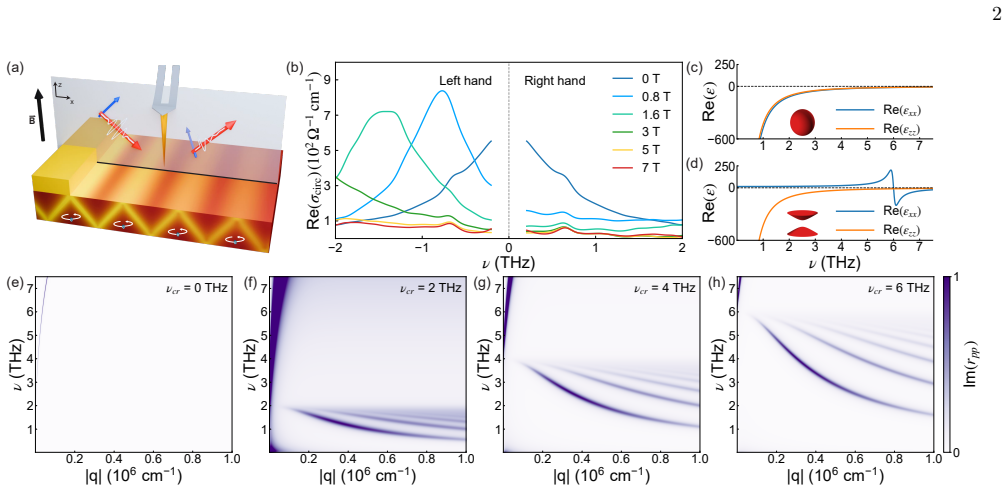
When a perpendicular magnetic field is applied to high-mobility semimetals, the cyclotron response drives the in-plane dielectric function from metallic- to insulating-like below the cyclotron resonance frequency, while the out-of-plane response remains metallic. This anisotropy creates a hyperbolic dielectric environment that supports field-tunable hyperbolic polaritons. A comprehensive theoretical framework incorporating coupling to other collective excitations shows that these modes can be directly visualized in real space via terahertz near-field nanoscopy.
What carries the argument
Magnetic-field-induced cyclotron resonance that flips the in-plane dielectric response from metallic to insulating-like below the resonance frequency while leaving the out-of-plane response metallic.
If this is right
- The polariton frequency and wavevector become continuously adjustable by changing the applied magnetic field strength.
- The modes couple to other collective excitations within the developed theoretical framework.
- Real-space visualization of the polaritons is possible using terahertz near-field nanoscopy.
- The setup supplies a platform in which nanophotonic response can be reprogrammed solely by magnetic field.
Where Pith is reading between the lines
- Device geometries could switch polariton propagation on and off by toggling the external field without altering material composition or structure.
- Similar cyclotron-induced anisotropy may appear in other high-mobility two-dimensional systems such as doped topological semimetals.
- Temperature or carrier-density dependence of the effect could be mapped to identify the mobility threshold required for the insulating-like in-plane response.
Load-bearing premise
The cyclotron motion in high-mobility semimetals produces a clean switch of the in-plane dielectric function to insulating-like behavior below resonance without other scattering or band effects dominating.
What would settle it
A terahertz near-field nanoscopy measurement on a high-mobility semimetal under perpendicular magnetic fields that shows no hyperbolic polariton dispersion or field-tunable modes below the cyclotron frequency would falsify the central claim.
Figures


read the original abstract
Hyperbolic polaritons are conventionally associated with structural anisotropy or phononic Reststrahlen bands. Here, we predict a new class of hyperbolic polaritons arising from magnetic-field-induced cyclotron motion of charge carriers. When a perpendicular magnetic field is applied to high-mobility semimetals, the cyclotron response drives the in-plane dielectric function from metallic- to insulating-like below the cyclotron resonance frequency, while the out-of-plane response remains metallic. This anisotropy creates a hyperbolic dielectric environment that supports field-tunable hyperbolic polaritons. We develop a comprehensive theoretical framework incorporating coupling to other collective excitations and show that these modes can be directly visualized in real space via terahertz near-field nanoscopy. Our work identifies cyclotron motion as a new route to hyperbolic polaritons and establishes a versatile platform for magnetically programmable nanophotonics.
Editorial analysis
A structured set of objections, weighed in public.
Referee Report
Summary. The manuscript predicts a new class of hyperbolic polaritons arising from magnetic-field-induced cyclotron motion of charge carriers in high-mobility semimetals. A perpendicular B-field is claimed to drive the in-plane dielectric function from metallic- to insulating-like below the cyclotron resonance frequency while the out-of-plane response remains metallic, creating a hyperbolic dielectric environment that supports field-tunable modes. The work develops a theoretical framework incorporating coupling to other collective excitations and proposes direct visualization via terahertz near-field nanoscopy.
Significance. If the central derivation holds after accounting for all tensor components, this identifies cyclotron resonance as a distinct route to hyperbolic polaritons, enabling magnetic tunability in semimetal platforms without requiring structural anisotropy or phononic bands. The emphasis on real-space THz imaging provides a concrete experimental test and could support programmable nanophotonics applications.
major comments (1)
- [Theoretical framework] Theoretical framework section (dielectric response derivation): The claim that the anisotropy produces a hyperbolic environment supporting standard hyperbolic polaritons must be verified with the full gyrotropic dielectric tensor. The perpendicular B-field induces a nonzero antisymmetric ε_xy component via the Hall conductivity; the isofrequency contours must be obtained from the 3×3 wave-equation determinant rather than the diagonal-tensor condition ε_xx > 0, ε_zz < 0. Please provide the explicit dispersion relation and confirm whether open hyperbolic contours persist or are replaced by non-reciprocal coupled modes.
minor comments (2)
- [Abstract] Abstract: The summary states a 'comprehensive theoretical framework' but supplies no equations, key parameter ranges, or explicit form of the dielectric tensor; a single sentence indicating the leading-order cyclotron contribution to ε(ω) would improve clarity.
- [Figures] Figure captions and text: Ensure consistent use of symbols (e.g., ω_c for cyclotron frequency, γ for damping) and label all curves with explicit B-field values or reduced units.
Simulated Author's Rebuttal
We thank the referee for the careful reading of our manuscript and the constructive comment on the theoretical framework. We address the point regarding the gyrotropic dielectric tensor below.
read point-by-point responses
-
Referee: [Theoretical framework] Theoretical framework section (dielectric response derivation): The claim that the anisotropy produces a hyperbolic environment supporting standard hyperbolic polaritons must be verified with the full gyrotropic dielectric tensor. The perpendicular B-field induces a nonzero antisymmetric ε_xy component via the Hall conductivity; the isofrequency contours must be obtained from the 3×3 wave-equation determinant rather than the diagonal-tensor condition ε_xx > 0, ε_zz < 0. Please provide the explicit dispersion relation and confirm whether open hyperbolic contours persist or are replaced by non-reciprocal coupled modes.
Authors: We agree that the full gyrotropic tensor must be employed. The conductivity tensor derived from the cyclotron motion of carriers in the perpendicular B-field indeed yields a nonzero antisymmetric ε_xy (Hall) component in addition to the diagonal terms. We have re-derived the dispersion by computing the determinant of the 3×3 wave matrix for propagation in the x-z plane (k_y = 0). The resulting relation shows that open hyperbolic isofrequency contours persist in the frequency window below the cyclotron resonance, although the contours are asymmetrically distorted and the modes become non-reciprocal. This confirms that the hyperbolic character is retained, now in the form of non-reciprocal cyclotron hyperbolic polaritons. We will add the explicit dispersion relation, the full tensor components, and the corresponding isofrequency contours to the revised Theoretical framework section. revision: yes
Circularity Check
No circularity; derivation applies standard cyclotron dielectric response
full rationale
The abstract and description present the hyperbolic anisotropy as following directly from the known cyclotron response of charge carriers in a perpendicular B field applied to high-mobility semimetals, with in-plane dielectric function becoming insulating-like below omega_c while out-of-plane remains metallic. No equations, fitted parameters, or self-citations are shown that would reduce the claimed prediction to an input by construction. The framework is stated as comprehensive but the core claim rests on external plasma-physics benchmarks rather than self-referential steps. This matches the expectation that most papers exhibit no significant circularity.
Axiom & Free-Parameter Ledger
axioms (1)
- domain assumption The dielectric tensor of a semimetal in a perpendicular magnetic field exhibits metallic-to-insulating crossover in-plane below the cyclotron frequency while remaining metallic out-of-plane.
Lean theorems connected to this paper
-
IndisputableMonolith/Foundation/AlexanderDuality.leanalexander_duality_circle_linking unclear?
unclearRelation between the paper passage and the cited Recognition theorem.
the cyclotron response drives the in-plane dielectric function from metallic- to insulating-like below the cyclotron resonance frequency, while the out-of-plane response remains metallic. This anisotropy creates a hyperbolic dielectric environment
What do these tags mean?
- matches
- The paper's claim is directly supported by a theorem in the formal canon.
- supports
- The theorem supports part of the paper's argument, but the paper may add assumptions or extra steps.
- extends
- The paper goes beyond the formal theorem; the theorem is a base layer rather than the whole result.
- uses
- The paper appears to rely on the theorem as machinery.
- contradicts
- The paper's claim conflicts with a theorem or certificate in the canon.
- unclear
- Pith found a possible connection, but the passage is too broad, indirect, or ambiguous to say the theorem truly supports the claim.
Reference graph
Works this paper leans on
-
[1]
D. N. Basov, M. M. Fogler, and F. J. G. de Abajo, Science 354, aag1992 (2016)
work page 2016
-
[2]
T. Low, A. Chaves, J. D. Caldwell, A. Kumar, N. X. Fang, P. Avouris, T. F. Heinz, F. Guinea, L. Martin-Moreno, and F. Koppens, Nature Materials16, 182 (2017)
work page 2017
-
[3]
J. D. Caldwell, A. V. Kretinin, Y. Chen, V. Giannini, M. M. Fogler, Y. Francescato, C. T. Ellis, J. G. Tischler, C. R. Woods, A. J. Giles, et al., Nature Communications 5, 5221 (2014)
work page 2014
-
[4]
J. D. Caldwell, I. Aharonovich, G. Cassabois, J. H. Edgar, B. Gil, and D. N. Basov, Nature Reviews Materials4, 552 (2019)
work page 2019
-
[5]
F. J. Garc´ ıa de Abajo, D. N. Basov, F. H. L. Koppens, L. Orsini, M. Ceccanti, S. Castilla, L. Cavicchi, M. Polini, P. A. D. Gon¸ calves, A. T. Costa, et al., ACS Photonics 12, 3961 (2025)
work page 2025
- [6]
- [7]
- [8]
-
[9]
G. Kipp, H. M. Bretscher, B. Schulte, D. Herrmann, K. Kusyak, M. W. Day, S. Kesavan, T. Matsuyama, X. Li, S. M. Langner, et al., Nature Physics21, 1926 (2025)
work page 1926
- [10]
-
[11]
S. Dai, Z. Fei, Q. Ma, A. S. Rodin, M. Wagner, A. S. McLeod, M. K. Liu, W. Gannett, W. Regan, K. Watanabe, et al., Science343, 1125 (2014)
work page 2014
-
[12]
W. Ma, P. Alonso-Gonz´ alez, S. Li, A. Y. Nikitin, J. Yuan, J. Mart´ ın-S´ anchez, J. Taboada-Guti´ errez, I. Amenabar, P. Li, S. V´ elez, et al., Nature562, 557 (2018)
work page 2018
-
[13]
S. Dai, Q. Ma, M. Liu, T. Andersen, Z. Fei, M. D. Goldflam, M. Wagner, K. Watanabe, T. Taniguchi, M. Thiemens, et al., Nature Nanotechnology10, 682 (2015)
work page 2015
-
[14]
A. Woessner, M. B. Lundeberg, Y. Gao, A. Prin- cipi, P. Alonso-Gonzalez, M. Carrega, K. Watanabe, T. Taniguchi, G. Vignale, M. Polini, et al., Nature Mate- rials14, 421 (2015)
work page 2015
-
[15]
H. Hu, N. Chen, H. Teng, R. Yu, Y. Qu, J. Sun, M. Xue, D. Hu, B. Wu, C. Li, et al., Nature Nanotechnology17, 940 (2022)
work page 2022
-
[16]
F. L. Ruta, B. S. Y. Kim, Z. Sun, D. J. Rizzo, A. S. 6 McLeod, A. Rajendran, S. Liu, A. J. Millis, J. C. Hone, and D. N. Basov, Nature Communications13, 3719 (2022)
work page 2022
-
[17]
A. J. Sternbach, S. L. Moore, A. Rikhter, S. Zhang, R. Jing, Y. Shao, B. S. Y. Kim, S. Xu, S. Liu, J. H. Edgar, et al., Science379, 555 (2023)
work page 2023
-
[18]
L. Wehmeier, S.-J. Yu, X. Chen, R. A. Mayer, L. Xiong, H. Yao, Y. Jiang, J. Hu, E. Janzen, J. H. Edgar, et al., Advanced Materials36, 2401349 (2024)
work page 2024
-
[19]
Y. Shao, A. J. Sternbach, B. S. Y. Kim, A. A. Rikhter, X. Xu, U. D. Giovannini, R. Jing, S. H. Chae, Z. Sun, S. H. Lee, et al., Science Advances8, eadd6169 (2022)
work page 2022
-
[20]
F. L. Ruta, Y. Shao, S. Acharya, A. Mu, N. H. Jo, S. H. Ryu, D. Balatsky, Y. Su, D. Pashov, B. S. Y. Kim, et al., Science387, 786 (2025)
work page 2025
-
[21]
G. Venturi, A. Mancini, N. Melchioni, S. Chiodini, and A. Ambrosio, Nature Communications15, 9727 (2024)
work page 2024
- [22]
- [23]
- [24]
- [25]
- [26]
- [27]
- [28]
-
[29]
P. A. D. Gon¸ calves and N. M. R. Peres,An Introduction to Graphene Plasmonics(World Scientific, Singapore, 2016)
work page 2016
-
[30]
C. C. Homes, M. N. Ali, and R. J. Cava, Phys. Rev. B 92, 161109 (2015)
work page 2015
-
[31]
B. Xu, L. X. Zhao, P. Marsik, E. Sheveleva, F. Lyzwa, Y. M. Dai, G. F. Chen, X. G. Qiu, and C. Bernhard, Phys. Rev. Lett.121, 187401 (2018)
work page 2018
-
[32]
S. Xu, Y. Li, R. A. Vitalone, R. Jing, A. J. Stern- bach, S. Zhang, J. Ingham, M. Delor, J. W. McIver, M. Yankowitz, et al., Science Advances10, eado5553 (2024)
work page 2024
- [33]
-
[34]
Z. K. Liu, B. Zhou, Y. Zhang, Z. J. Wang, H. M. Weng, D. Prabhakaran, S.-K. Mo, Z. X. Shen, Z. Fang, X. Dai, et al., Science343, 864 (2014)
work page 2014
-
[35]
Z. K. Liu, J. Jiang, B. Zhou, Z. J. Wang, Y. Zhang, H. M. Weng, D. Prabhakaran, S.-K. Mo, H. Peng, P. Dudin, et al., Nature Materials13, 677 (2014)
work page 2014
-
[36]
S.-Y. Xu, I. Belopolski, N. Alidoust, M. Neupane, G. Bian, C. Zhang, R. Sankar, G. Chang, Z. Yuan, C.-C. Lee, et al., Science349, 613 (2015)
work page 2015
-
[37]
N. P. Armitage, E. J. Mele, and A. Vishwanath, Rev. Mod. Phys.90, 015001 (2018)
work page 2018
-
[38]
L. Wehmeier, S. Xu, R. A. Mayer, B. Vermilyea, M. Tsuneto, M. Dapolito, R. Pu, Z. Du, X. Chen, W. Zheng, et al., Science Advances10, eadp3487 (2024)
work page 2024
-
[39]
Y. Shao, S. Moon, A. N. Rudenko, J. Wang, J. Herzog- Arbeitman, M. Ozerov, D. Graf, Z. Sun, R. Queiroz, S. H. Lee, et al., Phys. Rev. X14, 041057 (2024)
work page 2024
-
[40]
H. Herzig Sheinfux, L. Orsini, M. Jung, I. Torre, M. Cecca- nti, S. Marconi, R. Maniyara, D. Barcons Ruiz, A. H¨ otger, R. Bertini, et al., Nature Materials23, 499 (2024)
work page 2024
discussion (0)
Sign in with ORCID, Apple, or X to comment. Anyone can read and Pith papers without signing in.