Recognition: no theorem link
Enforcing Constraints in Generative Sampling via Adaptive Correction Scheduling
Pith reviewed 2026-05-13 02:42 UTC · model grok-4.3
The pith
Adaptive scheduling of projections during generative sampling improves accuracy at lower cost by targeting corrections where trajectories deviate most.
A machine-rendered reading of the paper's core claim, the machinery that carries it, and where it could break.
Core claim
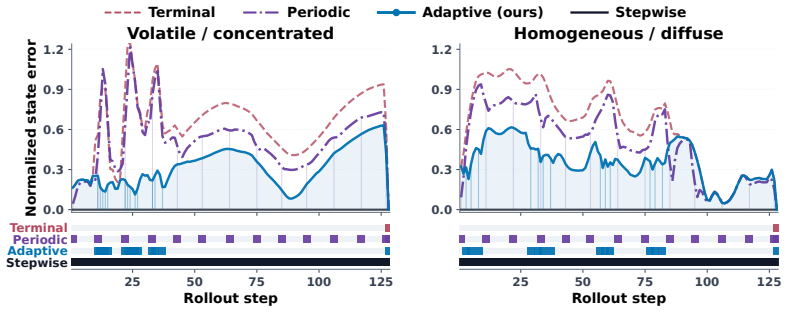
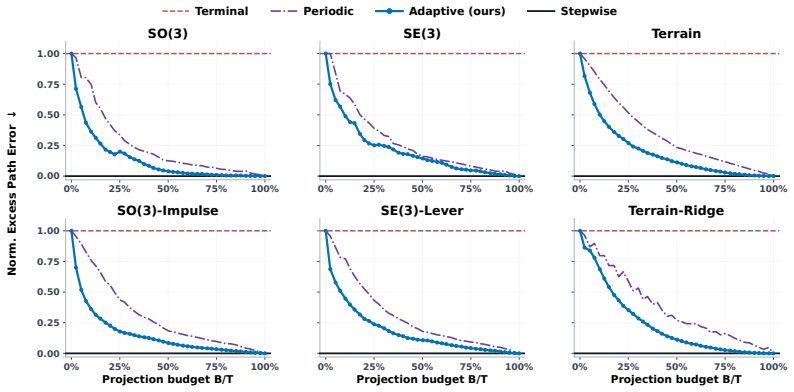
By formalizing constraint enforcement as a correction scheduling problem and using one-step constraint defect to allocate projections adaptively, the approach recovers 71.2% of the accuracy benefit of full stepwise projection while requiring only 25% as many corrections; terminal and per-step projection appear as the two extreme policies within the same family.
What carries the argument
Adaptive correction scheduling: a state-dependent policy that allocates the projection budget to the steps whose one-step constraint defect signals the strongest local geometric mismatch.
If this is right
- Terminal projection and full stepwise projection are recovered as the two limiting cases of the same scheduling family.
- Constraint timing becomes a first-class design choice that directly affects whether final samples respect the intended generative process.
- At any fixed projection budget the adaptive policy improves the accuracy frontier over both extremes.
- Enforcing feasibility alone is insufficient; the schedule must also keep the trajectory consistent with the underlying sampling dynamics.
Where Pith is reading between the lines
- The same local-defect idea could be tested in other iterative constrained processes such as optimization or simulation where corrections also reshape future steps.
- End-to-end training of a scheduler alongside the generative model might further reduce the required projection count.
- The method's gains may depend on how sharply the constraint surface curves; testing on highly nonlinear manifolds would clarify the limits.
Load-bearing premise
The one-step constraint defect gives a reliable enough local signal of where projection will best preserve the intended sampling dynamics.
What would settle it
A controlled experiment in which the adaptive scheduler produces lower accuracy than fixed terminal or stepwise projection at the same total projection budget, or in which the final samples still deviate from the target constrained distribution even after the scheduled corrections.
Figures



read the original abstract
Hard constraints in generative sampling are typically enforced by projection, applied either once at the end of sampling or after every update. This binary framing overlooks a fundamental issue: projection changes the distribution of states which future updates depend on. As a result, delayed projection can produce samples that are feasible but inconsistent with the intended sampling dynamics, even after final projection. We formalize constraint enforcement as a correction scheduling problem over the generative rollout. Using one-step constraint defect as a local signal of geometric mismatch, we introduce adaptive correction scheduling, a state-dependent policy that allocates projection budget to the steps that most strongly perturb the trajectory. Terminal and stepwise projection arise as limiting cases of this family. Across controlled manifold rollouts and a learned projected diffusion sampler, adaptive scheduling improves the cost-accuracy frontier at matched projection budgets, recovering 71.2% of full stepwise benefit with 75% fewer corrections. These results show that constraint timing is a first-class design variable in generative sampling, and that enforcing feasibility alone is insufficient to preserve the intended constrained sampling dynamics.
Editorial analysis
A structured set of objections, weighed in public.
Referee Report
Summary. The manuscript formalizes hard constraint enforcement in generative sampling (e.g., diffusion models on manifolds) as a correction scheduling problem over the rollout trajectory. It proposes adaptive correction scheduling, a state-dependent policy that uses the one-step constraint defect as a local signal of geometric mismatch to allocate a limited projection budget to the most disruptive steps. Terminal and per-step projection emerge as limiting cases. Experiments on controlled manifold rollouts and a learned projected diffusion sampler report that the adaptive policy improves the cost-accuracy frontier, recovering 71.2% of the benefit of full stepwise projection while using 75% fewer corrections.
Significance. If the empirical gains hold under detailed verification, the work establishes constraint timing as a first-class design variable rather than a binary choice, offering a practical way to trade off feasibility and fidelity to the intended sampling dynamics. The generalization of existing projection strategies and the reported efficiency improvements on both synthetic manifolds and learned models constitute a concrete contribution to constrained generative modeling.
major comments (2)
- [Experiments (controlled manifold rollouts and projected diffusion sampler)] The central empirical claim (recovery of 71.2% benefit with 75% fewer corrections) depends on the one-step constraint defect serving as a reliable proxy for steps that distort the constrained dynamics over the full trajectory. On curved manifolds, local defects can compound or be mitigated by subsequent updates; the controlled rollouts and diffusion experiments do not report an ablation that measures the correlation between the one-step signal and cumulative trajectory deviation (e.g., via push-forward measures or an oracle scheduler with future knowledge). This validation is load-bearing for the claim that adaptive allocation preserves intended dynamics better than fixed schedules.
- [Experimental Results] The cost-accuracy frontier comparison requires precise definition of the 'benefit' metric, the procedure for matching projection budgets across policies, and the statistical controls (number of runs, variance, baseline implementations). These details are not provided in the reported quantitative results, which prevents assessment of whether the observed improvement is robust or sensitive to post-hoc choices in the experimental design.
minor comments (1)
- [Method] Notation for the one-step constraint defect and the adaptive policy could be introduced with an explicit equation early in the method section to improve readability.
Simulated Author's Rebuttal
We thank the referee for their constructive and detailed feedback on our manuscript. We address each major comment below and will incorporate clarifications and additional analyses in the revised version to strengthen the presentation of our results.
read point-by-point responses
-
Referee: The central empirical claim (recovery of 71.2% benefit with 75% fewer corrections) depends on the one-step constraint defect serving as a reliable proxy for steps that distort the constrained dynamics over the full trajectory. On curved manifolds, local defects can compound or be mitigated by subsequent updates; the controlled rollouts and diffusion experiments do not report an ablation that measures the correlation between the one-step signal and cumulative trajectory deviation (e.g., via push-forward measures or an oracle scheduler with future knowledge). This validation is load-bearing for the claim that adaptive allocation preserves intended dynamics better than fixed schedules.
Authors: We agree that a direct validation of the one-step defect as a proxy for cumulative trajectory impact would strengthen the empirical support. The controlled manifold rollouts permit exact computation of full-trajectory effects, and the reported improvements over fixed schedules at matched budgets provide indirect evidence that the local signal identifies disruptive steps. To address the concern explicitly, we will add an ablation in the revision that computes the correlation between the one-step constraint defect and cumulative trajectory deviation (using push-forward measures on the manifolds). We will also include a comparison to an oracle scheduler with access to future trajectory information, quantifying how closely the adaptive policy approximates optimal allocation. This addition will directly test the load-bearing assumption. revision: yes
-
Referee: The cost-accuracy frontier comparison requires precise definition of the 'benefit' metric, the procedure for matching projection budgets across policies, and the statistical controls (number of runs, variance, baseline implementations). These details are not provided in the reported quantitative results, which prevents assessment of whether the observed improvement is robust or sensitive to post-hoc choices in the experimental design.
Authors: We acknowledge that these experimental details were insufficiently specified. In the revision we will define the benefit metric explicitly as the fraction of the performance gap (between terminal projection and full stepwise projection) recovered by the adaptive policy. Budget matching will be described as selecting the same number of corrections (e.g., 25% of steps) for the adaptive policy by ranking steps according to one-step defect, with direct comparison to uniform and terminal baselines at identical total correction counts. Statistical controls will be added: results averaged over 20 independent runs with standard deviations for the manifold experiments and 10 runs for the diffusion sampler, together with implementation details and pseudocode for all baselines to support reproducibility and robustness assessment. revision: yes
Circularity Check
No significant circularity; method and claims are empirically grounded
full rationale
The paper introduces adaptive correction scheduling as a new state-dependent policy that uses one-step constraint defect to allocate projection budget during generative rollouts. Terminal and stepwise projection are presented as limiting cases of this policy family, and performance claims rest on controlled manifold experiments and learned projected diffusion sampling that compare cost-accuracy frontiers at matched budgets. No derivation reduces a claimed result to its own inputs by construction, no fitted parameter is relabeled as a prediction, and no load-bearing step relies on self-citation chains or imported uniqueness theorems. The central contribution is a scheduling heuristic validated by external empirical comparison rather than algebraic self-reference.
Axiom & Free-Parameter Ledger
axioms (1)
- domain assumption Projection changes the distribution of states on which future updates depend
Reference graph
Works this paper leans on
-
[1]
Ni, Ruiqi and Qureshi, Ahmed H. , month = mar, year =. Physics-informed. doi:10.48550/arXiv.2403.05765 , abstract =
-
[2]
Kim, Kwanyoung and Kim, Sanghyun , month = mar, year =. Model. doi:10.48550/arXiv.2505.17561 , abstract =
-
[3]
Pei, Jianning and Hu, Han and Gu, Shuyang , month = mar, year =. Optimal. doi:10.48550/arXiv.2503.21774 , abstract =
-
[4]
Ye, Zilyu and Chen, Zhiyang and Li, Tiancheng and Huang, Zemin and Luo, Weijian and Qi, Guo-Jun , month = mar, year =. Schedule. doi:10.48550/arXiv.2412.01243 , abstract =
-
[5]
doi:10.48550/arXiv.2311.14768 , abstract =
Zhang, Hui and Wu, Zuxuan and Xing, Zhen and Shao, Jie and Jiang, Yu-Gang , month = dec, year =. doi:10.48550/arXiv.2311.14768 , abstract =
-
[6]
Foundations of Computational Mathematics , author =
Geometric. Foundations of Computational Mathematics , author =. 2014 , note =. doi:10.1007/s10208-013-9163-y , abstract =
-
[7]
BIT Numerical Mathematics , author =
Geometric. BIT Numerical Mathematics , author =. 2001 , keywords =. doi:10.1023/A:1021989212020 , abstract =
-
[8]
BIT Numerical Mathematics , author =
From low-rank retractions to dynamical low-rank approximation and back , volume =. BIT Numerical Mathematics , author =. 2024 , keywords =. doi:10.1007/s10543-024-01028-7 , abstract =
-
[9]
Foundations of Computational Mathematics , author =
Retraction maps: a seed of geometric integrators , volume =. Foundations of Computational Mathematics , author =. 2023 , note =. doi:10.1007/s10208-022-09571-x , abstract =
-
[10]
Diffusion Policy: Visuomotor Policy Learning via Action Diffusion
Chi, Cheng and Xu, Zhenjia and Feng, Siyuan and Cousineau, Eric and Du, Yilun and Burchfiel, Benjamin and Tedrake, Russ and Song, Shuran , month = mar, year =. Diffusion. doi:10.48550/arXiv.2303.04137 , abstract =
work page internal anchor Pith review Pith/arXiv arXiv doi:10.48550/arxiv.2303.04137
-
[11]
doi:10.48550/arXiv.2403.05571 , abstract =
Li, Anjian and Ding, Zihan and Dieng, Adji Bousso and Beeson, Ryne , month = oct, year =. doi:10.48550/arXiv.2403.05571 , abstract =
-
[12]
doi:10.48550/arXiv.2506.02955 , abstract =
Yang, Zewen and Dai, Xiaobing and Yu, Dian and Li, Zhijun and Khadiv, Majid and Hirche, Sandra and Haddadin, Sami , month = jan, year =. doi:10.48550/arXiv.2506.02955 , abstract =
-
[13]
Liang, Jinhao and Christopher, Jacob K. and Koenig, Sven and Fioretto, Ferdinando , month = jun, year =. Simultaneous. doi:10.48550/arXiv.2502.03607 , abstract =
-
[14]
Xiao, Wei and Wang, Tsun-Hsuan and Gan, Chuang and Hasani, Ramin and Lechner, Mathias and Rus, Daniela , month = oct, year =
-
[15]
Planning with Diffusion for Flexible Behavior Synthesis
Janner, Michael and Du, Yilun and Tenenbaum, Joshua B. and Levine, Sergey , month = dec, year =. Planning with. doi:10.48550/arXiv.2205.09991 , abstract =
work page internal anchor Pith review doi:10.48550/arxiv.2205.09991
-
[16]
Hoseinpour, Milad and Dvorkin, Vladimir , month = aug, year =. Constrained. doi:10.48550/arXiv.2506.11281 , abstract =
- [17]
-
[18]
and Kailkhura, Bhavya and Hartvigsen, Thomas and Fioretto, Ferdinando , month = sep, year =
Cardei, Michael and Christopher, Jacob K. and Kailkhura, Bhavya and Hartvigsen, Thomas and Fioretto, Ferdinando , month = sep, year =. Constrained
-
[19]
and Baek, Stephen and Fioretto, Ferdinando , month = nov, year =
Christopher, Jacob K. and Baek, Stephen and Fioretto, Ferdinando , month = nov, year =. Constrained
-
[20]
Zhang, Jichen and Zhao, Liqun and Papachristodoulou, Antonis and Umenberger, Jack , month = jun, year =. Constrained. doi:10.48550/arXiv.2506.12544 , abstract =
-
[21]
Utkarsh, Utkarsh and Cai, Pengfei and Edelman, Alan and Gomez-Bombarelli, Rafael and Rackauckas, Christopher Vincent , month = nov, year =. Physics-. doi:10.48550/arXiv.2506.04171 , abstract =
-
[22]
and Ansari, Abdul Fatir and Stuart, Andrew and Mahoney, Michael W
Cheng, Chaoran and Han, Boran and Maddix, Danielle C. and Ansari, Abdul Fatir and Stuart, Andrew and Mahoney, Michael W. and Wang, Bernie , month = oct, year =. Gradient-
-
[23]
arXiv preprint arXiv:2503.09790 , year=
Cardei, Michael and Christopher, Jacob K. and Hartvigsen, Thomas and Kailkhura, Bhavya and Fioretto, Ferdinando , month = dec, year =. Constrained. doi:10.48550/arXiv.2503.09790 , abstract =
discussion (0)
Sign in with ORCID, Apple, or X to comment. Anyone can read and Pith papers without signing in.