Recognition: 1 theorem link
· Lean TheoremQuantum Algorithm for Identifying Hidden Graphs: Spectral Theory and Numerical Evidence
Pith reviewed 2026-05-13 02:12 UTC · model grok-4.3
The pith
A quantum walk on an obfuscated graph distinguishes hidden base graphs using polynomially many measurements while classical methods require exponentially many.
A machine-rendered reading of the paper's core claim, the machinery that carries it, and where it could break.
Core claim
We give a quantum algorithm for identifying a hidden d-regular base graph G on n vertices from oracle access to its spired graph G_spire. The algorithm performs a continuous-time quantum walk on G_spire and a single Hadamard test at a precomputed time t*, returning the candidate base graph whose predicted amplitude is closest to the measurement outcome. This rests on a rigorous spectral theory showing that the walk from a spire apex is confined to a polynomial-dimensional invariant subspace evolving under the adjacency matrix of a towered graph, which block-diagonalizes into n independent tridiagonal systems solved in closed form by a Chebyshev secular equation. Numerical evidence on prism y
What carries the argument
The continuous-time quantum walk on the spired graph G_spire, whose evolution is analyzed via reduction to a towered graph whose adjacency matrix decomposes into tridiagonal blocks solved by Chebyshev secular equations.
If this is right
- The quantum algorithm requires only polynomially many measurements to identify the base graph for the tested families.
- Classical algorithms are conjectured to need exponentially many queries for the same task.
- The spectral decomposition allows efficient precomputation of the optimal evolution time t* for large graphs.
- Similar exponential speedups may exist for identifying other obfuscated regular graphs beyond the tested cases.
Where Pith is reading between the lines
- This approach could extend to identifying base graphs in other obfuscated structures where spectral gaps differ.
- Proving the classical lower bound rigorously would strengthen the case for quantum advantage in graph identification.
- Applying the method to random d-regular graphs might reveal broader applicability.
- The technique of reducing walks to Chebyshev-solvable systems could aid analysis of other quantum walk problems.
Load-bearing premise
The conjecture derived from numerics on specific graph families generalizes to arbitrary d-regular base graphs and the classical lower bound holds without a complete proof.
What would settle it
A failure to distinguish the graphs with the predicted number of measurements for some larger instance, or the discovery of a classical polynomial-query algorithm for the same problem, would disprove the conjectured speedup.
Figures





read the original abstract
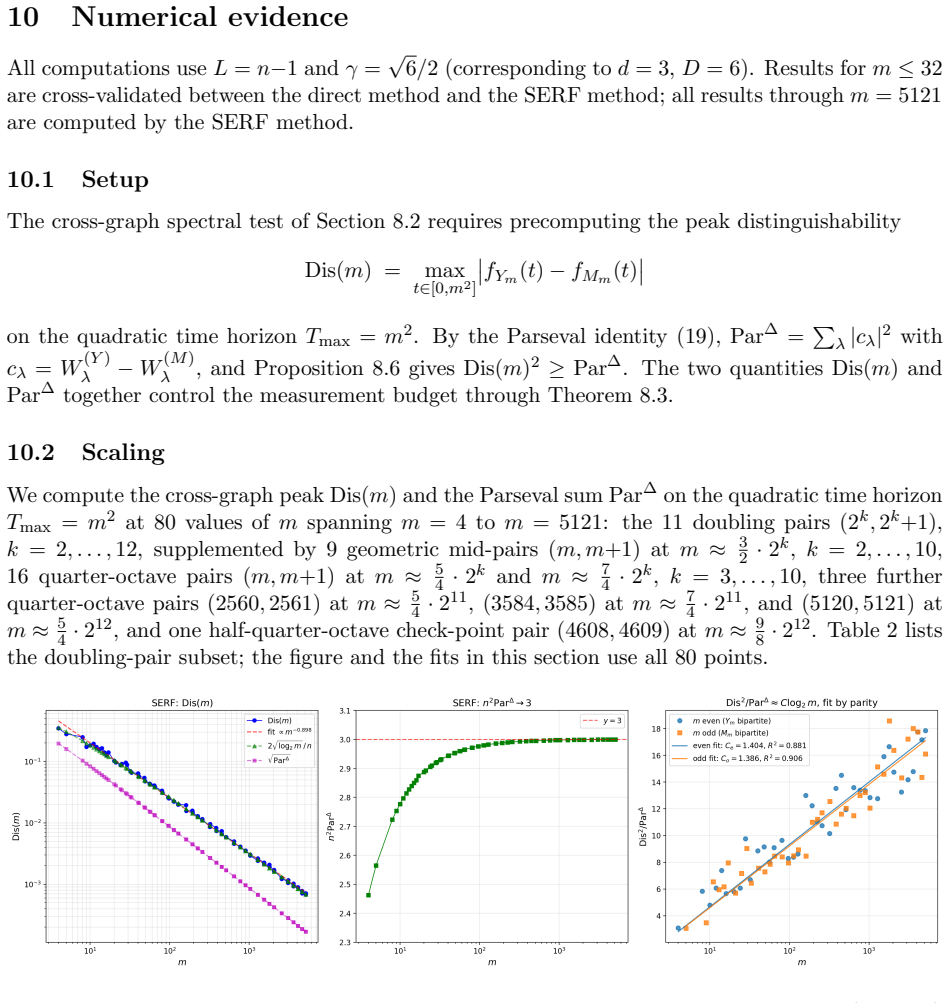
We give a quantum algorithm for a novel type of black-box problem: identifying a hidden $d$-regular base graph $G$ on $n$ vertices from oracle access to an obfuscated version of it, rather than traversing it. From $G$ we build the spired graph $G_{\rm spire}$ in three steps: each vertex is lifted into an exponentially large cluster, with adjacent clusters joined by a random bipartite graph; each cluster is then crowned with a balanced spire; finally, all vertices are randomly relabelled. Specializing to $G=K_2$ recovers the welded-trees graph. Our algorithm is conceptually simple: a continuous-time quantum walk on $G_{\rm spire}$, followed by a single Hadamard test at a classically precomputed time $t^*$; the algorithm returns the candidate whose predicted amplitude is closest to the measurement. The design rests on a rigorous spectral theory: from the apex of any spire, the walk is confined to a polynomial-dimensional invariant subspace evolving under the adjacency matrix of a simpler towered graph $G_{\rm tower}$; that matrix block-diagonalizes into $n$ independent tridiagonal systems of size $n$, each solved in closed form by a Chebyshev secular equation. Efficient numerics enabled by this decomposition supply $t^*$ and the predicted amplitudes. On the prism graphs $Y_m$ versus the M\"obius ladders $M_m$ (each on $n=2m$ vertices), the numerical study supports a precise conjecture that $\widetilde O(n^2/\log n)$ measurements at evolution time of order $m^2$ suffice to distinguish the two families; we have tested $4 \le m \le 5121$ ($n$ up to $10242$). By analogy with the welded-trees lower bounds, we further conjecture that any classical algorithm requires queries exponential in $n$. Together these conjectures point to an exponential quantum speedup for the identification of an obfuscated base graph.
Editorial analysis
A structured set of objections, weighed in public.
Referee Report
Summary. The manuscript presents a quantum algorithm for identifying a hidden d-regular base graph G from oracle access to its obfuscated 'spired' version G_spire. The algorithm performs a continuous-time quantum walk on G_spire and uses a Hadamard test at a precomputed time t* to distinguish candidate graphs based on predicted amplitudes. It provides a rigorous spectral analysis showing confinement to an n-dimensional invariant subspace that block-diagonalizes into n tridiagonal systems solved via Chebyshev secular equations. Numerical evidence is given for distinguishing prism graphs Y_m from Möbius ladders M_m up to n=10242, supporting a conjecture of O(n²/log n) quantum measurements at time O(m²) versus exponential classical queries, suggesting an exponential quantum speedup by analogy to welded trees.
Significance. If the conjectures hold, this would establish a new exponential quantum speedup for black-box graph identification, generalizing the welded-trees example. The rigorous spectral decomposition into tridiagonal blocks with closed-form Chebyshev secular solutions, combined with extensive numerics up to n=10242 enabled by the decomposition, represents a clear technical strength and supports reproducible verification of the specific-family results.
major comments (2)
- Abstract (final paragraph): the claim that classical algorithms require queries exponential in n rests only on analogy to welded-trees lower bounds, without a direct reduction, adversary-method argument, or query-complexity proof for the spired-graph oracle. This is load-bearing for the exponential separation.
- Numerical Evidence (conjecture statement): the O(n²/log n) measurement bound and time scaling are derived from numerics on the specific Y_m vs M_m families (4 ≤ m ≤ 5121). The generalization to arbitrary d-regular base graphs is asserted as a conjecture without further justification or testing, which is load-bearing for the claimed generality of the speedup.
minor comments (1)
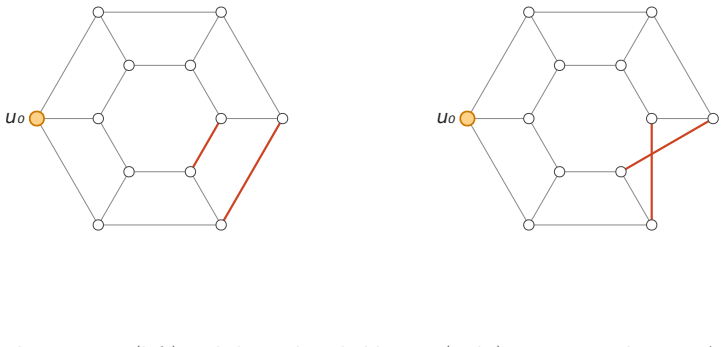
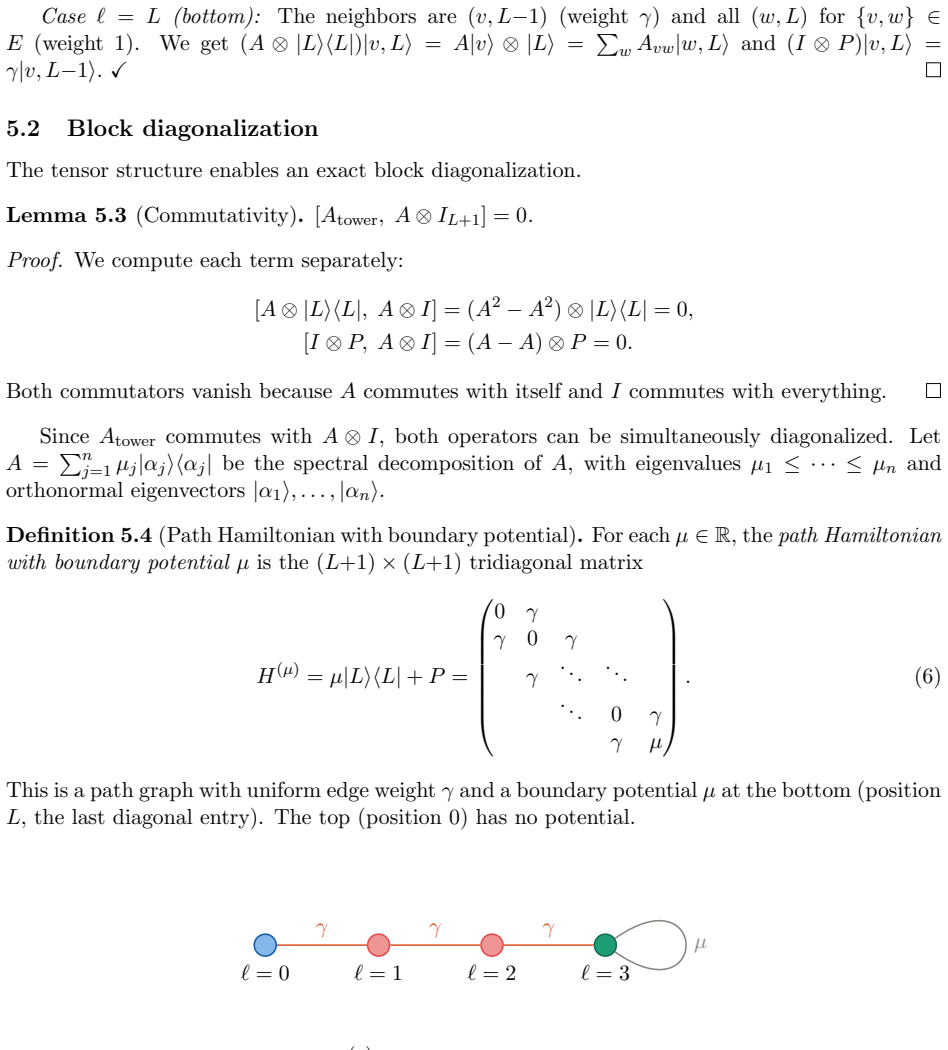
- The introduction of the spired graph G_spire and towered graph G_tower would benefit from an explicit small-n example or diagram to clarify the three-step construction before the spectral analysis.
Simulated Author's Rebuttal
We thank the referee for the careful reading, for identifying the technical strengths of the spectral decomposition and large-scale numerics, and for the constructive major comments. We address each point below and indicate the revisions we will make.
read point-by-point responses
-
Referee: Abstract (final paragraph): the claim that classical algorithms require queries exponential in n rests only on analogy to welded-trees lower bounds, without a direct reduction, adversary-method argument, or query-complexity proof for the spired-graph oracle. This is load-bearing for the exponential separation.
Authors: We agree that the exponential classical lower bound is asserted by analogy to the welded-trees result (recovered when the base graph is K_2) rather than by a new reduction or adversary-method argument for the general spired-graph oracle. The manuscript focuses on the quantum algorithm and its closed-form spectral analysis; a full classical lower-bound proof lies outside its scope. In the revised version we will change the abstract wording to present the exponential classical query complexity as a conjecture supported by the welded-trees analogy, and we will add a short clarifying paragraph in the introduction that explicitly states the basis and limitations of this conjecture. revision: yes
-
Referee: Numerical Evidence (conjecture statement): the O(n²/log n) measurement bound and time scaling are derived from numerics on the specific Y_m vs M_m families (4 ≤ m ≤ 5121). The generalization to arbitrary d-regular base graphs is asserted as a conjecture without further justification or testing, which is load-bearing for the claimed generality of the speedup.
Authors: The concrete O(n²/log n) scaling and O(m²) time are obtained from the numerics on the prism/Möbius-ladder families. The spectral theory, however, applies verbatim to any d-regular base graph: the walk from a spire apex is confined to an n-dimensional invariant subspace that block-diagonalizes into n independent tridiagonal matrices of size n, each solved by a Chebyshev secular equation. Because the effective dimension and the form of the blocks depend only on n and d-regularity (not on the specific edge set of G), the observed scaling supplies a reasonable basis for the conjecture that the same measurement complexity holds more generally. We will revise the manuscript to include an explicit subsection that derives this justification from the spectral decomposition and that states the scope of the numerical evidence more precisely. We will also add, if space permits, a small additional numerical check on one other small d-regular family. revision: partial
- A direct proof (via reduction, adversary method, or other query-complexity technique) of an exponential classical lower bound for the general hidden-spired-graph identification problem.
Circularity Check
No significant circularity; spectral derivation and conjectures are independent of fitted inputs
full rationale
The paper derives the quantum algorithm from first-principles spectral analysis: the continuous-time walk is confined to an invariant subspace whose adjacency matrix block-diagonalizes into independent tridiagonal blocks, each solved in closed form via Chebyshev secular equations. This yields predicted amplitudes and the precomputed time t* without reference to measurement data. Numerics on prism graphs versus Möbius ladders (up to n=10242) are used solely to select t* and to support an explicit conjecture on query complexity; they do not define the output distribution by construction. The classical exponential lower bound is stated as a conjecture by analogy to welded-trees results, not derived or proven within the paper. No self-definitional steps, fitted predictions masquerading as results, load-bearing self-citations, or ansatz smuggling appear in the derivation chain.
Axiom & Free-Parameter Ledger
free parameters (1)
- evolution time t*
axioms (2)
- domain assumption The quantum walk remains confined to the polynomial-dimensional invariant subspace spanned by the spire and tower levels.
- standard math The adjacency matrix of the towered graph block-diagonalizes into n independent tridiagonal systems.
invented entities (2)
-
spired graph G_spire
no independent evidence
-
towered graph G_tower
no independent evidence
Reference graph
Works this paper leans on
-
[1]
A. M. Childs, R. Cleve, E. Deotto, E. Farhi, S. Gutmann, and D. A. Spielman. Exponential algorithmic speedup by a quantum walk.Proc. 35th ACM STOC, pp. 59–68, 2003
work page 2003
-
[2]
S. Fenner and Y. Zhang. A note on the classical lower bound for a quantum walk algorithm. arXiv:quant-ph/0312230, 2003
-
[3]
C. D. Godsil and B. D. McKay. A new graph product and its spectrum.Bull. Austral. Math. Soc., 18(1):21–28, 1978
work page 1978
-
[4]
C. Godsil and G. Royle.Algebraic Graph Theory. Graduate Texts in Mathematics, vol. 207, Springer, 2001
work page 2001
-
[5]
G. H. Golub and C. F. Van Loan.Matrix Computations. 4th ed., Johns Hopkins, 2013
work page 2013
-
[6]
D. W. Berry, A. M. Childs, R. Cleve, R. Kothari, and R. D. Somma. Simulating Hamiltonian dynamics with a truncated Taylor series.Phys. Rev. Lett., 114:090502, 2015
work page 2015
-
[7]
A. H. Barnett, J. F. Magland, and L. af Klinteberg. A parallel non-uniform fast Fourier trans- form library based on an “exponential of semicircle” kernel.SIAM J. Sci. Comput., 41(5):C479– C504, 2019
work page 2019
-
[8]
A. H. Barnett, J. F. Magland, L. af Klinteberg, et al. FINUFFT: Flatiron Institute Nonuni- form Fast Fourier Transform (software library).https://github.com/flatironinstitute/ finufft
-
[9]
V. Havl´ ıˇ cek, A. D. C´ orcoles, K. Temme, A. W. Harrow, A. Kandala, J. M. Chow, and J. M. Gambetta. Supervised learning with quantum-enhanced feature spaces.Nature, 567:209–212, 2019
work page 2019
-
[10]
S. Balasubramanian, T. Li, and A. W. Harrow. Exponential speedups for quantum walks in random hierarchical graphs. arXiv:2307.15062, 2023
- [11]
discussion (0)
Sign in with ORCID, Apple, or X to comment. Anyone can read and Pith papers without signing in.