Recognition: no theorem link
Analogue quantum simulation with polylogarithmic interaction strengths by extrapolating within phases of matter
Pith reviewed 2026-05-13 01:40 UTC · model grok-4.3
The pith
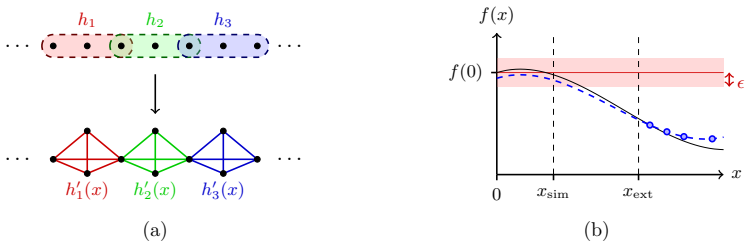
Non-critical quantum systems can be simulated with perturbative gadgets whose interaction strengths scale only polylogarithmically in system size and precision.
A machine-rendered reading of the paper's core claim, the machinery that carries it, and where it could break.
Core claim
Both local and extensive properties of non-critical thermal states and sufficiently gapped ground states can be recovered to arbitrary precision by simulating weaker gadget Hamiltonians at reduced energy scales and classically extrapolating the results to the target perturbative regime, yielding interaction strengths that scale only polylogarithmically rather than polynomially in the inverse precision and system size.
What carries the argument
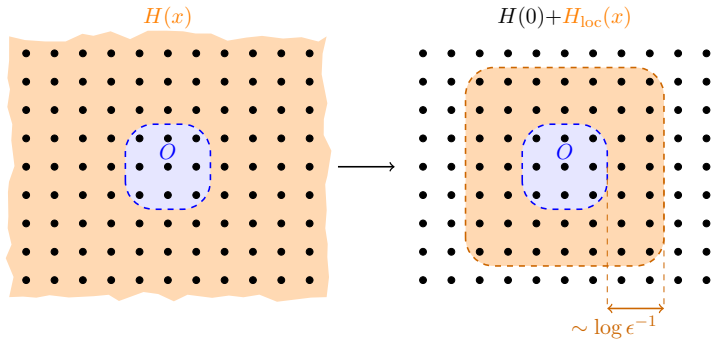
Extrapolation within a phase of matter, enabled by a generalised local Schrieffer-Wolff transformation that handles geometrically quasi-local Hamiltonians over many energy scales.
If this is right
- Local observables in thermal states with exponential correlation decay become simulable with gadget interactions that grow only as polylogarithms of system size and desired precision.
- Extensive quantities such as energy density in gapped ground states follow the same polylogarithmic scaling.
- Perturbative gadgets no longer require interaction strengths that span polynomially many orders of magnitude.
- The generalised Schrieffer-Wolff analysis applies to gadget constructions without extensive global energy penalties.
Where Pith is reading between the lines
- Hardware-limited simulators could reach larger system sizes by accepting weaker interactions and performing the extrapolation classically.
- The approach may combine with other error-mitigation or variational methods that also exploit phase stability.
- Testing on exactly solvable small models could quantify how far into a phase the extrapolation remains accurate before criticality effects appear.
- If extended beyond gadgets, similar extrapolation might reduce resource costs in other analogue or digital simulation schemes.
Load-bearing premise
The simulated systems must remain non-critical so that observables change continuously and smoothly when the effective energy scale is reduced.
What would settle it
On a small non-critical system, compute an observable exactly, then run the reduced-scale gadget simulation and extrapolate; if the extrapolated value deviates from the exact result by more than the claimed error after accounting for finite-size effects, the scaling claim fails.
Figures



read the original abstract
Simple families of quantum Hamiltonians can simulate general many-body systems at arbitrary precision through the use of perturbative gadgets, however this generally requires interaction strengths spanning many orders of magnitude which scale polynomially in the system size and inverse precision, resulting in physically unrealisable systems. In this work, we show that for non-critical systems these required scalings can be exponentially reduced through classical post-processing, by simulating the model at smaller energy scales and extrapolating observables to the perturbative limit. In particular, we show that both local and extensive properties of thermal states with exponentially decaying correlations and ground states with a sufficiently stable gap can be simulated using gadgets whose interaction strengths scale only polylogarithmically in the inverse precision and the system size. As a key tool, we develop a generalised treatment of the local Schrieffer-Wolff transformation for geometrically quasi-local Hamiltonians over many energy scales, facilitating the analysis of perturbative gadget Hamiltonians without extensive global energy penalities, which may be of independent interest.
Editorial analysis
A structured set of objections, weighed in public.
Referee Report
Summary. The paper claims that for non-critical many-body systems—specifically thermal states with exponentially decaying correlations and ground states with a sufficiently stable gap—perturbative gadgets can simulate both local and extensive properties at arbitrary precision using interaction strengths that scale only polylogarithmically in system size N and inverse precision, rather than polynomially. This is achieved by simulating the target model at reduced energy scales and extrapolating observables to the perturbative limit via classical post-processing. The key technical tool is a generalized local Schrieffer-Wolff transformation applicable to geometrically quasi-local Hamiltonians across multiple energy scales, which avoids the need for extensive global energy penalties.
Significance. If the error bounds and extrapolation procedure hold with the claimed uniformity, the result would meaningfully lower the barrier to analogue quantum simulation of large systems by reducing the dynamic range of required couplings from polynomial to polylogarithmic scaling. The generalized multi-scale Schrieffer-Wolff analysis is presented as potentially reusable for other perturbative gadget constructions and quasi-local Hamiltonians.
major comments (1)
- [Abstract (central claim) and the derivation of the generalized Schrieffer-Wolff error bounds] The central claim for extensive observables (e.g., total energy or magnetization) requires that the per-site approximation error in the generalized local Schrieffer-Wolff transformation remains sufficiently small (exponentially small in the polylog gadget strength, or otherwise uniform in N) so that the total error does not accumulate linearly with system size. The abstract asserts control over extensive properties, but if the local character of the transformation yields only polynomially small per-site errors, the polylog scaling would be lost upon extrapolation; explicit bounds addressing this accumulation must be supplied.
minor comments (1)
- [Abstract] The phrase 'sufficiently stable gap' in the abstract and main claim should be accompanied by a precise quantitative condition (e.g., gap lower bound in terms of N and precision) to make the domain of applicability unambiguous.
Simulated Author's Rebuttal
We thank the referee for their careful reading and constructive feedback. We address the major comment below regarding error bounds for extensive observables and have revised the manuscript to make the relevant uniformity statements explicit.
read point-by-point responses
-
Referee: [Abstract (central claim) and the derivation of the generalized Schrieffer-Wolff error bounds] The central claim for extensive observables (e.g., total energy or magnetization) requires that the per-site approximation error in the generalized local Schrieffer-Wolff transformation remains sufficiently small (exponentially small in the polylog gadget strength, or otherwise uniform in N) so that the total error does not accumulate linearly with system size. The abstract asserts control over extensive properties, but if the local character of the transformation yields only polynomially small per-site errors, the polylog scaling would be lost upon extrapolation; explicit bounds addressing this accumulation must be supplied.
Authors: We appreciate the referee's identification of this key technical requirement. The generalized local Schrieffer-Wolff transformation (developed in Section III and formalized in Theorems 1--3) establishes that the approximation error on each local term is exponentially small in the gadget interaction strength. Because the gadget strength is chosen to scale only polylogarithmically in both N and the target precision, this exponential suppression is superpolynomial in N and therefore compensates for any linear accumulation across sites. The exponentially decaying correlations assumed for the non-critical thermal states (and the stable gap for ground states) further ensure that the total error on extensive observables remains bounded by the claimed polylogarithmic scaling. The extrapolation step via classical post-processing is applied after this controlled approximation. To address the request for explicitness, we have added a dedicated paragraph in the revised main text (immediately following the statement of the main theorem) that spells out the accumulation argument and cites the relevant error bounds. revision: yes
Circularity Check
No circularity: new generalized Schrieffer-Wolff tool supports independent extrapolation analysis
full rationale
The derivation introduces a generalized local Schrieffer-Wolff transformation for geometrically quasi-local Hamiltonians over multiple scales as an original technical contribution (abstract and methods). This enables error analysis for gadgets without global penalties. Extrapolation of local/extensive observables relies on standard properties of non-critical phases (exponentially decaying correlations or stable gaps), which are external assumptions rather than fitted or self-defined quantities. No steps reduce by construction to inputs, self-citations, or renamed known results; the polylog scaling claim follows from the new transformation bounds applied to perturbative limits. The approach is self-contained against external benchmarks of phase stability.
Axiom & Free-Parameter Ledger
axioms (1)
- domain assumption Target systems are non-critical with exponentially decaying correlations (thermal states) or sufficiently stable gap (ground states)
Reference graph
Works this paper leans on
-
[1]
Robust analog quantum simulators by quantum error-detecting codes.arXiv preprint arXiv:2412.07764,
[CLD+24] Yingkang Cao, Suying Liu, Haowei Deng, Zihan Xia, Xiaodi Wu, and Yu-Xin Wang. Robust analog quantum simulators by quantum error-detecting codes.arXiv preprint arXiv:2412.07764,
-
[2]
Stochastic error cancellation in analog quantum simulation.arXiv preprint arXiv:2311.14818,
[CTP23] Yiyi Cai, Yu Tong, and John Preskill. Stochastic error cancellation in analog quantum simulation.arXiv preprint arXiv:2311.14818,
-
[3]
49 [DZPL25] Zhiyan Ding, Yongtao Zhan, John Preskill, and Lin Lin. End-to-end efficient quantum thermal and ground state preparation made simple.arXiv preprint arXiv:2508.05703,
-
[4]
Gonz´ alez-Guill´ en and Toby S
[GGC18] Carlos E. Gonz´ alez-Guill´ en and Toby S. Cubitt. History-state Hamiltonians are critical. arXiv preprint arXiv:1810.06528,
- [5]
-
[6]
Quantum thermal state preparation for near-term quantum processors.arXiv preprint arXiv:2506.21318,
[LA25] Jerome Lloyd and Dmitry A Abanin. Quantum thermal state preparation for near-term quantum processors.arXiv preprint arXiv:2506.21318,
-
[7]
Well-conditioned multiproduct Hamiltonian simulation.arXiv preprint arXiv:1907.11679,
[LKW19] Guang Hao Low, Vadym Kliuchnikov, and Nathan Wiebe. Well-conditioned multiproduct Hamiltonian simulation.arXiv preprint arXiv:1907.11679,
-
[8]
[LMK+25] Josias Langbehn, George Mouloudakis, Emma King, Rapha¨ el Menu, Igor Gornyi, Gio- vanna Morigi, Yuval Gefen, and Christiane P Koch. Universal cooling of quantum systems via randomized measurements.arXiv preprint arXiv:2506.11964,
- [9]
- [10]
-
[11]
Stability of digital and analog quantum simulations under noise
[REG25] Jayant Rao, Jens Eisert, and Tommaso Guaita. Stability of digital and analog quantum simulations under noise.arXiv preprint arXiv:2510.08467,
work page internal anchor Pith review Pith/arXiv arXiv
-
[12]
Many-body localization: concepts and simple models
[SS13] Robert Sims and Gunter Stolz. Many-body localization: concepts and simple models. arXiv preprint arXiv:1312.0577,
- [13]
discussion (0)
Sign in with ORCID, Apple, or X to comment. Anyone can read and Pith papers without signing in.