Recognition: 2 theorem links
· Lean TheoremCapturing many-body effects in electrical conductivity of warm dense matter
Pith reviewed 2026-05-13 00:45 UTC · model grok-4.3
The pith
A GW many-body framework for conductivity shows large reductions in DC values for warm dense beryllium at different temperatures.
A machine-rendered reading of the paper's core claim, the machinery that carries it, and where it could break.
Core claim
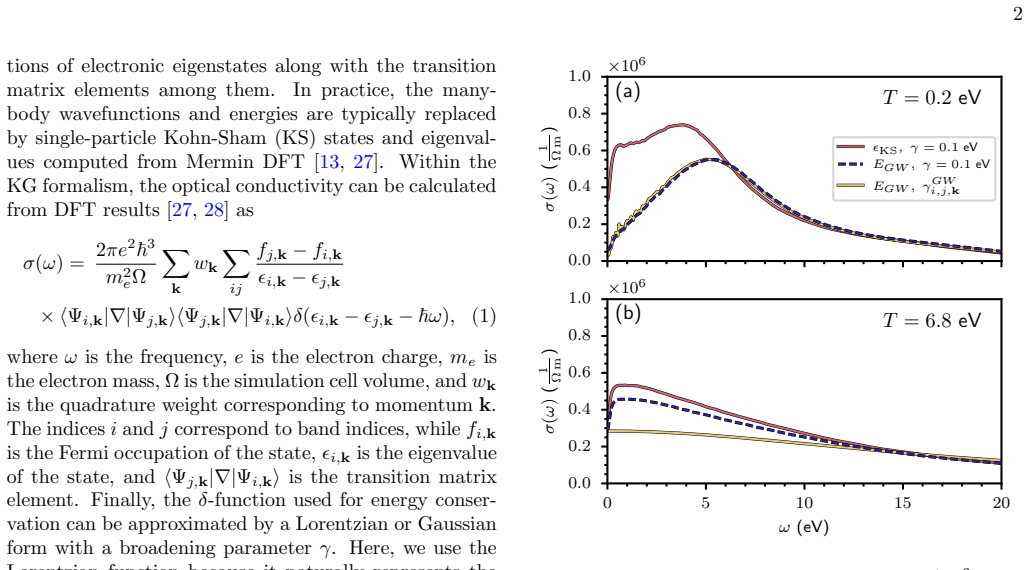
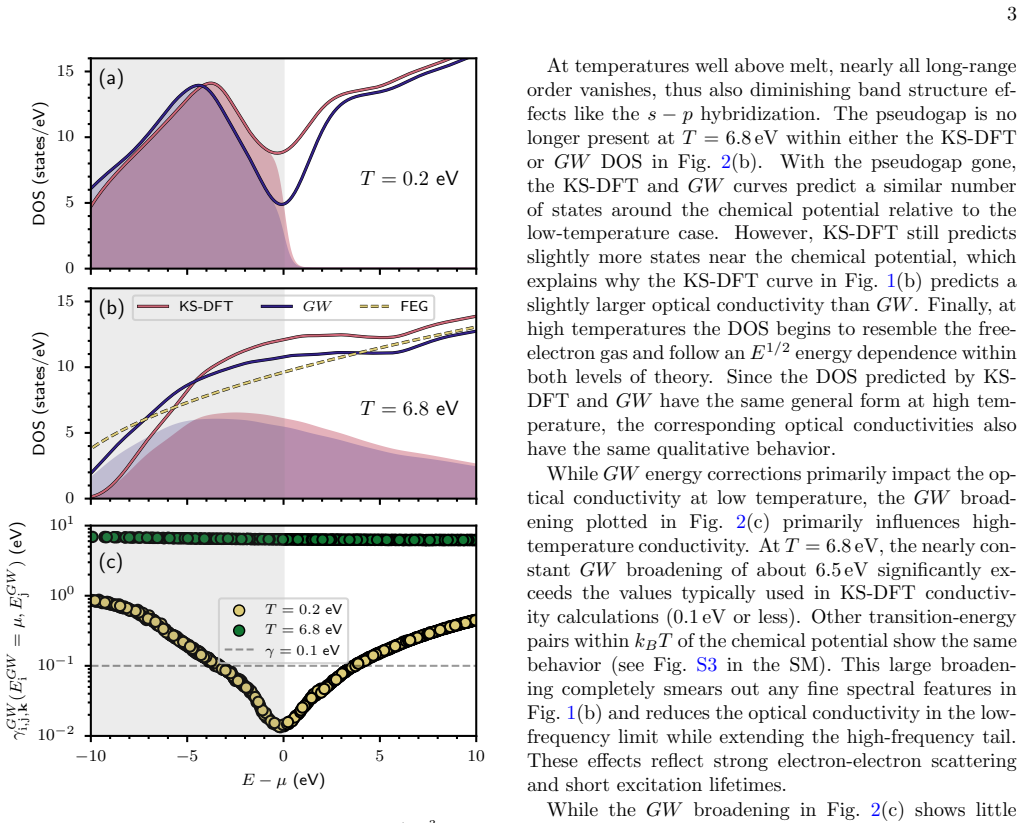
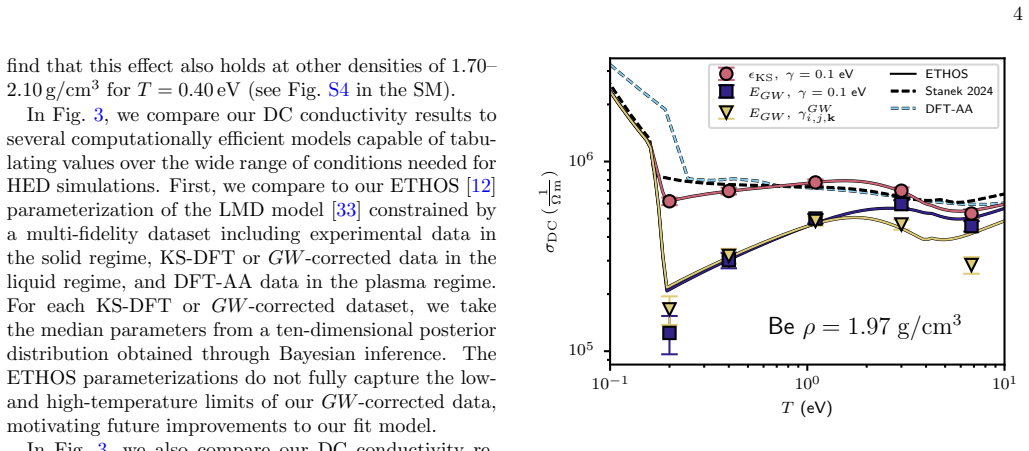
We introduce a many-body framework for electrical conductivity using the GW approximation of the electronic self-energy. For beryllium, improved transition energies yield a surprisingly large reduction in low-temperature DC conductivity, while electron-electron scattering primarily reduces high-temperature DC conductivity.
What carries the argument
The GW approximation of the electronic self-energy, which supplies improved transition energies and finite electron-electron scattering lifetimes for conductivity calculations beyond standard density functional theory.
If this is right
- Conductivity models for warm dense matter must include many-body effects to avoid underestimating reductions in DC conductivity.
- For beryllium the dominant reduction mechanism shifts from improved transition energies at low temperature to electron-electron scattering at high temperature.
- Simulations of planetary interiors and fusion experiments will produce different results when using conductivity values from this GW framework instead of density functional theory.
- The separation of temperature regimes suggests that different approximations may suffice in different parts of the warm dense matter phase space.
Where Pith is reading between the lines
- Similar many-body corrections are likely needed for conductivity in other low-Z materials relevant to planetary cores.
- The framework points toward a route for testing the accuracy of GW lifetimes against time-resolved spectroscopy in high-energy-density experiments.
- If validated, the temperature-dependent dominance of different mechanisms could guide the development of simpler yet accurate conductivity models for plasma simulations.
Load-bearing premise
The GW approximation of the electronic self-energy sufficiently captures the many-body physics and electron-electron scattering lifetimes neglected in standard density functional theory conductivity calculations for warm dense matter.
What would settle it
An experimental measurement of DC electrical conductivity in warm dense beryllium at low temperatures that shows no large reduction relative to density functional theory predictions would falsify the claim about improved transition energies.
Figures
read the original abstract
Conductivity models for warm dense matter inform simulations of planetary structure and fusion experiments. State-of-the-art conductivity calculations based on density functional theory approximate many-body physics and neglect electron-electron scattering lifetimes. We introduce a many-body framework for electrical conductivity using the GW approximation of the electronic self-energy. For beryllium, improved transition energies yield a surprisingly large reduction in low-temperature DC conductivity, while electron-electron scattering primarily reduces high-temperature DC conductivity.
Editorial analysis
A structured set of objections, weighed in public.
Referee Report
Summary. The manuscript introduces a many-body framework for computing electrical conductivity in warm dense matter by incorporating the GW approximation to the electronic self-energy, which supplies both improved quasiparticle transition energies and finite electron-electron scattering lifetimes. Applied to beryllium, the approach finds that corrections to transition energies produce a large reduction in low-temperature DC conductivity relative to standard DFT, while electron-electron scattering dominates the reduction at high temperatures.
Significance. If the numerical results and implementation hold, the work would provide a concrete advance over DFT-based conductivity models that neglect many-body effects, with direct relevance to simulations of planetary structure and fusion experiments. The explicit separation of the low-T energy-correction effect from the high-T lifetime effect is a useful physical insight, and the use of an established GW method without introducing new free parameters strengthens the approach.
major comments (2)
- [Results] Results section (around the beryllium DC conductivity plots): the abstract asserts a 'surprisingly large reduction' at low temperature, yet the provided text supplies no numerical values, percentage changes, or direct comparison to DFT or experiment. Without these data and associated error bars, the central claim cannot be quantitatively assessed.
- [Methodology] Methodology (conductivity formula): the framework applies the GW self-energy to the conductivity problem, but the manuscript must explicitly state the Kubo-Greenwood or current-current correlation expression used, including whether vertex corrections are neglected and how the finite lifetimes enter the spectral function. This is load-bearing for separating the two physical contributions.
minor comments (2)
- [Abstract] The abstract and introduction should include at least one quantitative benchmark (e.g., a conductivity value at a specific density and temperature) to allow readers to gauge the magnitude of the reported effects.
- [Theory] Notation for the self-energy and conductivity tensor should be defined consistently; the transition from the GW quasiparticle energies to the conductivity integral is not immediately clear from the framework description.
Simulated Author's Rebuttal
We thank the referee for their careful reading of the manuscript and for the constructive comments, which have helped us clarify key aspects of the work. We address each major comment below and indicate the revisions made to the manuscript.
read point-by-point responses
-
Referee: [Results] Results section (around the beryllium DC conductivity plots): the abstract asserts a 'surprisingly large reduction' at low temperature, yet the provided text supplies no numerical values, percentage changes, or direct comparison to DFT or experiment. Without these data and associated error bars, the central claim cannot be quantitatively assessed.
Authors: We agree that explicit numerical quantification strengthens the presentation of the central claim. The revised results section now includes tabulated DC conductivity values at selected low temperatures, the corresponding percentage reductions relative to standard DFT (extracted directly from the computed data underlying the figures), and estimated uncertainties arising from k-point sampling and GW convergence. A brief discussion of consistency with available experimental data for warm dense beryllium has also been added, while noting the limited experimental coverage in this regime. revision: yes
-
Referee: [Methodology] Methodology (conductivity formula): the framework applies the GW self-energy to the conductivity problem, but the manuscript must explicitly state the Kubo-Greenwood or current-current correlation expression used, including whether vertex corrections are neglected and how the finite lifetimes enter the spectral function. This is load-bearing for separating the two physical contributions.
Authors: We accept that an explicit statement of the conductivity expression is necessary. The revised methodology section now presents the Kubo-Greenwood formula in its many-body form, expressed via the GW spectral functions. We explicitly note that vertex corrections are neglected, as is standard in this GW-based approach. The finite lifetimes enter through the imaginary part of the self-energy, which determines the Lorentzian broadening of the spectral function A(k,ω) = −(1/π) Im G(k,ω); this broadening is what enables the separation of the quasiparticle energy-shift contribution (dominant at low T) from the lifetime contribution (dominant at high T). revision: yes
Circularity Check
No significant circularity detected in derivation chain
full rationale
The paper introduces a GW-based many-body framework for conductivity calculations, applying established quasiparticle energies and electron-electron scattering lifetimes from the self-energy to beryllium. No load-bearing step reduces by construction to a fitted parameter, self-definition, or self-citation chain that assumes the target result. The low-T reduction from improved transition energies and high-T reduction from scattering are computed as distinct outputs of the GW self-energy, without renaming or smuggling ansatzes. The framework remains self-contained against external benchmarks and does not invoke uniqueness theorems or prior author results to force the central claims.
Axiom & Free-Parameter Ledger
axioms (1)
- domain assumption The GW approximation adequately describes the electronic self-energy including many-body effects and scattering lifetimes in warm dense matter
Lean theorems connected to this paper
-
IndisputableMonolith/Cost/FunctionalEquation.leanwashburn_uniqueness_aczel unclearWe introduce a many-body framework for electrical conductivity using the GW approximation of the electronic self-energy... replacing the KS-DFT eigenvalues ϵi,k entering Eq. (1) with the GW-corrected energies EGWi,k and... γGWi,j,k
-
IndisputableMonolith/Foundation/AbsoluteFloorClosure.leanreality_from_one_distinction unclearFor beryllium, improved transition energies yield a surprisingly large reduction in low-temperature DC conductivity, while electron-electron scattering primarily reduces high-temperature DC conductivity.
Reference graph
Works this paper leans on
- [1]
-
[2]
N. Nettelmann, A. Becker, B. Holst, and R. Redmer, Jupiter Models with Improved Ab Initio Hydrogen Equa- tion of State (H-REOS.2), The Astrophysical Journal 750, 52 (2012)
work page 2012
-
[3]
B. M. Haines, Charged particle transport coefficient chal- lenges in high energy density plasmas, Physics of Plasmas 31, 050501 (2024)
work page 2024
-
[4]
J. Lindl, Development of the indirect-drive approach to inertial confinement fusion and the target physics basis for ignition and gain, Physics of Plasmas2, 3933 (1995)
work page 1995
-
[5]
J. D. Lindl, P. Amendt, R. L. Berger, S. G. Glendinning, S. H. Glenzer, S. W. Haan, R. L. Kauffman, O. L. Lan- den, and L. J. Suter, The physics basis for ignition using indirect-drive targets on the National Ignition Facility, Physics of Plasmas11, 339 (2004)
work page 2004
-
[6]
M. K. Matzen, M. A. Sweeney, R. G. Adams, J. R. Asay, J. E. Bailey, G. R. Bennett, D. E. Bliss, D. D. Bloomquist, T. A. Brunner, R. B. Campbell, G. A. Chandler, C. A. Coverdale, M. E. Cuneo, J.-P. Davis, C. Deeney, M. P. Desjarlais, G. L. Donovan, C. J. Garasi, T. A. Haill, C. A. Hall, D. L. Hanson, M. J. Hurst, B. Jones, M. D. Knudson, R. J. Leeper, R. W...
work page 2005
-
[7]
J. M. Ziman, A theory of the electrical properties of liq- uid metals. I: The monovalent metals, The Philosophical Magazine: A Journal of Theoretical Experimental and Applied Physics6, 1013 (1961)
work page 1961
-
[8]
L. Spitzer and R. H¨ arm, Transport Phenomena in a Com- pletely Ionized Gas, Physical Review89, 977 (1953)
work page 1953
-
[9]
N. R. Shaffer and C. E. Starrett, Model of electron trans- port in dense plasmas spanning temperature regimes, Physical Review E101, 053204 (2020)
work page 2020
-
[10]
Y. T. Lee and R. M. More, An electron conductivity model for dense plasmas, The Physics of Fluids27, 1273 (1984)
work page 1984
-
[11]
M. P. Desjarlais, C. R. Scullard, L. X. Benedict, H. D. Whitley, and R. Redmer, Density-functional calculations of transport properties in the nondegenerate limit and the role of electron-electron scattering, Physical Review E95, 033203 (2017)
work page 2017
-
[12]
L. J. Stanek, W. E. Lewis, K. R. Cochrane, C. A. Jen- nings, M. P. Desjarlais, and S. B. Hansen, ETHOS: An automated framework to generate multi-fidelity constitu- tive data tables and propagate uncertainties to hydrody- namic simulations, Physics of Plasmas31, 102707 (2024)
work page 2024
-
[13]
N. D. Mermin, Thermal Properties of the Inhomogeneous Electron Gas, Physical Review137, A1441 (1965)
work page 1965
-
[14]
M. P. Desjarlais, J. D. Kress, and L. A. Collins, Electri- cal conductivity for warm, dense aluminum plasmas and liquids, Physical Review E66, 025401 (2002)
work page 2002
- [15]
- [16]
-
[17]
C. E. Starrett, Kubo–greenwood approach to conductiv- ity in dense plasmas with average atom models, High Energy Density Physics19, 58 (2016)
work page 2016
-
[18]
H. Reinholz, G. R¨ opke, S. Rosmej, and R. Redmer, Conductivity of warm dense matter including electron- electron collisions, Physical Review E91, 043105 (2015)
work page 2015
-
[19]
G. R¨ opke, R. Redmer, M. Sch¨ orner, H. Reinholz, U. Kleinschmidt, and M. Bethkenhagen, Electron- electron collisions in calculations of the electrical conduc- tivity for warm dense matter based on density functional theory, Physical Review E111, 055201 (2025)
work page 2025
-
[20]
L. Hedin, New Method for Calculating the One-Particle Green’s Function with Application to the Electron-Gas Problem, Physical Review139, A796 (1965)
work page 1965
-
[21]
M. Shishkin and G. Kresse, Self-consistentGWcalcula- tions for semiconductors and insulators, Physical Review B75, 235102 (2007)
work page 2007
-
[22]
L. Reining, The GW approximation: content, successes and limitations, Wiley Interdisciplinary Reviews: Com- putational Molecular Science8, e1344 (2018). 6
work page 2018
-
[23]
F. Perrot and M. Dharma-Wardana, Hydrogen plasmas beyond density-functional theory: Dynamic correlations and the onset of localization, Physical Review A29, 1378 (1984)
work page 1984
-
[24]
S. G¨ unter, L. Hitzschke, and G. R¨ opke, Hydrogen spec- tral lines with the inclusion of dense-plasma effects, Phys- ical Review A44, 6834 (1991)
work page 1991
-
[25]
Kubo, Statistical-Mechanical Theory of Irreversible Processes
R. Kubo, Statistical-Mechanical Theory of Irreversible Processes. I. General Theory and Simple Applications to Magnetic and Conduction Problems, Journal of the Physical Society of Japan12, 570 (1957)
work page 1957
-
[26]
D. A. Greenwood, The Boltzmann Equation in the The- ory of Electrical Conduction in Metals, Proceedings of the Physical Society71, 585 (1958)
work page 1958
-
[27]
L. Calder´ ın, V. V. Karasiev, and S. B. Trickey, Kubo– Greenwood electrical conductivity formulation and im- plementation for projector augmented wave datasets, Computer Physics Communications221, 118 (2017)
work page 2017
- [28]
-
[29]
U. H¨ aussermann and S. I. Simak, Origin of thec/avaria- tion in hexagonal close-packed divalent metals, Physical Review B64, 245114 (2001)
work page 2001
-
[30]
T. Gawne, Z. A. Moldabekov, O. S. Humphries, K. Ap- pel, C. Baehtz, V. Bouffetier, E. Brambrink, A. Cangi, S. G¨ ode, Z. Konˆ opkov´ a, M. Makita, M. Mishchenko, M. Nakatsutsumi, K. Ramakrishna, L. Randolph, S. Schwalbe, J. Vorberger, L. Wollenweber, U. Zastrau, T. Dornheim, and T. R. Preston, Ultrahigh resolution x-ray Thomson scattering measurements at ...
work page 2024
-
[31]
G. Vignale, Dynamical mean-field theory of correlated electrons (Forschungszentrum J¨ ulich GmbH Institute for Advanced Simulation, J¨ ulich, Germany) Chap. 2 Fermi Liquids, pp. 53–92
-
[32]
J. Daligault, Crossover from Classical to Fermi Liquid Behavior in Dense Plasmas, Physical Review Letters119, 045002 (2017)
work page 2017
-
[33]
M. Desjarlais, Practical Improvements to the Lee-More Conductivity Near the Metal-Insulator Transition, Con- tributions to Plasma Physics41, 267 (2001)
work page 2001
-
[34]
K. J. Peterson, D. B. Sinars, E. P. Yu, M. C. Herrmann, M. E. Cuneo, S. A. Slutz, I. C. Smith, B. W. Atherton, M. D. Knudson, and C. Nakhleh, Electrothermal insta- bility growth in magnetically driven pulsed power liners, Physics of Plasmas19, 092701 (2012)
work page 2012
-
[35]
E. P. Yu, T. J. Awe, K. R. Cochrane, K. J. Peterson, K. C. Yates, T. M. Hutchinson, M. W. Hatch, B. S. Bauer, K. Tomlinson, and D. B. Sinars, Seeding the elec- trothermal instability through a three-dimensional, non- linear perturbation, Physical Review Letters130, 255101 (2023)
work page 2023
-
[36]
B. K. Ofori-Okai, A. Descamps, E. R. Toro, M. Ikeya, S. B. Hansen, M. Mo, A. D. Baczewski, D. Brown, L. B. Fletcher, E. E. McBride, X. Shen, A. Weinmann, J. Yang, J. Schein, Z. Chen, X. Wang, and S. H. Glenzer, Unveiling structural effects on the DC conductivity of warm dense matter via terahertz spectroscopy and ultrafast electron diffraction, Nature Com...
work page 2025
-
[37]
K. R. Cochrane, R. W. Lemke, Z. Riford, and J. H. Carpenter, Magnetically launched flyer plate technique for probing electrical conductivity of compressed copper, Journal of Applied Physics119, 105902 (2016)
work page 2016
-
[38]
J. Cl´ erouin, P. Renaudin, Y. Laudernet, P. Noiret, and M. P. Desjarlais, Electrical conductivity and equation- of-state study of warm dense copper: Measurements and quantum molecular dynamics calculations, Physical Re- view B71, 064203 (2005)
work page 2005
- [39]
-
[40]
Y. Takada, Inclusion of Vertex Corrections in the Self- Consistent Calculation of Quasiparticles in Metals, Phys- ical Review Letters87, 226402 (2001)
work page 2001
-
[41]
G. Kresse and J. Furthm¨ uller, Efficiency of ab-initio total energy calculations for metals and semiconductors using a plane-wave basis set, Computational Materials Science 6, 15 (1996)
work page 1996
-
[42]
G. Kresse and J. Furthm¨ uller, Efficient iterative schemes forab initiototal-energy calculations using a plane-wave basis set, Physical Review B54, 11169 (1996)
work page 1996
-
[43]
G. Kresse and D. Joubert, From ultrasoft pseudopoten- tials to the projector augmented-wave method, Physical Review B59, 1758 (1999)
work page 1999
-
[44]
W. Kohn and L. J. Sham, Self-Consistent Equations In- cluding Exchange and Correlation Effects, Physical Re- view140, A1133 (1965)
work page 1965
-
[45]
J. P. Perdew, K. Burke, and M. Ernzerhof, Generalized Gradient Approximation Made Simple, Physical Review Letters77, 3865 (1996)
work page 1996
-
[46]
P. E. Bl¨ ochl, Projector augmented-wave method, Physi- cal Review B50, 17953 (1994)
work page 1994
-
[47]
F. D. Murnaghan, Finite Deformations of an Elastic Solid, American Journal of Mathematics59, 235 (1937), 2371405
work page 1937
-
[48]
C. A. Melton, R. C. Clay, III, K. R. Cochrane, A. Dumi, T. A. Gardiner, M. K. Lentz, and J. P. Townsend, Trans- port coefficients of warm dense matter from Kohn-Sham density functional theory, Physics of Plasmas31, 043903 (2024)
work page 2024
-
[49]
H. N. Rojas, R. W. Godby, and R. J. Needs, Space-Time Method for Ab Initio Calculations of Self-Energies and Dielectric Response Functions of Solids, Physical Review Letters74, 1827 (1995)
work page 1995
-
[50]
P. Liu, M. Kaltak, J. Klimeˇ s, and G. Kresse, Cubic scal- ing GW: Towards fast quasiparticle calculations, Physical Review B94, 165109 (2016)
work page 2016
-
[51]
M. Kaltak and G. Kresse, Minimax isometry method: A compressive sensing approach for Matsubara summation in many-body perturbation theory, Physical Review B 101, 205145 (2020)
work page 2020
-
[52]
T. Matsubara, A New Approach to Quantum-Statistical Mechanics, Progress of Theoretical Physics14, 351 (1955)
work page 1955
-
[53]
H. J. Monkhorst and J. D. Pack, Special points for Brillouin-zone integrations, Physical Review B13, 5188 (1976)
work page 1976
-
[54]
D. A. Liberman, Self-consistent field model for condensed matter, Physical Review B20, 4981 (1979)
work page 1979
- [55]
-
[56]
L. Hedin and B. I. Lundqvist, Explicit local exchange- 7 correlation potentials, Journal of Physics C: Solid State Physics4, 2064 (1971)
work page 2064
-
[57]
C. Starrett and D. Saumon, A simple method for deter- mining the ionic structure of warm dense matter, High Energy Density Physics10, 35 (2014)
work page 2014
-
[58]
S. Hansen, A. Baczewski, T. Gomez, T. Hentschel, C. Jennings, A. Kononov, T. Nagayama, K. Adler, A. Cangi, K. Cochrane, B. Robinson, and A. Schleife, Improving Predictive Capability in REHEDS Simu- lations with Fast, Accurate, and Consistent Non- Equilibrium Material Properties, Tech. Rep. SAND2022- 13455, 1890268, 710422 (2022)
work page 2022
-
[59]
A. Y. Potekhin, D. A. Baiko, P. Haensel, and D. G. Yakovlev, Transport properties of degenerate electrons in neutron star envelopes and white dwarf cores, Astron- omy and Astrophysics346, 345 (1999)
work page 1999
-
[60]
L. J. Stanek, A. Kononov, S. B. Hansen, B. M. Haines, S. X. Hu, P. F. Knapp, M. S. Murillo, L. G. Stan- ton, H. D. Whitley, S. D. Baalrud, L. J. Babati, A. D. Baczewski, M. Bethkenhagen, A. Blanchet, R. C. Clay, III, K. R. Cochrane, L. A. Collins, A. Dumi, G. Faus- surier, M. French, Z. A. Johnson, V. V. Karasiev, S. Ku- mar, M. K. Lentz, C. A. Melton, K....
work page 2024
-
[61]
R. Franz and G. Wiedemann, Ueber die W¨ arme- Leitungsf¨ ahigkeit der Metalle, Annalen der Physik165, 497 (1853)
-
[62]
N. W. Ashcroft and N. D. Mermin,Solid State Physics (1976)
work page 1976
-
[63]
C. F. Mallinson and J. E. Castle, Beryllium and Beryl- lium Oxide by XPS, Surface Science Spectra20, 86 (2013)
work page 2013
-
[64]
A. Y. Pereyaslavtsev and A. V. Naumkin, XPS and UPS investigation of beryllium in native form, Surface Science Spectra32, 024009 (2025)
work page 2025
-
[65]
C.-Y. Li, C. Wang, Z.-Q. Wu, Z. Li, D.-F. Li, and P. Zhang, Electrical and optical properties of warm dense beryllium along the principal Hugoniot, Physics of Plas- mas22, 092705 (2015). 8 Supplemental Material: Capturing many-body effects in electrical conductivity of warm dense matter B. P. Robinson 1,2, A. Kononov 2, L. J. Stanek 5, A. D. Baczewski 2, ...
work page 2015
discussion (0)
Sign in with ORCID, Apple, or X to comment. Anyone can read and Pith papers without signing in.