Recognition: 2 theorem links
· Lean TheoremRandom-h Fractional-Dimensional Lattices Reveal Endpoint-Compressed Percolation Activation between Two and Three Dimensions
Pith reviewed 2026-05-13 01:54 UTC · model grok-4.3
The pith
Random-h fractional-dimensional lattices exhibit endpoint-compressed percolation activation from two to three dimensions.
A machine-rendered reading of the paper's core claim, the machinery that carries it, and where it could break.
Core claim
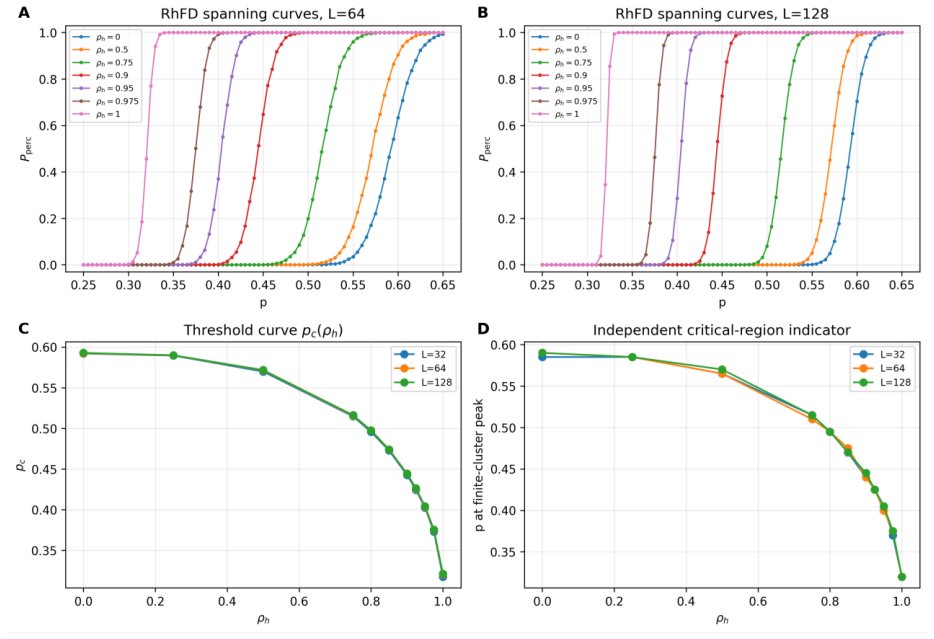
RhFD lattices are formed by recursively growing out-of-plane sites from a square base with probability rho_h. Using quenched site-percolation simulations, the construction recovers the integer-dimensional endpoints and yields a robust crossover in which the percolation threshold decreases from the 2D regime toward the 3D regime. The crossover is not a uniform interpolation: high-resolution scans reveal endpoint-compressed activation, with -dpc/d rho_h increasing toward rho_h = 1. Mass dimension increases with rho_h, whereas the coordination descriptor first decreases as sparse protrusions form and then rises sharply when a dense 3D backbone emerges.
What carries the argument
the RhFD lattice construction via stochastic activation of local connectivity with probability rho_h
If this is right
- The percolation threshold decreases from the 2D regime toward the 3D regime.
- High-resolution scans reveal endpoint-compressed activation, with the derivative of p_c with respect to rho_h increasing toward rho_h = 1.
- Mass dimension increases with rho_h.
- Coordination first decreases then rises sharply with rho_h.
- Geometric mass, local coordination, and critical connectivity decouple during dimensional crossover.
Where Pith is reading between the lines
- This lattice construction could enable direct simulations of other statistical mechanics models such as Ising spins in fractional dimensions.
- The decoupling of geometric, coordination, and critical properties implies that fractional-dimensional critical phenomena may require separate scaling treatments for different observables.
- Similar stochastic activation methods might generalize to crossovers involving other integer dimensions or base lattice types.
Load-bearing premise
that stochastic activation of local connectivity with probability rho_h produces lattices that faithfully represent fractional-dimensional environments on which classical statistical-mechanical models such as quenched site percolation can be directly simulated.
What would settle it
A direct measurement showing that the percolation threshold changes uniformly with rho_h rather than with increasing rate near rho_h=1, or failure to recover the known 2D and 3D percolation thresholds on the constructed lattices, would falsify the endpoint-compressed activation and faithful representation.
Figures



read the original abstract
Non-integer dimensionality is central to fractal and complex systems, yet it is rarely represented as an explicit lattice on which classical statistical-mechanical models can be directly simulated. Here we introduce random-h fractional dimension (RhFD), a constructive lattice framework in which fractional-dimensional environments are generated by stochastic activation of local connectivity, h. In the 2D-to-3D interval, RhFD lattices are formed by recursively growing out-of-plane sites from a square base with probability \r{ho}h. Using quenched site-percolation simulations, we show that the construction recovers the integer-dimensional endpoints and yields a robust crossover in which the percolation threshold decreases from the 2D regime toward the 3D regime. The crossover is not a uniform interpolation: high-resolution scans reveal endpoint-compressed activation, with -dpc/d\r{ho}h increasing toward \r{ho}h = 1. Mass dimension increases with \r{ho}h, whereas the coordination descriptor first decreases as sparse protrusions form and then rises sharply when a dense 3D backbone emerges. RhFD provides an explicit lattice substrate for fractional-dimensional statistical mechanics and shows that geometric mass, local coordination, and critical connectivity can decouple during dimensional crossover.
Editorial analysis
A structured set of objections, weighed in public.
Referee Report
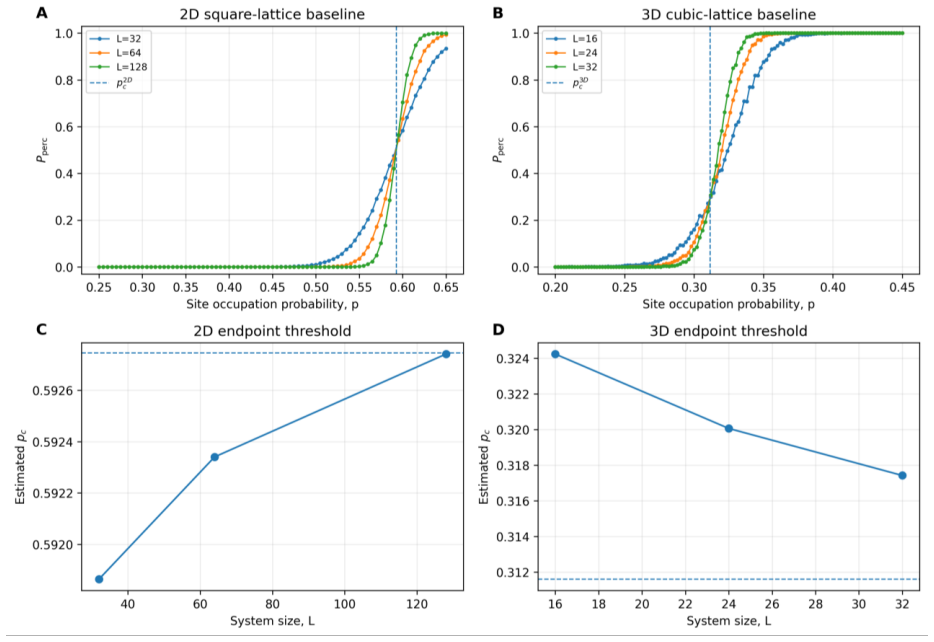
Summary. The paper introduces random-h fractional-dimensional (RhFD) lattices, constructed by stochastic recursive activation of out-of-plane sites with probability ρ_h starting from a 2D square base. Quenched site-percolation simulations on these lattices are reported to recover the known integer-dimensional percolation thresholds at the endpoints (pc ≈ 0.5927 at ρ_h = 0 and pc ≈ 0.3116 at ρ_h = 1) while exhibiting a non-uniform crossover in which -dpc/dρ_h increases toward ρ_h = 1. The work further claims decoupling between mass dimension (which increases with ρ_h), local coordination (non-monotonic), and critical connectivity during the 2D-to-3D transition, positioning RhFD as an explicit lattice substrate for fractional-dimensional statistical mechanics.
Significance. If the construction is shown to represent fractional dimensions in a manner suitable for classical models, the provision of a directly simulatable lattice family between d=2 and d=3 would be a useful addition to the toolkit for studying dimensional crossovers. The reported endpoint-compressed activation and decoupling of geometric, coordination, and percolation properties constitute a concrete, falsifiable observation that could motivate further analytic or numerical work on non-integer dimensions.
major comments (3)
- [Quenched site-percolation simulations section] Quenched site-percolation simulations section: the manuscript provides no information on lattice linear sizes, number of independent realizations, finite-size scaling procedure, or how error bars on pc(ρ_h) are obtained. Without these details the statistical robustness of the claimed endpoint-compressed activation (-dpc/dρ_h increasing toward ρ_h=1) and the non-monotonic coordination behavior cannot be assessed.
- [RhFD lattice construction section] RhFD lattice construction section: the stochastic out-of-plane growth produces anisotropic, randomly branched structures whose effective dimension is controlled by ρ_h. The central interpretation that the observed decoupling and compressed crossover reflect generic fractional-dimensional behavior (rather than artifacts of protrusion-induced disorder) requires explicit justification or comparison against isotropic fractional-dimension constructions (e.g., analytic continuation or deterministic fractals).
- [Results on mass dimension and coordination] Results on mass dimension and coordination: the definitions and numerical procedures used to extract mass dimension (presumably via some scaling of site count with linear size) and the coordination descriptor are not stated with sufficient precision to allow independent verification of the reported decoupling from critical connectivity.
minor comments (3)
- Notation: the abstract uses the awkward macro form “ρ_h” (rendered as “r{ho}h”); replace with consistent, standard mathematical notation ρ_h throughout the text and figures.
- Add explicit citations to the accepted 2D and 3D site-percolation thresholds (e.g., the values 0.592746… and 0.311607…) and state how the simulated endpoints compare quantitatively to these benchmarks.
- Figure captions and legends should include the number of realizations and any error-bar conventions used in the pc(ρ_h) and coordination plots.
Simulated Author's Rebuttal
We thank the referee for their thorough review and valuable suggestions. We have carefully considered each comment and revised the manuscript to address the concerns raised regarding methodological details and interpretations. Our point-by-point responses are provided below.
read point-by-point responses
-
Referee: Quenched site-percolation simulations section: the manuscript provides no information on lattice linear sizes, number of independent realizations, finite-size scaling procedure, or how error bars on pc(ρ_h) are obtained. Without these details the statistical robustness of the claimed endpoint-compressed activation (-dpc/dρ_h increasing toward ρ_h=1) and the non-monotonic coordination behavior cannot be assessed.
Authors: We agree with the referee that these simulation details are crucial for evaluating the reliability of our results. The original submission focused on the novel aspects of the RhFD construction and omitted some technical specifications. In the revised manuscript, we have added a new 'Methods' section that specifies the lattice sizes (linear dimensions L ranging from 64 to 512), the number of independent realizations (at least 10,000 per ρ_h value), the finite-size scaling procedure (using the position of the peak in the susceptibility or the wrapping probability with extrapolation), and the method for error bars (standard error from the ensemble of realizations). These additions substantiate the robustness of the endpoint-compressed activation and the non-monotonic behavior of the coordination descriptor. revision: yes
-
Referee: RhFD lattice construction section: the stochastic out-of-plane growth produces anisotropic, randomly branched structures whose effective dimension is controlled by ρ_h. The central interpretation that the observed decoupling and compressed crossover reflect generic fractional-dimensional behavior (rather than artifacts of protrusion-induced disorder) requires explicit justification or comparison against isotropic fractional-dimension constructions (e.g., analytic continuation or deterministic fractals).
Authors: The referee correctly identifies that the RhFD lattices are anisotropic due to the stochastic growth. However, we maintain that this stochasticity is a deliberate feature to model the irregular connectivity in fractional dimensions, as opposed to perfectly isotropic but non-constructive approaches. To strengthen the manuscript, we have added a discussion in the revised version comparing our observed decoupling to results from hyperscaling relations in non-integer dimensions obtained via analytic continuation, showing qualitative agreement in the trend of pc(d). We note that deterministic fractal lattices like the Sierpinski carpet are limited in applicability to percolation and do not easily extend to other models, whereas RhFD allows direct simulation of classical models. A full comparison to all possible isotropic constructions is beyond the scope of this work but is suggested as future research. revision: partial
-
Referee: Results on mass dimension and coordination: the definitions and numerical procedures used to extract mass dimension (presumably via some scaling of site count with linear size) and the coordination descriptor are not stated with sufficient precision to allow independent verification of the reported decoupling from critical connectivity.
Authors: We appreciate this comment on the need for precision. In the revised manuscript, we have clarified the definitions and procedures in the 'Results' section: The mass dimension d_m is obtained by fitting the scaling relation N(L) ~ L^{d_m} using linear regression on log-log plots of the average number of sites within linear size L, for multiple L values. The coordination descriptor is defined as the average number of nearest-neighbor connections per site, computed by summing the occupied bonds and dividing by the number of sites, averaged over the lattice realizations. These explicit definitions and the fitting procedures now enable independent verification of the decoupling between mass dimension, coordination, and the percolation threshold pc(ρ_h). revision: yes
Circularity Check
No circularity: results emerge from direct simulation on explicitly defined RhFD lattices.
full rationale
The paper defines RhFD lattices constructively via recursive stochastic out-of-plane site activation at probability ρ_h on a square base, then runs quenched site-percolation simulations to obtain pc(ρ_h), mass dimension, and coordination number. All reported features (endpoint recovery at ρ_h=0 and ρ_h=1, non-uniform crossover with increasing -dpc/dρ_h near ρ_h=1, and decoupling of mass/coordination/connectivity) are direct numerical outputs from this model rather than quantities fitted to data or derived from equations that presuppose the target result. No self-citations, uniqueness theorems, or ansatzes are invoked to justify the central claims; the derivation chain is self-contained against external benchmarks.
Axiom & Free-Parameter Ledger
free parameters (1)
- ρ_h
axioms (1)
- domain assumption Quenched site-percolation on the generated RhFD lattices accurately captures percolation behavior in fractional dimensions.
invented entities (1)
-
RhFD lattices
no independent evidence
Lean theorems connected to this paper
-
IndisputableMonolith/Foundation/AlexanderDuality.leanalexander_duality_circle_linking unclearRhFD lattices are formed by recursively growing out-of-plane sites from a square base with probability ρ_h... mass dimension Dm, coordination descriptor Dh, and percolation threshold pc
Reference graph
Works this paper leans on
-
[1]
Stanley, H. E. Introduction to Phase Transitions and Critical Phenomena. Oxford University Press, 1971
work page 1971
-
[2]
Lectures on Phase Transitions and the Renormalization Group
Goldenfeld, N. Lectures on Phase Transitions and the Renormalization Group. Addison-Wesley, 1992
work page 1992
-
[3]
Scaling and Renormalization in Statistical Physics
Cardy, J. Scaling and Renormalization in Statistical Physics. Cambridge University Press, 1996. 11
work page 1996
-
[4]
Broadbent, S. R. & Hammersley, J. M. Percolation processes. I. Crystals and mazes. Proceedings of the Cambridge Philosophical Society 53, 629-641 (1957)
work page 1957
-
[5]
Stauffer, D. & Aharony, A. Introduction to Percolation Theory. 2nd ed. Taylor & Francis, 1994
work page 1994
- [6]
-
[7]
Wilson, K. G. & Fisher, M. E. Critical exponents in 3.99 dimensions. Physical Review Letters 28, 240 -243 (1972)
work page 1972
-
[8]
Wilson, K. G. & Kogut, J. The renormalization group and the epsilon expansion. Physics Reports 12, 75 -199 (1974)
work page 1974
-
[9]
Mandelbrot, B. B. The Fractal Geometry of Nature. W. H. Freeman, 1982
work page 1982
-
[10]
Fractal Geometry: Mathematical Foundations and Applications
Falconer, K. Fractal Geometry: Mathematical Foundations and Applications. Wiley, 1990
work page 1990
-
[11]
Bunde, A. & Havlin, S. eds. Fractals and Disordered Systems. Springer, 1991
work page 1991
-
[12]
Gefen, Y., Aharony, A. & Mandelbrot, B. B. Phase transitions on fractals. I. Quasilinear lattices. Journal of Physics A: Mathematical and General 16, 1267-1278 (1983)
work page 1983
-
[13]
Gefen, Y., Aharony, A. & Mandelbrot, B. B. Phase transitions on fractals. II. Sierpinski gaskets. Journal of Physics A: Mathematical and General 17, 1277-1289 (1984)
work page 1984
-
[14]
Newman, M. E. J. & Ziff, R. M. Efficient Monte Carlo algori thm and high-precision results for percolation. Physical Review Letters 85, 4104-4107 (2000)
work page 2000
-
[15]
Newman, M. E. J. & Ziff, R. M. Fast Monte Carlo algorithm for site or bond percolation. Physical Review E 64, 016706 (2001)
work page 2001
-
[16]
Mertens, S. & Moore, C. Perco lation thresholds and Fisher exponents in hypercubic lattices. Physical Review E 98, 022120 (2018)
work page 2018
-
[17]
Hoshen, J. & Kopelman, R. Percolation and cluster distribution. I. Cluster multiple labeling technique and critical concentration algorithm. Physical Review B 14, 3438-3445 (1976)
work page 1976
-
[18]
Havlin, S. & Ben-Avraham, D. Diffusion in disordered media. Advances in Physics 36, 695-798 (1987). Supplementary material Supplementary Movie 1. Random -h fractional-dimensional lattice growth from sparse protrusions to a three - dimensional slab. The animation visualizes the RhFD construction by increasing ρh from 0 to 1 using a fixed random field. The ...
work page 1987
discussion (0)
Sign in with ORCID, Apple, or X to comment. Anyone can read and Pith papers without signing in.