Recognition: no theorem link
Optical Design of OPTICAM-ARG: A Three-Channel High-Time-Resolution Camera for the Jorge Sahade Telescope
Pith reviewed 2026-05-13 01:36 UTC · model grok-4.3
The pith
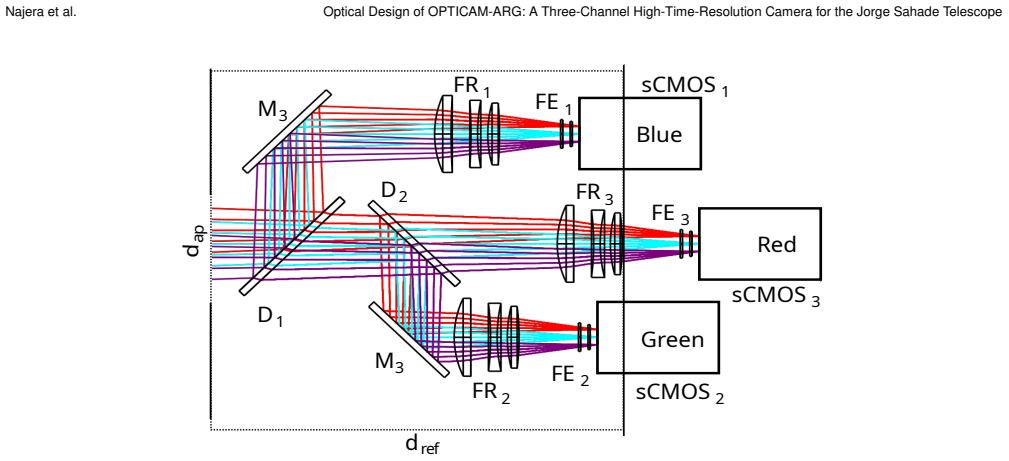
The optical design for OPTICAM-ARG uses two dichroics and three dedicated focal reducers to split the beam from an f/8.5 telescope into simultaneous blue, green, and red channels while correcting aberrations.
A machine-rendered reading of the paper's core claim, the machinery that carries it, and where it could break.
Core claim
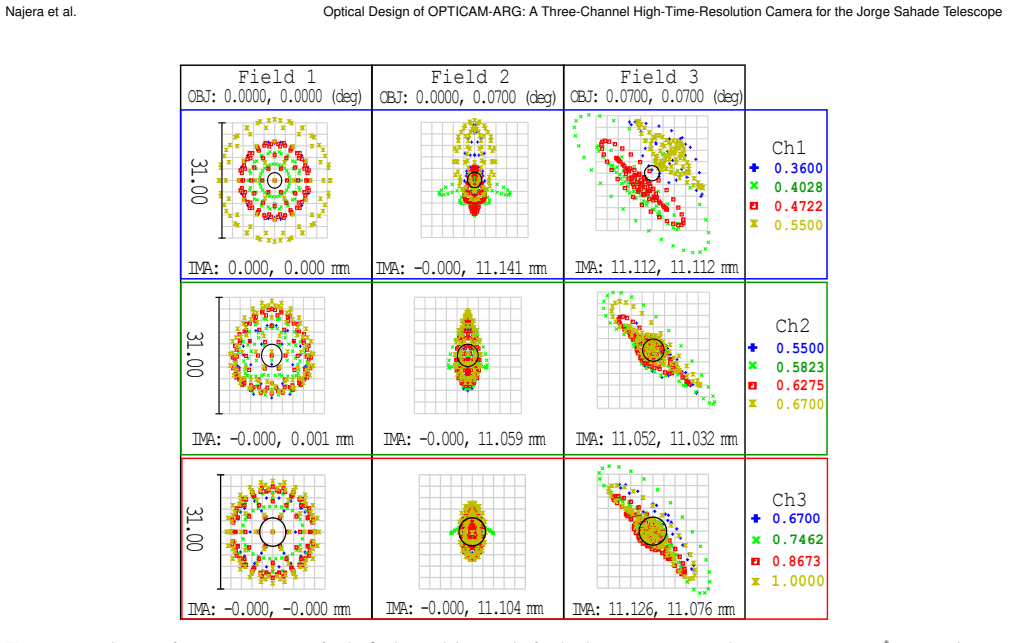
The design employs two dichroics to spectrally separate the telescope beam into blue, green, and red channels, each followed by a three-element focal reducer that shortens the effective focal length to approximately 9.1 m and delivers a uniform 22.6 arcsec/mm plate scale over an 8.4 arcmin square field. Wedge angles applied to the second surfaces of the dichroics are adjusted during global optimization to counteract off-axis aberrations introduced by their placement in the converging f/8.5 beam. Optical performance is quantified through ray tracing that reports RMS spot radii and encircled-energy values, with the EE50 metric converted to an equivalent FWHM to allow direct comparison against
What carries the argument
A pair of dichroics with optimized wedge angles on their second surfaces, which both divide the incoming beam into three spectral channels and compensate for the off-axis aberrations that appear when dichroics are used in a converging beam, allowing each channel's focal reducer to produce matched fields and plate scales.
If this is right
- Simultaneous three-band data collection eliminates the need to interpolate between sequential exposures when studying rapidly variable sources.
- The 8.4 arcmin field of view per channel allows the instrument to capture the full typical seeing disk plus surrounding sky under normal conditions at the site.
- Interchangeable SDSS filters and fast sCMOS detectors enable flexible selection of bandpasses and high-cadence timing within the 0.35 to 1.00 micrometer range.
- The reported encircled-energy metrics indicate that optical blur remains comparable to or smaller than atmospheric seeing, preserving sensitivity for time-resolved photometry.
Where Pith is reading between the lines
- The wedge-angle correction technique could be tested on other f/8-class telescopes to see whether it reduces the need for additional corrective lenses in multi-channel designs.
- If the on-sky FWHM matches the ray-traced predictions, the same conversion of EE50 to equivalent FWHM could be applied to evaluate other instruments under varying seeing conditions.
- The uniform plate scale across channels simplifies the co-alignment and cross-calibration of light curves obtained in different bands.
Load-bearing premise
The ray-traced performance achieved with the chosen wedge angles will survive translation to hardware once manufacturing tolerances, alignment errors, and real atmospheric conditions at the telescope are taken into account.
What would settle it
On-sky images of a point source that show measured full-width at half-maximum values in any channel exceeding the ray-traced equivalent FWHM by more than the expected contribution from site seeing.
Figures




read the original abstract
We present the optical design of OPTICAM-ARG, a multi-channel instrument for the simultaneous acquisition of images in three spectral bands at the Cassegrain focus of an f/8.5 telescope, covering the 0.35 to 1.00 um wavelength range. The converging beam delivered by the telescope is spectrally separated by two dichroics into three channels, blue, green, and red, each incorporating a dedicated three-lens focal reducer, an interchangeable SDSS filter stage, and an sCMOS detector. The focal reducers establish an effective focal length of approximately 9.1 m, a uniform plate scale of 22.6 arcsec/mm, and a field of view of 8.4 arcmin x 8.4 arcmin per channel, consistent with the typical seeing conditions at the site. Operation of the dichroics in a converging beam introduces off-axis aberrations, which are mitigated through wedge angles applied to their second surface and optimized as part of the global design. Optical performance is assessed through exact ray tracing using RMS spot radii and encircled energy metrics, with EE50 values further expressed in terms of an equivalent FWHM to enable direct comparison with atmospheric seeing and to evaluate sensitivity to manufacturing tolerances.
Editorial analysis
A structured set of objections, weighed in public.
Referee Report
Summary. The manuscript presents the optical design of OPTICAM-ARG, a three-channel high-time-resolution camera for simultaneous imaging in blue, green, and red bands (0.35–1.00 μm) at the Cassegrain focus of the f/8.5 Jorge Sahade Telescope. Two dichroics separate the converging beam into three channels, each with a dedicated three-lens focal reducer, interchangeable SDSS filter, and sCMOS detector. The focal reducers are designed to deliver an effective focal length of approximately 9.1 m, a uniform plate scale of 22.6 arcsec/mm, and an 8.4 arcmin × 8.4 arcmin field of view per channel. Off-axis aberrations introduced by the dichroics are mitigated by optimized wedge angles on their second surfaces. Performance is quantified via exact ray tracing using RMS spot radii, encircled-energy (EE50) metrics, and equivalent FWHM, with additional tolerance analysis.
Significance. If the simulated performance holds after fabrication, this instrument would provide a practical capability for simultaneous multi-band, high-time-resolution observations tailored to typical site seeing, enabling studies of variable astrophysical sources. The manuscript's strengths include the provision of full lens prescriptions, specific wedge-angle values, and tolerance runs, which support reproducibility and community use—features that are valuable in an instrumentation design paper. The internal consistency between the reported plate-scale uniformity, FOV, and ray-traced metrics is a positive aspect of the work.
minor comments (2)
- [Abstract] Abstract: The abstract states an effective focal length of 'approximately 9.1 m' and a uniform plate scale of 22.6 arcsec/mm but omits the specific optimized wedge angles and quantitative tolerance results (e.g., maximum degradation in RMS spot radii or EE50 under manufacturing errors). Since the full text supplies these values and runs, adding summary numbers to the abstract would improve accessibility and better support the central performance claims.
- The manuscript would benefit from explicitly naming the ray-tracing software (and version) used for the exact ray tracing, global optimization, and tolerance analysis to enhance reproducibility of the reported RMS spot radii, EE50, and equivalent FWHM metrics.
Simulated Author's Rebuttal
We thank the referee for the positive and constructive review of our manuscript on the optical design of OPTICAM-ARG. The assessment correctly identifies the key features of the three-channel camera, including the use of dichroics in a converging beam, the focal reducer design achieving the target plate scale and FOV, and the mitigation of off-axis aberrations via wedge angles. We appreciate the recognition of the manuscript's strengths in providing full lens prescriptions, specific wedge values, and tolerance analysis to support reproducibility. The recommendation for minor revision is noted, and we will prepare a revised version accordingly.
Circularity Check
No significant circularity in optical design derivation
full rationale
The paper presents a forward optical design for OPTICAM-ARG using explicit lens prescriptions, dichroic wedge angles, and exact ray tracing to achieve target effective focal length (~9.1 m), plate scale (22.6 arcsec/mm), and FOV (8.4 arcmin). These quantities are direct outputs of the chosen focal reducer geometry and optimization, not predictions that reduce to fitted inputs or self-definitions. No load-bearing self-citations, uniqueness theorems, or ansatzes are invoked; performance metrics (RMS spot radii, EE50, equivalent FWHM) are computed from the stated design parameters. The derivation chain is self-contained as standard ray-tracing engineering without circular reduction.
Axiom & Free-Parameter Ledger
free parameters (1)
- Wedge angles on dichroic second surfaces
axioms (2)
- domain assumption The telescope delivers a converging f/8.5 beam at the Cassegrain focus
- standard math Ray tracing in commercial software accurately predicts real optical performance
Reference graph
Works this paper leans on
- [1]
-
[2]
Genetic algorithms for lens design: a review , journal =
Kaspar H. Genetic algorithms for lens design: a review , journal =. 2019 , doi =
work page 2019
-
[3]
Telescope Optics: Evaluation and Design , author=. 1988 , publisher=
work page 1988
-
[4]
Reflecting Telescope Optics I: Basic Design Theory and its Historical Delvelopment , author=. 2004 , publisher=
work page 2004
-
[5]
Introduction to Lens Design , ISBN =
Sasián, José , year =. Introduction to Lens Design , ISBN =. doi:10.1017/9781108625388 , publisher =
-
[6]
Monthly Notices of the Royal Astronomical Society , volume=
HiPERCAM: a quintuple-beam, high-speed optical imager on the 10.4-m Gran Telescopio Canarias , author=. Monthly Notices of the Royal Astronomical Society , volume=. 2021 , publisher=
work page 2021
-
[7]
Ground-based and Airborne Instrumentation for Astronomy IV , volume=
First light with RATIR: an automated 6-band optical/NIR imaging camera , author=. Ground-based and Airborne Instrumentation for Astronomy IV , volume=. 2012 , organization=
work page 2012
- [8]
-
[9]
Bane Sullivan and Alexander Kaszynski , title =. 2019 , month =. doi:10.21105/joss.01450 , url =
-
[10]
The Visualization Toolkit (4th ed.)
Will Schroeder and Ken Martin and Bill Lorensen. The Visualization Toolkit (4th ed.). 2006
work page 2006
- [11]
- [12]
-
[13]
Charles R. Harris and K. Jarrod Millman and St. Array programming with. Nature , volume =. 2020 , month =. doi:10.1038/s41586-020-2649-2 , publisher =
-
[14]
ZEMAX OpticStudio , year =
-
[15]
A. Castro and I. Zavala and E. Colorado and J. Herrera and N. OPTICAM triple-channel astronomical image acquisition control software and external triggering synchronization system , journal =. 2024 , issn =. doi:https://doi.org/10.1016/j.ascom.2023.100773 , url =
-
[16]
OPTICAM reveals hints of cyclotron emission from the intermediate polar V709 Cas. , keywords =. doi:10.1093/mnras/staf2177 , adsurl =
-
[17]
The binary millisecond pulsar PSR J1023+0038 during its accretion state - I. Optical variability. , keywords =. doi:10.1093/mnras/stv1686 , archivePrefix =. 1507.07473 , primaryClass =
-
[18]
DW Cnc: a micronova with a negative superhump and a flickering spin. , keywords =. doi:10.1093/mnras/staf412 , archivePrefix =. 2503.07704 , primaryClass =
-
[20]
Monthly Notices of the Royal Astronomical Society: Letters , volume =
Castro Segura, N and Irving, Z A and Vincentelli, F M and Altamirano, D and Tampo, Y and Knigge, C and Pelisoli, I and Coppejans, D L and Rawat, N and Castro, A and Sahu, A and Santisteban, J V Hernández and Kimura, M and Veresvarska, M and Michel, R and Scaringi, S and Najera, M R , title =. Monthly Notices of the Royal Astronomical Society: Letters , vo...
-
[21]
The Sloan Digital Sky Survey Photometric System. , keywords =. doi:10.1086/117915 , adsurl =
-
[22]
Monthly Notices of the Royal Astronomical Society , author =
ULTRACAM: an ultrafast, triple-beam CCD camera for high-speed astrophysics. , keywords =. doi:10.1111/j.1365-2966.2007.11881.x , archivePrefix =. 0704.2557 , primaryClass =
-
[23]
Marana sCMOS Ultimate Sensitivity Back-illuminated sCMOS for Astronomy & Physical Sciences , author =. 2021 , url =
work page 2021
-
[24]
James W. Howard , journal =. Formulas for the coma and astigmatism of wedge prisms used in converging light , volume =. 1985 , url =. doi:10.1364/AO.24.004265 , abstract =
-
[25]
Applied Optics and Optical Design, Part One , publisher =
Conrady, Alexander Eugen , year =. Applied Optics and Optical Design, Part One , publisher =
-
[26]
Applied Optics and Optical Design, Part Two , author =. 1992 , publisher =
work page 1992
- [27]
-
[28]
Field Guide to Lens Design , ISBN =
Bentley, Julie and Olson, Craig , year =. Field Guide to Lens Design , ISBN =. doi:10.1117/3.934997 , publisher =
-
[29]
Opticam: a triple-camera optical system designed to explore the fastest timescales in astronomy , author=. Revista mexicana de astronom. 2019 , publisher=
work page 2019
-
[30]
MEDICIONES DE SEEING EN EL COMPLEJO ASTRON
Mammana, Luis , journal =. MEDICIONES DE SEEING EN EL COMPLEJO ASTRON
-
[31]
American Journal of Physics , volume =
Halbach, Klaus , title =. American Journal of Physics , volume =. 1964 , month =. doi:10.1119/1.1970159 , url =
- [32]
- [33]
-
[34]
Virtanen, Pauli and Gommers, Ralf and Oliphant, Travis E. and Haberland, Matt and Reddy, Tyler and Cournapeau, David and Burovski, Evgeni and Peterson, Pearu and Weckesser, Warren and Bright, Jonathan and. Nature Methods , year =
-
[35]
KrakenOS: Python-based general exact ray tracing library , author=. Optical Engineering , volume=. 2022 , publisher=
work page 2022
- [36]
discussion (0)
Sign in with ORCID, Apple, or X to comment. Anyone can read and Pith papers without signing in.