Recognition: 2 theorem links
· Lean TheoremPeriodic cosmic evolution in Hybrid and Logarithmic Teleparallel Gravity
Pith reviewed 2026-05-13 01:23 UTC · model grok-4.3
The pith
Hybrid and logarithmic teleparallel gravity with imposed oscillating deceleration parameter models cyclic cosmic expansion.
A machine-rendered reading of the paper's core claim, the machinery that carries it, and where it could break.
Core claim
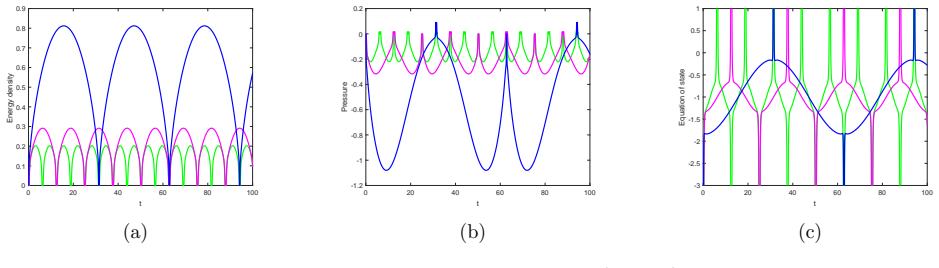
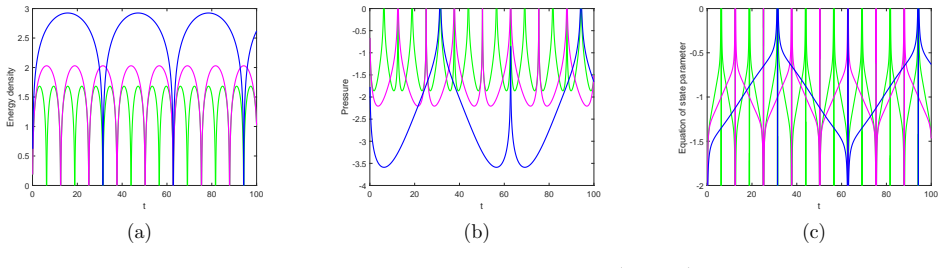
Adopting q(t) = m cos(kt) - 1 in hybrid and logarithmic f(T) teleparallel gravity produces a cyclic universe whose energy density remains positive, pressure and equation of state oscillate, and expansion phases alternate between deceleration and acceleration, with the logarithmic form regularizing divergences for smoother evolution.
What carries the argument
The imposed oscillating deceleration parameter q(t) = m cos(kt) - 1 acting together with the hybrid f(T) = e^{γ T} T^σ and logarithmic f(T) models.
If this is right
- For m ≈ 0.48 the model recovers q0 ≈ -0.52 and the observed present acceleration.
- m ≥ 1 produces strongly oscillatory regimes that include super-acceleration.
- Energy density stays positive while pressure oscillates; the equation of state crosses quintessence and phantom regimes in the hybrid case.
- The logarithmic model stabilizes the dynamics and keeps the equation of state mainly in the quintessence regime.
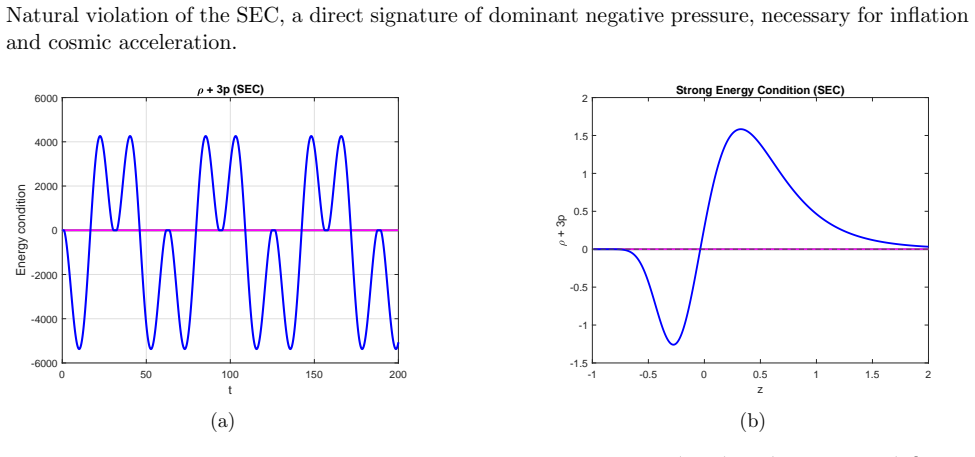
- Violation of the strong energy condition supports acceleration while partial validity of the null and dominant energy conditions maintains physical consistency.
Where Pith is reading between the lines
- The imposed oscillation may provide a single mechanism that unifies early decelerated and late accelerated eras without separate dark-energy components.
- If the periodic q(t) form can be derived from the field equations in a future extension, the model would become more predictive.
- Comparison with supernova or baryon-acoustic-oscillation data on the Hubble parameter's time derivative could test whether the oscillation amplitude m is observationally viable.
- The cyclic behavior raises the possibility of addressing the horizon problem through repeated expansion-contraction cycles.
Load-bearing premise
The deceleration parameter is assumed to follow the specific oscillating form q(t) = m cos(kt) - 1 rather than being derived from the modified-gravity field equations.
What would settle it
A direct measurement showing that the deceleration parameter does not oscillate periodically with cosmic time, or detection of negative energy density at any epoch in the hybrid model.
Figures





read the original abstract
In this work, we investigate a cosmological model within modified teleparallel gravity using two functional forms of $f(T)$: a hybrid model $f(T)=e^{\gamma T}T^{\sigma}$ and a logarithmic model, in the context of a periodic cosmic evolution driven by an oscillating deceleration parameter $q(t)=m\cos(kt)-1$. This approach describes a cyclic Universe with successive transitions between decelerating and accelerating phases. By constraining the model with observational values $m \simeq 0.48$ and $H_0 = 69.2\,\text{km}\,\text{s}^{-1}\,\text{Mpc}^{-1}$, we recover the present accelerated expansion with $q_0 \approx -0.52$, while larger values $m \geq 1$ lead to strongly oscillatory regimes including super-acceleration. For the hybrid model ($\gamma = 0.1$, $\sigma = -0.5$), the energy density remains positive, while the pressure oscillates. The equation of state evolves dynamically, crossing both quintessence and phantom regimes. In contrast, the logarithmic model stabilizes the dynamics, regularizes divergences, and yields smoother evolution, with the equation of state mainly remaining in the quintessence regime. The analysis of energy conditions shows that the violation of the SEC supports accelerated expansion, while the partial validity of NEC and DEC ensures physical consistency. Overall, this framework provides a flexible alternative to the standard $\Lambda$CDM model, allowing a unified description of different phases of cosmic expansion.
Editorial analysis
A structured set of objections, weighed in public.
Referee Report
Summary. The paper investigates cosmological models in hybrid f(T)=e^{γT}T^σ and logarithmic teleparallel gravity, driven by an imposed oscillating deceleration parameter q(t)=m cos(kt)-1 to produce periodic evolution with alternating decelerating and accelerating phases. Parameters are constrained to observational values (m≈0.48, H0=69.2 km s^{-1} Mpc^{-1}) to recover q0≈-0.52, after which the modified Friedmann equations are used to derive ρ(t), p(t), ω(t) and energy conditions; the hybrid model shows oscillatory pressure and EoS crossing quintessence/phantom regimes while the logarithmic model yields smoother quintessence-dominated evolution, with SEC violation supporting acceleration and partial NEC/DEC validity ensuring consistency. The framework is presented as a flexible alternative to ΛCDM for unified description of cosmic phases.
Significance. If the results hold, the work provides explicit illustrations of how these two f(T) forms can accommodate phenomenological cyclic cosmologies, with the hybrid model permitting dynamic EoS transitions and the logarithmic model regularizing behavior. The energy-condition analysis offers a concrete check on physical viability for accelerated phases, adding to the catalog of modified-gravity constructions that can be tuned to non-standard expansion histories.
major comments (2)
- [Abstract and model construction] The periodic evolution is not obtained by solving the f(T) field equations but is imposed by the external ansatz q(t)=m cos(kt)-1; H(t) and a(t) are obtained by direct integration of this q(t) and then substituted into the modified Friedmann equations. Consequently the claimed “unified description of different phases” and “natural support” for cyclic behavior rest on the viability of the input assumption rather than on any dynamical prediction of the gravity theories (see abstract and the description of the approach).
- [Results and discussion] The paper states that the hybrid model yields positive energy density and that energy conditions are partially satisfied, yet no explicit integration steps from q(t) to H(t), a(t), ρ(t), p(t) or error analysis on the parameter choices (γ=0.1, σ=-0.5) are supplied. Without these derivations the robustness of the reported consistency with observations and the claimed stabilization by the logarithmic model cannot be verified.
minor comments (2)
- [Model definitions] The explicit functional form of the logarithmic f(T) model is not stated in the abstract; it should be written out in the main text together with the hybrid form.
- [Figures] Any plots of ω(t) or energy-condition evolution should be explicitly referenced in the text with the precise parameter values used, to facilitate reproducibility.
Simulated Author's Rebuttal
We thank the referee for the constructive comments. We address each major comment below and indicate the revisions that will be incorporated.
read point-by-point responses
-
Referee: [Abstract and model construction] The periodic evolution is not obtained by solving the f(T) field equations but is imposed by the external ansatz q(t)=m cos(kt)-1; H(t) and a(t) are obtained by direct integration of this q(t) and then substituted into the modified Friedmann equations. Consequently the claimed “unified description of different phases” and “natural support” for cyclic behavior rest on the viability of the input assumption rather than on any dynamical prediction of the gravity theories (see abstract and the description of the approach).
Authors: We agree that the oscillating form of q(t) is introduced as a phenomenological ansatz to explore periodic cosmic evolution, with H(t) and a(t) obtained by direct integration and then inserted into the modified Friedmann equations of the hybrid and logarithmic f(T) models. The manuscript does not claim that cyclic behavior emerges as a dynamical solution from the field equations; rather, it demonstrates that these f(T) forms can consistently accommodate the assumed expansion history, yielding positive energy density, viable equation-of-state evolution, and partial satisfaction of energy conditions. We will revise the abstract and introduction to clarify this phenomenological character and remove any implication of dynamical prediction. revision: yes
-
Referee: [Results and discussion] The paper states that the hybrid model yields positive energy density and that energy conditions are partially satisfied, yet no explicit integration steps from q(t) to H(t), a(t), ρ(t), p(t) or error analysis on the parameter choices (γ=0.1, σ=-0.5) are supplied. Without these derivations the robustness of the reported consistency with observations and the claimed stabilization by the logarithmic model cannot be verified.
Authors: We acknowledge that the explicit integration steps and parameter sensitivity were not presented in sufficient detail. In the revised version we will add the full derivations: starting from q(t) = m cos(kt) − 1, the integration for H(t), the subsequent scale factor a(t), and the closed-form expressions for ρ(t) and p(t) obtained by substituting into the modified Friedmann equations for each f(T) model. We will also include a short discussion of the chosen values γ = 0.1, σ = −0.5 and a brief check of robustness under small variations around these values. revision: yes
Circularity Check
Periodic evolution imposed by assumed q(t)=m cos(kt)-1 ansatz rather than derived from f(T) field equations
specific steps
-
fitted input called prediction
[Abstract]
"in the context of a periodic cosmic evolution driven by an oscillating deceleration parameter q(t)=m cos(kt)-1. This approach describes a cyclic Universe with successive transitions between decelerating and accelerating phases. By constraining the model with observational values m ≃ 0.48 and H0 = 69.2 km s^{-1} Mpc^{-1}, we recover the present accelerated expansion with q0 ≈ -0.52"
The oscillating q(t) form is imposed externally to generate the periodic behavior and phase transitions; m is then fitted to observational q0, after which H(t), a(t) and all thermodynamic quantities follow by integration and substitution into the f(T) equations. The 'prediction' of cyclic evolution is therefore statistically forced by the input ansatz rather than emerging from the gravity theory.
full rationale
The paper's central derivation begins by adopting the oscillating form q(t)=m cos(kt)-1 as an external input to enforce cyclic expansion phases, then constrains m≈0.48 to match observed q0≈-0.52 and H0, integrates to obtain H(t) and a(t), and substitutes into the hybrid/logarithmic f(T) Friedmann equations to compute ρ(t), p(t), ω(t) and energy conditions. This renders the claimed 'unified description of different phases' and 'flexible alternative to ΛCDM' a direct consequence of the phenomenological ansatz and fit, not an independent dynamical prediction of the teleparallel models. No self-citation chains or other reductions appear in the provided text, but the load-bearing step reduces the result to the input assumption.
Axiom & Free-Parameter Ledger
free parameters (4)
- m =
0.48
- γ =
0.1
- σ =
-0.5
- k
axioms (2)
- ad hoc to paper The deceleration parameter is given by q(t) = m cos(kt) - 1
- standard math Standard teleparallel gravity framework with modifications via f(T)
Lean theorems connected to this paper
-
IndisputableMonolith/Foundation/DimensionForcing.leanreality_from_one_distinction (8-tick period 2^D=8) contradictswe adopt a phenomenological periodic form of the deceleration parameter given by q(t)=m cos(kt)-1 ... This parametrization allows for a rich dynamical behavior
-
IndisputableMonolith/Cost/FunctionalEquation.leanwashburn_uniqueness_aczel (J-cost uniqueness) unclearH= k/m sin(kt) ... a(t)=(tan(kt/2))^{1/m}
Reference graph
Works this paper leans on
-
[1]
A. A. Penzias and R. W. Wilson,A Measurement of Excess Antenna Temperature at 4080 Mc/s, Astrophysical Journal142, 419 (1965)
work page 1965
-
[2]
A. G. Riesset al.,Observational Evidence from Supernovae for an Accelerating Universe and a Cosmological Constant, Astronomical Journal116, 1009 (1998)
work page 1998
-
[3]
S. Perlmutteret al.,Measurements ofΩandΛfrom 42 High-Redshift Supernovae, Astrophysical Journal517, 565 (1999)
work page 1999
-
[4]
P. J. E. Peebles and B. Ratra,The Cosmological Constant and Dark Energy, Reviews of Modern Physics75, 559 (2003)
work page 2003
- [5]
-
[6]
Li,A Model of Holographic Dark Energy, Physics Letters B603, 1 (2004)
M. Li,A Model of Holographic Dark Energy, Physics Letters B603, 1 (2004). 24
work page 2004
-
[7]
C. Gao, F. Wu, X. Chen, and Y. G. Shen,A Holographic Dark Energy Model from Ricci Scalar Curvature, Physical Review D79, 043511 (2009)
work page 2009
-
[8]
S. Nojiri and S. D. Odintsov,Introduction to Modified Gravity and Gravitational Alternative for Dark Energy, International Journal of Geometric Methods in Modern Physics4, 115 (2007)
work page 2007
-
[9]
A. De Felice and S. Tsujikawa,f(R)Theories, Living Reviews in Relativity13, 3 (2010)
work page 2010
-
[10]
Y.-F. Cai, S. Capozziello, M. De Laurentis, and E. N. Saridakis,f(T)Teleparallel Gravity and Cosmology, Reports on Progress in Physics79, 106901 (2016)
work page 2016
-
[11]
G. R. Bengochea and R. Ferraro, Dark torsion as the cosmic speed-up, Phys. Rev. D 79, 124019 (2009)
work page 2009
-
[12]
E. V. Linder, Einstein’s Other Gravity and the Acceleration of the Universe, Phys. Rev. D 81, 127301 (2010)
work page 2010
- [13]
- [14]
-
[15]
M. S. Berman, A Special Law of Variation for Hubble’s Parameter, Nuovo Cimento B 74, 182 (1983)
work page 1983
-
[16]
M. S. Berman and F. M. Gomide, Cosmological models with constant deceleration parameter, Gen. Relativ. Gravit. 20, 191 (1988)
work page 1988
-
[17]
M. Shen and L. Zhao, Oscillating Quintom Model with Time Periodic Varying Deceleration Parameter, Chinese Phys. Lett. 31, 010401 (2014)
work page 2014
-
[18]
J. B. Jim´ enez, L. Heisenberg and T. Koivisto, Coincident General Relativity, Phys. Rev. D 98, 044048 (2018)
work page 2018
- [19]
-
[20]
V. C. de Andrade and J. G. Pereira, Phys. Rev. D56, 4689 (1997)
work page 1997
- [21]
-
[22]
General Relativity with Spin and Torsion: Foundations and Prospects,
F. W. Hehl, P. von der Heyde, G. D. Kerlick, and J. M. Nester, “General Relativity with Spin and Torsion: Foundations and Prospects,” Rev. Mod. Phys.48, 393 (1976)
work page 1976
-
[23]
R. Aldrovandi and J. G. Pereira,An Introduction to Teleparallel Gravity, available at:http: //www.ift.unesp.br/users/jpereira/tele.pdf. 25
-
[24]
Mandal, S., Bhattacharjee, S., Pacif, S. K. J., & Sahoo, P. K. 2020,Accelerating Universe in Hybrid and Logarithmic Teleparallel Gravity, arXiv e-prints
work page 2020
-
[25]
S. W. Hawking and G. F. R. Ellis,The Large Scale Structure of Space-Time, Cambridge University Press, Cambridge (1973)
work page 1973
-
[26]
Visser, Energy conditions in the epoch of galaxy formation,Science276, 88 (1997)
M. Visser, Energy conditions in the epoch of galaxy formation,Science276, 88 (1997)
work page 1997
-
[27]
S. W. Hawking and R. Penrose, The singularities of gravitational collapse and cosmology,Proc. Roy. Soc. Lond. A314, 529 (1970)
work page 1970
-
[28]
J. M. Bardeen, B. Carter and S. W. Hawking, The four laws of black hole mechanics,Commun. Math. Phys.31, 161 (1973)
work page 1973
- [29]
-
[30]
R. M. Wald,General Relativity, University of Chicago Press, 1984. 26
work page 1984
discussion (0)
Sign in with ORCID, Apple, or X to comment. Anyone can read and Pith papers without signing in.